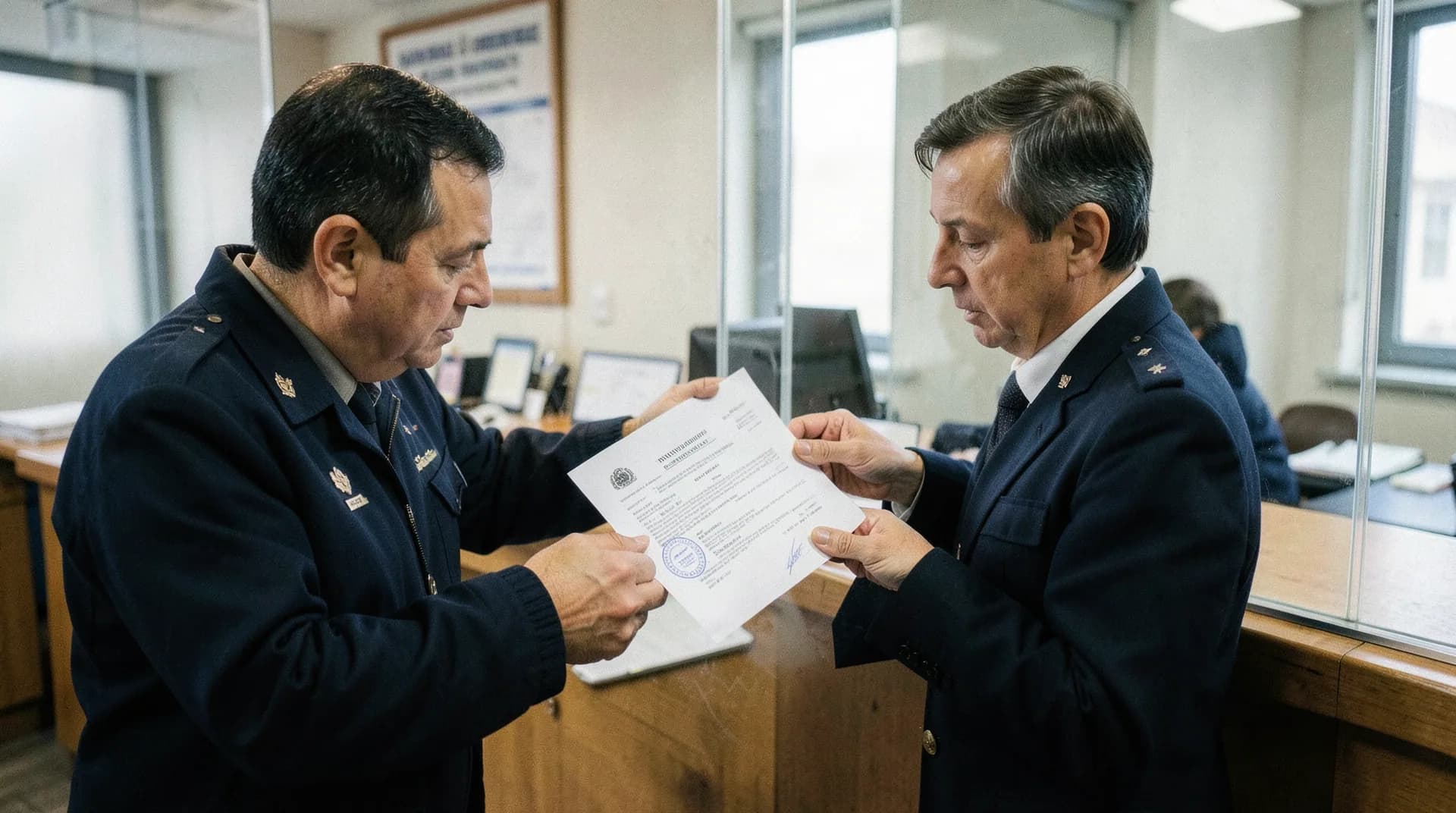
An AFP check — formally known as a National Police Certificate issued by the Australian Federal Police — is a criminal record check required for many Australian visa applications. If you've spent time living in Australia and you're applying for permanent residency or certain other visas, the Department of Home Affairs will want to see an AFP National Police Certificate. It's one piece of the character requirement puzzle, and getting it wrong (or getting it late) can hold up your entire application.
What Is an AFP Check?
The AFP National Police Certificate is a document that discloses your criminal history — or confirms the absence of one — based on records held by Australian police agencies. It covers convictions, findings of guilt, and pending charges across all Australian states and territories.
For immigration purposes, the AFP check is specifically identified as Code 33 — "To meet a requirement of an Australian Government department for a Commonwealth purpose." This is important: if you apply for an AFP check under a different purpose code (say, for employment screening), the Department of Home Affairs may not accept it.
The certificate will show one of two outcomes:
- No disclosable court outcomes — meaning no criminal history was found matching your details
- Disclosable court outcomes — listing convictions, findings of guilt, or pending charges
Having disclosable outcomes doesn't automatically mean your visa will be refused. The Department assesses character on a case-by-case basis, considering the nature, severity, and recency of any offences. But serious convictions — particularly those involving imprisonment — can be a significant obstacle.
When Do You Need an AFP Check?
You'll need an AFP check if:
- You've spent 12 months or more in Australia (cumulative, not necessarily continuous) in the 10 years before your visa application
- You're applying for permanent residency — most PR visa subclasses require it
- You're applying for certain temporary visas that have character requirements
- The Department specifically requests it during processing
The 12-month rule applies cumulatively. If you've had three separate 5-month visits to Australia over the past decade, that's 15 months total — you need the AFP check.
Common Visa Types Requiring AFP Checks
- Subclass 189 (Skilled Independent)
- Subclass 190 (Skilled Nominated)
- Subclass 186 (Employer Nomination Scheme)
- Subclass 858 (National Innovation Visa)
- Subclass 801/100 (Partner visa — permanent stage)
- Subclass 887/191 (Skilled Regional)
- Any visa where the case officer requests it as part of character assessment
How to Apply for an AFP Check
Online Application (Recommended)
The fastest and most common method:
- Visit the AFP website — go to the AFP's National Police Checks page
- Select an accredited body — the AFP partners with accredited agencies that process applications online. Current providers include the Australian Criminal Intelligence Commission (ACIC) and other approved organisations
- Complete the online form — provide your personal details including full name (and any former names), date of birth, gender, and current address
- Select purpose Code 33 — this is critical for immigration purposes
- Provide identification — you'll need to verify your identity through the online system, usually using 100 points of ID (passport, driver's licence, Medicare card, etc.)
- Pay the fee — currently AUD $42 (check the AFP website for the most current fee)
- Submit — your application is processed electronically
Through an Accredited Body
Several organisations are accredited to process AFP checks on behalf of applicants. These include:
- National Crime Check
- Fit2Work
- Australian National Character Check
- Checked
These bodies charge the standard AFP fee plus their own service fee (usually AUD $10-$30 on top). The advantage is that they often have streamlined online processes and can assist with identity verification.
In Person (Limited Availability)
In-person applications are rarely necessary but may be required if:
- Your identity can't be verified electronically
- You don't have sufficient online-verifiable ID documents
- You're directed to apply in person by the AFP
Contact the AFP directly if you need in-person processing.
Processing Times
Typical processing times for AFP National Police Certificates:
| Scenario | Timeframe |
|---|---|
| No criminal record, clean identity match | 2-3 business days |
| Minor name discrepancies or common names | 5-10 business days |
| Criminal history requiring manual review | 10-15 business days |
| Complex cases | Up to 15+ business days |
Most applicants with no criminal history and a straightforward identity match receive their certificate within a few days. But don't count on it — apply well in advance of your visa application deadline.
Timing tip: If you've received an Invitation to Apply (ITA) with a 60-day deadline, order your AFP check immediately. Don't wait until you've gathered all other documents. Processing delays happen, and you don't want your AFP check to be the reason you miss your deadline.
AFP Check vs Overseas Police Certificates
Here's where people sometimes get confused. The AFP check covers your time in Australia only. It doesn't cover any criminal history from other countries. If you've lived in other countries for 12 months or more in the past 10 years, you'll need separate police certificates from each of those countries as well.
The Department of Home Affairs maintains a list of how to obtain police certificates from most countries. Requirements vary enormously:
- Some countries issue certificates quickly through online portals
- Others require you to visit an embassy or consulate in person
- Some countries have notoriously slow processing (several months)
- A few countries are difficult or impossible to obtain certificates from, in which case the Department may accept a statutory declaration
Key Differences
| Feature | AFP Check | Overseas Police Certificate |
|---|---|---|
| Covers | Time in Australia | Time in the specific country |
| How to apply | Online through AFP or accredited body | Varies by country — embassy, consulate, or national police authority |
| Cost | AUD $42 | Varies (free to AUD $100+) |
| Processing time | 2-15 business days | Days to months depending on country |
| Purpose code | Code 33 for immigration | Country-specific requirements |
What Shows Up on an AFP Check?
An AFP National Police Certificate can disclose:
Convictions — criminal offences where you were found guilty and sentenced. This includes fines, community service orders, suspended sentences, and terms of imprisonment.
Findings of guilt without conviction — where a court found you guilty but didn't record a formal conviction. These may or may not appear depending on the jurisdiction and the type of finding.
Pending charges — criminal charges that have been laid but not yet resolved in court.
Spent convictions — under Commonwealth law, some older convictions become "spent" after a qualifying period (generally 10 years for adults, 5 years for juvenile offences) and are not disclosed on a standard National Police Certificate. However, immigration checks may access a broader range of records than standard employment checks.
What doesn't show up:
- Traffic infringements (unless they resulted in a criminal charge)
- Civil disputes
- Apprehended Violence Orders (unless related to a criminal charge)
- Intelligence or surveillance information
Character Test Under Migration Law
The AFP check is part of the broader character test under section 501 of the Migration Act 1958. The character test considers:
- Whether you have a "substantial criminal record" (generally, a sentence of 12 months or more of imprisonment)
- Whether you've been involved in people smuggling, trafficking, or other serious crimes
- Whether there's a risk you'd engage in criminal conduct in Australia
- Your general conduct and associations
Failing the character test can result in visa refusal or cancellation. The Minister for Immigration also has personal powers to cancel visas on character grounds, even if the applicant technically passes the standard test.
Validity of the AFP Check
AFP National Police Certificates don't have a formal expiry date printed on them, but the Department of Home Affairs generally considers them valid for 12 months from the date of issue. If your visa processing takes longer than expected and your certificate is over 12 months old, the Department may request a new one.
Practical Tips
Apply early. The moment you know you'll need an AFP check, apply. Don't wait for your ITA or application deadline to prompt you.
Use the correct purpose code. Code 33 for immigration. Using another code could mean the certificate doesn't cover the right scope of records for immigration purposes.
Check your name matches. Make sure the name on your AFP application matches the name on your passport and visa application exactly. Discrepancies (including middle names, spelling variations, or former names) can delay processing or create issues at the assessment stage.
Keep the original. Some practitioners recommend uploading a certified copy to your ImmiAccount application and retaining the original. The Department may request the original during processing.
Budget for multiple certificates. If you've lived in multiple countries, you may need three, four, or more police certificates. Factor in the cost and processing time for each.
Don't panic about minor offences. A traffic fine or a decades-old minor offence is unlikely to derail your visa application. The character test is designed to identify serious risks, not to penalise people for minor past mistakes. However, if you have significant criminal history, get professional legal advice before applying.
Key Takeaways
The AFP National Police Certificate is a standard requirement for visa applicants who've spent time in Australia. It costs AUD $42, typically takes 2-15 business days, and must be applied for under purpose Code 33 for immigration. Order it early, use the correct code, and remember that it only covers your time in Australia — you'll need separate certificates from any other countries where you've lived for 12 months or more. It's a straightforward process, but timing it correctly within your overall visa application timeline is what matters most.