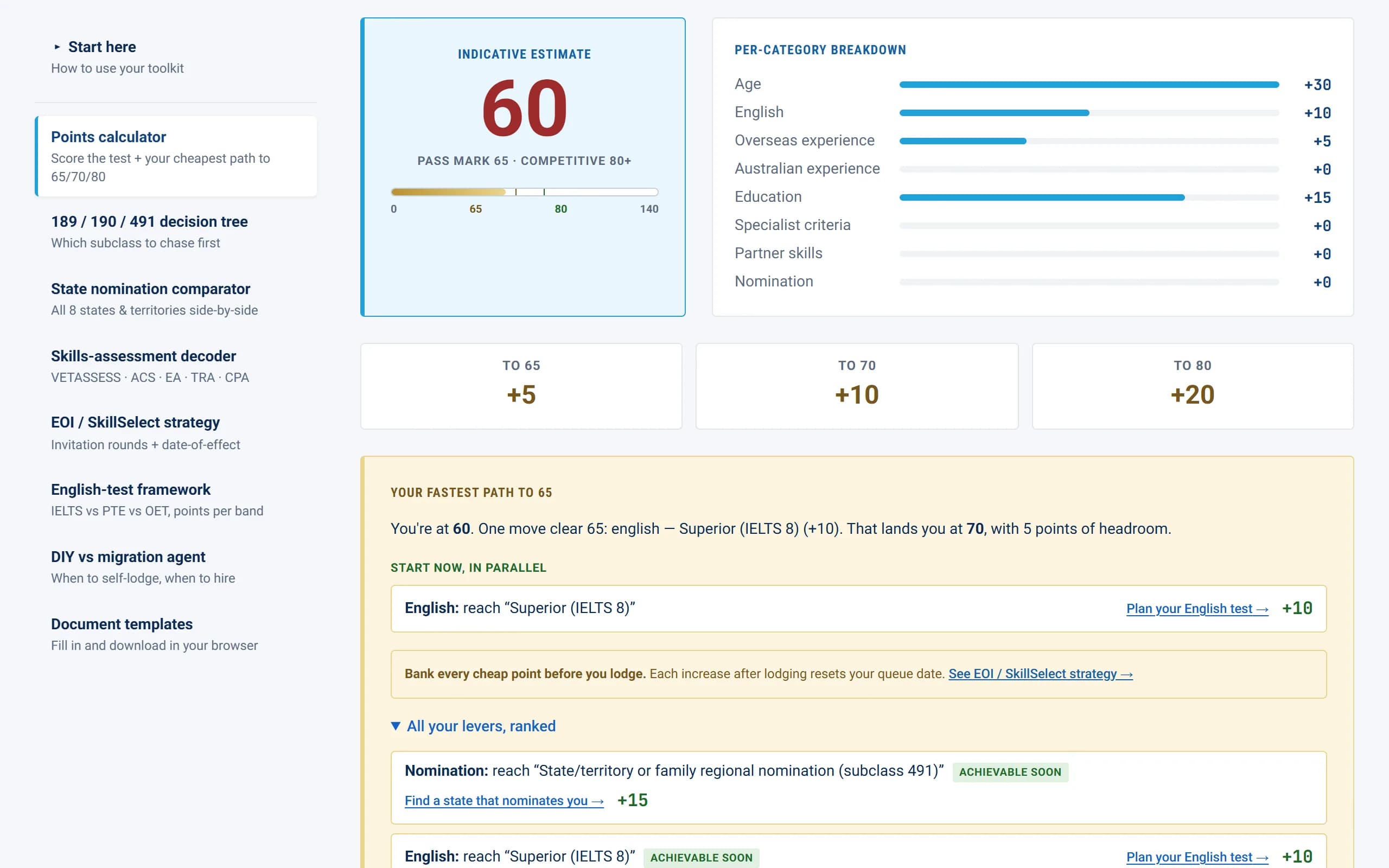
Neurosurgeon Visa Pathway to Australia: Complete 2026 Guide
Updated: 16 August 2026
Australia classifies Neurosurgeons under ANZSCO 253513. The Royal Australasian College of Surgeons (RACS) conducts the specialist assessment via its Neurosurgical Society of Australasia panel and the Medical Board of Australia (MedBA) handles registration. The occupation is on both the CSOL and MLTSSL, opening subclasses 189, 190, 491, 482 and 186. Typical 2026 salaries range AUD $372,000-$750,000, with senior consultants at the top of that band.
Quick Facts: Neurosurgeon Migration Pathway
| Detail | Information |
|---|---|
| ANZSCO Code | 253513 (Neurosurgeon) |
| Skill Level | 1 (MBBS plus FRACS-equivalent neurosurgical fellowship) |
| Skills Assessment | RACS (Royal Australasian College of Surgeons) + MedBA registration |
| Occupation List | CSOL and MLTSSL |
| Visa Options | 189, 190, 491, 482, 186 |
| Demand Level | High in regional and outer-metropolitan units; constrained pipeline nationally |
| Salary Range | AUD $372,000-$750,000+ (SalaryExpert 2026; PayScale; ATO/MedRecruit) |
| Typical 189 Score | 80-95 points |
| Key Challenge | Narrow job market; most posts concentrated in 30-40 hospitals nationally |
What Neurosurgery in Australia Looks Like
Neurosurgery covers cranial work (tumours, vascular malformations, trauma, hydrocephalus, functional neurosurgery), spinal surgery (degenerative, oncological, traumatic, paediatric), peripheral nerve and complex pain procedures. Australian neurosurgical departments cluster around major tertiary trauma centres: Royal Melbourne, The Alfred, Royal North Shore, Royal Prince Alfred, Princess Alexandra, Royal Brisbane and Women's, Royal Adelaide, Sir Charles Gairdner, John Hunter, and the major paediatric hospitals (Royal Children's Melbourne, Sydney Children's, Queensland Children's, Perth Children's). Private neurosurgical practice is largely subspecialised — spine, vascular, functional, paediatric, neuro-oncology — and concentrated in capital cities.
The market is narrower than general surgery. There are roughly 30-40 hospitals in Australia with active neurosurgical units. New consultant posts tend to open through retirement, expansion at the larger centres, or the few subspecialty fellowships that lead into substantive appointments. Despite the narrow market, demand is steady: ageing population, growing burden of spinal degenerative disease, and persistent regional gaps mean Jobs and Skills Australia continues to flag neurosurgery within the surgical-specialist shortage cluster.
ANZSCO 253513 — Code Mapping
The official ANZSCO description covers medical practitioners who specialise in the diagnosis and surgical treatment of disorders of the nervous system — brain, spinal cord, peripheral nerves and supporting structures. The code applies to consultants holding FRACS (Neurosurgery), the European Board of Neurological Surgery, US ABNS, UK CCT in Neurosurgery, or recognised equivalents.
There is no separate ANZSCO code for spinal surgery, functional neurosurgery, paediatric neurosurgery or neuro-oncology — all subspecialties fall under 253513. Spinal surgery performed by orthopaedic surgeons uses 253514 (Orthopaedic Surgeon).
For wider help, see how to find your ANZSCO code.
Skills Assessment
Two processes are required: RACS comparability for college recognition (assessed by RACS in conjunction with the Neurosurgical Society of Australasia panel), and MedBA specialist registration.
RACS Specialist Assessment
The Royal Australasian College of Surgeons assesses Specialist International Medical Graduates against an Australian-trained FRACS (Neurosurgery).
Requirements:
- Recognised primary medical qualification (MBBS, MD or equivalent)
- Recognised specialist qualification in neurosurgery (FRCS Neurosurgery, EBNS, ABNS, equivalent)
- Documented post-fellowship neurosurgical experience (typically 5+ years for substantial comparability)
- English at IELTS Academic 7.0 / OET Grade B minimum
Process:
- Document-based assessment — RACS plus Neurosurgical Society of Australasia panel review qualifications and operative logbooks
- Interview with two assessors
- Comparability decision — substantially / partially / not comparable
- Workplace-based assessment for partially-comparable outcomes — typically 6-24 months under RACS supervision at an accredited Australian neurosurgical unit
Indicative fees (RACS published schedule):
- Australian specialist assessment fee: AUD $10,650 (see RACS assessment fees)
- 20% refund if not comparable at document stage and interview not held
- Additional supervision and examination fees during workplace-based assessment
Processing: Document review 3-6 months; interview 2-4 months thereafter. Substantially-comparable outcomes can complete in 9-15 months. Partially-comparable outcomes routinely take 24-36 months total when workplace-based assessment is required.
Common rejection reasons: narrow operative scope (e.g. spine-only with limited cranial); insufficient independent primary-operator case numbers; gaps in elective and emergency case mix; references that fail to specify primary surgeon status; logbook gaps that suggest fellow-level rather than consultant-level practice.
MedBA Specialist Registration
The Medical Board of Australia issues the registration that allows independent neurosurgical practice.
- Application cost: approximately AUD $1,000-$1,400
- Annual renewal: approximately AUD $980
- Processing: 8-16 weeks after RACS comparability is issued
- English: OET (Medicine) Grade B or IELTS Academic 7.0 minimum
- Documents: AHPRA national police check, proof of identity, certificates of good standing for every jurisdiction worked over the past 10 years
AHPRA proof-of-identity should run in parallel with RACS.
Visa Pathways for Neurosurgeons
253513 is on the MLTSSL, so every skilled subclass is available. In practice, employer sponsorship dominates because the small number of neurosurgical posts that open are filled through direct recruitment by tertiary hospitals.
Subclass 482 — Skills in Demand (Specialist Skills Stream)
Neurosurgeon consultant salaries clear the Specialist Skills Stream threshold by a wide margin.
- Visa fee: AUD $4,015 primary applicant
- Salary threshold: AUD $146,576 (from 1 July 2026; AUD $141,210 until 30 June 2026)
- Duration: up to 4 years
- Processing: target 7-day decisions for decision-ready Specialist Skills nominations
- Quirk: tertiary trauma centres are practised sponsors and move quickly once a signed offer is in place
Subclass 186 — Employer Nomination Scheme
- Visa fee: AUD $6,140 primary applicant
- Nomination fee: AUD $540
- SAF levy (employer): AUD $3,000-$5,000
- Streams: Direct Entry (open for 253513) or Temporary Residence Transition (after 2+ years on 482)
- Processing: 6-12 months typical
Subclass 189 — Skilled Independent
- Visa fee: AUD $6,135 primary applicant
- Realistic invite score: 80-95 points
- Processing: 7-12 months from invitation
Subclass 190 — State Nominated
- Visa fee: AUD $6,140 primary applicant
- Points boost: +5
Subclass 491 — Skilled Work Regional
- Visa fee: AUD $6,140 primary applicant
- Points boost: +15
- Note: few true regional neurosurgical posts exist outside major centres; this pathway works where a regional hospital is expanding its neurosurgical service (occasionally NT, regional WA, regional Queensland)
Points Test Strategy
| Points Factor | Points | Notes |
|---|---|---|
| Age 25-32 | 30 | Maximum |
| Age 33-39 | 25 | Common for new neurosurgical fellows |
| Age 40-44 | 15 | |
| Bachelor's degree | 15 | MBBS |
| Doctorate | 20 | PhD / MD by research — common among neurosurgical fellows |
| English Superior (8.0) | 20 | |
| English Proficient (7.0) | 10 | |
| Overseas experience 8+ years | 15 | |
| State nomination (190) | 5 | |
| Regional (491) | 15 | |
| Partner skills | 5-10 |
Realistic Scenarios
Scenario 1 — 38-year-old fellow, FRCS Neurosurgery, IELTS 8.0, PhD, 7 years post-CCT, applying 189: 25 (age) + 20 (PhD) + 20 (English) + 15 (experience) = 80 points. Add 190 (Victoria or NSW) for 85. Strong invitation profile.
Scenario 2 — 45-year-old consultant with Royal Melbourne offer: Skip the points test. 482 Specialist Skills lodged inside 14 days; transition to 186 TRT after 2 years. Senior consultant base packages at major tertiary hospitals sit around AUD $500,000-$650,000 before private operating.
State Nomination
Victoria
Victoria's 2025-26 programme explicitly lists Neurosurgeon among eligible occupations under its health priority sector. Fast-track processing applies. Melbourne carries the largest concentration of neurosurgical units outside Sydney.
New South Wales
NSW nominates at unit group level so 253513 is captured. Sydney holds the country's largest neurosurgical workforce. Realistically, the practical path is a signed offer from a Sydney or Hunter unit, with state nomination following.
Queensland
Queensland's 2026 programme has 2,600 places. Royal Brisbane and Princess Alexandra both recruit internationally. Gold Coast University Hospital has expanded its neurosurgical service in recent years.
South Australia, Western Australia, Northern Territory
All three nominate neurosurgeons case-by-case where a state hospital offer exists. The Royal Adelaide, Sir Charles Gairdner Hospital and Royal Darwin (with referrals to interstate centres) are the relevant employers.
Salary and Employment Outlook
Typical 2026 Earnings
| Role | Range (AUD, total package) |
|---|---|
| New fellow (staff specialist) | $372,000-$450,000 |
| Senior staff specialist (5+ years post-fellowship) | $500,000-$650,000 |
| VMO private practice (established) | $600,000-$1,200,000 |
| Locum (daily rate) | $3,000-$4,000+/day |
| Subspecialty private (spine, functional) | $700,000-$1,500,000 |
Sources: SalaryExpert 2026 ($619,660 Australia average; $372,536 entry; $749,760 senior 8+ years), PayScale 2026, ATO / MedRecruit 2026 ($604k average), Talent.com Australia. Gross before super (11.5%) and private billing. New post-fellowship earnings of AUD $250,000-$400,000 are typical immediately after gaining FRACS; this scales sharply by year 5.
Highest-Paying Settings
- Established private practice in Sydney, Melbourne or Brisbane — spinal, functional, or neuro-oncology subspecialty rooms
- Senior staff specialist + private rights at major tertiary teaching hospitals
- Locum cover for tertiary units — rates routinely AUD $3,500+/day
- Subspecialty fellowship programmes at major centres with academic loading
- Medico-legal expert witness work as a senior consultant — significant supplementary income
Tips for a Successful Application
1. Subspecialty exposure matters
A logbook that is 95% spine without cranial work will struggle to score "substantially comparable" against Australian-trained FRACS neurosurgeons, who train across the full scope. Where possible, document elective and emergency cranial cases, vascular, paediatric exposure, and trauma management. The RACS panel evaluates breadth as well as numbers.
2. Operative logbooks must be detailed
RACS wants primary-operator case numbers by procedure type, with dates and supervision status. Anonymised case lists with this detail are routinely the make-or-break document. Start compiling well before submission.
3. Target the right hospital first
There are roughly 30-40 hospitals in Australia with active neurosurgical units. Identify the 5-8 that are actively recruiting (RACS public training position numbers and unit websites are the best signal). Most successful migrant neurosurgeons arrived with an offer from a known unit, not via SkillSelect alone.
4. Plan for the AUD $10,650 RACS fee upfront
Payment is required at submission. If not comparable at document stage and the interview is not held, 20% is reimbursed. Budget the full amount and have it ready before lodging.
5. Use the points test as a backup, not the primary route
For neurosurgery, 189/190 EOIs typically take 12+ months from EOI to grant. A signed offer plus 482 Specialist Skills sponsorship is faster and gives certainty. Run the EOI in parallel as insurance.
Step-by-Step Migration Roadmap
- Confirm code — 253513 for any neurosurgical fellowship holder; spinal surgery via orthopaedics uses 253514
- Translate and notarise medical qualification, fellowship, training certificates, operative logbooks, certificates of good standing
- Sit IELTS Academic and OET (Medicine) — IELTS for points, OET for AHPRA
- Lodge RACS specialist assessment — pay the AUD $10,650 fee
- Lodge AHPRA proof-of-identity in parallel
- Approach Australian neurosurgical units directly with CV, logbook summary and references
- Attend RACS interview with the Neurosurgical Society of Australasia panel
- MedBA specialist registration once RACS comparability is issued
- Visa nomination and application — 482, 186, 189, 190 or 491
- Health and character checks
- Visa grant and relocate
- Complete any RACS-directed workplace-based assessment at the supervising Australian neurosurgical unit to achieve FRACS
For wider context, see the skills assessment bodies guide and the 2026 SOL.
Frequently Asked Questions
Is the job market in neurosurgery realistic for migrants?
Yes, but with eyes open. There are about 30-40 active neurosurgical units in Australia and around 350-400 practising consultants. Vacancies tend to open through retirement or specific subspecialty expansion. Migrants with strong subspecialty profiles (paediatric, complex spine, functional, vascular) and UK/Irish/US/Canadian credentials regularly secure positions. Generalist neurosurgeons without subspecialty differentiation can find the market tighter.
Will my UK FRCS Neurosurgery be accepted?
UK CCT in neurosurgery is one of the qualifications RACS most often recognises as substantially comparable. The document assessment plus interview typically completes inside 9-12 months. Most UK CCT-holding neurosurgeons clear the process without workplace-based assessment, provided their operative logbook supports the application.
How much does a senior neurosurgeon actually earn in Australia in 2026?
SalaryExpert places the average gross neurosurgeon salary at AUD $619,660 in 2026, with senior (8+ years) at AUD $749,760. ATO and MedRecruit 2026 data show an average of AUD $604,000. Established private practice consultants in capital cities — particularly spinal and functional neurosurgery — routinely clear AUD $1,000,000+ in total income.
Can spinal surgery be done as a neurosurgeon or orthopaedic surgeon?
Both. In Australia, spinal surgery is performed by neurosurgeons and by orthopaedic surgeons with spinal fellowship training. Neurosurgeons use ANZSCO 253513; orthopaedic surgeons use 253514. The migration pathway and assessing college (RACS for both) are the same; the specialty section within RACS differs.
What's the realistic timeline from RACS submission to landing in Australia?
UK CCT holder, substantially comparable outcome, employer-sponsored 482: 12-18 months total. Standard pathway with no top-up required: 18-24 months. Partially-comparable outcome with 12-24 month workplace-based assessment: 30-42 months. Plan funding for at least 18 months of process before income starts.
Is regional neurosurgery a real pathway?
Limited but real. A small number of regional health services (Canberra, Hobart, Townsville, Darwin) operate neurosurgical units or refer to interstate centres. Regional 491 nomination works where one of these units is expanding. Most regional neurosurgery is conducted by visiting specialists from metropolitan units rather than locally-based consultants — but that's slowly changing as tele-health and outreach models expand.