Plastic and Reconstructive Surgeon Visa Pathway to Australia: Complete 2026 Guide
Updated: 16 August 2026
Australia classifies Plastic and Reconstructive Surgeons under ANZSCO 253517. The Medical Board of Australia (MedBA) grants specialist registration after the Royal Australasian College of Surgeons (RACS) assesses overseas-trained candidates via the Australian Society of Plastic Surgeons (ASPS) advisory committee. The occupation sits on the MLTSSL and CSOL, unlocking subclasses 189, 190, 491, 482 and 186. Typical 2026 salaries range AUD $300,000-$750,000+.
Quick Facts: Plastic and Reconstructive Surgeon Migration Pathway
| Detail | Information |
|---|---|
| ANZSCO Code | 253517 (Plastic and Reconstructive Surgeon) |
| Skill Level | 1 (Bachelor degree or higher plus specialist training) |
| Skills Assessment | RACS (Royal Australasian College of Surgeons) plus MedBA specialist registration |
| Occupation List | MLTSSL and CSOL |
| Visa Options | 189, 190, 491, 482, 186 |
| Demand Level | High in reconstructive subspecialties (head and neck, burns, lower limb trauma, paediatric); moderate in aesthetic-only practice |
| Salary Range | AUD $300,000-$750,000+ (SEEK Career Advice, ERI SalaryExpert 2026) |
| Typical 189 Score | 85-90 points |
| Key Challenge | RACS rarely grants Substantially Comparable; most SIMGs receive Partially Comparable with 12-24 months of supervised practice |
What Plastic and Reconstructive Surgeons Do in Australia
The specialty is split between reconstructive work, which dominates public hospital practice, and aesthetic work, which is concentrated in private rooms. Reconstructive practice covers head and neck cancer reconstruction, burns surgery, hand surgery, microsurgical free flaps, breast reconstruction after mastectomy, lower limb trauma and craniofacial work. Aesthetic practice covers rhinoplasty, breast augmentation and reduction, abdominoplasty, facelifts and minor cosmetic procedures.
Demand is asymmetric. Public reconstructive consultant posts in burns units, head and neck cancer services and major trauma centres are persistently understaffed, particularly outside Sydney and Melbourne. Aesthetic-only positions are saturated in metro areas but still grow in regional centres. The Therapeutic Goods Administration tightened cosmetic surgery regulation in 2023 and 2024, which restricted the use of the title "surgeon" to MedBA-registered specialists and pushed market share back toward fellowship-trained practitioners. Major employers include public LHD plastic surgery units, the Victorian Adult Burns Service, Concord Repatriation General, Royal Children's Hospital, and private groups such as Ramsay Health Care and Healthe Care.
ANZSCO Code Mapping
ANZSCO 253517 covers specialist plastic and reconstructive surgeons. The position description includes diagnosing, treating and preventing diseases, injuries and deformities by surgical means involving the restoration, reconstruction, correction or improvement of body form and function. Task summary covers preoperative consultation, surgical planning, performance of reconstructive and aesthetic procedures under general or regional anaesthesia, postoperative care, and supervision of trainees.
If you trained as a general surgeon and now perform some plastic surgery, you should not nominate 253517. The correct code is 253511 General Surgeon. Cosmetic physicians without RACS fellowship cannot use 253517 — the title and ANZSCO code are tied to specialist registration in plastic surgery, not to procedural scope.
Skills Assessment and Specialist Recognition
Two sequential processes: RACS specialist assessment, then MedBA specialist registration. The Australian Society of Plastic Surgeons provides specialty expertise to RACS during assessment.
Royal Australasian College of Surgeons (RACS)
- Body: Royal Australasian College of Surgeons
- Requirements: Recognised specialist plastic surgery fellowship, AMC-verified primary medical degree, minimum four years of post-fellowship practice, structured CV, three referees, IELTS Academic 7.0 across bands or equivalent.
- Assessment cost: AUD $10,000+ for the specialist assessment application (confirm current figure on the RACS College fees page)
- Processing time: 12-18 months from complete application to outcome
- Common rejection reasons: Inadequate microsurgical logbook; gaps in reconstructive subspecialty coverage; aesthetic-heavy training mismatched against Australia's reconstructive-led scope.
RACS issues one of three outcomes: Substantially Comparable, Partially Comparable or Not Comparable. For plastic surgery, Substantially Comparable is uncommon — most international training programmes are shorter or narrower than the RACS plastic surgery SET, which leads to a Partially Comparable finding with 12-24 months of supervised practice.
Medical Board of Australia (MedBA)
- Body: Medical Board of Australia
- Requirements: Positive RACS outcome, AMC-verified primary qualification, English evidence, criminal history check, recency of practice, professional indemnity insurance.
- Processing time: 4-8 weeks after RACS outcome
- Common rejection reasons: Insufficient recency; English evidence outside the 24-month validity window.
Visa Pathways for Plastic and Reconstructive Surgeons
Subclass 482 — Skills in Demand Visa
The default route. Most overseas plastic surgeons arrive on a 482 sponsored by a Local Health District or private group while RACS and MedBA processes complete.
- Visa fee: AUD $4,015 (primary applicant)
- Salary thresholds: Specialist Skills stream from $146,576 (from 1 July 2026; previously $141,210)
- Processing time: Specialist Skills 7-11 days; Core Skills 4-7 months
- Eligibility note: Consultant plastic surgery salaries clear the Specialist Skills threshold, removing labour market testing
Subclass 186 — Employer Nomination Scheme
Permanent residency via employer sponsorship. Direct Entry requires three years of relevant experience and a positive RACS assessment. TRT requires two years on a 482.
- Visa fee: AUD $6,140 (primary applicant)
- Processing time: 6-12 months
- Eligibility note: TRT pathway is the most common route for SIMGs who entered on a 482
Subclass 189 — Skilled Independent Visa
Points-tested permanent residency. Health invitations are issued at lower points than ICT but still require 85-90.
- Visa fee: AUD $6,135 (primary applicant)
- Processing time: 6-12 months
- Eligibility note: No employer sponsor required; suitable for offshore consultants with PhD-equivalent qualifications and Superior English
Subclass 190 — State Nominated Visa
State nomination adds 5 points and grants permanent residency.
- Visa fee: AUD $6,140 (primary applicant)
- Processing time: 6-12 months
- Eligibility note: Two-year live-and-work commitment in the nominating state; NSW, VIC and SA actively nominate specialist medical practitioners
Subclass 491 — Skilled Work Regional
Five-year provisional regional visa, 15-point boost, with subclass 191 PR transition after three years of qualifying regional income.
- Visa fee: AUD $6,140 (primary applicant)
- Processing time: 6-12 months
- Eligibility note: Regional plastic surgery posts are scarce — usually tied to head and neck cancer or trauma services in regional teaching hospitals
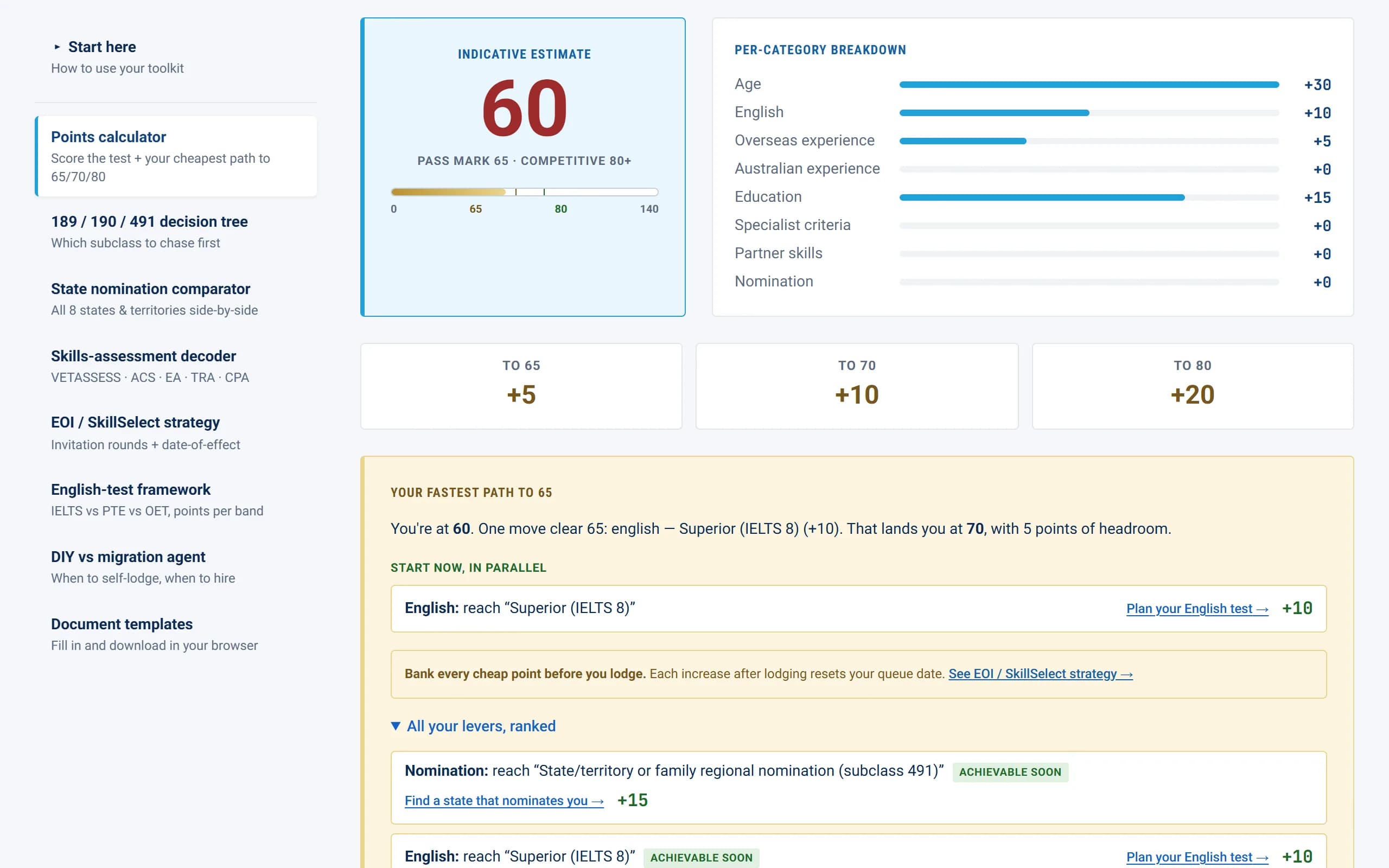
Points Test Strategy
| Points Factor | Points | Notes |
|---|---|---|
| Age (25-32) | 30 | Maximum bracket |
| Age (33-39) | 25 | Most consultant SIMGs |
| Qualification (Doctoral) | 20 | Fellowship-trained plastic surgeons typically score here via Vetassess equivalency |
| English (Superior 8.0) | 20 | Achievable for surgeons trained in English-medium systems |
| English (Proficient 7.0) | 10 | Baseline |
| Overseas skilled experience (8+ years) | 15 | Maximum |
| State Nomination (190) | 5 | Apply if eligible |
| Regional (491) | 15 | Limited regional posts available |
| Partner Skills | 5-10 | If partner has skilled occupation |
Realistic Score Scenarios
Scenario 1: Senior consultant (37 years old, fellowship-trained, Superior English, 8 years post-fellowship)
- Age 25 + Doctoral 20 + English 20 + Experience 15 = 80 points
- Add 190 nomination: 85 — competitive
Scenario 2: Early consultant (34 years old, Proficient English, 4 years post-fellowship)
- Age 25 + Bachelor's 15 + English 10 + Experience 5 = 55 points
- Needs 190 (+5) or 491 (+15) plus partner skills or Superior English retest to clear 85
- 482 employer sponsorship is faster
State Nomination
New South Wales
NSW Health is the largest single employer of plastic and reconstructive consultants in Australia. Major posts at Royal Prince Alfred, Concord Repatriation General, John Hunter, and the Sydney Children's Hospitals Network are reliably advertised. NSW's 190 program includes specialist medical practitioners.
Victoria
Victoria's burns service, head and neck units at Peter MacCallum and Royal Melbourne, and the Royal Children's Hospital create steady demand. Victoria assesses ROIs against age, English, qualification, experience and Victorian salary.
Queensland
Queensland's expanded 190 allocation for 2025-26 (1,850 places, up from approximately 600) makes it more accessible than in prior years. Confirmed Hospital and Health Service offers are the most reliable nomination route.
South Australia
South Australia operates targeted Health Worker streams. The Royal Adelaide Hospital, Flinders Medical Centre and Women's and Children's Hospital are active recruiters for reconstructive consultants.
Western Australia
Fiona Stanley Hospital, Royal Perth and Princess Margaret Hospital for Children have ongoing reconstructive needs. WA's state nomination program includes specialist medical practitioners.
Salary and Employment Outlook
What Plastic and Reconstructive Surgeons Earn
| Role | Typical Salary Range |
|---|---|
| Junior consultant (public hospital) | AUD $280,000-$360,000 |
| Mid-career consultant (public hospital) | AUD $360,000-$480,000 |
| Senior consultant (public with VMO private rights) | AUD $450,000-$650,000 |
| Private practice (reconstructive focus) | AUD $500,000-$900,000 |
| Private practice (aesthetic focus) | AUD $600,000-$1,500,000+ |
| Locum consultant (per day) | AUD $2,500-$4,000 |
| Head of unit / burns director | AUD $500,000-$700,000+ |
Public salaries are governed by state enterprise agreements with compulsory super at 11.5% (rising to 12% from 1 July 2026). Private aesthetic practice income varies widely with case mix, marketing reach and rooms ownership.
Sources: SEEK Career Advice (May 2026), ERI SalaryExpert (2026), worldsalaries.com aggregate (2026).
Highest-Paying Segments
- Established aesthetic rooms in Sydney, Melbourne and the Gold Coast
- Microsurgical reconstructive practices with cancer centre attachments
- Private hospital VMO contracts with Ramsay, Healthscope and St John of God
- Hand surgery subspecialty within private group rooms
- Locum reconstructive cover for regional teaching hospitals
Tips for a Successful Application
1. Document Your Reconstructive Logbook in Detail
RACS scrutinises microsurgical free flap volume, breast reconstruction numbers, hand surgery exposure, and burns experience. Aesthetic-heavy logbooks correlate with Not Comparable outcomes for the reconstructive scope of Australian practice. Audit your logbook before submission and request structured letters from supervisors covering specific case categories.
2. Apply via a Hospital-Aligned Pathway, Not a Cosmetic Clinic
Cosmetic clinics rarely sponsor SIMGs because they cannot offer the supervised reconstructive scope RACS requires. Public LHD posts and reconstructive private groups are the realistic sponsorship sources during the upskilling window.
3. Plan for a Partially Comparable Outcome
Substantially Comparable is uncommon for plastic surgery SIMGs. Build your financial and visa plan around 12-24 months of supervised practice on a non-specialist consultant salary. A 482 Specialist Skills visa is the appropriate vehicle for this period.
4. Maintain Subspecialty Currency
If you arrive with a stronger aesthetic background, accept reconstructive cases during the upskilling period to close the logbook gap. RACS reviews the supervised practice period before granting fellowship and looks for clear case-mix evolution.
5. Verify Cosmetic Endorsement Rules Before You Market Yourself
Since the 2023-24 Ahpra reforms, MedBA tightly regulates the use of "surgeon" and "cosmetic surgeon" titles. Specialist plastic surgeons remain the only group permitted to use the unqualified title "surgeon" in cosmetic practice. Build your private practice plan around this regulatory advantage.
Step-by-Step Migration Roadmap
- Confirm your code — 253517 is the correct mapping for fellowship-trained plastic surgeons; review the ANZSCO code finder
- Verify list status — current Skilled Occupation List 2026
- Lodge AMC EPIC verification — primary qualification and specialist fellowship
- Sit IELTS Academic — 7.0 minimum for MedBA, 8.0 for full points
- Submit RACS specialist assessment — paper review, interview, ASPS advisory input
- Receive RACS outcome — likely Partially Comparable with supervised practice plan
- Apply to MedBA — specialist registration
- Secure Australian job offer — public LHD reconstructive unit or aligned private group
- Lodge visa application — 482 Specialist Skills, 189, 190, 491 or 186
- Complete medicals and police checks — Bupa Medical Visa Services, AFP, overseas checks
- Begin supervised practice — complete the Partially Comparable period
- Transition to 186 TRT or 191 PR — after qualifying onshore residency period
Frequently Asked Questions
Why is Substantially Comparable so rare for plastic surgery SIMGs?
The RACS plastic surgery SET programme is six years of accredited specialist training after general surgical principles, with a structured logbook covering reconstructive, microsurgical, paediatric and aesthetic domains. Most international training programmes are shorter or narrower, particularly in microsurgery and breast reconstruction. RACS applies the same scope test to all applicants, which produces Partially Comparable outcomes more often than substantial findings.
Can I work in aesthetic-only practice during my supervised period?
Generally no. Partially Comparable supervised practice is structured around reconstructive scope and runs through an accredited hospital placement. Aesthetic-only private practice would not satisfy the RACS supervised practice requirement. After fellowship is granted you are free to focus on aesthetic work.
Will my UK FRCS (Plast) be recognised by RACS?
UK FRCS (Plast) holders are frequently assessed as Partially Comparable, with the duration of supervised practice depending on individual logbook depth. The decisive factors are microsurgical case numbers, breast reconstruction volume and recency of practice.
Is there a difference between 253517 and cosmetic surgeon codes?
Yes, and the distinction matters. ANZSCO 253517 covers specialist plastic and reconstructive surgeons with RACS fellowship and MedBA specialist registration. There is no separate ANZSCO code for "cosmetic surgeon" — non-fellowship cosmetic practitioners cannot use 253517 and have no direct migration pathway in this specialty stream.
Are there specific shortages I should target?
Burns surgery, head and neck reconstruction, hand surgery and paediatric reconstructive plastic surgery have the most persistent vacancies. The Victorian Adult Burns Service, Children's Health Queensland and the Sydney Children's Hospitals Network are routine recruiters. Targeting these subspecialties strengthens both the RACS assessment narrative and the job offer pipeline.
What if I want to add aesthetic-only training after PR?
There is no formal Australian aesthetic-only qualification recognised by MedBA. Specialist plastic surgeons add aesthetic scope through fellowship years, mentorship and accredited continuing professional development. The cosmetic surgery accreditation reforms of 2023-24 raised the bar for non-plastic-surgery practitioners but did not create a new training pathway for them.