Teaching Visa Pathway to Australia: Complete 2026 Guide
Australia faces a national teacher shortage, particularly in secondary education STEM subjects, regional schools, and early childhood education. Teaching occupations are on the MLTSSL with full visa access, and state nomination opportunities are strong. However, the teaching migration pathway has unique requirements including AITSL assessment and state teacher registration that set it apart from other occupations. Here's your complete guide.
Quick Facts: Teaching Migration Pathway
| Detail | Information |
|---|---|
| Key ANZSCO Codes | 241411 (Secondary Teacher), 241111 (Early Childhood Teacher), 241213 (Primary Teacher), 241511 (Special Education Teacher) |
| Skills Assessment | AITSL (Australian Institute for Teaching and School Leadership) |
| Registration | State/territory teacher regulatory authority |
| Occupation List | MLTSSL — most teaching codes |
| Visa Options | 189, 190, 491, 482, 186 |
| Demand | High, particularly secondary STEM and regional |
Teaching Occupations on Skilled Lists
| Occupation | ANZSCO | List |
|---|---|---|
| Secondary School Teacher | 241411 | MLTSSL |
| Primary School Teacher | 241213 | MLTSSL |
| Early Childhood (Pre-Primary) Teacher | 241111 | MLTSSL |
| Special Needs Teacher | 241511 | MLTSSL |
| Teacher of English to Speakers of Other Languages | 249311 | STSOL |
| University Lecturer | 242111 | MLTSSL |
AITSL Skills Assessment
The Australian Institute for Teaching and School Leadership is the designated assessing body for teachers seeking migration.
What AITSL Assesses
Qualification Requirements:
- A four-year (minimum) teacher education qualification, OR
- A three-year degree plus a recognised teaching qualification (e.g., Graduate Diploma of Education)
- The qualification must include supervised teaching practice (practicum)
For Secondary Teachers:
- At least one year of study in your first teaching subject
- At least one semester of study in your second teaching subject (if applicable)
- The subjects must be those taught in Australian secondary schools
For Primary and Early Childhood Teachers:
- Qualification specifically focused on the relevant level (primary or early childhood)
- Supervised practicum at the relevant level
English Language Requirements
AITSL has specific English requirements:
- IELTS Academic: Reading and Writing 7.0, Speaking and Listening 8.0, OR
- Combination of test scores (AITSL accepts test score combinations from tests taken within a six-month period)
- Exemptions for citizens of certain English-speaking countries (UK, Ireland, US, Canada, NZ)
Note: The speaking and listening requirement of 8.0 is higher than most other occupations. This reflects the communication demands of teaching.
AITSL Assessment Process
- Create an AITSL online account
- Upload all required documents (qualifications, transcripts, English results, identity)
- Pay the assessment fee (approximately AUD $460)
- AITSL assesses your documentation
- Processing: 10-16 weeks
- Receive assessment outcome
Common Assessment Issues
- Insufficient practicum hours: Your qualification must include supervised teaching practice. Qualifications without practicum may receive conditional or negative assessments.
- Subject mismatch: For secondary teachers, your university subjects must align with Australian school curriculum subjects.
- English scores: The 8.0 speaking/listening requirement catches many applicants. Multiple test attempts may be needed.
State Teacher Registration
Beyond AITSL assessment (for migration), you need state teacher registration to actually work as a teacher in Australia. Each state has its own teacher regulatory authority:
- NSW: NSW Education Standards Authority (NESA)
- Victoria: Victorian Institute of Teaching (VIT)
- Queensland: Queensland College of Teachers (QCT)
- South Australia: Teachers Registration Board of South Australia (TRB)
- Western Australia: Teacher Registration Board of Western Australia (TRBWA)
- Tasmania: Teachers Registration Board Tasmania (TRB)
- ACT: ACT Teacher Quality Institute (TQI)
- Northern Territory: Teacher Registration Board of the Northern Territory (TRB-NT)
Registration requirements vary by state but generally include qualification verification, English proficiency, and a working with children check.
Subject Demand Variations
Not all teachers are equally in demand. Subject specialisation significantly affects your migration prospects.
High Demand Subjects
- Mathematics: Critical shortage nationally
- Science (Physics, Chemistry): Severe shortage
- Technology/IT: Growing demand
- Languages (particularly Asian languages): Strong demand
- Special Education: Persistent shortage
- English as an Additional Language: Demand in high-migration areas
Moderate Demand
- English
- History
- Geography
- Physical Education
Lower Demand (Metro Areas)
- Visual Arts (though regional demand exists)
- Music
- Drama
Visa Options for Teachers
Subclass 189 (Skilled Independent)
Points-tested, no nomination needed. Teachers typically need 75-85 points, which is lower than occupations like accounting or IT but still requires a strong profile.
Subclass 190 (State Nominated)
State nomination adds 5 points. States with acute teacher shortages may nominate at lower thresholds. Regional states (SA, TAS, NT) are particularly accessible.
Subclass 491 (Regional)
15 bonus points. Regional schools face the most severe teacher shortages. The 491 is an excellent pathway for teachers willing to work in regional communities.
Employer Sponsored (482/186)
Schools — particularly independent schools and regional/remote schools — can sponsor teachers directly. This bypasses the points test entirely.
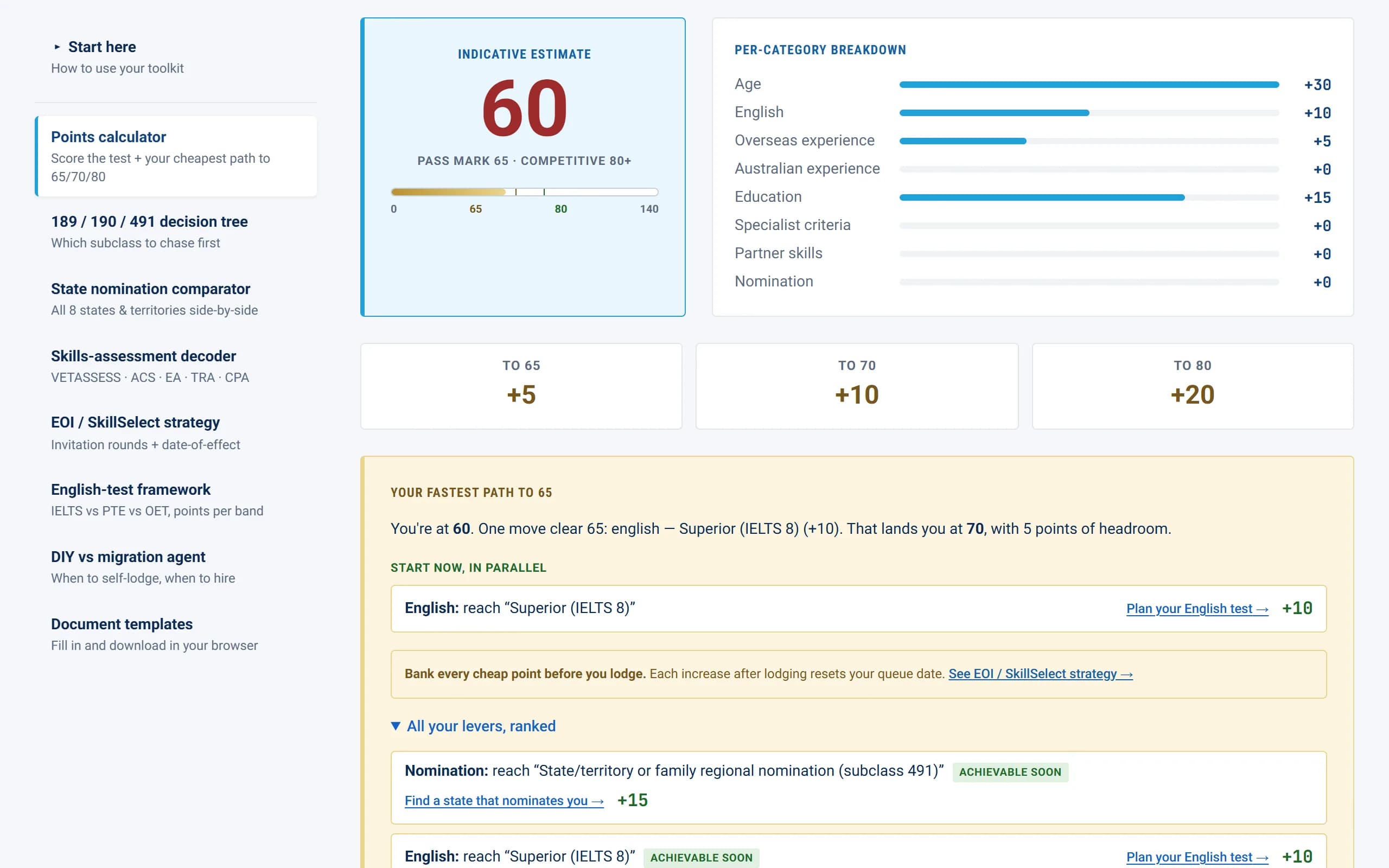
Points Considerations for Teachers
| Factor | Typical Score |
|---|---|
| Age (25-32) | 25-30 |
| English (IELTS R/W 7.0, S/L 8.0) | 10-20 |
| Overseas experience | 5-15 |
| Qualifications | 15-20 |
| State nomination | 5-15 |
The English Score Advantage
Because AITSL requires 8.0 in speaking and listening, teachers who meet this threshold often qualify for Proficient or Superior English points. This high English requirement, while challenging, becomes an advantage in the points calculation.
Teaching in Regional Australia
Regional schools offer:
- Higher demand and easier visa pathways
- Incentives (housing, relocation assistance, salary loadings)
- Smaller class sizes
- Strong community connections
- Regional visa benefits (491 + 15 points)
The trade-off is distance from major cities and potentially limited amenities. However, many regional teaching positions come with excellent packages to compensate.
Frequently Asked Questions
Why is the English requirement so high for teachers?
Teaching requires constant verbal communication with students, parents, and colleagues. The 8.0 speaking and listening requirement ensures teachers can communicate effectively in Australian classrooms.
Can I teach in Australia with a qualification from my country?
You need a positive AITSL assessment and state teacher registration. If your qualification meets Australian standards (4-year program with practicum), you can teach. Some qualifications may require additional bridging study.
Do I need to know Australian curriculum?
Not before arriving, but you'll need to familiarise yourself with the Australian Curriculum (nationally) and any state-specific requirements. This is typically done during your registration and induction process.
What's the salary for teachers in Australia?
Teacher salaries vary by state, sector, and experience. Starting salaries are typically AUD $70,000-$80,000, rising to AUD $100,000-$120,000+ for experienced teachers. Regional loadings and independent school salaries can be higher.
Can I teach at a university on a skilled visa?
University Lecturer (242111) is on the MLTSSL. However, university positions typically require a PhD, research track record, and publication history. Skills assessment for university lecturers is through VETASSESS.
How long does the whole process take?
From starting AITSL assessment to visa grant: approximately 8 to 18 months, depending on visa subclass, state registration processing, and document preparation time.