Nurse Educator Visa Pathway to Australia: Complete 2026 Guide
Updated: 16 August 2026
Australia classifies Nurse Educator under ANZSCO 254211. The Australian Nursing and Midwifery Accreditation Council (ANMAC) conducts the skills assessment, and AHPRA's Nursing and Midwifery Board of Australia (NMBA) handles practice registration. The occupation sits on the Core Skills Occupation List (CSOL) and STSOL, unlocking subclasses 190, 491, 482 and 186. Typical 2026 salaries range AUD $110,000-$160,000. The role requires at least five years of relevant nursing experience.
Quick Facts: Nurse Educator Migration Pathway
| Detail | Information |
|---|---|
| ANZSCO Code | 254211 (Nurse Educator) |
| Skill Level | 1 (Bachelor degree or higher in nursing plus at least 5 years experience) |
| Skills Assessment | ANMAC (Australian Nursing and Midwifery Accreditation Council) |
| Occupation List | CSOL and STSOL — no 189 access |
| Visa Options | 190, 491, 482, 186 |
| Demand Level | High — sustained shortage in tertiary nursing education and clinical training |
| Salary Range | AUD $130,000-$140,000 average (SEEK May 2026), $110,000-$160,000 spread |
| Typical 190 Score | 75-85 points after state nomination |
| Key Challenge | Dual track — ANMAC for migration plus AHPRA for practice registration |
Role Context: Nurse Educators in Australia
Nurse Educators design, deliver and evaluate nursing education programs across two main employer types: tertiary institutions (universities and TAFE) running undergraduate and postgraduate nursing courses, and large hospital networks running clinical training, professional development, and graduate nurse programs. Around 33% of nurse educators work in NSW and 25% in Victoria, with the remainder distributed across Queensland, South Australia and Western Australia.
Demand is consistent and growing. Australia's nursing workforce has expanded under the federal Aged Care Workforce Strategy, the National Rural and Remote Nursing Strategy, and ongoing investment in undergraduate nursing places — but the supply of qualified educators to teach the next generation has not kept pace. The result is sustained recruitment pressure in nursing schools at Sydney, UTS, Monash, Melbourne, Deakin, UQ and ACU, and in the clinical education departments of major tertiary hospitals (RPA, Royal Melbourne, Princess Alexandra, Royal Adelaide).
The role is distinct from a Clinical Nurse Educator employed within a single ward, which often falls under Registered Nurse classifications. ANZSCO 254211 captures dedicated educator positions — academic appointments, clinical training coordinators, simulation lab managers, graduate nurse program directors and curriculum developers. The five-year minimum nursing experience requirement filters out applicants who have moved into education too quickly.
ANZSCO 254211 — Code Mapping and Tasks
The ANZSCO descriptor for Nurse Educator covers professionals who design, plan, implement and evaluate the delivery of nursing education. The code sits inside Unit Group 2542 Nurse Educators and Researchers, alongside 254212 Nurse Researcher.
Typical tasks include:
- Designing curricula for nursing education programs (undergraduate, postgraduate, professional development)
- Delivering lectures, tutorials, clinical simulations and bedside teaching
- Assessing student clinical competencies and academic work
- Coordinating clinical placement programs with hospital partners
- Mentoring nursing students and early-career registered nurses
- Conducting research into nursing pedagogy and clinical education methods
- Managing accreditation processes for nursing education programs
Critical mapping question: are you a clinical nurse who occasionally teaches, or a dedicated educator whose primary role is teaching? If your duties are predominantly clinical with teaching as a minor component, you should nominate a Registered Nurse code (254418 or specialist nursing code), not 254211. ANMAC examines duties forensically against the descriptor.
Skills Assessment: ANMAC
ANMAC is the sole assessing body for ANZSCO 254211 and 254212. Nurse Educator is one of the few migration pathways where the skills assessment is interlinked with the practice registration framework — to receive a positive ANMAC outcome, you must hold (or be eligible for) AHPRA registration as a Registered Nurse.
Qualification requirements:
- Bachelor degree in nursing (or higher — Master's, PhD) from a recognised program
- Postgraduate qualification in nursing education, clinical teaching, or adult learning preferred
- At least 5 years of post-registration nursing experience
- At least 2 years of relevant nurse educator experience aligned with the ANZSCO 254211 descriptor
Modified Skills Assessment vs Full Skills Assessment: ANMAC offers two assessment types:
- Full Skills Assessment (AUD $595) — for applicants needing both qualification and skill level assessment
- Modified Skills Assessment (AUD $395) — for applicants already holding AHPRA registration and seeking only an ANZSCO mapping outcome
The Modified Skills Assessment is the faster route for nurses already registered in Australia. Offshore applicants typically require the Full Skills Assessment.
Processing time: ANMAC standard processing is 8-12 weeks. Priority processing can compress this where required.
Common rejection reasons:
- Insufficient educator-specific experience — less than two years of dedicated educator work in the past five years
- Job descriptions blurring clinical and educational duties — references must clearly identify the proportion of time spent on educational design, delivery and assessment
- Qualification gaps — applicants without postgraduate education qualifications and without sufficient teaching experience to demonstrate competence
AHPRA / NMBA Registration (parallel, mandatory before practice)
Independent of ANMAC, all nurses working in Australia must be registered with the Nursing and Midwifery Board of Australia (NMBA) through AHPRA. For internationally qualified nurses (IQNs):
Steps:
- Self-check against NMBA's English language requirement (IELTS 7.0 minimum each band, OET B in each subscore, or equivalent)
- Application via AHPRA's online portal — includes identity, qualification, employment history
- NMBA assessment — three streams: Stream A (substantially equivalent qualification, registration granted), Stream B (additional bridging required), Stream C (full Bachelor of Nursing required)
- For Stream B candidates: complete the NMBA-approved Outcomes-Based Assessment (OBA) — three components including online self-assessment, multiple choice exam and objective structured clinical examination (OSCE)
- Identity, criminal history check, professional indemnity insurance
Fees: AHPRA application fee for internationally qualified nurses is AUD $640 (2025-26), plus annual registration fee of AUD $185 for general registration. OBA examination fees are charged separately by the assessment provider.
Processing time: AHPRA registration for IQNs typically takes 6-12 months, with Stream B candidates extending to 12-18 months depending on OBA scheduling and bridging program availability.
Visa Pathways for Nurse Educators
Subclass 482 — Skills in Demand Visa
Employer sponsorship is the dominant pathway. Hospital networks and universities are experienced sponsors.
- Visa fee: AUD $4,015 (Core Skills stream, primary applicant)
- Salary threshold: Core Skills Income Threshold AUD $79,423 (FY2026-27)
- Processing time: Median ~4 months, 90% within 7 months
- Quirk: Senior nurse educator roles often clear the AUD $146,576 Specialist Skills threshold, which routes the application through the faster Specialist stream (median 7 days)
Subclass 190 — Skilled Nominated Visa
PR via state nomination plus 5 points. NSW and Victoria are the most active nominators.
- Visa fee: AUD $6,140 (primary applicant)
- Nominating states in 2026: NSW and Victoria both prioritise healthcare under their nomination programs; Queensland and South Australia also nominate from Unit Group 2542 where roles are available
- Processing time: 6-12 months after nomination
- Obligation: Reside in the nominating state for two years
Subclass 491 — Skilled Work Regional Visa
Five-year provisional regional visa with PR pathway via subclass 191.
- Visa fee: AUD $6,140 (primary applicant)
- Points boost: +15 from regional nomination
- Quirk: Regional health services (Western Sydney University, Charles Sturt, University of New England, James Cook) actively recruit nurse educators to support rural nursing programs
Subclass 186 — Employer Nomination Scheme
Permanent residency via employer sponsorship.
- Visa fee: AUD $6,140 (primary applicant)
- Processing time: Direct Entry stream median 12-13 months; TRT typically faster after two years on 482
- Quirk: Universities and large hospital networks routinely sponsor 186 applications for senior nurse educators after a successful 482 period
Points Test Strategy
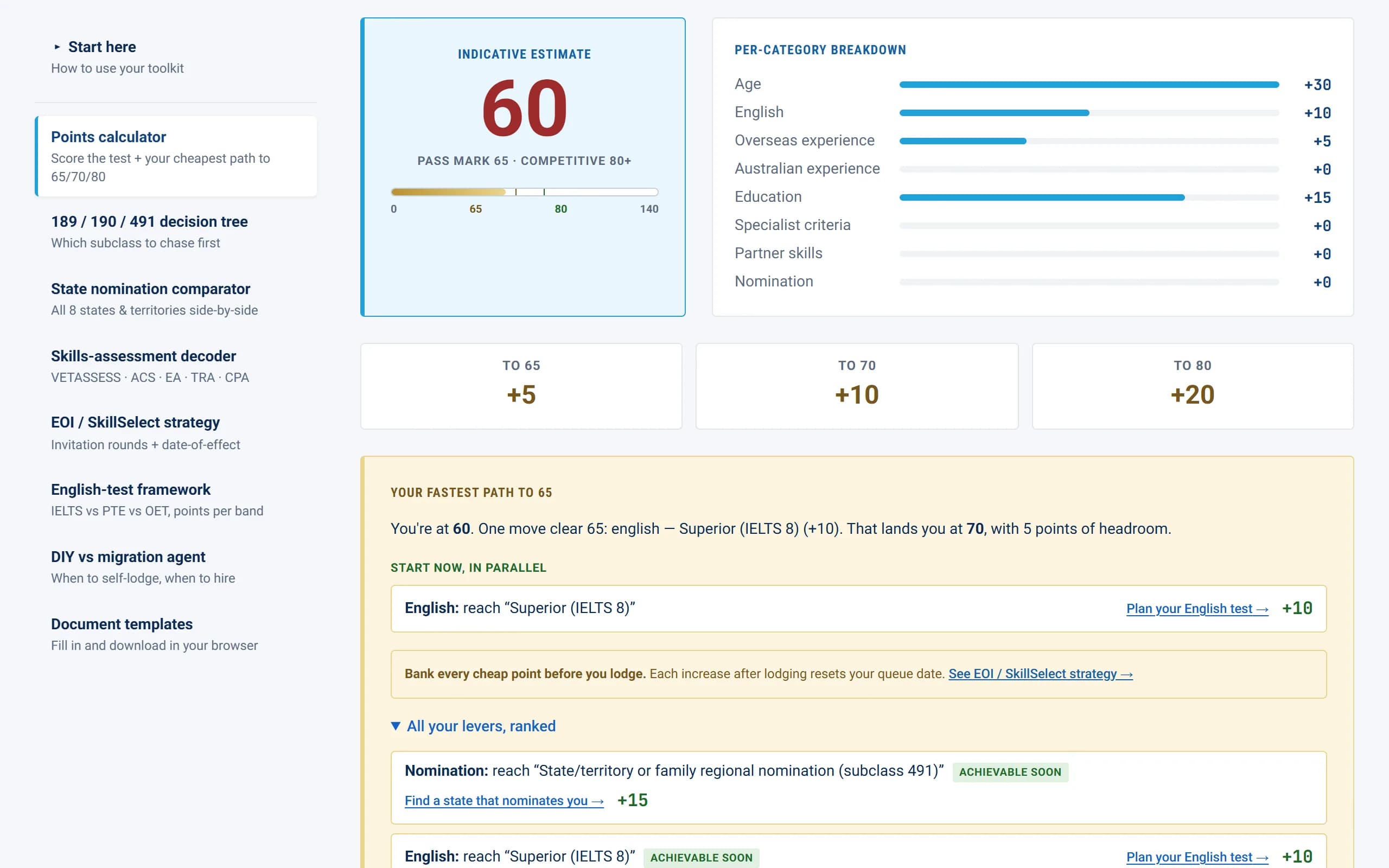
Nurse Educator is not on the MLTSSL, so 189 is unavailable. State nomination (190, 491) and employer sponsorship are the routes.
| Points Factor | Points | Notes |
|---|---|---|
| Age 25-32 | 30 | Less common at senior educator level |
| Age 33-39 | 25 | More typical given 5-year experience minimum |
| Bachelor of Nursing | 15 | Floor qualification |
| Master's in Nursing or Education | 15 | Common for educators |
| PhD | 20 | Increasingly required for academic appointments |
| English Superior (8.0+) | 20 | Worth pursuing — significant point swing |
| English Proficient (7.0) | 10 | Adequate for AHPRA registration |
| Overseas experience 5-8 years | 10 | Standard for the role |
| Overseas experience 8+ years | 15 | Common for senior educators |
| State nomination (190) | 5 | Often essential |
| Regional (491) | 15 | Worth considering for regional university roles |
Realistic Scenarios
Scenario 1: Mid-career nurse educator, 35, Master's in Clinical Education, OET B (Proficient), 9 years nursing experience
- Age 25 + Master's 15 + English 10 + Experience 15 = 65 points
- Add NSW 190 nomination (+5) = 70 points, marginal for healthcare invitation rounds
- Add 491 regional (+15 instead of +5) = 80 points if accepting regional placement
Scenario 2: Senior academic, 41, PhD, IELTS 8.0, 15 years nursing including 6 years education
- Age 25 + PhD 20 + English 20 + Experience 15 = 80 points
- Add 190 nomination = 85 points, competitive
State Nomination for Nurse Educators
New South Wales
NSW publishes ANZSCO Unit Group 2542 within its healthcare priority sector under the Care Economy framework. Sydney's tertiary hospital network (RPA, RNS, Westmead, Prince of Wales) and major nursing schools (USYD, UTS, UNSW, Macquarie, ACU) create the largest single concentration of nurse educator roles in Australia. NSW invitation rounds in 2026 have favoured candidates with 80+ points and clear settlement intent.
Victoria
Victoria flags health as a top priority sector. Melbourne universities (Melbourne, Monash, Deakin, La Trobe, ACU, Australian Catholic, RMIT) and the Royal Melbourne, Alfred and Austin networks recruit consistently. Victorian rolling rounds in 2026 have been issuing invitations at 80+ points across most healthcare unit groups.
Queensland
Queensland Health and James Cook University recruit nurse educators particularly for North Queensland and rural placements. QSMP nomination supports both 190 and 491 pathways.
South Australia
South Australia's 2025-26 program allocates 2,250 nomination places. Adelaide hospitals and Flinders, Adelaide and UniSA nursing schools support consistent demand.
Australian Capital Territory
The ACT nominates from healthcare under its Canberra Matrix system. The Canberra Hospital, University of Canberra and ANU have small but steady nurse educator recruitment programs.
Salary and Employment Outlook
What Nurse Educators Earn in 2026
| Role | Typical Salary Range (AUD) |
|---|---|
| Clinical nurse educator (hospital, mid-career) | $115,000-$135,000 |
| Senior clinical educator | $130,000-$155,000 |
| University lecturer (Level B, nursing) | $115,000-$140,000 |
| University senior lecturer (Level C) | $140,000-$170,000 |
| Associate professor (Level D) | $170,000-$200,000 |
| Director of nursing education | $180,000-$230,000+ |
Source: SEEK Salary Hub May 2026 (Nurse Educator average AUD $130,000-$140,000), cross-referenced against PayScale Australia 2026 (average hourly rate AUD $46.75) and university enterprise bargaining agreement salary scales.
Total packages include superannuation at 11.5% (rising to 12% on 1 July 2026), and for university appointments, generous leave entitlements including study leave for ongoing PhD candidates.
Sectors and Employers
- Universities — USYD, UTS, Monash, Melbourne, Deakin, UQ, ACU, ECU, Flinders all recruit consistently
- TAFE and private RTOs — diploma of nursing and Enrolled Nurse program delivery
- Hospital networks — NSW Health (Sydney LHD, Northern Sydney LHD, Western Sydney LHD), Alfred Health, Monash Health, Metro North, Metro South Health, SA Health
- Aged care — large operators (Bupa, Estia, Regis, McKenzie Aged Care) employ educators to deliver graduate programs and continuous professional development
- Defence Force — Royal Australian Army Nursing Corps employs educators on Permanent and Reserve appointments
Geographic Variation
Sydney and Melbourne pay broadly comparable, with Sydney slightly higher at senior levels. Regional Australia commands a modest premium under rural workforce incentives — Tasmania, regional WA and remote NT offer additional allowances and remote location benefits.
Tips for a Successful Application
1. Document at least two years of dedicated educator experience
ANMAC requires the role to be substantially educator-focused, not clinical with education as a secondary duty. References must quantify the proportion of time spent on curriculum design, teaching delivery, assessment and student supervision.
2. Complete AHPRA registration in parallel with ANMAC
AHPRA registration takes 6-12 months — the same window as your migration timeline. Lodge your AHPRA application immediately after your ANMAC application, not after. Many nurse educator candidates lose 6-9 months by treating these as sequential rather than parallel processes.
3. Use OET if your English subscore is uneven
OET (Occupational English Test) is healthcare-specific and frequently produces stronger writing and speaking subscores than IELTS for clinically experienced applicants. AHPRA accepts OET B in each subscore as meeting the English standard. Many nurses migrate via OET rather than IELTS for this reason.
4. Tailor employment references to ANZSCO 254211 language
Use the descriptor's exact terminology: "designs and delivers nursing education programs", "evaluates curriculum effectiveness", "supervises clinical placements", "assesses student competence", "mentors graduate nurses". Generic "training" or "preceptoring" wording leaves room for ANMAC to reclassify as a clinical role.
5. Consider regional university roles for 491 advantage
Regional universities (Charles Sturt, UNE, JCU, USC, Federation, Southern Cross) consistently recruit nurse educators and qualify for the +15 regional points boost via 491. This can be the difference between an invitation and silence on the points test.
Step-by-Step Migration Roadmap
- Confirm your role maps to 254211 — review the ANZSCO code finder
- Verify CSOL status — confirm Nurse Educator remains on the CSOL
- Sit your English test — IELTS 7.0 minimum each band, or OET B each subscore
- Lodge ANMAC skills assessment — Full Skills Assessment (AUD $595) or Modified ($395) if already AHPRA registered
- Lodge AHPRA registration application in parallel — NMBA Stream A, B or C depending on qualification
- Complete OBA examination if Stream B is required
- Receive positive ANMAC outcome and AHPRA registration
- Submit EOI in SkillSelect for 190/491, or secure sponsoring employer for 482/186
- Apply for state nomination — NSW, Victoria, Queensland, SA or ACT
- Receive invitation and lodge visa within 60 days
- Complete health and character checks
- Receive grant and relocate — confirm AHPRA registration is active before commencing practice
Frequently Asked Questions
Do I need AHPRA registration to migrate as a Nurse Educator?
Yes. ANMAC requires evidence that you hold or are eligible for AHPRA registration as a Registered Nurse. Even where your educator role is academic and does not involve direct patient care, the practice registration underpins the nursing qualification foundation of the educator role. Lodge both applications in parallel to compress your migration timeline.
Is the role open to nurses without a Master's degree?
A Bachelor of Nursing plus substantial educator experience can satisfy ANMAC if employment evidence demonstrates competence in curriculum design, teaching delivery and assessment. However, a Master's in Nursing, Clinical Education or Adult Learning significantly strengthens both the assessment outcome and points test score. Most university appointments require a Master's at minimum.
Can I work as a Registered Nurse while waiting for the Nurse Educator pathway?
Yes. Many migrants enter Australia as a Registered Nurse first, gain Australian clinical and teaching experience, then transition to a 254211 role. This pathway is well-trodden, particularly for nurses arriving on 482 visas with major hospital sponsors who then transition to educator roles internally.
Is the role on the MLTSSL or only the CSOL?
Nurse Educator (254211) sits on the CSOL and STSOL but not the MLTSSL, which means the subclass 189 independent skilled visa is unavailable. Pathways are 190, 491, 482 and 186 only.
What's the difference between 254211 Nurse Educator and 254212 Nurse Researcher?
254211 covers professionals whose primary work is designing and delivering nursing education programs. 254212 covers nurses whose primary work is conducting research into nursing or multidisciplinary health topics. Many academic appointments span both — applicants in this position should nominate the code that captures the majority of their work.
Are PhD-qualified nurse academics in higher demand?
Yes. Australian universities are increasingly tying nursing school accreditation to a PhD-qualified faculty proportion. PhD candidates and PhD-qualified nurses are in stronger demand for tenured academic roles, while clinical educator roles in hospitals remain accessible at Master's level. A PhD also adds 20 points on the points test.
Can I bring my partner who is also a nurse?
Yes. If your partner holds a recognised nursing qualification and English, they can claim 5-10 points as a skilled partner. Both partners then have AHPRA registration pathways available, and many couples migrate jointly — one as primary applicant on 482 or 190, the other as dependent who then pursues their own AHPRA registration on arrival.