Registered Nurse (Developmental Disability) Visa Pathway to Australia: Complete 2026 Guide
Updated: 16 August 2026
Australia classifies Registered Nurse (Developmental Disability) under ANZSCO 254416. The Australian Nursing and Midwifery Accreditation Council (ANMAC) conducts the skills assessment and AHPRA grants registration through the Nursing and Midwifery Board of Australia. The occupation sits on the MLTSSL and CSOL, opening subclasses 189, 190, 491, 482 and 186. Typical 2026 salaries range AUD $80,000-$110,000, with NDIS-driven demand and a national registered nurse shortage sustaining year-on-year recruitment.
Quick Facts: Registered Nurse (Developmental Disability) Migration Pathway
| Detail | Information |
|---|---|
| ANZSCO Code | 254416 (Registered Nurse — Developmental Disability) |
| Skill Level | 1 (Bachelor degree or higher, plus professional registration) |
| Skills Assessment | ANMAC (Australian Nursing and Midwifery Accreditation Council) |
| Registration | AHPRA / Nursing and Midwifery Board of Australia |
| Occupation List | MLTSSL and CSOL |
| Visa Options | 189, 190, 491, 482, 186 |
| Demand Level | High — sits inside the broader Registered Nurse critical shortage tracked by Jobs and Skills Australia; NDIS sustains specialty-specific demand |
| Salary Range | AUD $80,000-$110,000 (SEEK, 2026; CNS and clinical educator roles toward the upper end) |
| Typical 189 Score | 70-80 (clears at lower scores than ICT) |
| Key Challenge | Documenting clinical hours specifically in intellectual or developmental disability settings, not generic community nursing |
What Developmental Disability Nurses Do in Australia
Registered nurses in developmental disability care for people with intellectual disability, autism spectrum conditions, cerebral palsy, Down syndrome, Prader-Willi syndrome, fragile X, foetal alcohol spectrum disorder and other lifelong conditions affecting cognitive and adaptive function. The work spans community group homes, supported independent living, day programs, behaviour support teams, paediatric outreach, and dedicated developmental disability units in state health services.
The Australian sector shifted permanently after the National Disability Insurance Scheme rollout. NDIS funding underwrites individualised packages, which pulled clinical nursing oversight into community providers rather than concentrating it in large institutions. Big NDIS-registered providers — Aruma, Endeavour Foundation, Life Without Barriers, Yooralla, Cerebral Palsy Alliance, Achieve Australia — recruit registered nurses with specialty experience to lead complex care planning, medication oversight, swallowing and seizure management, and clinical education for support workers.
Jobs and Skills Australia treats Registered Nurses (Developmental Disability) as a sub-component of the broader 2544 unit group. The occupation profile carries suppressed data because fewer than 50 people identify in this exact specialty role title at any one time, but practising nurses spread across NDIS providers, state disability services and community health number in the thousands.
ANZSCO 254416 — Code Mapping
ANZSCO 254416 covers registered nurses who provide nursing care to people with intellectual and developmental disability across health, welfare and community settings. Required tasks include health assessment, behavioural intervention planning, medication management, supervision of personal care workers, family education, transition planning between paediatric and adult services, and coordinated care with allied health.
The code is distinct from 254417 Registered Nurse (Disability and Rehabilitation), which is broader and covers physical disability and post-injury rehabilitation. If your practice has been overwhelmingly in intellectual disability — community group homes, behaviour support, paediatric developmental services — 254416 is the correct code. If your work has straddled physical rehabilitation and disability, 254417 may suit you better.
Both codes sit on the MLTSSL and CSOL and use ANMAC as the assessing body. The migration pathways are functionally identical. The choice matters because ANMAC and AHPRA assess your documented practice against the specific code — claiming 254416 with mostly orthopaedic rehab experience invites a refusal.
Skills Assessment
ANMAC Skills Assessment
ANMAC certifies that your nursing qualification and English meet Australian standards for migration purposes. It does not authorise clinical practice — AHPRA does that, separately and in parallel.
- Body: Australian Nursing and Midwifery Accreditation Council
- Requirements: Recognised nursing qualification at AQF Bachelor level or equivalent, sufficient post-qualification clinical hours, current home-country registration, and English at IELTS Academic 7.0 in each band, OET B grade, or equivalent.
- Assessment cost (2026): Modified Skills Assessment AUD $395, Direct Care AUD $545, Full Skills Assessment AUD $595.
- Processing time: Approximately 6-8 weeks from a complete lodgement.
- Common rejection reasons: Direct care hours documented without clinical supervision evidence; specialty hours that read as generic community nursing rather than developmental disability practice; transcripts that fail to separate theory hours from clinical placement hours.
ANMAC assigns one of three pathways based on country of qualification. Applicants from Canada, Hong Kong, Ireland, Singapore, Spain, the UK and the US generally use the Full Skills Assessment. Applicants from other countries use the Modified or Modified PLUS Skills Assessment in tandem with the AHPRA IQRN pathway.
AHPRA Registration (Nursing and Midwifery Board of Australia)
AHPRA registration is the regulatory licence to practise as a registered nurse in Australia. It applies regardless of specialty.
- Body: Australian Health Practitioner Regulation Agency
- Initial registration fee: Approximately AUD $500
- Annual renewal: AUD $193 (1 June 2026 to 31 May 2027)
- English: IELTS Academic 7.0 each band, OET B grade, or equivalent
- IQRN assessment fee (Stream A): AUD $640
Submit AHPRA and ANMAC in parallel — the two bodies do not share information and running them sequentially adds six months of dead time to your timeline.
Visa Pathways for Developmental Disability Nurses
Subclass 482 — Skills in Demand Visa
Employer-sponsored temporary visa. NDIS providers and state disability services sponsor regularly because the specialty is hard to fill domestically.
- Visa fee: AUD $3,210
- Core Skills Income Threshold: AUD $76,515 (rising to AUD $79,499 on 1 July 2026)
- Processing time: 2-3 months for healthcare priority
- Reality: Most developmental disability RN base salaries clear the Core Skills threshold; sponsors typically lodge in Core Skills rather than Specialist Skills
Subclass 491 — Skilled Work Regional Visa
The dominant points-based pathway for this specialty given the geographic spread of NDIS providers and group homes into regional postcodes.
- Visa fee: AUD $6,140
- Points boost: +15 from regional nomination
- Processing time: 12-15 months
- Quirk: Most NDIS supported accommodation outside Greater Sydney and Greater Melbourne sits in 491-eligible regional zones
Subclass 190 — Skilled Nominated Visa
State nomination grants permanent residency with a 2-year residence commitment in the nominating state.
- Visa fee: AUD $6,140
- Processing time: 9-19 months
- Best states: All states with active disability services nominate the broader 254 nursing codes in 2026 — verify the current state list before applying
Subclass 189 — Skilled Independent Visa
Available because 254416 is on the MLTSSL. Less common than 491 and 482 in this specialty because invitation rounds favour higher-scoring candidates and nursing applicants frequently combine state nomination with their points score.
- Visa fee: AUD $6,135
- Typical invitation score: 70-80
- Processing time: 8-12 months; healthcare priority can compress this to 3-6 months
Subclass 186 — Employer Nomination Scheme
Permanent residency through employer sponsorship. NDIS providers and state services use the Direct Entry stream when a candidate already holds a skills assessment, AHPRA registration and three years of post-qualification experience.
- Visa fee: AUD $6,140
- Streams: Direct Entry or Temporary Residence Transition (after 2 years on 482)
- Processing time: 4-12 months under healthcare priority
Points Test Strategy
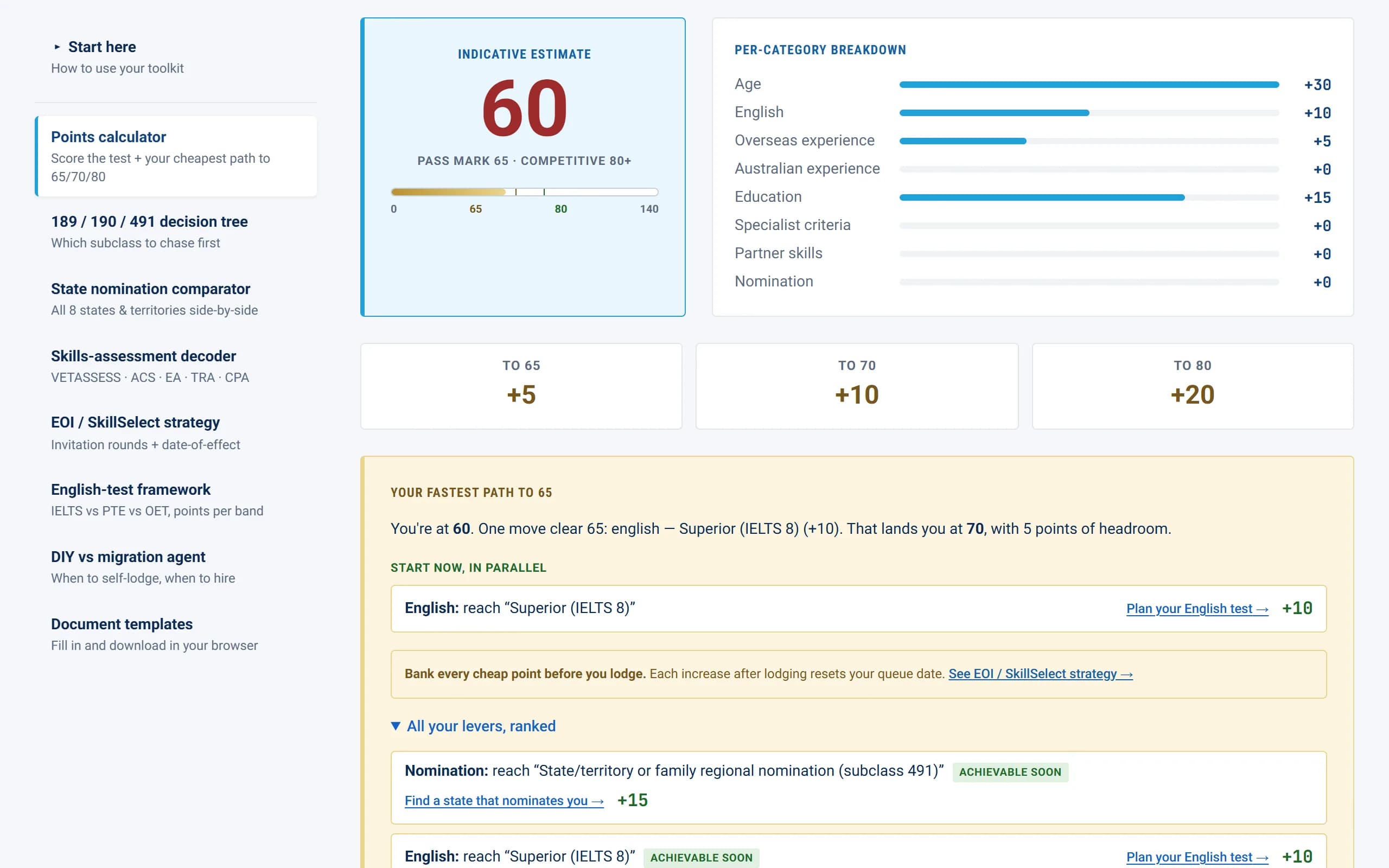
Nursing specialties typically clear the points test at lower scores than ICT roles, but a strong score still shortens the wait.
| Points Factor | Points | Notes |
|---|---|---|
| Age (25-32) | 30 | Maximum bracket |
| Age (33-39) | 25 | Most internationally qualified nurses sit here |
| Bachelor's degree | 15 | Minimum entry qualification |
| Master's degree | 15 | Same band as Bachelor's |
| PhD | 20 | Rare in nursing but possible |
| English (Proficient — IELTS 7) | 10 | The realistic baseline for IQRN pathway |
| English (Superior — IELTS 8) | 20 | Worth the second sitting if you can hit it |
| Skilled employment overseas (3-4 yrs) | 5 | Most applicants |
| Skilled employment overseas (5-7 yrs) | 10 | Common for specialty nurses |
| Skilled employment overseas (8+ yrs) | 15 | Senior CNS-level candidates |
| Australian study (CRICOS bridging or postgrad) | 5 | Plus optional regional study bonus |
| State nomination (190) | 5 | |
| Regional nomination (491) | 15 | |
| Partner skills | 5-10 | Where applicable |
Realistic Scenarios
Scenario 1: Filipino RN with seven years of community disability nursing
Age 31 (30) + Bachelor's (15) + IELTS 7 (10) + Experience 5-7 years (10) = 65 points. Add 491 nomination (+15) = 80 points. Comfortable invitation territory for regional NDIS roles.
Scenario 2: UK RN with master's in intellectual disability nursing and ten years experience
Age 38 (25) + Master's (15) + Superior English (20) + Experience 8+ (15) = 75 points. Add 190 nomination (+5) = 80 points, or 491 (+15) = 90 points. Strong candidate for invitation in either stream.
State Nomination
New South Wales
NSW nominates registered nurses across specialty codes in 2026 under sustained healthcare workforce demand. The NSW skills list includes the 2544 unit group. NSW Health and the major NDIS providers operating in Sydney, Newcastle and Wollongong drive most metropolitan demand. Successful 190 candidates in 2026 typically hold 85-100 points.
Victoria
Victoria's nomination program prioritises healthcare across the board. Melbourne hosts large NDIS providers (Yooralla, Annecto) plus state-run developmental disability services. Victoria typically requires demonstrated commitment to live in the state and may favour applicants with prior connection (study, work, family).
Queensland
Queensland's offshore and onshore nomination streams include registered nursing. Demand is strongest in Brisbane and the regional coastal corridor where private NDIS providers are scaling. Queensland weights occupation lists toward offshore applicants for nursing.
South Australia
SA's nomination program has consistently favoured healthcare for both 190 and 491. South Australia has historically waived some English thresholds for offshore healthcare applicants — verify the current state policy at lodgement.
Western Australia
WA nominates registered nurses across all specialties. The state's 190 quota for 2025-26 is approximately 1,000 places, with healthcare prioritised.
Tasmania
Tasmania nominates nursing roles via 190 and 491. Hobart and Launceston have small but persistent demand for disability nurses through state-run services and community providers.
If a state is not listed here, it does not actively nominate this specialty code at the time of writing. Verify before lodging. The current Skilled Occupation List carries the official assignments.
Salary and Employment Outlook
| Role | Typical Salary Range |
|---|---|
| RN (entry-level developmental disability) | AUD $75,000-$85,000 |
| RN (mid-career, 5+ years specialty) | AUD $85,000-$95,000 |
| Clinical Nurse Specialist (CNS) | AUD $95,000-$110,000 |
| Clinical Nurse Consultant (CNC) | AUD $110,000-$130,000 |
| Nurse Manager (NDIS provider) | AUD $115,000-$140,000 |
Source: SEEK Australia, May 2026. Specialty disability nursing data is partly suppressed at the ANZSCO level by Jobs and Skills Australia because the registered occupation pool is small, but provider-level recruitment data on SEEK gives a consistent picture across NDIS and state services. Total packages typically include the 11.5% superannuation contribution, NDIS sector salary packaging (which can lift take-home meaningfully), shift loadings and on-call allowances.
The not-for-profit and NDIS-funded sectors permit salary packaging of up to AUD $15,900 living expenses plus AUD $2,650 meal and entertainment annually — worth roughly 5-10% extra after tax depending on bracket.
Highest-Paying Employers and Sectors
- State health services — public sector enterprise agreements push CNC pay above AUD $130,000
- Large NDIS providers — Aruma, Endeavour Foundation, Life Without Barriers and similar pay competitive base salaries plus salary packaging
- Specialist developmental disability hospitals and units — limited in number but pay at the senior end
- Behaviour support consultancies — registered nurses with positive behaviour support qualifications attract premium rates
- Locum and agency work — daily rates of AUD $700-$1,000 for senior specialty nurses, more in remote postings
Tips for a Successful Application
1. Choose the right ANZSCO code
If your work has been mostly with people with intellectual or developmental disability, 254416 is correct. If it has straddled physical rehabilitation, 254417 may fit better. Choosing the closer match is more important than choosing the more "in-demand" code — ANMAC will refuse if your documented practice does not match the nominated code.
2. Document specialty hours precisely
Reference letters should specify hours worked in developmental disability settings, the nature of the clinical work (medication management, behaviour support, swallowing assessment, seizure management, family liaison), and the supervision structure. Generic letters that read "worked as a registered nurse" weaken applications.
3. Submit ANMAC and AHPRA in parallel
The two bodies operate independently. Submitting AHPRA after ANMAC adds three to six months. Run them simultaneously from day one.
4. Plan for IELTS 7 minimum, IELTS 8 ideal
ANMAC and AHPRA require IELTS Academic 7.0 in each band. Hitting 8.0 unlocks 20 points instead of 10 in the points test — often the difference between an invitation and a long wait. Pearson PTE Academic 73 and OET B equivalents are accepted.
5. Use 491 if your points score sits in the 60-70 band
Regional nomination adds 15 points. NDIS providers operate widely in regional postcodes, which keeps the residence requirement realistic for disability nurses. The 491 pathway is the dominant route for this specialty.
Step-by-Step Migration Roadmap
- Confirm your ANZSCO code — review the how to find your ANZSCO code guide
- Sit an English test — aim for IELTS Academic 7.0 in each band minimum, 8.0 if achievable
- Lodge AHPRA self-check for international registration eligibility
- Submit ANMAC and AHPRA applications in parallel (Modified Skills Assessment if from a country requiring IQRN)
- Complete AHPRA Outcomes Based Assessment if required (MCQ then OSCE)
- Receive ANMAC outcome and AHPRA registration
- Submit EOI in SkillSelect for 189, 190 or 491
- Apply for state nomination if pursuing 190 or 491 — see the skilled occupation list
- Alternatively, secure NDIS provider or state health sponsorship for 482 or 186
- Receive invitation and lodge visa within 60 days
- Complete health, character and biometrics
- Receive visa grant and relocate
Frequently Asked Questions
What is the difference between 254416 and 254417?
ANZSCO 254416 covers registered nurses working with people who have intellectual and developmental disability — autism, cerebral palsy, Down syndrome, fragile X. 254417 is broader and covers physical disability and rehabilitation after injury or illness. If your practice is mainly community group homes and behaviour support, 254416 fits. If it includes spinal injury, stroke or orthopaedic rehab, 254417 is closer.
Does ANMAC require specialty postgraduate qualifications for 254416?
No. ANMAC requires a recognised general nursing qualification plus documented practice hours. A specialty postgraduate qualification — for example, a Graduate Certificate in Intellectual Disability Nursing — strengthens the application but is not mandatory. AHPRA registration is similarly based on the underlying nursing qualification, not the specialty endorsement.
Are NDIS provider roles eligible for 482 sponsorship?
Yes. Many large NDIS providers hold accredited sponsor status and run rolling international recruitment for registered nurses. The Core Skills stream is the more common 482 pathway because typical specialty nurse base salaries clear the AUD $76,515 threshold but sit below the Specialist Skills threshold.
How long does the full migration process take for a developmental disability RN?
Realistic timelines from first AHPRA submission to visa grant run 12-24 months. AHPRA and ANMAC together take six to nine months including OBA. State nomination and EOI processing add three to six months. Visa decision adds three to twelve months depending on subclass and health checks. Healthcare priority processing compresses some stages.
Which Australian states have the strongest demand for developmental disability nurses in 2026?
NSW, Victoria and Queensland lead in raw provider volume because the largest NDIS providers are concentrated in the eastern states. Western Australia and South Australia run smaller but persistent demand through state disability services. Regional areas across all states have unmet demand because NDIS supported accommodation is geographically dispersed.