Dental Specialist Visa Pathway to Australia: Complete 2026 Guide
Updated: 16 August 2026
Australia classifies Dental Specialist under ANZSCO 252311. The Australian Dental Council (ADC) conducts qualification assessment; the Dental Board of Australia (via AHPRA) grants specialist registration. The occupation sits on STSOL and CSOL, unlocking subclasses 190, 491, 482 and 186 — not 189. Typical 2026 salaries range AUD $245,000-$490,000+ depending on specialty. Oral and maxillofacial surgery commands the highest band.
Quick Facts: Dental Specialist Migration Pathway
| Detail | Information |
|---|---|
| ANZSCO Code | 252311 (Dental Specialist) |
| Skill Level | 1 (specialist postgraduate qualification in an approved dental specialty) |
| Skills Assessment | ADC (Australian Dental Council) — Specialist Assessment Pathway |
| Occupation List | STSOL and CSOL — not on MLTSSL |
| Visa Options | 190, 491, 482, 186 (no 189) |
| Demand Level | High — specialist shortage in regional Australia is acute, metro markets tighter |
| Salary Range | AUD $245,000-$490,000+ (SEEK, Glassdoor, ERI SalaryExpert 2026) |
| Typical 190 Score | 75-95 |
| Key Challenge | Specialist Pathway with the Dental Board requires Board-approved specialty qualifications — many overseas specialty programs are not pre-approved |
Role Context in Australia
Dental specialists hold AHPRA specialist registration in one of 13 Board-approved specialties. The recognised specialties include orthodontics, oral and maxillofacial surgery, oral surgery, periodontics, endodontics, prosthodontics, paediatric dentistry, oral medicine, oral pathology, special needs dentistry, public health dentistry, forensic odontology, and dento-maxillofacial radiology.
Demand is uneven across geography and specialty. Orthodontics is the largest specialty workforce by volume, with strong metropolitan supply and persistent regional shortages. Oral and maxillofacial surgery is consistently undersupplied — the workforce is around 200 nationally and concentrated in tertiary hospitals. Endodontics, periodontics and paediatric dentistry all show regional vacancies that private groups (Smiles Inclusive, Pacific Smiles, 1300 Smiles, BOQ Dental) and the public hospital network struggle to fill outside the major capitals. Public hospital dental specialist roles in NSW Health, Royal Children's Melbourne, Royal Dental Hospital, and the Queensland Children's Hospital run with persistent vacancies.
ANZSCO Code Mapping: 252311
ANZSCO 252311 covers dental practitioners holding Board-approved specialist registration who deliver advanced clinical care within their specialty scope. Tasks include conducting specialist clinical assessments, designing and implementing treatment plans within the specialty, performing procedures (surgical, prosthetic, orthodontic, endodontic), supervising registrars and dental therapists, and contributing to teaching and research.
The code is distinct from 252312 Dentist (general dental practitioner, also a skilled migration code) and 411211 Dental Hygienist (skill level 2). The distinction matters: a general dentist who works in a specialty area without specialist registration must apply under 252312, not 252311. Claiming specialist status without specialist registration is the fastest route to a refused application.
Skills Assessment: Australian Dental Council
The Australian Dental Council is the assessing body. Dental specialists use the Specialist Assessment Pathway, which differs from the general dentist pathway.
Specialist Assessment Pathway
The Specialist Pathway tests whether your overseas specialty qualification is substantially equivalent to an Australian Board-approved specialty program. The Dental Board assesses two distinct outcomes:
- Substantial equivalence — your qualification and training are accepted as equivalent without further examination. Direct pathway to specialist registration.
- Partial equivalence — limited equivalence. Bridging activities may be required (period of supervised practice, additional examinations, or a top-up specialty program).
- Not substantially equivalent — the qualification does not align with the Australian specialty standard. Full retraining through an Australian Doctor of Clinical Dentistry program is required.
The Specialist Pathway has historically recognised UK MOrth, MFDS and equivalent specialty qualifications, RCS specialty fellowships, and some US, Canadian and Irish specialty programs. South Asian, Middle Eastern, African and Eastern European specialty qualifications are usually assessed as partially equivalent, with bridging requirements.
ADC fees
- Initial assessment: AUD $647 (documentary review)
- Written examination application: AUD $2,122 (if required)
- Practical examination application: AUD $4,775 (if required)
- Annual Dental Board registration fee: AUD $818 (2025-26 registration period)
Most specialist pathway applicants pay the initial assessment fee plus any bridging requirements ordered by the Board. Full general dentist examination is required only where the Specialist Pathway assessment finds the qualification insufficient even for general registration.
Processing time
The Specialist Pathway documentary assessment runs 8-16 weeks. Bridging activities — supervised practice, supplementary examinations, or top-up programs — extend the timeline by 6 months to 2 years depending on the requirement.
Common rejection drivers: specialty programs that are recognised as specialist qualifications in the home country but not by the Dental Board (many Eastern European and South Asian "MDS" specialty pathways fall into this category); incomplete training documentation where the program structure is opaque to the Board; and applicants attempting the Specialist Pathway without first satisfying the Australian general registration prerequisites.
Specialist registration through AHPRA
A positive ADC outcome does not by itself authorise practice. Specialist registration requires:
- General registration as a dentist with the Dental Board of Australia (AHPRA)
- Specialist registration in the approved specialty
- Annual registration renewal and CPD compliance
The Board's Specialist Registration Standard requires applicants to have completed a minimum of two years of general dental practice in addition to all other general registration requirements. This general practice requirement can be satisfied by experience outside Australia subject to Board approval. Annual specialist registration fee is approximately AUD $818 for the 2025-26 period.
Visa Pathways for Dental Specialists
Because 252311 sits on STSOL and CSOL but not on the MLTSSL, the 189 Skilled Independent visa is not available. The route runs through state nomination, regional nomination or employer sponsorship.
Subclass 482 — Skills in Demand (SID)
The dominant pathway for offshore-trained specialists with an Australian job offer. Most specialist salaries clear the Specialist Skills Income Threshold by a wide margin.
- Visa fee: AUD $3,210 (Core Skills stream); AUD $3,210 (Specialist Skills stream, fee aligned with Core)
- Salary threshold: Core Skills Income Threshold AUD $73,150; Specialist Skills Income Threshold AUD $135,000 (2026)
- Processing time: 1-3 months in the Core Skills stream; 1-2 months in the Specialist Skills stream
- Quirk: Public hospital dental services and the larger private specialty groups (Bupa Dental, Smiles Inclusive, Pacific Smiles) are experienced sponsors. Solo specialist practices may need to set up sponsorship from scratch.
Subclass 190 — Skilled Nominated
State-nominated permanent residency. +5 points. Two-year state residency commitment.
- Visa fee: AUD $6,140 (primary applicant)
- Best states: NSW, Victoria, South Australia, Queensland all carry 252311 on their 2025-26 health-priority lists
- Processing time: 6-12 months post-invitation
Subclass 491 — Skilled Work (Regional)
Five-year regional provisional visa, +15 points, PR pathway via subclass 191 after three years.
- Visa fee: AUD $6,140
- Processing time: 6-9 months
- Quirk: Regional specialist shortages — particularly in orthodontics and endodontics — make 491 invitations in regional NSW, regional Victoria, regional Queensland and Tasmania faster than 190 in metro markets.
Subclass 186 — Employer Nomination Scheme
Permanent residency through employer sponsorship. Direct Entry stream requires three years of skilled post-qualification experience plus the ADC outcome and Board specialist registration. TRT stream follows two years on 482.
- Visa fee: AUD $6,140
- Processing time: 3-7 months Direct Entry; 6-12 months TRT
Points Test Strategy
| Points Factor | Points | Notes |
|---|---|---|
| Age 25-32 | 30 | Maximum band — uncommon for specialists |
| Age 33-39 | 25 | Most common for newly qualified specialists |
| Age 40-44 | 15 | Senior specialists |
| Doctorate / specialist qualification | 20 | Most specialty programs qualify |
| Master's | 15 | If specialty is masters-level |
| English Proficient (IELTS 7) | 10 | |
| English Superior (IELTS 8) | 20 | Achievable for native-English-trained specialists |
| Overseas work 5-8 yrs | 10 | Typical mid-career |
| Overseas work 8+ yrs | 15 | Senior specialists |
| State 190 nomination | 5 | |
| Regional 491 nomination | 15 | |
| Partner skills | 5-10 |
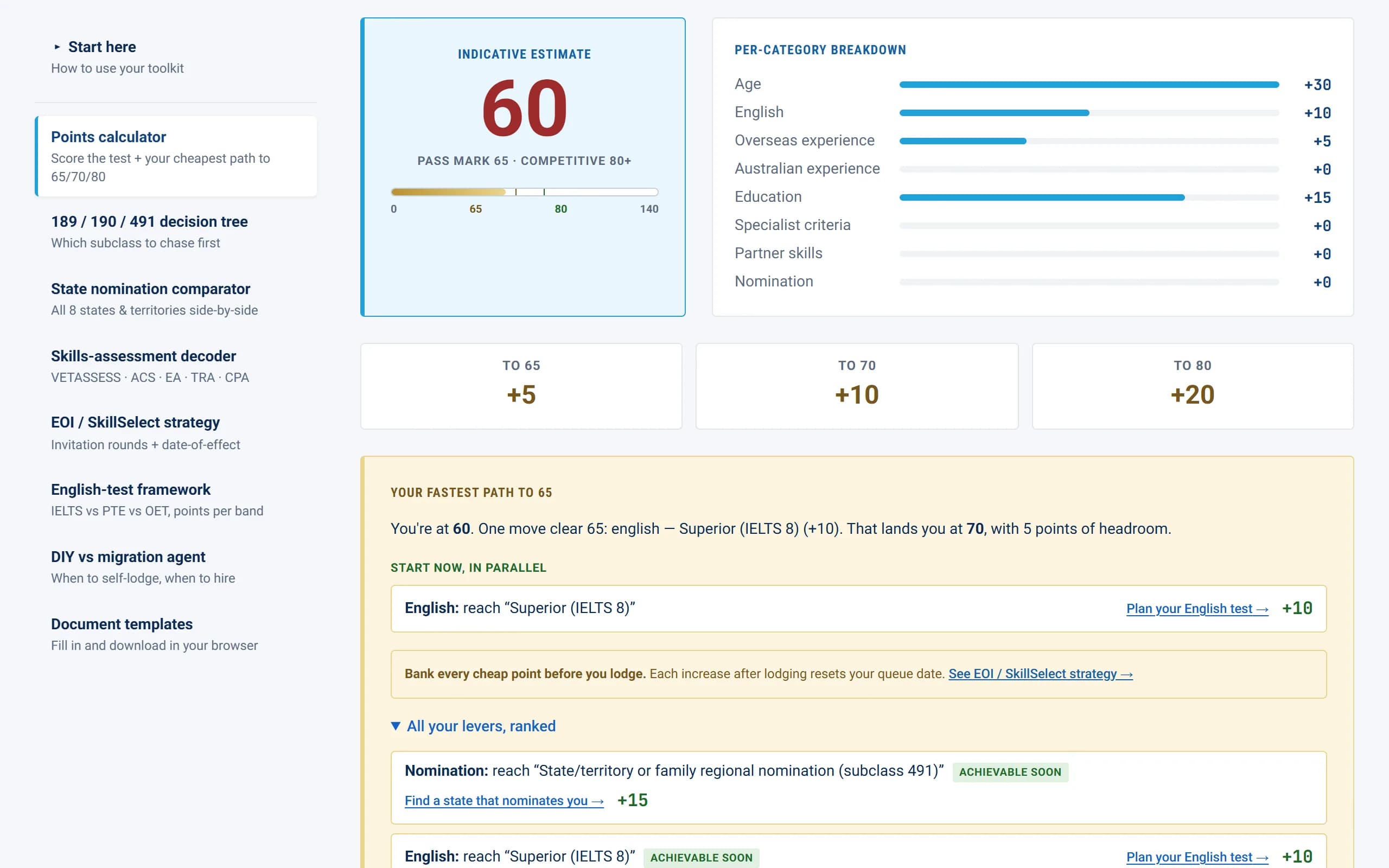
Scenario A — 36-year-old orthodontist, 8 years post-specialty experience, Superior English Age 25 + Doctorate 20 + English 20 + Overseas exp 15 = 80. Add 190 (+5) = 85. Strong invitation position even in competitive 190 rounds.
Scenario B — 40-year-old endodontist, 12 years experience, Proficient English Age 15 + Doctorate 20 + English 10 + Overseas exp 15 = 60. Add 491 (+15) = 75. Workable for regional invitation; senior applicants often shift to employer sponsorship for faster timelines.
State Nomination
New South Wales
NSW's 2025-26 priority list includes dental specialists, with explicit weighting toward services outside Sydney metropolitan. The NSW Health dental network and major private specialty groups in Newcastle, Wollongong and the Central Coast actively recruit.
Victoria
Victoria prioritises dental specialists where the role is consistent with AHPRA specialist registration. The Royal Dental Hospital of Melbourne, Royal Children's Hospital, and regional Victoria networks (Bendigo, Ballarat, Geelong, Latrobe) run persistent vacancies. The 2025-26 program closed mid-cycle — applicants should monitor for the 2026-27 program opening.
South Australia
South Australia opened all skilled occupations for 2025-26. Adelaide Dental Hospital, the SA Dental Service and regional services in Mount Gambier and Whyalla all sponsor specialists. SA is one of the more accessible state pathways for specialists with confirmed offers.
Queensland
QSOL prioritises specialists with confirmed Queensland employment. Brisbane's Royal Brisbane and Women's Hospital, the Queensland Children's Hospital and major private groups in the Gold Coast, Sunshine Coast and Cairns sponsor specialists. Regional Queensland (Townsville, Mackay, Toowoomba) has the deepest shortages.
Western Australia
WA's Graduate stream and Skilled Migration stream both list 252311. Perth metro is well supplied but regional WA (Kalgoorlie, Geraldton, Karratha) carries persistent vacancies, particularly in orthodontics.
Tasmania
Tasmania includes 252311 on its 491 list. Royal Hobart Hospital, Launceston General Hospital and the small private specialty cohort all sponsor. Tasmania is one of the most accessible 491 pathways for specialists willing to commit to two years of regional residency.
Salary and Employment Outlook
| Specialty | Typical Salary Range (AUD) |
|---|---|
| General dentist (for comparison) | $215,000-$235,000 |
| Orthodontist (employed) | $245,000-$300,000 |
| Orthodontist (private practice principal) | $300,000-$500,000+ |
| Oral and maxillofacial surgeon | $300,000-$490,000+ |
| Endodontist | $250,000-$400,000 |
| Periodontist | $250,000-$380,000 |
| Prosthodontist | $230,000-$350,000 |
| Paediatric dentist | $230,000-$320,000 |
| Public sector specialist (consultant) | $220,000-$280,000 |
Source: SEEK Salary Hub 2026, Glassdoor 2026, ERI SalaryExpert 2026. Base pay quoted; superannuation (11.5%), private practice profit share, on-call allowances (oral/maxillofacial) and procedure-based fee-for-service materially shift effective income. Specialists running private practices often clear the upper end of the range plus business equity.
Top employer types:
- Private specialty practices — independent and group-owned. The largest income ceilings sit here.
- Corporate dental groups — Bupa Dental, Smiles Inclusive, Pacific Smiles, 1300 Smiles — provide stable salaries with associate buy-in options
- Public hospital dental services — Royal Dental Hospital of Melbourne, Adelaide Dental Hospital, Sydney Dental Hospital, Royal Brisbane
- University academic appointments — University of Melbourne, University of Sydney, University of Queensland, University of Adelaide
- Hybrid roles — many specialists combine public hospital consultant work with private practice sessions
Tips for a Successful Application
-
Verify the specialty equivalence before paying any fees. Email the Dental Board of Australia and the ADC with your specialty program details. The Board maintains a non-public list of overseas specialty programs it has previously assessed as substantially equivalent. A pre-lodgement view can save 18 months of bridging activity.
-
Sequence the visa side around the registration timeline. ADC assessment plus AHPRA specialist registration typically takes 12-30 months. Lodge the visa pathway in parallel with the registration application — 482 employer sponsorship is the fastest route to commencement, with employer-supervised practice during bridging where required.
-
Target regional placements during bridging. Public hospital regional services often offer supervised practice positions that satisfy Board bridging requirements while paying full salary. These positions are far more available outside the major capitals.
-
Document continuing professional development (CPD) thoroughly. AHPRA requires evidence of CPD compliance throughout the registration period. Specialists with patchy CPD documentation face delays at the registration stage even if the ADC outcome was clean.
-
Don't apply as a specialist if you hold only general dental registration overseas. Specialty work in your home country without specialist registration there does not qualify you for 252311 — you must apply under 252312 Dentist instead. Misclassification at the start of the file is the single most expensive error a dental migrant can make.
Step-by-Step Migration Roadmap
- Confirm your specialty qualification is one of the 13 Board-approved Australian specialties
- Email the ADC and Dental Board for a preliminary equivalence view (free; 4-6 weeks)
- Sit your English test — aim for Superior (IELTS 8 / OET A)
- Lodge the ADC initial Specialist Assessment (AUD $647)
- Receive ADC outcome (8-16 weeks documentary; bridging timeline extends 6 months-2 years if required)
- Apply for general registration with the Dental Board through AHPRA
- Apply for specialist registration once general registration is granted
- Lodge the SkillSelect EOI for 190 or 491, or pursue 482 employer sponsorship
- Apply for state nomination (NSW, Victoria, SA, Queensland)
- Receive invitation and lodge visa within 60 days
- Complete health and character checks, receive visa grant
- Commence specialist clinical practice with AHPRA specialist registration
Frequently Asked Questions
Why isn't dental specialist on the MLTSSL?
The Department of Home Affairs maintains 252311 on the Short-Term Skilled Occupation List and the Core Skills Occupation List rather than the MLTSSL. The practical effect is that the 189 Skilled Independent visa is not available — applicants must pursue state nomination (190, 491) or employer sponsorship (482, 186). For specialists with confirmed Australian employment this is rarely a constraint; for offshore specialists without an employer, it changes the strategic sequence.
How long does the full pathway take?
For specialists whose overseas qualification is assessed as substantially equivalent, the full pathway runs 18-30 months from ADC lodgement to a permanent residency grant. For specialists requiring bridging activities, add 6 months to 2 years for supervised practice or supplementary examinations. The fastest route in practice is 482 employer sponsorship + 186 TRT after two years.
Which dental specialty has the strongest migration outlook in 2026?
Oral and maxillofacial surgery has the deepest shortage relative to workforce size. Orthodontics has the largest absolute job market but is more competitive in metro markets. Endodontics, periodontics and paediatric dentistry all carry strong regional demand. The right specialty for migration is the one you already hold — switching specialties for migration reasons is not realistic given the years of training each involves.
Can I work as a general dentist while my specialist registration is being processed?
Yes, provided you hold general registration with the Dental Board. Many overseas-trained specialists complete general registration first and work as general dentists while the specialist registration assessment runs in parallel. This is also a practical way to satisfy the Board's requirement for two years of general dental practice if your overseas training does not document it clearly.
Are UK and Irish dental specialty qualifications recognised in Australia?
Generally yes, particularly MOrth/MOrth RCS (orthodontics), specialty fellowships of the Royal College of Surgeons, and equivalent Irish specialty qualifications. The Dental Board has an established track record of granting substantial equivalence outcomes for these programs. Individual outcomes still depend on the specific program and your training documentation.
What are the most common reasons a dental specialist application fails?
Three reasons dominate. First, the overseas specialty qualification is not recognised as a Board-approved specialty in Australia — common with some Eastern European and South Asian MDS specialty pathways. Second, applicants apply under 252311 when their actual qualification supports only general dental registration (252312). Third, English requirements are underestimated — Specialist registration through AHPRA requires evidence of English competence at a high band, and many specialists trained in non-English jurisdictions undershoot the threshold and have to re-sit.