Australian Skilled Migration for Nepalese Citizens: 2026 Guide
Updated: 16 August 2026
Skilled migration is the main permanent residency route for Nepalese citizens in Australia, typically reached after a student 500 and Temporary Graduate 485. The points-tested visas are subclass 189, 190, and 491, with 494 available for employer-sponsored regional roles. Nepalese applicants concentrate in healthcare, hospitality, IT, and trades. Regional state nomination (491) is the most accessible route.
Quick Facts: Skilled Migration for Nepalese Citizens
| Detail | Information |
|---|---|
| Independent (no nomination) | Subclass 189 (most competitive) |
| State nominated | Subclass 190 (adds 5 points, permanent) |
| Regional (state or family) | Subclass 491 (adds 15 points, provisional) |
| Employer regional | Subclass 494 (sponsor required, provisional) |
| Skills assessment | Required, occupation-specific assessing authority |
| English | Competent (IELTS 6 each band) minimum; more points at proficient/superior |
| Points threshold | Technically 65; practically 75-95 depending on occupation |
| Onshore graduate route | 500 → 485 → 189/190/491 is the dominant Nepalese pattern |
| Health and character | Standard health exam plus Nepal PCC and AFP check |
The Five Pathways at a Glance
Subclass 189 (Skilled Independent). Permanent. No nomination or employer needed. The occupation must be on the relevant list. Highly competitive: most invited Nepalese applicants score in the 90s for occupations like software engineer or accountant.
Subclass 190 (Skilled Nominated). Permanent. A state or territory nominates you, which adds 5 points and locks you to that state for two years post-grant. Each state runs its own occupation list, work-experience criteria, and English thresholds.
Subclass 491 (Skilled Work Regional - Provisional). Provisional, valid 5 years. Either state-nominated or sponsored by an eligible family member living in regional Australia. Adds 15 points. After three years of regional work meeting earnings and residence requirements, you transition to permanent residency via the subclass 191. This is the highest-volume route for Nepalese applicants right now.
Subclass 494 (Skilled Employer Sponsored Regional - Provisional). Provisional, valid 5 years. An employer in regional Australia sponsors you in a nominated occupation. Pathway to PR via the 191 after three years.
Subclass 482 (Skills in Demand) → 186. Not points-tested. An employer sponsors you on a temporary work visa, and after two years you can transition to the permanent 186 via the temporary residence transition stream. This is the major non-points alternative for Nepalese applicants who have an employer willing to sponsor them.
For a side-by-side, the 189 vs 190 vs 491 comparison breaks the differences down line by line.
The Common Nepalese Pathway: 500 → 485 → 491/190
Most successful Nepalese skilled migration files start with a student visa. The pattern looks like this:
- Subclass 500. Complete an Australian qualification, ideally one aligned to an occupation on the Core Skills Occupation List (CSOL) or a state occupation list.
- Subclass 485. Stay on for two to four years of post-study work rights, longer if you've studied at a regional campus. Use this time to gain Australian work experience and improve your English.
- Skills assessment. Get a positive assessment from the relevant authority for your nominated occupation.
- Points test. Lodge an Expression of Interest in SkillSelect. Optimise for state nomination if your points alone won't reach an invitation round threshold.
- Invitation and lodgement. Once invited, lodge the 189, 190, or 491 application within 60 days.
Regional study and regional work experience are the levers that move the most points for Nepalese applicants. A graduate of a regional campus who works regionally on a 485 and then nominates regionally for a 491 stacks meaningful points from each stage.
Common Occupations and Their Assessing Authorities
| Occupation | Assessing Authority | English Notes |
|---|---|---|
| Registered nurse | ANMAC | IELTS Academic 7.0 each band, or OET B grade |
| Aged care registered nurse | ANMAC | As above |
| Cook / chef | TRA | Competent English minimum, higher for points |
| Software engineer / developer | ACS | Competent minimum, superior for max points |
| ICT business analyst | ACS | Competent minimum |
| Accountant (general) | CPA Australia, CA ANZ, or IPA | Proficient often needed for invitations |
| Motor mechanic | TRA | Competent minimum |
| Electrician | TRA | Competent minimum, plus state licensing |
| Early childhood teacher | AITSL | IELTS Academic 7.0 each band |
| Civil engineer | Engineers Australia | Competent minimum |
The skills assessment process is occupation-specific. Some assessing authorities require an Australian qualification, others assess overseas qualifications equivalence. Many require a work-experience component. The skills assessment guide walks through the choices.
The Points Test in Practice
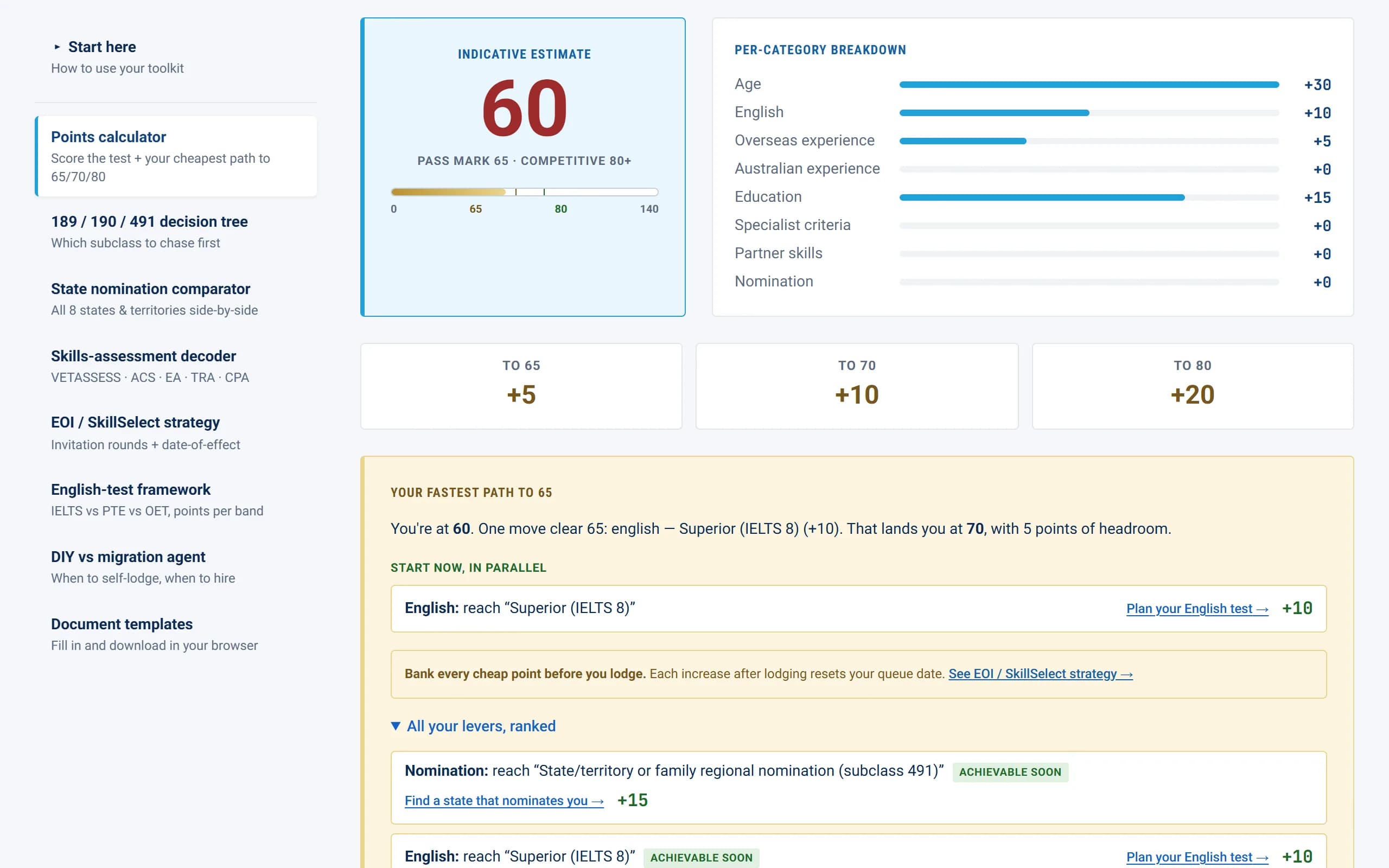
You need at least 65 points to lodge an Expression of Interest. In reality, you need closer to 75 to 95 to be invited, depending on your occupation and visa.
| Factor | Points Available |
|---|---|
| Age 25-32 | 30 |
| Age 33-39 | 25 |
| English: Competent (IELTS 6) | 0 |
| English: Proficient (IELTS 7) | 10 |
| English: Superior (IELTS 8) | 20 |
| Australian study (regional bonus possible) | 5-10 |
| Australian work experience (3+ years) | 10 |
| Overseas work experience (3-5 years) | 5-10 |
| State nomination (190) | 5 |
| Regional nomination or family sponsor (491) | 15 |
| Specialist STEM postgrad | 10 |
| Single applicant or partner skills | up to 10 |
For most Nepalese applicants, the realistic path to a competitive score is: maximise English (IELTS 8 each or PTE 79 each for superior), gain Australian work experience on a 485, study regionally where feasible, and use state or regional nomination.
The full breakdown of point factors lives in the subclass 189 pillar guide and the points calculator guide.
State Nomination Patterns for Nepalese Applicants
Each state and territory publishes its own occupation list, residence requirement, work-experience minimum, and ranking criteria. The states most commonly nominating Nepalese applicants tend to be those running regional incentives. Useful starting points:
- Tasmania state nomination
- South Australia state nomination
- Northern Territory state nomination
- ACT Canberra Matrix
- NSW state nomination
- Victoria state nomination
States change priorities each programme year. Don't apply blind. Check the current occupation list and ranking criteria for the state you're targeting before committing to a study or work location.
How to Apply Step by Step
- Confirm your nominated occupation is on the relevant skilled occupation list.
- Get a positive skills assessment from the relevant authority.
- Sit IELTS, PTE, OET, or another accepted English test. Aim higher than the minimum.
- Create an ImmiAccount and submit an Expression of Interest in SkillSelect.
- If targeting 190 or 491, also apply to the state or territory for nomination.
- Wait for an invitation to apply (ITA) through SkillSelect.
- Lodge the visa application within 60 days of the invitation.
- Upload supporting evidence: identity documents, education evidence, skills assessment, English results, employment references, partner evidence (if applicable).
- Attend biometrics at VFS Global Kathmandu, complete the Bupa panel medical including TB chest X-ray, and submit your Nepal Police Clearance Certificate plus AFP check.
- Wait for the grant decision by email.
The wider lodgement mechanics are covered in the step-by-step application guide.
Cost and Processing Times
Visa application charges in 2026:
- Subclass 189: AUD $6,135
- Subclass 190: AUD $6,140
- Subclass 491: AUD $6,140
- Subclass 494: confirm the current charge on the official fee schedule (sponsorship costs sit with the employer)
Skills assessment fees vary by authority. Add English test fees, the medical, police checks, biometric fees, and any migration agent costs.
Processing times sit at roughly 6 to 15 months for most points-tested skilled visas, with state-nominated and regional pathways often moving faster than the 189. Current published medians are in the processing times guide.
What Nepalese Applicants Need to Know
English score determines almost everything
The single largest controllable points factor is English. Moving from competent (0 points) to proficient (10 points) to superior (20 points) is usually the difference between waiting indefinitely for an invitation and being invited next round. Most Nepalese applicants who reach 189/190/491 invitations sat their English test more than once. Take it seriously, prep properly, and don't settle for a borderline result.
Australian work experience compounds
A 485 spent in cafe shifts isn't useless, but it's far less valuable than a 485 spent doing skilled work in your nominated occupation. Where possible, work in roles that count toward your skills assessment and toward Australian work experience points. Some assessing authorities allow concurrent work experience to count toward both the assessment and the points test.
Regional carries real benefits
Regional study, regional work, and regional nomination each add points and reduce competition. The subclass 491 with 15 nomination points is the most accessible PR-leading pathway for most Nepalese applicants. The trade-off is committing to three years of regional residence and earnings before the 191 transition. Most who follow this route describe it as the practical choice.
Skills assessment for healthcare and trades
Nurses must complete ANMAC bridging requirements if their Nepali qualification isn't directly equivalent, plus AHPRA registration. Trades assessments through TRA generally require Australian work experience or a Job Ready Program component. Plan for these steps to take 6 to 12 months on top of the visa itself.
Health and character
The standard subclass health exam applies including TB chest X-ray at a Bupa-approved clinic in Kathmandu. The Nepal Police Clearance Certificate is issued through the Nepal Police Headquarters and District Police Office, with verification through the Department of Foreign Affairs. If you've been in Australia for 12+ months since age 16, an AFP check is also required.
Common Pitfalls for Nepalese Applicants
Lodging the EOI before the skills assessment. Some applicants submit an EOI with a planned assessment date in mind, then under-claim or over-claim against an assessment they haven't received yet. Get the assessment first.
English score plateau. Sitting once at competent and assuming further attempts won't help. Most applicants who push from IELTS 6 to 7 each band describe targeted prep over four to eight weeks as the difference, not raw talent.
State nomination without checking criteria. Each state's occupation list and ranking criteria change year to year. Applying based on last year's rules is the single biggest reason nomination applications are declined.
Not claiming partner skills points. If your partner has a skills assessment, English, and an occupation on the list, you can claim up to 10 partner points. Many Nepalese couples leave these on the table.
Overlooking the 494. A regional employer sponsor with a 494 is often faster and more certain than points-tested invitation queues for some occupations, especially in regional healthcare and trades.
Frequently Asked Questions
What's the easiest skilled visa for Nepalese citizens?
For most Nepalese applicants, the subclass 491 with state or regional family nomination is the most accessible PR-leading pathway. The 15 nomination points usually bridge the gap between a competitive and uncompetitive score, and the 191 transition after three years of compliant regional residence is reliable for those who meet the income and residence tests.
Can I apply for skilled migration from Nepal without studying in Australia?
Yes. If your Nepali qualification and work experience meet the assessing authority's criteria, you can lodge an EOI from Nepal. In practice, an Australian qualification and Australian work experience contribute significant points, and most Nepalese applicants who succeed went through study first. Direct-from-Nepal lodgement works for senior professionals with strong overseas experience in shortage occupations.
How long does it take to get PR through skilled migration from Nepal?
The realistic timeline for the student-to-PR route is roughly 5 to 8 years from arrival in Australia. That includes the qualification, the 485 post-study work period, the skills assessment, the EOI wait, the invited visa processing, and (for 491 holders) the three-year transition to 191. Direct from Nepal is faster on paper but harder to qualify for.
Do I need a job offer for the 189 or 190?
No. The 189 and 190 don't require employer sponsorship. A skills assessment in a nominated occupation is enough. State nomination for the 190 requires evidence you'll work in your occupation in that state, but not a held job offer in most cases.
Can I include my family in the skilled visa?
Yes. Spouse and dependent children can be added at lodgement or as subsequent entrants. A spouse with skills, English, and an occupation on the list can also contribute partner skills points.
Does the 491 actually lead to PR?
Yes, through the subclass 191. After three years of holding the 491 and meeting the residence and minimum-income requirements in a designated regional area, you apply for the 191 permanent visa. The grant rate for compliant 491 holders is high.
Related Guides
- Australian Visa for Nepalese Citizens (country overview)
- Subclass 189 Skilled Independent Visa
- Subclass 494 Employer Sponsored Regional
- Skilled Independent Visa subclass 189 details
- Skilled Work Regional subclass 491 details
- Skills assessment complete guide
- English language requirements guide
- 189 vs 190 vs 491 comparison
- Visa processing times 2026