Skilled Independent Visa (Subclass 189): Points-Tested PR Without a Sponsor
The Subclass 189 is Australia's premier skilled migration visa — permanent residency without needing an employer or state sponsor. You need a minimum of 65 points on the points test, a positive skills assessment, competent English, and an occupation on the relevant skilled list. You submit an Expression of Interest through SkillSelect and wait for an invitation. Reality check: while 65 is the minimum, competitive occupations currently require 80–95+ points to receive an invitation.
Quick Facts
| Detail | Information |
|---|---|
| Visa subclass | 189 (Points-Tested stream) |
| Visa type | Permanent residence |
| Cost | $6,135 (main applicant) |
| Points minimum | 65 (effective minimum much higher) |
| Sponsor required | No |
| Location restriction | None — live anywhere in Australia |
| Processing time | 5–12 months after invitation |
| Occupation list | Medium and Long-term Strategic Skills List (MLTSSL) |
| Travel facility | 5 years |
| Work rights | Unrestricted |
How the 189 Works: The SkillSelect Process
The Subclass 189 uses an invitation-based system through SkillSelect. You can't simply apply — you must be invited.
Step 1: Skills assessment. Get your occupation assessed by the relevant skills assessing authority. This confirms your qualifications and experience match an occupation on the MLTSSL.
Step 2: Take an English test. You need at least competent English (IELTS 6.0 each band), but aiming higher is strategically important — superior English (IELTS 8.0+) gives you 20 points.
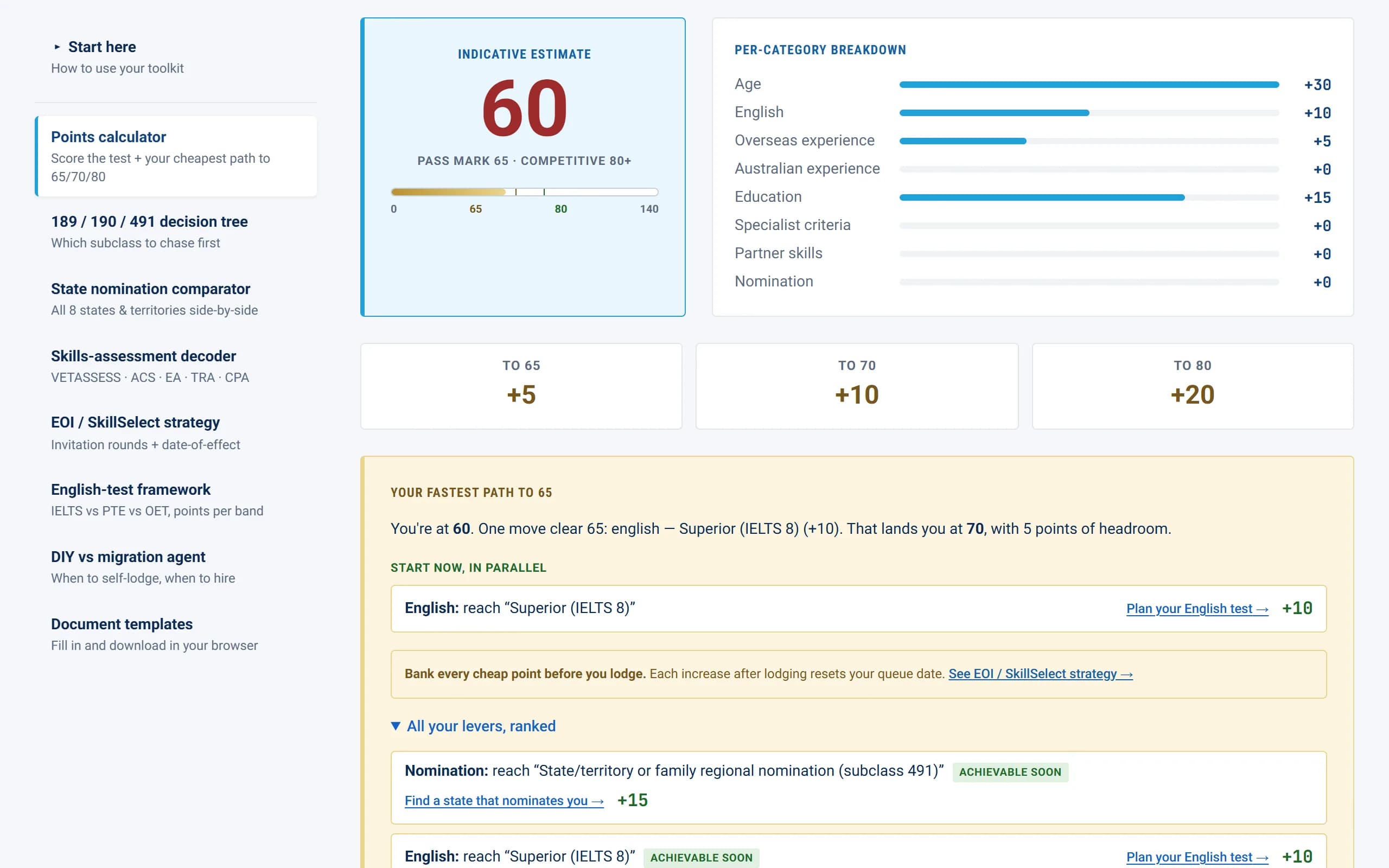
Step 3: Calculate your points. Use the points calculator to determine your score. You need at least 65, but realistically 80+.
Step 4: Lodge an Expression of Interest (EOI). Submit your EOI through SkillSelect with your claimed points, nominated occupation, and personal details. The EOI is free.
Step 5: Wait for an invitation. The Department of Home Affairs runs regular invitation rounds (typically monthly). EOIs are ranked by points score, then by date of effect (how long you've been in the queue). Highest points get invited first.
Step 6: Apply within 60 days. Once invited, you have 60 days to lodge your visa application through ImmiAccount with full supporting documents.
Step 7: Decision. Processing takes 5–12 months after you lodge. You may be asked for additional documents or to attend an interview (rare).
The Points Test
Every factor in the points test is designed to identify migrants who'll contribute economically. Here's the full breakdown.
Age
| Age at Invitation | Points |
|---|---|
| 18–24 | 25 |
| 25–32 | 30 |
| 33–39 | 25 |
| 40–44 | 15 |
| 45+ | 0 (ineligible) |
The sweet spot is 25–32. If you're 33+, you lose 5 points compared to the peak — and every point matters.
English Language
| Level | IELTS Score | Points |
|---|---|---|
| Competent | 6.0 each band | 0 |
| Proficient | 7.0 each band | 10 |
| Superior | 8.0 each band | 20 |
This is one of the highest-impact factors. The jump from Competent (0 points) to Superior (20 points) is massive. Investing time and money in English preparation can be the difference between receiving an invitation and waiting indefinitely.
Skilled Employment
| Experience | Points (Australian) | Points (Overseas) |
|---|---|---|
| Less than 1 year | 0 | 0 |
| 1–2 years | 5 | 5 |
| 3–4 years | 10 | 10 |
| 5–7 years | 15 | 15 |
| 8+ years | 20 | 15 |
Australian work experience is worth more at the top end. Employment must be in your nominated occupation and post-qualification.
Qualifications
| Qualification | Points |
|---|---|
| PhD | 20 |
| Bachelor's degree or higher | 15 |
| Diploma or trade qualification | 10 |
| Recognised qualification/award | 10 |
Other Factors
| Factor | Points |
|---|---|
| Australian study requirement (2 years) | 5 |
| Specialist education (STEM PhD or master's by research) | 10 |
| Professional Year completion | 5 |
| Credentialed community language (NAATI) | 5 |
| Study in regional Australia | 5 |
| Partner with skills assessment + competent English | 10 |
| Partner with competent English (no skills assessment) | 5 |
| Single applicant (no partner) | 10 |
| State/territory nomination (190, not applicable for 189) | 5 |
| Regional nomination (491, not applicable for 189) | 15 |
For a detailed walkthrough of every factor, see our points calculator guide.
Current Invitation Trends
The 189 invitation landscape has shifted significantly in recent years. Here's what to expect.
High-demand occupations (receiving invitations at lower points):
- Registered Nurses
- Software Engineers
- Civil Engineers
- Secondary School Teachers
- Accountants (though competitive)
- ICT professionals (selected roles)
Points thresholds (approximate, as of 2025–2026):
| Occupation Group | Typical Minimum Points for Invitation |
|---|---|
| Engineering | 80–85 |
| ICT | 85–90 |
| Accounting | 90–95 |
| Healthcare (nursing, medical) | 70–80 |
| Teaching | 75–80 |
| Trades | 75–85 |
These thresholds fluctuate with each invitation round. The Department publishes round results showing the minimum points score and date of effect for each occupation. Monitor SkillSelect rounds closely.
Pro-rated occupations: Some occupations have annual caps. When an occupation is pro-rated, only a fixed number of invitations are issued per round. Accounting, auditing, and some ICT occupations are typically pro-rated.
Occupation Lists
Your occupation must appear on the Medium and Long-term Strategic Skills List (MLTSSL) for the Subclass 189. This list includes occupations identified as having long-term strategic importance to Australia's economy.
Popular MLTSSL occupations include:
| ANZSCO Code | Occupation |
|---|---|
| 233211 | Civil Engineer |
| 233311 | Electrical Engineer |
| 261312 | Developer Programmer |
| 261313 | Software Engineer |
| 263111 | Computer Network and Systems Engineer |
| 254499 | Registered Nurse |
| 241411 | Secondary School Teacher |
| 221111 | Accountant (General) |
| 233111 | Chemical Engineer |
| 272511 | Social Worker |
The full list contains hundreds of occupations across trades, professions, and specialist roles. Check the current list on the Department of Home Affairs website before starting your skills assessment.
What You Get with a 189 Visa
The Subclass 189 is one of Australia's most valuable visas. Here's what it grants.
- Permanent residence from the day of grant
- Unrestricted work rights — any employer, any occupation, anywhere
- No location restrictions — live in Sydney, Melbourne, Perth, or regional areas
- Medicare — access to public healthcare
- 5-year travel facility — enter and leave Australia freely
- Family inclusion — partner and dependent children get PR too
- Pathway to citizenship — eligible after 1 year as PR (4 years total residence)
- Sponsor family — can sponsor parents and other relatives for visas
- Social security — eligible for most government payments after waiting periods
189 vs. 190 vs. 491: Which Skilled Visa?
Can't get enough points for the 189? You have two alternatives.
| Feature | 189 | 190 | 491 |
|---|---|---|---|
| Visa type | Permanent | Permanent | Provisional (5 years) |
| Bonus points | 0 | +5 (state nomination) | +15 (regional nomination) |
| Location obligation | None | Live in nominating state | Live in regional area |
| Effective minimum points | 80–95 | 75–85 | 65–75 |
| PR pathway | Immediate | Immediate | 491 → 191 after 3 years |
For a detailed comparison, see our 189 vs 190 vs 491 guide.
Frequently Asked Questions
How long does the SkillSelect queue take?
It depends entirely on your points score and occupation. With 90+ points in a non-pro-rated occupation, you might receive an invitation within weeks. With 80 points in a competitive occupation like accounting, you could wait 12–18 months. With 65 points, you may never receive an invitation for popular occupations.
Can I update my EOI after lodging?
Yes. You can update your EOI at any time to reflect new circumstances — a higher English score, additional work experience, or a change in personal circumstances. Updating your EOI changes your "date of effect," which may push you back in the queue if others have the same points score.
What if I'm not invited within 2 years?
EOIs expire after 2 years. If you're not invited within that period, you can lodge a new EOI. There's no penalty for expired EOIs, and no limit on how many times you can submit new ones.
Can I apply for the 189 from outside Australia?
Yes. The 189 can be applied for from anywhere in the world. You can also be in Australia (on another valid visa) when you apply. Many applicants are in Australia on 485, 482, or other visas when they receive their invitation.
Is the 189 better than employer sponsorship?
It depends on your situation. The 189 offers freedom (no employer ties, no location restrictions) but requires high points. Employer sponsorship (482→186) doesn't need points but ties you to one employer for 2+ years. If you can score 85+ points and your occupation is in demand, the 189 is usually the faster, more flexible path. If your points are lower, employer sponsorship may be more reliable.