Educational Psychologist Visa Pathway to Australia: Complete 2026 Guide
Updated: 16 August 2026
Australia classifies the role under ANZSCO 272312 Educational Psychologist. The Australian Psychological Society (APS) is the sole assessing body for skilled migration and AHPRA registration is mandatory before practice. The occupation sits on both the Core Skills Occupation List and the MLTSSL, unlocking subclasses 189, 190, 491, 482, and 186. Typical 2026 salaries range AUD $97,000-$130,000.
Quick Facts: Educational Psychologist Migration Pathway
| Detail | Information |
|---|---|
| ANZSCO Code | 272312 (Educational Psychologist) |
| Skill Level | 1 (Bachelor degree or higher plus AHPRA registration) |
| Skills Assessment | APS (Australian Psychological Society) |
| Occupation List | CSOL and MLTSSL — full visa access |
| Visa Options | 189, 190, 491, 482, 186 |
| Demand Level | High — listed on the Core Skills Occupation List, with sustained school-sector shortages in regional Australia |
| Salary Range | AUD $97,000-$130,000 (SEEK, May 2026; Education & Training sector average $97,222) |
| Typical 189 Score | 80-90 points in 2026 invitation rounds |
| Key Challenge | Dual-track process — APS skills assessment and AHPRA general registration must both succeed before a job offer translates into a visa |
What Educational Psychologists Do in Australia
Educational psychologists work with children, adolescents, families, and school staff to address learning, behavioural, social, and emotional challenges. The day-to-day mix typically combines cognitive and educational assessments (WISC-V, WIAT-III, achievement and adaptive functioning batteries), classroom observations, individual therapy with students, consultation with teachers, and intervention planning under formal frameworks such as Nationally Consistent Collection of Data on School Students with Disability.
In practice the work is split across four employer types. State education departments operate the largest school-psychology services — NSW Department of Education, the Victorian Department of Education, and Queensland's Education Queensland each employ hundreds of school psychologists. Catholic and independent school systems run parallel teams. NDIS-registered private practices have expanded sharply since 2020, since registered psychologists can write detailed functional capacity reports that unlock NDIS plans for school-aged participants. The fourth setting is regional and remote area health services, where shortages are most acute.
Demand follows the rural/metro split closely. Major capital cities have adequate supply at the entry level but persistent gaps in senior school-psychologist roles. Regional New South Wales, Victoria, Queensland, and the Northern Territory advertise educational psychologist roles year-round without filling them. Jobs and Skills Australia categorises psychology occupations among current skills shortages, and educational psychology specifically appears on the Core Skills Occupation List for that reason.
The ANZSCO 272312 Code
ANZSCO 272312 Educational Psychologist covers professionals who investigate and treat the social, emotional, and learning difficulties of students. The ABS description emphasises assessment, intervention, and consultation within educational settings — kindergarten through tertiary. It sits inside Unit Group 2723 Psychologists, alongside 272311 Clinical Psychologist, 272313 Organisational Psychologist, and 272399 Psychologists nec.
The choice between 272312 and 272311 Clinical Psychologist matters. If you hold an AHPRA endorsement in Educational and Developmental Psychology, or your overseas qualifications and supervised practice align primarily with school-aged developmental work, 272312 is the correct code. If your training is generalist clinical and your work focuses on adult mental health, 272311 fits better. The wrong code creates assessment refusals at the APS stage — the body checks whether your competencies match the nominated specialisation, not just generic psychology.
Skills Assessment — Australian Psychological Society
The Australian Psychological Society is Australia's sole approved assessing authority for overseas-trained psychologists under all four ANZSCO codes in Unit Group 2723.
What APS Assesses
APS evaluates qualifications, supervised practice, and registration history against the Australian Psychology Accreditation Council 2019 standards. The benchmark is a six-year sequence of psychology study in Australia — typically a four-year undergraduate sequence plus a Master's-level postgraduate qualification with supervised practice. Pure-research PhDs without supervised clinical training rarely satisfy the full benchmark on their own.
For Educational Psychologist (272312) the assessment specifically checks competencies in child and adolescent psychology, educational assessment, intervention planning, and consultation with schools and families.
Common Pathways That Succeed
- Qualifications accredited by the British Psychological Society at Chartered level
- Qualifications listed on the American Psychological Association's accredited programs list
- New Zealand qualifications meeting the New Zealand Psychologists Board pathway
- Canadian qualifications from CPA-accredited programs with documented school psychology specialisation
Assessment Cost and Processing Time
The APS does not publish a single flat fee — the cost depends on assessment type and whether the applicant submits from inside or outside Australia. Applicants should budget AUD $1,000-$1,500 for the migration assessment and confirm the current schedule on the APS application portal before lodging. Approximate processing time is eight weeks from a complete submission.
Common Rejection Reasons
The two highest-volume rejections are insufficient supervised practice hours documented at postgraduate level, and a mismatch between the nominated specialisation and the applicant's actual training. Applicants who completed a clinical Master's but nominate Educational Psychologist (272312) without school-based supervised practice frequently fail. The fix is either changing the nominated code or completing additional supervised practice before lodging.
AHPRA Registration — Mandatory Before Practice
A successful APS skills assessment lets you migrate. AHPRA registration through the Psychology Board of Australia lets you practice. The two processes are independent and run on different timelines.
Overseas-qualified psychologists apply for provisional registration first. The Psychology Board assesses substantial equivalence under General Registration Standard requirements. Most overseas applicants are then required to complete a period of supervised practice in Australia and pass the National Psychology Exam before progressing to general registration.
Qualifications accredited by BPS (UK) or APA (US) at the listed levels are streamlined to general registration in some cases — check the Psychology Board's overseas applicant guidance for the current rules.
The practical sequencing matters: many applicants lodge AHPRA paperwork in parallel with the APS skills assessment to compress the timeline. State education departments will not interview without at least conditional AHPRA registration in progress.
Visa Pathways
Subclass 189 — Skilled Independent
Permanent residency through SkillSelect. No employer or state sponsor required.
- Visa fee: AUD $6,135 (primary applicant)
- Minimum points: 65 — realistic invitation threshold for 272312 was 80-90 points in early 2026 rounds
- Processing time: 6-12 months after invitation, with priority skilled visas accelerated following the March 2026 processing overhaul
- Quirk: Healthcare-aligned occupations including psychology have been receiving favourable points cut-offs in priority rounds since late 2025
Subclass 190 — State Nominated
Permanent residency with a five-point state nomination boost and a two-year obligation to live and work in the nominating state.
- Visa fee: AUD $6,140 (primary applicant)
- Best states for 272312: New South Wales, Victoria, and South Australia all include Psychologists 2723 on their 2025-26 skills lists. Verify the specific 272312 sub-code with the state before applying — unit-group-level listings do not guarantee every sub-code is eligible
- Processing time: 6-12 months after state nomination
Subclass 491 — Skilled Work Regional (Provisional)
A five-year provisional visa with a permanent residency pathway via subclass 191. Regional nomination adds 15 points.
- Visa fee: AUD $6,140 (primary applicant)
- Quirk: Educational psychology demand is heaviest in regional NSW, Victoria, Queensland, and Tasmania — the 491 fits the geographical reality of the role
- Pathway to PR: Three years of working and living in regional Australia, including 12 months earning above the income threshold
Subclass 482 — Skills in Demand
Employer-sponsored temporary work visa. Common for school systems and large NDIS providers willing to sponsor.
- Visa fee: AUD $4,015 (primary applicant) — same for all streams
- Core Skills Stream salary threshold: AUD $79,423 (current, from 1 July 2026; previously $76,515)
- Duration: Up to four years
- Quirk: State education departments rarely sponsor 482 directly. Independent schools and NDIS practices are the realistic sponsorship sources
Subclass 186 — Employer Nomination Scheme
Permanent residency through employer sponsorship.
- Visa fee: AUD $6,140 (primary applicant)
- Streams: Direct Entry or Temporary Residence Transition (after 482)
Points Test Strategy
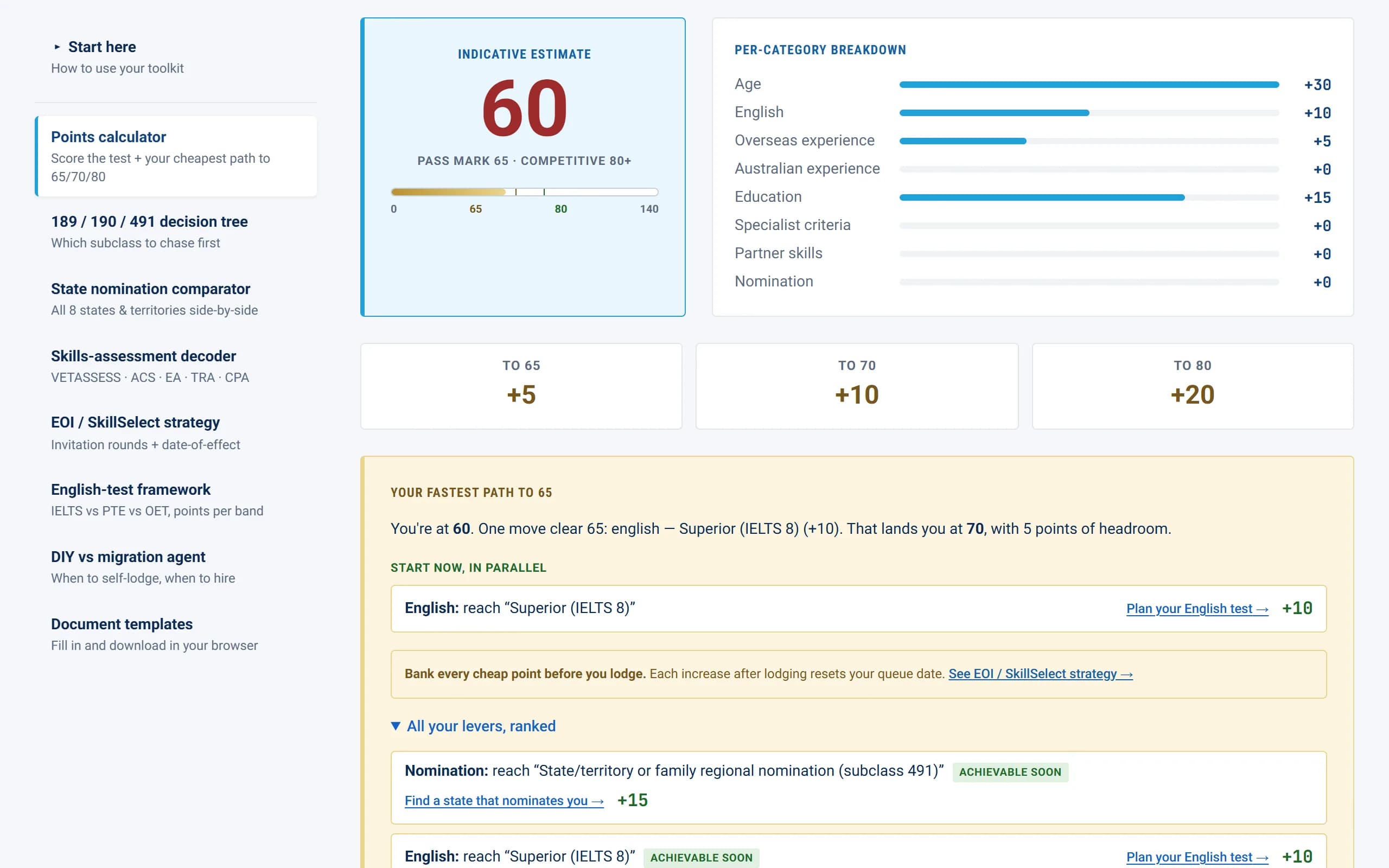
| Points Factor | Points | Notes for Educational Psychologists |
|---|---|---|
| Age 25-32 | 30 | Maximum bracket |
| Age 33-39 | 25 | Most overseas-trained psychologists fall here after Master's plus practice |
| English Superior (8.0+) | 20 | Achievable for applicants from UK/IE/SA/NZ/CA |
| English Proficient (7.0) | 10 | Default IELTS target |
| Master's degree | 15 | Standard for the profession |
| PhD | 20 | DPsych/PhD holders score the maximum |
| Overseas experience 8+ years | 15 | After any APS-equivalent deductions |
| Australian study | 5 | Postgraduate top-up in Australia is common |
| State nomination (190) | 5 | NSW/VIC most relevant |
| Regional nomination (491) | 15 | Strong fit for the role |
| Partner skills | 10 | If partner holds an MLTSSL/CSOL occupation |
| Community language (NAATI CCL) | 5 | Worth pursuing for South Asian and East Asian applicants |
Scenario 1 — UK-trained Educational Psychologist, age 31, BPS Chartered
Age 30 + Master's 15 + Superior English 20 + 8 years experience 15 = 80 points. State nomination takes the score to 85, comfortable in current invitation rounds.
Scenario 2 — Indian-trained applicant, age 34, AHPRA conditional registration
Age 25 + Master's 15 + Proficient English 10 + 5 years experience 10 = 60 points. Regional 491 (+15) plus partner skills (+5) reaches 80 points and an invitation pathway, while NDIS or independent-school 482 sponsorship runs in parallel.
State Nomination for Educational Psychologists
New South Wales
NSW lists Psychologists 2723 on both its 190 and 491 skills lists for 2025-26. The 2025-26 NSW Skilled Migration Program allocates 3,600 places overall, with monthly invitation rounds running through to mid-2026. Sydney has the largest concentration of NDIS-registered school psychology practices, while regional NSW carries the heaviest department-of-education shortages.
Victoria
Victoria's 2025-26 program runs through a Registration of Interest system. Onshore applicants with skilled employment in Victoria carry the strongest selection signal. The state closed 2025-26 ROIs early on 28 April 2026 after demand outstripped places, so applicants should watch for the July 2026 program reopening.
South Australia
South Australia operates a Designated Area Migration Agreement and lists psychology occupations under its skilled list. Regional South Australia, including the Limestone Coast and Riverland, frequently advertises school psychology roles.
Western Australia
WA includes psychology occupations in WASMOL for 2026 across the General Stream. The state's program offers 5,000 places (3,000 for 190, 2,000 for 491) and engineering- and health-focused selection criteria.
Tasmania and Northern Territory
Both smaller-jurisdiction programs prioritise education and health occupations. Tasmanian school districts have advertised educational psychology vacancies in regional schools for two consecutive years.
Salary and Employment Outlook
What You Can Expect to Earn
| Role | Typical Annual Salary (SEEK, May 2026) |
|---|---|
| Early-career School Psychologist (1-3 years) | AUD $85,000-$100,000 |
| Educational Psychologist (general) | AUD $97,000-$120,000 |
| Senior School Psychologist | AUD $115,000-$135,000 |
| Lead/Principal Educational Psychologist | AUD $130,000-$155,000 |
| NDIS Private Practice (per session billing) | AUD $130,000-$180,000 (capacity-dependent) |
Public-sector packages typically include 11.5% superannuation, professional development allowances, and salary packaging for not-for-profit hospital and community-health employers. NDIS private-practice income depends on session volume and the proportion of plan-managed versus self-managed clients.
Highest-paying Settings
- Independent schools — long-established Sydney and Melbourne independents pay above public scale for senior roles
- NDIS specialist providers — functional capacity assessment work generates the highest per-hour income
- Regional and remote schools — state-department incentive payments and rural retention bonuses add 10-20%
- Defence and veterans' services — specialist youth and family practice within Defence Health pays at the top of the public scale
Tips for a Successful Application
1. Sequence APS and AHPRA in parallel
The APS skills assessment is required for the visa. AHPRA registration is required to practice. The two processes do not depend on each other and run on different timelines. Lodge both as early as possible — applicants who wait for the APS outcome before approaching AHPRA add 4-6 months to the total.
2. Document supervised practice in hours, not months
The APS assesses supervised hours at postgraduate level. Vague references that describe "two years of supervised work" without breaking down direct-client hours, supervision hours, and assessment hours are a leading rejection cause. Ask former supervisors for letters that mirror the APAC 2019 competency structure.
3. Match the nominated code to your actual specialisation
If you hold a clinical Master's and your work is adult mental health, do not nominate 272312 Educational Psychologist for points-list reasons. The APS checks specialisation evidence carefully. The right code is the code that matches your training and practice.
4. Target regional 491 if your points are tight
Educational psychology shortages are heaviest in regional and remote settings. The 491 adds 15 points, takes you to where the work is, and provides a clean PR pathway via subclass 191 after three years.
5. Prepare for AHPRA's National Psychology Exam
Most overseas-qualified applicants must sit the National Psychology Exam to move from provisional to general registration. The exam covers ethics, assessment, intervention, and practice. Allow 2-3 months of preparation alongside supervised practice.
Step-by-Step Migration Roadmap
- Confirm 272312 fits your training and practice — read the ANZSCO code finder and Unit Group 2723 descriptions in full
- Verify list status on the 2026 Skilled Occupation List and the Core Skills Occupation List
- Sit IELTS Academic, PTE, or OET — target Superior (8.0+) for maximum points
- Prepare APS application documents — qualifications, transcripts, supervised practice records, registration history
- Lodge AHPRA provisional registration application in parallel
- Submit APS skills assessment via the APS portal — budget eight weeks
- Calculate points and submit EOI in SkillSelect for 189, 190, or 491
- Apply for state nomination if pursuing 190 or 491 — NSW, VIC, and SA are the leading options
- Or pursue employer sponsorship via independent schools or NDIS providers — 482 then 186
- Receive invitation, lodge visa within 60 days
- Complete National Psychology Exam and supervised practice for AHPRA general registration
- Arrive in Australia, complete provisional-to-general AHPRA transition, commence practice
Frequently Asked Questions
Can I use a US PsyD to migrate as an Educational Psychologist?
In most cases yes, if the program is listed on the APA accredited programs list and includes supervised school-based practice. The APS treats APA-accredited qualifications as substantially equivalent to a Board-approved postgraduate qualification at the fifth-and-sixth-year level. Confirm your specific program is on the APA list and document school-psychology placement hours separately.
How is Educational Psychologist different from Clinical Psychologist for migration?
Both occupations sit on the CSOL and MLTSSL with identical visa access. The difference is the APS specialisation check — 272312 requires demonstrated competence in child, adolescent, and school-based assessment and intervention. 272311 Clinical Psychologist requires generalist clinical training across the lifespan. Use the code that matches your actual training, not the code with the better-perceived demand.
Will I have to repeat my Master's in Australia?
Not typically, if your qualification is from a BPS-accredited (UK), APA-accredited (US), CPA-accredited (Canada), or NZPsB-recognised (NZ) program at the right level. Applicants from countries without recognised accreditation may be directed to complete additional Australian postgraduate study or an extended period of supervised practice. The APS assessment outcome specifies what is required.
Are state education departments sponsoring 482 visas in 2026?
Rarely. State education departments generally hire candidates who already hold AHPRA general registration and the right to work in Australia. Independent schools, Catholic diocesan systems, and large NDIS providers are the realistic sources of 482 sponsorship for newly arrived educational psychologists. Once on a 482, transitioning to permanent residency through 186 or applying for state nomination becomes straightforward.
What's the demand outlook for educational psychology in Australia in 2026?
Demand is high and rising. The Core Skills Occupation List status reflects sustained shortages, the NDIS continues to expand funded psychology hours for school-aged participants, and state education departments are funded to recruit. Jobs and Skills Australia categorises psychology occupations among current shortage occupations. Regional shortages are the most acute and are expected to persist through 2027.
Can my partner work while I complete supervised practice?
Yes. Subclass 189, 190, and 491 visas grant full work rights to the primary applicant and partner from grant. Subclass 482 partner visas also include work rights. Many applicants use the supervised-practice period to support partner job-search and to settle children into Australian schools.