Psychotherapist Visa Pathway to Australia: Complete 2026 Guide
Updated: 16 August 2026
Australia classifies psychotherapists under ANZSCO 272314 at Skill Level 1. VETASSESS conducts the skills assessment. The occupation sits on the Core Skills Occupation List (CSOL) and the Short-Term Skilled Occupation List (STSOL), unlocking subclasses 190, 491, 482 and 186. Typical 2026 salaries range AUD $75,000-$120,000, with mental health demand driving strong private-practice growth.
Quick Facts: Psychotherapist Migration Pathway
| Detail | Information |
|---|---|
| ANZSCO Code | 272314 (Psychotherapist) |
| Skill Level | 1 (Bachelor degree or higher) |
| Skills Assessment | VETASSESS (Vocational Education and Training Assessment Services) |
| Occupation List | CSOL and STSOL — no 189 access |
| Visa Options | 190, 491, 482, 186 |
| Demand Level | High — sustained mental health workforce gap |
| Salary Range | AUD $75,000-$120,000 (SEEK 2026) |
| Typical 189 Score | N/A — not on MLTSSL |
| Key Challenge | No 189 pathway; reliance on state nomination or employer sponsorship |
Role Context in Australia
Psychotherapists in Australia work mainly in private practice, community mental health services, hospital outpatient programs, and not-for-profit organisations that handle trauma, addiction and family therapy. The role is distinct from psychology and counselling: psychotherapists apply long-form modalities such as psychodynamic therapy, cognitive analytic therapy, Gestalt and existential frameworks, often with clients who have complex or chronic presentations.
Demand is concentrated in capital cities and regional centres with established mental health networks. Sydney, Melbourne and Brisbane absorb the largest share of private-practice positions, while regional Victoria and northern New South Wales have grown community-funded roles since the post-pandemic mental health funding uplift. The National Mental Health Workforce Strategy continues to flag therapy workforce shortages, especially for practitioners trained in evidence-based trauma modalities.
Unlike psychologists, psychotherapists are not nationally registered through AHPRA. Most practitioners hold voluntary registration with PACFA (Psychotherapy and Counselling Federation of Australia) or ACA (Australian Counselling Association). Medicare rebates flow to registered psychologists rather than psychotherapists, which shapes where and how the role operates commercially.
ANZSCO 272314: What the Code Covers
ANZSCO 272314 covers practitioners who diagnose and treat mental, emotional and behavioural disorders using psychotherapeutic methods. Tasks include interviewing clients, formulating treatment plans, conducting individual and group therapy sessions, evaluating progress, and referring clients to other specialists where appropriate.
Common day-to-day duties matching this code:
- Conducting structured psychotherapy sessions using a defined modality
- Applying behavioural therapy, biofeedback, hypnotherapy or relaxation therapy
- Maintaining detailed clinical notes and treatment formulations
- Liaising with GPs, psychiatrists and allied health practitioners on shared care
- Supervising junior therapists or counsellors in larger practices
If your work is primarily generalist counselling rather than structured therapy, ANZSCO 272115 Counsellor may be a closer match. If you hold a doctoral psychology qualification with AHPRA registration, code 272311-272314 variants for psychologists give wider list access. Read the ANZSCO descriptions side-by-side before nominating — see the ANZSCO code finder for the full unit group taxonomy.
Skills Assessment with VETASSESS
VETASSESS classifies psychotherapist as a Group A professional occupation. The minimum bar is an AQF Bachelor degree or higher in a highly relevant field, plus at least one year of post-qualification highly relevant employment in the past five years.
Requirements:
- Qualification at Australian Bachelor level or higher, assessed as highly relevant to psychotherapy practice
- One year minimum of full-time equivalent post-qualification work at Skill Level 1
- Employment evidence including reference letters, tax records and payslips
- English at Competent level minimum (IELTS 6.0 each band) for the assessment itself; higher for visa stage
Highly relevant fields include: psychotherapy, counselling psychology, clinical psychology, and applied psychotherapy programs. Generalist psychology degrees without therapy specialisation are often assessed at points-test eligibility only rather than full positive assessment.
Assessment cost: AUD $1,076 (standard full skills assessment, effective from 22 October 2025) Processing time: 8-10 weeks from full lodgement Common rejection reasons: Qualifications classified as counselling-only without therapy depth; employment references that describe psychology or social work duties rather than therapy delivery; gaps in the five-year experience window.
Apply through the VETASSESS portal. VETASSESS pre-application advice is available for ambiguous cases and is worth the modest fee if your qualification or job title is non-standard.
Visa Pathways for Psychotherapists
Psychotherapists do not have access to subclass 189 because the occupation is not on the MLTSSL. The pathways below are ordered by realistic likelihood.
Subclass 190 — Skilled Nominated Visa
State-nominated permanent residency. A state government sponsors the application, adding 5 points and unlocking the 190 stream.
- Visa fee: AUD $6,140 (primary applicant)
- Points threshold: Practical floor of 65 with nomination; competitive applicants score 75-85
- Processing time: 6-12 months for most applicants in 2026
- Quirk: Most states require a current or recent practice base in the state. Sydney-based therapists rarely succeed in QLD or SA nominations without a clear move plan.
Subclass 491 — Skilled Work Regional (Provisional)
A five-year provisional visa requiring residence and work in a designated regional area. Adds 15 points to the score and converts to permanent residence via subclass 191 after meeting the income and residence thresholds.
- Visa fee: AUD $6,140
- Points threshold: 65 minimum; +15 from regional nomination
- Processing time: Variable; 50% of cases finalised within 6-20 months in 2026
- Quirk: Regional mental health services often offer relocation incentives and faster nomination decisions for therapists willing to work outside Greater Sydney, Melbourne or Brisbane.
Subclass 482 — Skills in Demand (Core Skills Stream)
Employer-sponsored temporary visa, valid up to four years. Psychotherapist sits on the Core Skills Occupation List which underpins the Core Skills stream.
- Visa fee: AUD $3,210 (primary applicant, Core Skills stream)
- Salary threshold: Core Skills Income Threshold (currently AUD $76,515)
- Processing time: Median 51 days for Core Skills stream in 2026
- Quirk: Larger private clinics and not-for-profit mental health providers sponsor more reliably than solo practices. Look at headspace, Beyond Blue partner networks and major hospital outpatient programs.
Subclass 186 — Employer Nomination Scheme
Permanent residence through employer sponsorship. Available via Direct Entry (3 years post-qualification experience plus positive VETASSESS) or Transition (after 2+ years on a 482 with the same employer).
- Visa fee: AUD $6,140
- Processing time: Median 4-9 months under the Direct Entry stream
- Quirk: Direct Entry requires positive skills assessment plus competent English; Transition stream waives the formal assessment if held on the 482.
State Nomination for Psychotherapists
Because the occupation sits on CSOL and STSOL only, state nomination drives most permanent residence outcomes. The list below reflects 2025-2026 program-year activity. Confirm current eligibility against each state's published list before lodging an Expression of Interest in SkillSelect.
New South Wales
NSW prioritises occupations in the Care Economy umbrella, which includes mental health and allied health. Sydney has the largest private-practice market in the country, and NSW Health's Mental Health Branch funds community psychotherapy positions across local health districts. Applicants with current NSW employment or a confirmed job offer at a recognised provider see the strongest invitation outcomes.
Victoria
Victoria's 2025-26 program prioritises healthcare and social services for both 190 and 491. The Live in Melbourne Registration of Interest system requires applicants to register skills, occupation and intent before invitation. Therapists working at major Melbourne providers — St Vincent's Mental Health, Alfred Mental and Addiction Health, Bouverie Centre — have a credible pathway, though Registered Nurses and teachers dominate health-sector invitations.
South Australia
South Australia made all skilled occupations eligible for its 2025-26 migration program. Psychotherapist nomination is most viable for applicants who already hold employment in SA or graduates of SA universities. Adelaide's mental health workforce is growing through Country Health SA and Wellbeing SA programs.
Tasmania and Northern Territory
Both jurisdictions accept Psychotherapist nominations on a case-by-case basis where applicants have a job offer, study background, or family connection to the state. Allocations are small but competition is correspondingly lower.
Salary and Employment Outlook
What Can You Expect to Earn?
| Role | Typical Salary Range |
|---|---|
| Early-career Psychotherapist (1-3 yrs) | AUD $63,000-$80,000 |
| Psychotherapist (mid-career) | AUD $85,000-$110,000 |
| Senior Psychotherapist | AUD $105,000-$130,000 |
| Clinical Director / Practice Owner | AUD $130,000-$180,000+ |
| Hourly private-practice rate | AUD $180-$280 per 50-minute session |
Source: SEEK Career Advice 2026 salary data cross-checked against ERI SalaryExpert. Superannuation at 11.5% sits on top of base.
Where Demand Concentrates
- Private practice — Sydney, Melbourne and Brisbane absorb the majority of solo and group-practice growth
- Headspace and community mental health — federally funded networks with steady caseloads in metro and regional centres
- Hospital outpatient programs — public hospitals with mental health units
- EAP and workplace mental health — employee assistance providers serving large corporates
- Specialist trauma services — refugee, veteran and complex trauma programs, often grant-funded
Geographic Notes
Sydney's Eastern Suburbs and Inner West, Melbourne's inner north, and Brisbane's inner suburbs carry the highest private session rates. Regional areas offer lower rates but stronger government-funded caseloads and faster nomination outcomes for migrants.
Tips for a Successful Application
1. Match your modality to a recognised therapy framework
VETASSESS scrutinises whether your work is structured psychotherapy or general counselling. Reference letters should name specific modalities — psychodynamic, CAT, EMDR, schema therapy — and describe formal session structure, supervision and outcome tracking. Vague language like "support clients with emotional issues" can land you in counsellor territory.
2. Pursue PACFA or ACA registration in parallel
Australian employers expect at least Provisional registration with PACFA or ACA. Starting the registration process while your VETASSESS application is in flight saves months on the job-search side and signals seriousness to sponsoring employers.
3. Treat state nomination as primary, not backup
No 189 access means the points-test ceiling alone does not deliver an invitation. Build the application around a target state, ideally with a job offer or active employment there before lodging the EOI.
4. Sit a Superior English test
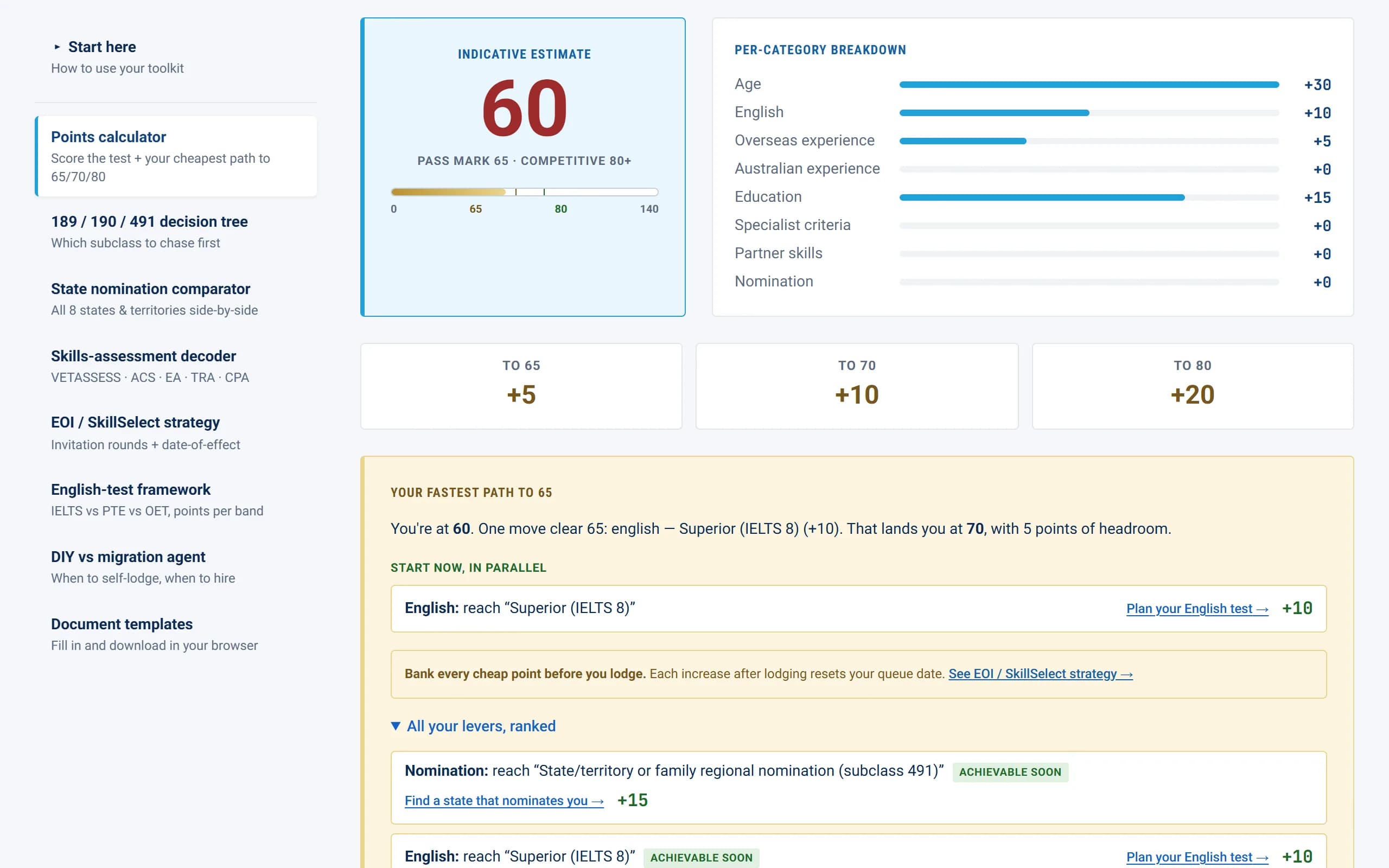
Superior English (IELTS 8.0+ across all bands or equivalent) adds 20 points. For a points-floor occupation like psychotherapist, those 20 points often decide whether the file gets selected. Sit the test early and re-sit if any band drops below 8.
5. Document supervised hours
Australian regulators value documented clinical supervision. Maintain a supervision log signed by your supervisor, with hours, modality and case categories. This evidence supports both VETASSESS and PACFA/ACA registration.
Step-by-Step Migration Roadmap
- Confirm ANZSCO fit — review the 272314 description and compare to your job duties via the ANZSCO code finder
- Check CSOL status — verify 272314 remains on the Core Skills Occupation List
- Gather qualification documents — degree transcripts, professional registration in your home country, supervision logs
- Apply to VETASSESS — lodge full skills assessment ($1,076)
- Sit an English test — IELTS, PTE or OET at minimum Proficient; aim for Superior
- Identify your state — read each state's published nomination criteria and skills list
- Submit your EOI — through SkillSelect
- Apply for state nomination — separately from EOI, against the chosen state's process
- Receive invitation — within the 60-day lodgement window
- Lodge the visa — supply medicals, AFP and overseas police checks
- Plan PACFA or ACA registration — start the membership process in parallel
- Secure employment — confirm employer or practice base in nominating state before arrival
For the broader skilled-migration sequence and points tactics, see the skills assessment bodies hub and the most-in-demand occupations list.
Frequently Asked Questions
Why isn't psychotherapist on the MLTSSL?
Australia's skilled-occupation lists reflect labour-market analysis by Jobs and Skills Australia and Home Affairs. Psychotherapy is in demand but is treated as a state-level priority rather than a national long-term shortage occupation. The result is CSOL and STSOL listing — full state-nomination and employer-sponsored access, but no 189 independent pathway.
Can a psychotherapist register with AHPRA?
No. Psychotherapy is not one of the 16 regulated health professions under AHPRA. The recognised voluntary bodies are PACFA and ACA. Psychologists, who do register with AHPRA, fall under a different ANZSCO code (272311-272313) with different visa list access.
Which is better for migration — counsellor or psychotherapist?
The honest answer depends on your duties. Counsellor (272115) is also on CSOL and STSOL with VETASSESS as the assessing body, so the visa options mirror each other. Pick the code that genuinely fits your day-to-day work. Misalignment between job title, references and ANZSCO description is the leading cause of assessment failure.
Will my UK or US psychotherapy training be recognised?
UK Counselling and Psychotherapy Central Awarding Body (CPCAB) graduates, BACP-accredited training and APA-recognised US programs are routinely accepted by VETASSESS where the degree is at Bachelor level or higher and includes structured psychotherapy content. UKCP-registered psychotherapists generally have a strong evidence base for both VETASSESS and PACFA registration.
What does private practice look like financially?
A full-time private practice psychotherapist seeing 25 sessions per week at AUD $200 per session generates around AUD $260,000 gross before room rent, supervision and tax. Net income after costs typically lands in the AUD $130,000-$180,000 range. Established practitioners with a waiting list and corporate EAP contracts earn more; new arrivals usually need 12-18 months to build a sustainable caseload.
Can I work in Medicare-rebated roles as a psychotherapist?
Not directly. Medicare's Better Access program rebates sessions delivered by registered psychologists, clinical psychologists, AHPRA-registered mental health social workers and occupational therapists. Psychotherapists work outside Medicare on private fees, NDIS plans, EAP contracts and not-for-profit funded programs.