Aeronautical Engineer Visa Pathway to Australia: Complete 2026 Guide
Updated: 16 August 2026
Australia classifies aeronautical engineers under ANZSCO 233911. Engineers Australia conducts the migration skills assessment. The occupation sits on both the MLTSSL and the Core Skills Occupation List, unlocking subclasses 189, 190, 491, 482, and 186. Typical 2026 salaries range AUD $95,000-$190,000. AUKUS submarine and aerospace programs have driven aeronautical engineering into national shortage status.
Quick Facts: Aeronautical Engineer Migration Pathway
| Detail | Information |
|---|---|
| ANZSCO Code | 233911 (Aeronautical Engineer) |
| Skill Level | 1 (Bachelor degree or higher, plus relevant experience) |
| Skills Assessment | Engineers Australia (Migration Skills Assessment) |
| Occupation List | MLTSSL and CSOL — full visa access |
| Visa Options | 189, 190, 491, 482, 186 |
| Demand Level | High — Jobs and Skills Australia lists aeronautical engineering among the engineering disciplines in national shortage |
| Salary Range | AUD $95,000-$190,000 (SEEK and SalaryExpert, 2026) |
| Typical 189 Score | 80-90 points for invitations in 2026 |
| Key Challenge | Many roles require Australian citizenship or security clearance — limits accessible employers for new migrants |
Role Context: What Aeronautical Engineers Do in Australia
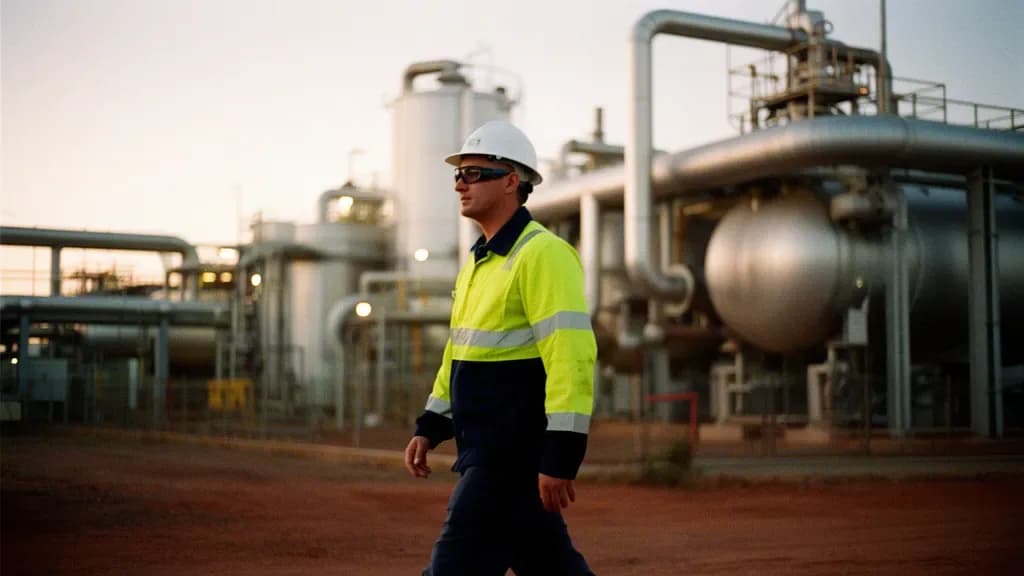
Aeronautical engineers in Australia work across three broad sectors: civil aviation (Qantas, Virgin Australia, regional carriers, and the MRO supply chain), defence and aerospace (Boeing Defence Australia, Lockheed Martin Australia, BAE Systems Australia, Northrop Grumman, Raytheon), and space and unmanned systems (Gilmour Space, Electro Optic Systems, the Australian Space Agency, and a growing UAV sector). Roles span design, stress and fatigue analysis, propulsion, avionics integration, certification, flight testing, and continuing airworthiness.
The current decade is the strongest demand cycle in a generation. AUKUS Pillar 2 is funding uncrewed maritime and air systems work, the F-35 sustainment contract continues through 2028, and the Defence Strategic Review committed billions to long-range strike capability. Boeing Technology Innovation Australia (Melbourne and Brisbane) and Lockheed Martin Australia together account for the largest private-sector aeronautical engineering footprint outside government. Geographically, the work clusters in Brisbane (Boeing, Amberley RAAF), Melbourne (Boeing, GKN, defence primes), Adelaide (the Australian Space Agency, BAE), and the Sydney basin (Sydney aerospace cluster, Williamtown RAAF).
ANZSCO 233911 — Aeronautical Engineer
ANZSCO defines the role as performing engineering work concerned with the design, development, manufacture, maintenance, and modification of aircraft for flight. The classification covers fixed-wing and rotary aircraft, unmanned systems, missiles, and spacecraft. Specialisations recognised within the code include aerodynamics, aircraft structures, avionics, flight test engineering, propulsion engineering, and aerospace systems engineering.
Aeronautical engineer is distinct from aircraft maintenance engineer (ANZSCO 323111-323114, assessed by TRA) and from engineering technologist (233914). If your work is design and analysis at degree level, 233911 is correct. If your work is mechanical hands-on maintenance, you are likely in the aircraft maintenance engineer codes — a trade assessment, not a professional one. Migrants whose work spans systems engineering across multiple disciplines sometimes nominate 233914 Engineering Technologist instead — Engineers Australia accepts both as long as the nominated tasks and qualifications match.
Skills Assessment: Engineers Australia
Engineers Australia is the sole assessing authority for 233911. It operates four pathways and migrants must select the one that matches their qualification.
CDR Pathway (most common for offshore applicants)
The Competency Demonstration Report is for engineers whose qualifications are not from a Washington Accord, Sydney Accord, or Dublin Accord signatory country. It requires three Career Episodes, a Continuing Professional Development summary, and a Summary Statement that maps each competency element to evidence in the Career Episodes.
- Assessment fee: AUD $1,034 (standard CDR, GST inclusive). With overseas PhD or skilled-employment assessment: AUD $1,336.50-$1,815.
- Processing time: standard allocation 15+ weeks; fast-track allocation within 20 business days for an extra AUD $396.
- English: IELTS 6.0 in each band (or PTE Academic 50 in each), valid within 2 years of application.
- Common rejection reasons: Career Episodes written in the passive voice with no personal engineering contribution; copied content from published sources triggers the AI/plagiarism check; competency claims unsupported by Career Episode evidence.
Washington Accord Pathway
For applicants with a four-year accredited engineering degree from a Washington Accord signatory (India IEI Tier 1, UK IET, US ABET-EAC, Canada CEAB, Ireland, South Africa ECSA, and others). No CDR required, but the qualification must be fully accredited at the time of award.
- Assessment fee: AUD $555.50 (assessment only).
- Processing time: typically faster than CDR because no Career Episode review.
Sydney Accord and Dublin Accord Pathways
Sydney Accord covers three-year engineering technology qualifications. Dublin Accord covers two-year engineering associate qualifications. Either may be relevant for migrants whose Bachelor's degree is three years rather than four, but the resulting assessment will usually be at engineering technologist (233914) or engineering associate level rather than professional engineer.
Australian Qualification Pathway
For applicants who completed an Engineers Australia accredited program at an Australian university. Assessment-only fee AUD $346.50.
Visa Pathways for Aeronautical Engineers
Subclass 482 — Skills in Demand Visa
The dominant pathway for migrants joining the major defence primes. Sponsorship is common at Boeing Defence Australia, Lockheed Martin Australia, BAE Systems Australia, Northrop Grumman, and the F-35 sustainment supply chain. Note that many defence roles require Australian citizenship and a security clearance, which migrants cannot obtain until after permanent residence and a qualifying residence period — so first roles are typically in the unclassified or commercial side of these companies.
- Visa fee: approximately AUD $4,015 (Core Skills stream, primary applicant).
- Core Skills Income Threshold (CSIT) 2026-27: AUD $79,423 (from 1 July 2026; previously AUD $76,515).
- Specialist Skills Income Threshold (SSIT): AUD $146,576 (from 1 July 2026 indexation).
- Processing time: Specialist Skills stream around 8-67 days (50%-90%); Core Skills stream 51 days-3 months.
- Duration: up to 4 years, renewable.
Subclass 189 — Skilled Independent Visa
Permanent residency via points test. Aeronautical engineer was previously among the lower-competition ICT-adjacent codes in SkillSelect, but 189 invitation rounds were paused during much of 2024-25 and have only partially resumed. Watch the subclass 189 ceiling and invitation rounds before assuming this is your fastest route.
- Visa fee: AUD $6,135 (primary applicant).
- Realistic invitation score: 80-90 points.
- Processing time: 6-12 months once invited.
Subclass 190 — Skilled Nominated Visa
State nomination adds 5 points and grants permanent residence on grant. Most useful for offshore applicants who can secure NSW, Victoria, or South Australia nomination. See state nomination section below.
- Visa fee: AUD $6,140.
Subclass 491 — Skilled Work Regional (Provisional)
Regional nomination adds 15 points, with a 5-year provisional visa and a pathway to 191 permanent residence after 3 years of regional residence and qualifying income. Aeronautical work concentrated in Williamtown (NSW), Amberley (QLD), and Adelaide makes 491 viable for this occupation, though processing times have blown out — 50% finish within 6-20 months, 90% within 15-28 months in 2026.
- Visa fee: AUD $6,140.
Subclass 186 — Employer Nomination Scheme
Permanent residency via employer sponsorship. Direct Entry stream requires 3 years' relevant experience post-qualification. TRT stream applies after 2 years on a 482 with the sponsoring employer.
- Visa fee: AUD $6,140 (primary applicant).
- Processing time: Direct Entry 12-19 months (50%-90%); TRT 13-18 months.
Points Test Strategy
| Points Factor | Points | Notes |
|---|---|---|
| Age 25-32 | 30 | Maximum bracket |
| Age 33-39 | 25 | Still competitive |
| PhD | 20 | Common in flight test, structures research |
| Master's | 15 | Most international aerospace migrants |
| Bachelor's (4-yr) | 15 | Minimum for Skill Level 1 |
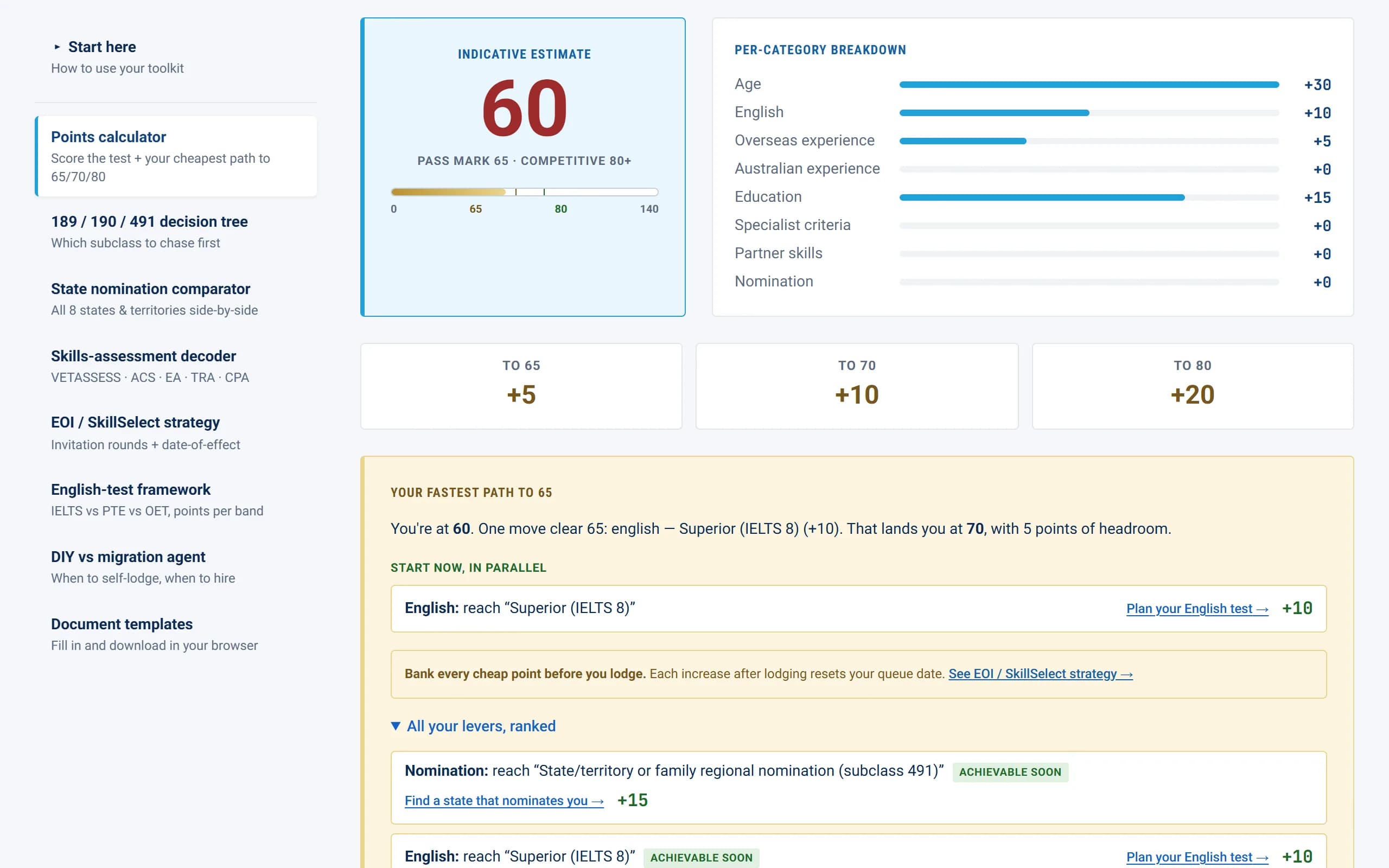
| English Superior (IELTS 8 / PTE 79) | 20 | The single biggest unlock |
| English Proficient (IELTS 7 / PTE 65) | 10 | Realistic for most migrants |
| Skilled Experience Overseas 5-7 yrs | 10 | Engineers Australia may deduct years |
| Skilled Experience Overseas 8+ yrs | 15 | After EA assessment |
| State Nomination (190) | 5 | |
| Regional Nomination (491) | 15 | |
| Partner Skills | 5-10 | If partner also has skilled occupation |
Realistic Scenarios
Scenario A — Indian aerospace engineer, 30, 6 years at HAL or a Tier-1 supplier, PTE 79. Age 30, Master's 15, English 20, overseas experience 10 = 75 points. Adding NSW or VIC 190 nomination reaches 80 — competitive in current rounds.
Scenario B — UK aerospace engineer, 35, 10 years at BAE or Airbus, IELTS 7.0. Age 25, Master's 15, English 10, overseas experience 15 = 65. Needs 491 (+15) or employer sponsorship to compete. Given UK-Australian defence relationships, employer sponsorship is often faster.
State Nomination for Aeronautical Engineers
South Australia
Adelaide hosts the Australian Space Agency, BAE Systems Australia headquarters, and the Osborne Naval Shipyard. South Australia's skilled occupation list includes 233911 in both offshore and onshore streams in 2026, and the state has actively recruited aerospace and defence engineers. The state nomination program prioritises applicants with skilled employment in South Australia and recent SA graduates.
New South Wales
NSW includes 233911 on its 190 list. Sydney's aerospace cluster, plus Williamtown RAAF base (F-35A and Super Hornet operations), drive demand. NSW typically invites at 85-95 effective points for engineering occupations.
Victoria
Victoria accepts all occupations on the national SOL for 190 nominations. Melbourne hosts Boeing Technology Innovation Australia, GKN Aerospace, and a strong defence supply chain. Victoria prioritises onshore applicants with Victorian experience but offshore applications are accepted.
Queensland
Brisbane and Amberley host significant aerospace activity (Boeing Defence Australia, RAAF Amberley). Queensland's nomination criteria typically require recent skilled employment in the state for onshore applicants, with more limited offshore quotas.
Salary and Employment Outlook
| Role | Typical Salary Range |
|---|---|
| Graduate Aeronautical Engineer | AUD $80,000-$95,000 |
| Aeronautical Engineer (3-7 yrs) | AUD $110,000-$145,000 |
| Senior Aeronautical / Stress Engineer | AUD $140,000-$180,000 |
| Principal / Tech Lead | AUD $170,000-$220,000 |
| Engineering Manager | AUD $190,000-$260,000+ |
| Contractor (defence prime) | AUD $900-$1,500/day |
Total packages typically include superannuation at 11.5% (rising to 12% from 1 July 2026), and many defence primes offer relocation assistance, salary packaging, and additional leave for cleared roles. Sydney and Adelaide pay a premium over Melbourne and Brisbane for senior structures and systems engineers.
Highest-Paying Sectors
- Defence primes — Lockheed Martin Australia, BAE Systems Australia, Boeing Defence Australia, Northrop Grumman pay the strongest senior packages
- Civil airlines and MRO — Qantas Engineering, Virgin Australia, Cobham, StandardAero
- Space and unmanned systems — Gilmour Space, Electro Optic Systems, smaller startups offer equity
- Government and research — DSTG (Defence Science and Technology Group), CSIRO, the Australian Space Agency
Tips for a Successful Application
-
Choose 233911 only if your qualification is aerospace or mechanical with aerospace specialisation. Engineers Australia rejects nominations where the qualification is generic mechanical engineering with no aerospace content. If your degree is mechanical but your work is aerospace, consider whether 233512 Mechanical Engineer is a stronger match.
-
Front-load English to PTE 79 / IELTS 8 before lodging the EOI. Superior English is worth 10 more points than Proficient. For aeronautical engineers most likely to clear at 80-90 points in 2026, those 10 points are the difference between an invitation and a stalled EOI.
-
For CDR applicants, write Career Episodes around projects with measurable engineering decisions. Engineers Australia rejects Career Episodes that read like project diaries. Every Career Episode should answer: what engineering problem, what was your specific contribution, what calculations or analyses did you perform, what was the outcome. Plagiarism detection is aggressive — write original prose.
-
If you target defence roles, be transparent about citizenship limits with recruiters. Most defence primes can hire migrants for unclassified, commercial, or civil-side work but cannot place you on AUKUS, F-35, or SCS-anything roles until you hold Australian citizenship (typically 4+ years after PR). Plan a 6-8 year career arc.
-
Use Engineers Australia's fast-track service if you have an offer in hand. The AUD $396 fast-track fee allocates your file to an assessor within 20 business days. For a 482 application chasing a sponsor's start date, this is usually the right call.
Step-by-Step Migration Roadmap
- Confirm 233911 is the right code — review the how-to-find-anzsco-code guide and the Engineers Australia occupation descriptions
- Identify your pathway — Washington Accord (if applicable) is faster than CDR. Compare options on the most in-demand occupations hub
- Sit IELTS or PTE — target Superior (IELTS 8 / PTE 79) where realistic
- Prepare documents — qualifications, transcripts, employment references describing engineering tasks
- Lodge with Engineers Australia — AUD $1,034 standard CDR, plus AUD $396 for fast-track
- Receive positive assessment — outcome letter valid 3 years
- Calculate points and submit EOI in SkillSelect for 189, 190, or 491
- Apply for state nomination — South Australia and NSW are strongest for aeronautical
- In parallel, approach Australian defence and aerospace employers for 482 sponsorship
- Lodge visa within 60 days of invitation — or with 482 nomination
- Complete health (BUPA Medical Visa Services) and AFP / overseas character checks
- Receive grant and relocate — most cleared aerospace roles cluster in Brisbane, Adelaide, Sydney, Melbourne
Frequently Asked Questions
Can I work on F-35 or AUKUS programs as a new migrant?
Not initially. Both programs require Australian citizenship and a baseline or higher security clearance. Most migrants need permanent residence first, then a qualifying residency period (typically 4 years total) before being granted Australian citizenship and eligibility for clearance-required roles. In the interim, defence primes can place you on civil, export, or unclassified engineering work. Plan a 6-8 year arc to cleared roles.
Which ANZSCO code should I choose — 233911 Aeronautical Engineer or 233512 Mechanical Engineer?
Use 233911 if your qualification is aerospace-specific (or mechanical with a substantial aerospace specialisation) AND your work history is in aircraft, spacecraft, or related propulsion and aerodynamics. Use 233512 Mechanical Engineer if your degree and work history are general mechanical with only occasional aerospace projects. Engineers Australia checks consistency — a nominated 233911 with a mechanical degree and automotive work history will fail.
Is the Washington Accord pathway always faster than CDR?
Usually, yes — but only if your qualification was accredited at the time you graduated. A degree from an Indian institution accredited under the Washington Accord in 2018 is fine if you graduated in 2020. A degree accredited in 2018 but awarded to you in 2014 (before accreditation) is not — you would default to CDR. Check the National Board of Accreditation (India) or your home country's signatory body for the year your specific program was accredited.
What's the demand outlook for aeronautical engineers in Australia in 2026?
Strong and persistent. Jobs and Skills Australia includes aeronautical engineering among the engineering disciplines in confirmed national shortage. AUKUS Pillar 2 funding through 2028, the F-35 sustainment contract, the Australian Space Agency's growth plan, and Boeing's MQ-28 Ghost Bat program all create medium-term demand. The constraint on hiring is increasingly security clearance availability, not engineering supply.
Can I bring my partner and children on a 482 visa?
Yes. Subclass 482 includes a primary applicant plus dependent partner and children. Partners can work in Australia with no occupational restriction (full work rights). Children can attend school — note that some states charge international student fees for 482 dependants attending public schools (typically AUD $4,000-$10,000 per child per year). Check the relevant state's policy before relocating.
What are the most common reasons aeronautical engineer applications fail?
Three reasons dominate. First, Career Episode plagiarism — Engineers Australia uses AI-detection and plagiarism tools, and copied content triggers immediate rejection. Second, qualification-occupation mismatch — a mechanical degree nominating Aeronautical Engineer without aerospace-specific coursework or experience. Third, employment references that describe maintenance work rather than design and analysis work — this often pushes the application toward a trade assessment (TRA) rather than EA. Use the skills assessment bodies complete list to confirm you are with the right assessor before lodging.