Agricultural Engineer Visa Pathway to Australia: Complete 2026 Guide
Updated: 16 August 2026
Australia classifies agricultural engineers under ANZSCO 233912. Engineers Australia conducts the migration skills assessment. The occupation is on the MLTSSL and the Core Skills Occupation List, opening subclasses 189, 190, 491, 482, and 186. Typical 2026 salaries range AUD $88,000-$155,000. Regional 491 nomination is the dominant route — agricultural engineering work concentrates in regional Australia.
Quick Facts: Agricultural Engineer Migration Pathway
| Detail | Information |
|---|---|
| ANZSCO Code | 233912 (Agricultural Engineer) |
| Skill Level | 1 (Bachelor degree or higher, plus relevant experience) |
| Skills Assessment | Engineers Australia (Migration Skills Assessment) |
| Occupation List | MLTSSL and CSOL — full visa access |
| Visa Options | 189, 190, 491, 482, 186 |
| Demand Level | Moderate — niche but growing, driven by precision agriculture and climate adaptation |
| Salary Range | AUD $88,000-$155,000 (SalaryExpert and SEEK, 2026) |
| Typical 189 Score | 75-85 points — lower competition than ICT |
| Key Challenge | Small national hiring pool — most roles concentrate in regional Australia and require relocation outside capital cities |
Role Context: What Agricultural Engineers Do in Australia
Agricultural engineers in Australia design and manage the equipment, infrastructure, and systems that underpin a AUD $90+ billion agricultural sector. Work falls into four broad streams: machinery and automation (harvesters, autonomous tractors, precision-spraying systems for cotton, grain, sugar, and horticulture), irrigation and water management (drip and sub-surface systems, dam design, irrigation district modernisation), farm structures (grain storage, livestock housing, dairy parlours, post-harvest facilities), and digital agriculture (sensor networks, telemetry, on-farm data systems). CSIRO's Agriculture and Food unit is the largest single research employer, and the grain industry leads adoption of precision agriculture.
The hiring concentration is regional. Major employers include John Deere Australia (Crows Nest QLD, Toowoomba), Case IH and New Holland (Toowoomba, regional NSW), CSIRO (Black Mountain, Brisbane, Toowoomba, Armidale), GRDC-funded research bodies, and private agribusinesses like Costa Group, Olam, Sundrop Farms, and the cotton and sugar industry. State agriculture departments (NSW DPI, Agriculture Victoria, QDAF) also hire agricultural engineers for extension and policy roles. Cities matter less than regions — most positions sit in regional centres like Toowoomba, Tamworth, Mildura, Bundaberg, Griffith, and Wagga Wagga.
ANZSCO 233912 — Agricultural Engineer
ANZSCO defines the role as planning, designing, organising, and overseeing the construction, operation, and maintenance of farm structures, farm machinery, and equipment used to produce crops and livestock. The classification covers farm machinery design, irrigation engineering, post-harvest engineering, agricultural building design, and agricultural systems engineering. Specialisations include precision agriculture and digital farming, water and irrigation, livestock systems, and machinery and automation.
If your work is primarily mechanical design of agricultural machinery, 233512 Mechanical Engineer may also fit and tends to have a deeper hiring pool. If your work is environmental impact assessment of agricultural systems, 233915 Environmental Engineer applies. Choose 233912 when your degree and work history are explicitly agricultural engineering (not "general mechanical with some farm projects").
Skills Assessment: Engineers Australia
Engineers Australia is the assessing authority. The four pathways are CDR, Washington Accord, Sydney Accord, and Australian Qualification. Agricultural engineering degrees from India, the Philippines, Pakistan, and other non-Accord countries default to CDR. Australian, US, UK, Irish, Canadian, and South African Bachelor's degrees in agricultural engineering typically use Washington Accord.
CDR Pathway
- Three Career Episodes that demonstrate competency at professional engineer level. Career Episodes should describe specific agricultural engineering projects — irrigation design calculations, machinery design analysis, structural design of grain silos — not generic farm work.
- Assessment fee: AUD $1,034 (standard CDR, GST inclusive). Adding skilled-employment or PhD assessment increases the fee to AUD $1,336.50-$1,815.
- Processing time: standard allocation 15+ weeks; fast-track allocation within 20 business days for AUD $396.
- English requirement: IELTS 6.0 in each band, or PTE Academic 50 in each.
- Common rejection reasons: Career Episodes describing farm management or extension work rather than engineering design and analysis; CDR plagiarism flagged by Engineers Australia's detection tools; mismatch between agricultural science qualification and nominated engineering occupation.
Washington Accord Pathway
- For accredited 4-year agricultural engineering degrees from signatory countries.
- Assessment fee: AUD $555.50 (assessment only).
- Processing typically faster than CDR.
Australian Qualification Pathway
- For Engineers Australia accredited Australian degrees — typically from University of Southern Queensland, University of New England, James Cook University, and Charles Sturt University.
- Assessment fee: AUD $346.50.
Visa Pathways for Agricultural Engineers
Subclass 491 — Skilled Work Regional (Provisional)
The dominant pathway for agricultural engineering. Almost every meaningful employer is in a regional postcode, so applicants typically meet the regional residency obligation naturally. After 3 years on the 491 and qualifying taxable income (currently AUD $53,900+ per year for the primary applicant), you can apply for the 191 permanent visa.
- Visa fee: AUD $6,140 (primary applicant).
- Processing time: 50% finish in 6-20 months, 90% in 15-28 months (2026 figures).
- Points boost: +15 from regional nomination.
- Quirk: A signed letter of support from a regional employer dramatically improves nomination odds in NSW, VIC, and QLD.
Subclass 482 — Skills in Demand Visa
Practical option when a regional agribusiness or machinery manufacturer offers sponsorship. Less common than 491 because many smaller agribusinesses lack accredited sponsor status.
- Visa fee: approximately AUD $4,015 (Core Skills stream).
- Salary requirement (2026-27): Core Skills Income Threshold AUD $79,423; Specialist Skills Income Threshold AUD $146,576. Both apply from 1 July 2026.
- Processing time: Core Skills stream 51 days-3 months (50%-90%); Specialist Skills around 8-67 days.
Subclass 190 — Skilled Nominated Visa
Open in South Australia and Tasmania for agricultural engineering. Less common in NSW and VIC because most agricultural engineering work is regional and therefore better-served by 491.
- Visa fee: AUD $6,140.
Subclass 189 — Skilled Independent Visa
Available in principle but invitations are rare for niche occupations. Pursue only if your points score reaches 90+.
- Visa fee: AUD $6,135.
Subclass 186 — Employer Nomination Scheme
Direct Entry stream requires 3 years' post-qualification experience; TRT stream requires 2 years on a 482 with the sponsoring employer.
- Visa fee: AUD $6,140.
Points Test Strategy
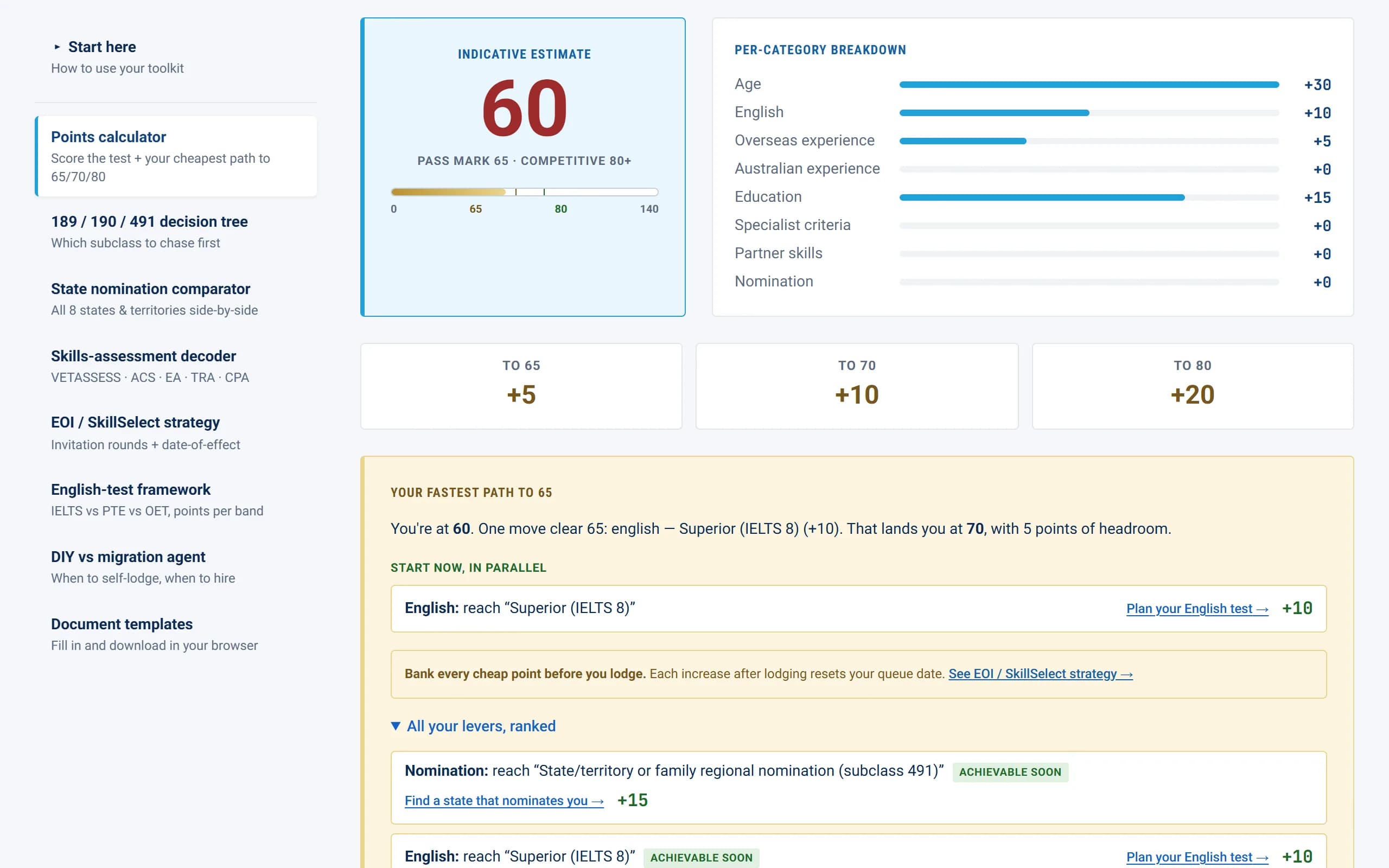
| Points Factor | Points | Notes |
|---|---|---|
| Age 25-32 | 30 | Maximum bracket |
| Age 33-39 | 25 | |
| PhD | 20 | Common for CSIRO and university roles |
| Master's | 15 | |
| Bachelor's | 15 | |
| English Superior (IELTS 8 / PTE 79) | 20 | The single biggest unlock |
| English Proficient (IELTS 7 / PTE 65) | 10 | |
| Skilled Experience Overseas 5-7 yrs | 10 | |
| Skilled Experience Overseas 8+ yrs | 15 | |
| State Nomination (190) | 5 | |
| Regional Nomination (491) | 15 | |
| Partner Skills | 5-10 |
Realistic Scenarios
Scenario A — Filipino agricultural engineer, 29, 5 years at a sugar industry contractor, PTE 65. Age 30, Bachelor's 15, English 10, overseas experience 10 = 65 points. Adding 491 regional nomination (+15) reaches 80 — competitive for an invitation, with regional QLD or NSW as the strongest targets.
Scenario B — Indian agricultural engineer, 33, 8 years in irrigation systems, IELTS 7.5. Age 25, Master's 15, English 10, overseas experience 15 = 65. Add 491 (+15) and a partner skills claim (+10) and the result is 90 — strongly competitive.
State Nomination for Agricultural Engineers
Queensland
Queensland's regional agriculture footprint — cotton, sugar, beef, grain, horticulture — drives the strongest hiring for agricultural engineers in the country. Toowoomba is the centre of agricultural machinery R&D (John Deere, Case IH, CNH Industrial). Queensland's 491 stream typically requires a job offer from a regional employer.
New South Wales
NSW agriculture concentrates in the Riverina (Griffith, Wagga Wagga, Leeton), New England (Tamworth, Armidale), and the cotton-growing north (Moree, Narrabri). NSW Department of Primary Industries hires agricultural engineers for extension, water policy, and biosecurity infrastructure roles. NSW 491 stream is well-suited to agricultural engineers with a regional offer.
South Australia
South Australia's wine, grain, and horticulture industries drive demand. The Adelaide-Riverland corridor (Loxton, Renmark, Berri) and the Limestone Coast are the strongest hiring regions. South Australia includes 233912 in the offshore-eligible occupation list in 2026, making this a reasonable pathway for applicants without an Australian connection.
Victoria
Agriculture Victoria, the Goulburn Valley horticulture region, and the dairy industry (south-west Victoria) drive demand. Victoria accepts all national SOL occupations for 190 nomination, though regional 491 is more aligned with where the work sits.
Tasmania
Tasmania's irrigation modernisation program (Tasmanian Irrigation Pty Ltd) and dairy expansion create ongoing demand. Tasmania's nomination program is smaller and more selective but includes agricultural engineering in 2026.
Salary and Employment Outlook
| Role | Typical Salary Range |
|---|---|
| Graduate Agricultural Engineer | AUD $75,000-$90,000 |
| Agricultural Engineer (3-7 yrs) | AUD $95,000-$130,000 |
| Senior Agricultural Engineer | AUD $125,000-$160,000 |
| Principal / Tech Lead | AUD $150,000-$190,000 |
| CSIRO Research Scientist | AUD $110,000-$170,000 |
| State Agriculture Department Senior | AUD $130,000-$165,000 |
Packages typically include superannuation (11.5%, rising to 12% from July 2026). Many regional employers add vehicle allowances, on-call premiums, and relocation packages. Private industry pays more than government, but government roles offer stronger work-life balance and more predictable hours.
Highest-Paying Sectors
- Agricultural machinery manufacturers — John Deere, CNH Industrial, AGCO; design and product engineering roles
- Cotton, sugar, and grain industry research — Cotton Research and Development Corporation, Sugar Research Australia, Grains Research and Development Corporation
- Irrigation infrastructure — Sunwater (QLD), WaterNSW, SA Water, Goulburn-Murray Water
- CSIRO and university research — Black Mountain (ACT), Toowoomba, Armidale, the AgriFutures network
Geographic Premium
There is no Sydney/Melbourne premium for this occupation. The strongest packages are in regional Queensland (Toowoomba machinery cluster) and remote-area roles in mining-adjacent cropping (FIFO arrangements for some irrigation infrastructure work).
Tips for a Successful Application
-
Pick 233912 only if your degree title and work history are explicitly agricultural engineering. A Bachelor of Mechanical Engineering with one farm-machinery project is not enough — Engineers Australia will downgrade or reject. Programs commonly accepted include Bachelor of Agricultural Engineering, Bachelor of Engineering (Agricultural), and combined Agricultural Engineering + Biosystems Engineering degrees.
-
Plan around 491, not 189. Almost every agricultural engineering employer is regional. Lodging a 491 EOI with a regional postcode in mind (Toowoomba 4350, Wagga Wagga 2650, Tamworth 2340, Mildura 3500) sets you up for nomination, faster than chasing rare 189 invitations for a low-volume occupation.
-
Approach machinery manufacturers and CSIRO before lodging. John Deere Australia and CSIRO Agriculture and Food both have structured graduate and lateral-hire programs that include 482 sponsorship. A live offer transforms the visa equation.
-
For irrigation specialists, document hydraulic design experience in detail. Engineers Australia's Career Episodes for irrigation engineers should include specific pressure-flow calculations, system design choices, and measurable outcomes. Vague "managed irrigation projects" descriptions get downgraded.
-
Use the skills assessment bodies complete list and the most in-demand occupations hub to confirm you are with Engineers Australia and not AsTSSE. Some agricultural science qualifications (without the engineering content) belong with VETASSESS as Agricultural Scientist (234112), not EA.
Step-by-Step Migration Roadmap
- Confirm 233912 is right — review the ANZSCO code finder and EA's occupation description
- Choose your pathway — Washington Accord (faster) or CDR
- Sit IELTS or PTE — target Proficient or Superior English
- Compile evidence — qualifications, transcripts, references describing engineering design tasks
- Lodge with Engineers Australia — AUD $1,034 standard CDR or AUD $555.50 Washington Accord
- Receive positive outcome — valid 3 years
- Submit EOI in SkillSelect — flag 491 regional interest
- Target Queensland, NSW, SA, or Tasmania 491 nomination with a regional postcode
- Approach machinery manufacturers and CSIRO for 482 sponsorship in parallel
- Receive invitation and lodge visa within 60 days
- Health and character checks — BUPA Medical Visa Services, AFP, overseas police clearance
- Relocate to regional Australia — most roles in QLD, regional NSW, regional SA
Frequently Asked Questions
Why isn't agricultural engineering on the 189 priority list more visible?
Agricultural engineering is a low-volume occupation — Australia hires only a few hundred per year compared to thousands of software engineers. 189 invitation rounds tend to favour high-volume occupations with deep ceilings. As a result, agricultural engineers often see no 189 invitations even at high points scores, while 491 and 190 invitations come through normally. The pragmatic route is regional.
Can my agricultural science degree be assessed as agricultural engineering?
Usually no. Agricultural science (an applied biology/agronomy qualification) is assessed by VETASSESS as Agricultural Scientist (ANZSCO 234112). Agricultural engineering (an engineering qualification with physics, calculus, and design content) is assessed by Engineers Australia as Agricultural Engineer (233912). If your degree title is "Agricultural Science" or "Agronomy", check whether the curriculum included engineering design subjects — if not, VETASSESS is your assessor.
Is precision agriculture experience valued in the skills assessment?
Yes. Engineers Australia recognises precision agriculture, autonomous machinery design, sensor networks, and on-farm data systems as legitimate engineering specialisations within 233912. Career Episodes describing GPS-guided machinery design, variable-rate irrigation systems, or sensor-network deployments are strong material — provided the engineering content (calculations, design decisions, technical analysis) is documented.
What's the demand outlook for agricultural engineers in Australia in 2026?
Steady, with growth pockets. The Jobs and Skills Australia Occupation Shortage List flagged broader engineering shortages, and agricultural engineering is included among those identified by Engineers Australia as in shortage. Climate adaptation funding, the National Reconstruction Fund's agricultural priorities, and ongoing irrigation modernisation in the Murray-Darling Basin all create medium-term demand. Hiring is unevenly distributed — strong in QLD and regional NSW, weaker in WA and the NT.
Can I bring my partner and children on a 491?
Yes. The 491 visa allows the primary applicant plus partner and dependent children. All family members must live in the nominated regional area, though they can travel anywhere in Australia for work and study during the visa period. Partner work rights are unrestricted.
What are the most common reasons agricultural engineer applications fail?
Three reasons recur. First, wrong assessor — applicants with agricultural science qualifications mistakenly apply through Engineers Australia and are rejected (they belong with VETASSESS). Second, generic Career Episodes that describe farm management or extension work without engineering design content. Third, low points scores held back by mediocre English — many agricultural engineering migrants come from countries where IELTS 6.0-6.5 is the realistic ceiling, leaving them under-pointed for an invitation. Investing 2-3 months in PTE coaching to lift the score to Proficient (10 points) or Superior (20 points) is often the highest-ROI step.