Gastroenterologist Visa Pathway to Australia: Complete 2026 Guide
Updated: 16 August 2026
Australia classifies Gastroenterologists under ANZSCO 253316. The Medical Board of Australia (MedBA) administers specialist registration through AHPRA, with the Royal Australasian College of Physicians (RACP) confirming comparability of overseas qualifications. The occupation is on the MLTSSL and Core Skills Occupation List, unlocking visa subclasses 189, 190, 491, 482 and 186. Typical 2026 salaries range AUD $325,000-$575,000.
Quick Facts: Gastroenterologist Migration Pathway
| Detail | Information |
|---|---|
| ANZSCO Code | 253316 (Gastroenterologist) |
| Skill Level | 1 (Bachelor degree plus specialist medical training) |
| Skills Assessment | MedBA (Medical Board of Australia) via AHPRA; comparability through RACP |
| Occupation List | MLTSSL and CSOL |
| Visa Options | 189, 190, 491, 482, 186 |
| Demand Level | High — bowel cancer screening, hepatitis C elimination and ageing demographics keep demand rising |
| Salary Range | AUD $325,000-$575,000 (ERI SalaryExpert 2026; private practice substantially higher) |
| Typical 189 Score | 70-85 points |
| Key Challenge | RACP comparability often requires endoscopy procedural-volume evidence |
What Gastroenterologists Do in Australia
Gastroenterologists diagnose and treat diseases of the digestive tract, liver, pancreas and biliary system. Australian practice runs on a strong procedural base — gastroscopy, colonoscopy, ERCP, endoscopic ultrasound — alongside outpatient hepatology, inflammatory bowel disease and motility services. The National Bowel Cancer Screening Program drives steady colonoscopy demand, with screening uptake rising year on year.
Most consultants work across a public hospital appointment and a private endoscopy practice. Major endoscopy centres operate in Sydney (RPA, Concord, Royal North Shore), Melbourne (Alfred, Austin, Royal Melbourne), Brisbane (PA, Royal Brisbane and Women's), Perth (Sir Charles Gairdner) and Adelaide (Royal Adelaide). Hepatology is concentrated in liver transplant centres at Austin Health, RPA and PA Hospital. Regional Australia depends heavily on visiting consultant models for endoscopy lists.
ANZSCO 253316 — What the Code Covers
The ABS describes Gastroenterologists as specialist physicians who diagnose, treat and prevent diseases and disorders of the digestive system. Registration is required.
Typical duties recognised under the code:
- Diagnosing and treating disorders of the oesophagus, stomach, intestine, liver, pancreas and biliary tree
- Performing diagnostic and therapeutic endoscopy (gastroscopy, colonoscopy, ERCP, EUS)
- Managing chronic conditions including inflammatory bowel disease, coeliac disease, hepatitis C, NAFLD and cirrhosis
- Supervising hepatology services for liver failure and transplant work-up
- Interpreting motility studies, breath tests and capsule endoscopy
Hepatologists practising primarily in liver disease still nominate 253316 rather than seeking a separate code — there is no dedicated ANZSCO entry for hepatology.
Skills Assessment
Specialist Pathway — Medical Board of Australia
The specialist pathway runs through AHPRA, with the RACP providing comparability assessment against the FRACP advanced training program. Refer to the skills assessment hub for the body-by-body comparison.
Requirements:
- Primary medical degree verified through EPIC (ECFMG)
- Recognised specialist qualification in gastroenterology
- Evidence of recent procedural practice — endoscopy logbook is critical
- English at IELTS 7.0 each band, OET B, PTE 65 or TOEFL equivalent
- A sponsoring Australian position for workplace-based assessment if required
Cost: AHPRA specialist application AUD $989. RACP $1,096 initial application plus $6,184 assessment of comparability. Workplace-based assessment $4,802 annually if required.
Processing time: RACP comparability decisions issue within 6 months on a complete file. Total time to general specialist registration is typically 12-18 months. Candidates rated "partially comparable" complete top-up training of 6-24 months.
Common rejection reasons:
- Insufficient procedural volume — RACP wants documented endoscopy numbers consistent with Australian Conjoint Committee for Recognition of Training in Endoscopy benchmarks
- Hepatology-only training without general gastroenterology exposure
- Inadequate exposure to therapeutic ERCP or EUS in training programs from countries where these are concentrated in tertiary referral centres
Procedural Recognition and Conjoint Committee
Australia maintains the Conjoint Committee for Recognition of Training in Endoscopy, which sets procedural benchmarks (typically 200 colonoscopies, 200 gastroscopies for initial recognition). Overseas-trained gastroenterologists may need to demonstrate equivalent procedural numbers or complete supervised procedures during a workplace-based assessment.
Visa Pathways for Gastroenterologists
Subclass 482 — Skills in Demand Visa
Employer sponsorship is the most direct entry route, especially because endoscopy practices and regional services run active offshore recruitment.
- Visa fee: AUD $4,015 (primary applicant)
- Stream: Specialist Skills (salary above $146,576) — qualifies for 7-11 day priority processing
- Duration: Up to 4 years, renewable
- Processing time: 7-14 days (Specialist Skills); 21-47 days (Core Skills)
- Quirk: Private endoscopy groups commonly sponsor consultants under the 482 then transition them to 186 after two years
Subclass 186 — Employer Nomination Scheme
The permanent residency pathway, typically reached via TRT after two years on the 482.
- Visa fee: AUD $6,140
- Streams: Direct Entry or TRT
- Processing time: 12-20 months (Direct Entry); TRT often faster
- Age exemption: Medical practitioners benefit from the age exemption above 45 in nominated shortage roles
Subclass 189 — Skilled Independent Visa
Permanent residency via the points test.
- Visa fee: AUD $6,135
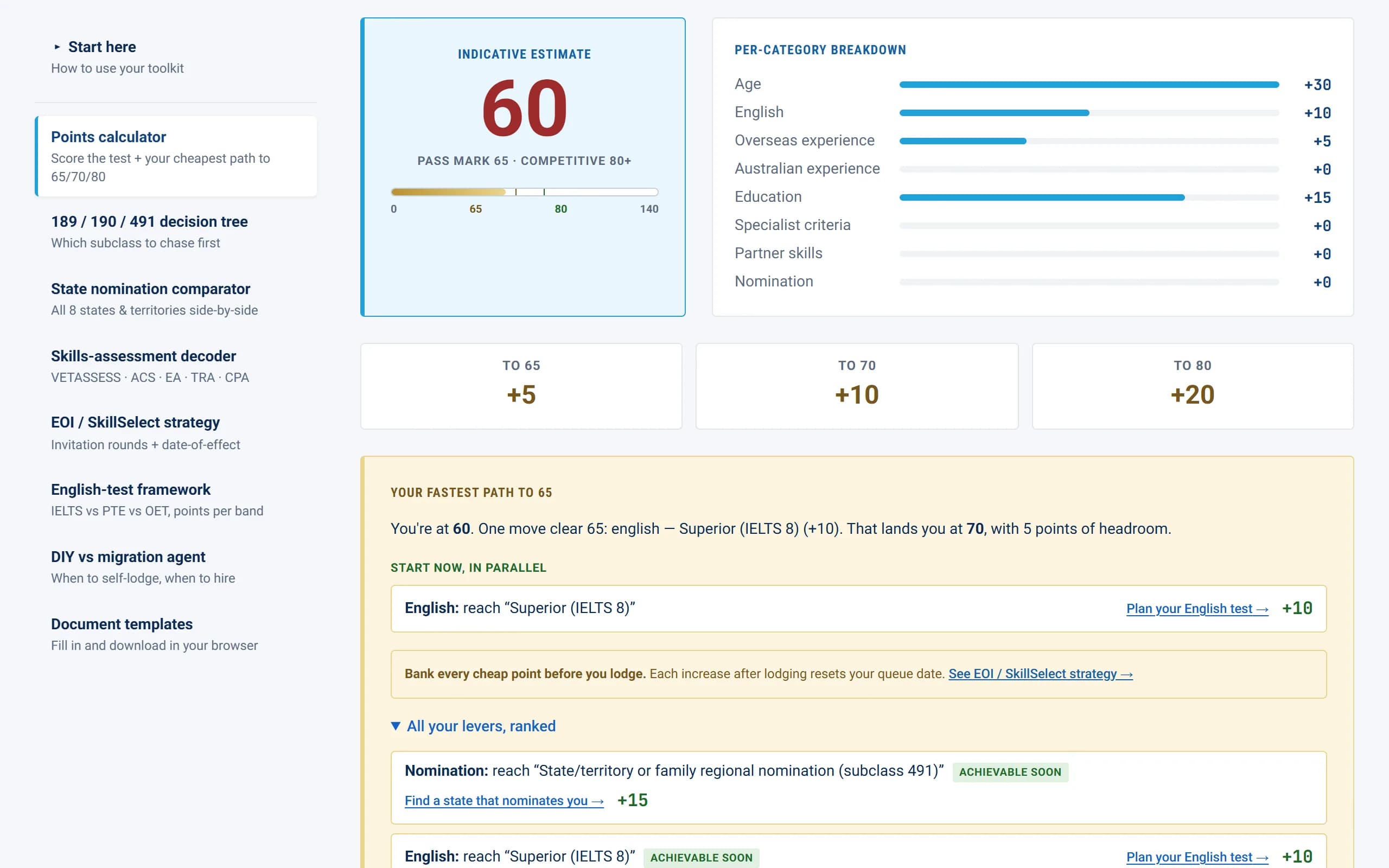
- Minimum points: 65 — invitations for 253316 typically issue between 70-85 points
- Processing time: 8-14 months
Subclass 190 — Skilled Nominated Visa
- Visa fee: AUD $6,140
- Points boost: +5
- Processing time: 6.5-19 months
- Best states: WA, SA, TAS, QLD regional
Subclass 491 — Skilled Work Regional Visa
- Visa fee: AUD $6,140
- Points boost: +15
- Processing time: 12-15 months
- Reality: Regional hepatitis C elimination programs and bowel cancer screening have raised demand in regional NSW, Victoria and Queensland
Points Test Strategy
| Points Factor | Points | Notes |
|---|---|---|
| Age (25-32) | 30 | Maximum bracket |
| Age (33-39) | 25 | Common consultant range |
| Doctoral / Specialist Fellowship | 20 | FRACP equivalent |
| Bachelor / Postgraduate Medical Degree | 15 | Floor |
| English (Superior — 8.0+) | 20 | OET A |
| English (Proficient — 7.0) | 10 | OET B |
| Overseas Experience (8+ years) | 15 | Standard |
| State Nomination (190) | 5 | |
| Regional (491) | 15 | |
| Partner Skills | 5-10 |
Realistic Score Scenarios
Scenario 1 — Procedural consultant 36-year-old gastroenterologist, 8 years post-Fellowship, OET A: 25 + 20 + 20 + 15 = 80 points. Strong for 189 in normal invitation rounds.
Scenario 2 — Senior hepatologist seeking employer sponsorship 44-year-old hepatologist, 16 years post-Fellowship, OET B: 15 + 20 + 10 + 15 = 60 points. Employer sponsorship via 482 then 186 TRT is the realistic route.
State Nomination
Western Australia
WA actively nominates 253316 for both metropolitan and regional services. Regional WA — particularly the Kimberley and Pilbara — has chronic endoscopy access shortages and runs visiting consultant models supported by sponsorship.
South Australia
SA nominates gastroenterologists under its health stream with offshore concessions on English testing. Adelaide's three tertiary networks (CALHN, NALHN, SALHN) plus the Riverland recruit consistently.
Tasmania
Tasmania nominates gastroenterologists for both Hobart and Launceston, with sustained demand in liver disease services tied to Hepatitis C treatment scale-up.
Queensland
Queensland nominates 253316 under its shortage-focused list. Townsville, Cairns and the Gold Coast University Hospital are the most active sponsors. The Aboriginal and Torres Strait Islander hepatitis B burden in regional Queensland drives sustained hepatology demand.
New South Wales
NSW nominates gastroenterologists primarily under the 491 stream through Local Health Districts in Hunter New England, Murrumbidgee and Mid North Coast.
Victoria
Victoria nominates under its Health and Medical Research stream, with active recruitment at Monash Health, Western Health and Goulburn Valley Health.
Salary and Employment Outlook
Typical Earnings
| Role | Typical Salary Range |
|---|---|
| Staff Specialist (Year 1-3) | AUD $325,000-$420,000 |
| Senior Staff Specialist | AUD $400,000-$520,000 |
| VMO / Public Sessional | AUD $450,000-$600,000 |
| Private Endoscopy Practice | AUD $600,000-$1,200,000+ |
| Locum Consultant | AUD $2,500-$3,000/day |
Source: ERI SalaryExpert 2026, MedRecruit Australia salary survey, and reports from Australian Gastroenterology Week 2025. Private endoscopy income depends heavily on procedural volume — high-volume practices in Sydney and Melbourne routinely exceed $1 million in annual billings. Public salaries include 11.5% superannuation, salary packaging and procedural allowances.
Highest-Paying Sectors
- Private endoscopy day-procedure centres — Sydney North Shore, Melbourne East, Brisbane CBD and Perth Western Suburbs run the highest-billing practices
- Tertiary hepatology and transplant centres — Austin, RPA, PA Hospital, Sir Charles Gairdner
- Inflammatory bowel disease subspecialty rooms — Sydney, Melbourne, Brisbane
- Regional VMO contracts — premium hourly rates for fly-in fly-out endoscopy lists
- Pharma and clinical trial advisory roles — paid consultancies for hepatitis C, IBD and obesity drug trials
Tips for a Successful Application
1. Build your endoscopy logbook before applying
RACP comparability decisions weigh procedural numbers heavily. Document every gastroscopy, colonoscopy, ERCP and EUS performed, with dates, indications and complication rates. The Conjoint Committee benchmarks are public — meet them or explain the gap.
2. Distinguish hepatology and general gastroenterology training carefully
If your training was hepatology-focused, do not present yourself as a general gastroenterologist. The RACP scrutinises the breadth of training, and overstating scope is a common cause of "partially comparable" outcomes.
3. Approach private endoscopy groups directly for sponsorship
Public hospital sponsorship is the default route, but Australia's large private endoscopy groups (such as Sydney Adventist, Cabrini and Western Private) sponsor consultants willing to commit to procedural lists. These roles often offer higher take-home pay than equivalent public posts.
4. Plan for Conjoint Committee recognition separately
Specialist registration through AHPRA and procedural recognition through the Conjoint Committee are independent processes. Lodge both early. Without Conjoint recognition you cannot bill Medicare for endoscopic procedures, which collapses private practice viability.
5. Target OET A on the first sitting
The 10-point English bonus is worth more than any other points lever for consultants in their late 30s and early 40s. OET A is achievable for native and near-native English speakers — schedule the test before lodging RACP so the result is available throughout the process.
Step-by-Step Migration Roadmap
- Confirm Gastroenterologist 253316 matches your scope of practice
- Verify list status on the 2026 SOL
- Verify your primary medical degree through EPIC (ECFMG)
- Compile your endoscopy logbook with verified procedural numbers
- Sit OET — target A in all four bands
- Lodge the RACP comparability application ($1,096 initial fee)
- Apply to AHPRA for specialist registration ($989)
- Approach Australian employers and negotiate sponsorship
- Lodge a subclass 482 Specialist Skills nomination through the employer
- Or, submit an EOI in SkillSelect for 189/190/491
- Apply for state nomination if relevant
- Receive invitation, lodge visa, complete health and character checks
Frequently Asked Questions
Do I need separate recognition to perform endoscopy in Australia?
Yes. The Conjoint Committee for Recognition of Training in Endoscopy must recognise your procedural training before you can bill Medicare for endoscopic procedures. This is independent of specialist registration through AHPRA — both are required for a procedural practice.
Can hepatologists migrate under ANZSCO 253316?
Yes. There is no separate ANZSCO code for hepatology. Hepatologists nominate Gastroenterologist 253316, and the RACP recognises hepatology as a sub-discipline within gastroenterology advanced training.
Which states offer the fastest pathway for offshore gastroenterologists?
Western Australia, South Australia, Tasmania and regional Queensland process medical specialist nominations faster than NSW or Victoria. They run smaller applicant pools and apply shortage-driven nomination criteria that favour confirmed-offer candidates.
Will my European Board of Gastroenterology qualification be recognised?
The European Board of Gastroenterology certification is not automatically equivalent to FRACP. The RACP assesses comparability against the full advanced training curriculum. Most European candidates with a multi-year specialist program clear at "substantially comparable" with a workplace-based top-up of 6-12 months.
Is private practice as lucrative as it sounds?
Yes, for high-volume procedural practices. Private endoscopy revenue depends on theatre access, referral networks and case mix. Established practices in Sydney and Melbourne CBDs commonly bill above $1 million annually, but new arrivals typically spend 18-24 months building a referral base before reaching those levels.
What is the demand outlook for gastroenterologists in 2026?
Demand is high and sustained. The National Bowel Cancer Screening Program continues to drive colonoscopy volume, hepatitis B remains a workforce priority in Aboriginal and Torres Strait Islander health, and chronic liver disease from NAFLD and alcohol use is rising. See the most-in-demand occupations list.