Radiation Oncologist Visa Pathway to Australia: Complete 2026 Guide
Updated: 16 August 2026
Australia classifies Radiation Oncologist under ANZSCO 253918. The Medical Board of Australia handles registration; the Royal Australian and New Zealand College of Radiologists (RANZCR) is the AMC-accredited body for the comparability assessment. The occupation sits on the MLTSSL and CSOL, opening subclasses 189, 190, 491, 482 and 186. Typical 2026 salaries range AUD $275,000-$600,000+, and the Health Ministry categorises the workforce as vulnerable due to documented shortages.
Quick Facts: Radiation Oncologist Migration Pathway
| Detail | Information |
|---|---|
| ANZSCO Code | 253918 (Radiation Oncologist) |
| Skill Level | 1 (Bachelor degree plus five+ years specialist training, registration required) |
| Skills Assessment | MedBA (Medical Board of Australia) via RANZCR SIMG pathway |
| Occupation List | MLTSSL and CSOL |
| Visa Options | 189, 190, 491, 482, 186 |
| Demand Level | Critical — Health Ministry classifies the radiation oncology workforce as vulnerable; one in ten newly diagnosed cancer patients reportedly lack adequate access to radiotherapy |
| Salary Range | AUD $275,000-$600,000+ (PayScale 2026; Glassdoor 2026; private practice consultants exceed this) |
| Typical 189 Score | 80-90 points (healthcare occupations clear at lower thresholds than ICT) |
| Key Challenge | Few RANZCR-accredited radiation oncology departments outside major capitals — peer review must be onshore in an approved site |
Role Context: Radiation Oncology in Australia
Radiation oncologists in Australia treat cancer patients using ionising radiation, working alongside medical oncologists, surgeons, radiation therapists and medical physicists in multidisciplinary teams. Most consultants work in dedicated cancer centres — Peter MacCallum Cancer Centre, Chris O'Brien Lifehouse, GenesisCare facilities, Icon Group centres and public networks like Liverpool/Macarthur, Royal North Shore and Princess Alexandra. The role combines clinical consultation, treatment planning, on-treatment review and outcome follow-up.
The workforce is acutely constrained. Australia's cancer incidence is projected to rise from 28,000 to 34,000 cases annually by 2031 (AIHW projections), but radiation oncologist supply is not keeping pace. Average consultant age is 42 with a significant cohort approaching retirement; burnout has driven part-time conversion and earlier retirements since the pandemic. To meet projected demand the workforce would need to roughly double. The Department of Health categorises radiation oncology as a vulnerable workforce, which directly informs state nomination priorities for 2026.
ANZSCO Code 253918
ANZSCO 253918 covers specialists who plan, deliver and supervise radiation therapy for cancer patients. Tasks include consulting with patients on diagnosis and treatment options, prescribing radiation dose and fractionation, contouring target volumes and organs at risk, supervising treatment delivery, monitoring acute and late effects, and participating in multidisciplinary tumour boards. The code is distinct from medical oncology (253913) and from radiation therapists/medical radiation practitioners (251212), each of which has its own assessment pathway. Radiation oncologists are physicians; medical radiation practitioners are non-medical allied health professionals.
Skills Assessment
Medical Board of Australia — Specialist Pathway
The Medical Board of Australia (MedBA), part of AHPRA, is the registering authority for specialist medical practitioners. RANZCR is the AMC-accredited college for radiation oncology comparability assessment. Primary source verification of medical qualifications runs through ECFMG's EPIC service (approximately USD $145 for verification plus registration in 2026).
RANZCR SIMG Assessment
RANZCR assesses Specialist International Medical Graduates in both clinical radiology and radiation oncology. The radiation oncology pathway is conceptually identical to the diagnostic radiology pathway: the College reviews your training, qualifications and experience against the standard of a RANZCR-trained radiation oncology Fellow.
Outcomes are:
- Substantially comparable — required to complete up to 12 months of peer review in a RANZCR-accredited training site before unrestricted fellowship
- Partially comparable — required to undertake training or upskilling in a RANZCR-accredited department before sitting the Phase 2 examinations
- Not comparable — must complete the full RANZCR radiation oncology training program
Refund policy: 50% of the assessment fee is refundable if withdrawn beyond four weeks of the scheduled assessment, 25% within four weeks. The most common partial-comparability findings for radiation oncology SIMGs are limited modality breadth (e.g. heavy 3D conformal experience without IMRT, VMAT or SBRT), insufficient brachytherapy exposure, and gaps in multidisciplinary tumour board participation. Logbooks and treatment-planning portfolios should map directly to the RANZCR radiation oncology training program competencies.
A practical constraint specific to this specialty: there are relatively few RANZCR-accredited radiation oncology training departments compared to diagnostic radiology, so peer review and upskilling positions are concentrated in capital cities and major regional cancer centres. Plan the geography of your sponsoring role carefully.
Visa Pathways for Radiation Oncologists
Subclass 482 — Skills in Demand Visa (Specialist Skills stream)
The standard pathway for SIMG radiation oncologists. Consultant salaries comfortably clear the Specialist Skills Income Threshold (AUD $146,576 from 1 July 2026).
- Visa fee: AUD $4,015 primary applicant
- Processing time: 7-day median for Specialist Skills stream; up to ~50 days at the 90th percentile (Home Affairs, April 2026)
- Duration: Up to 4 years
- Quirk: Two-year clear pathway to subclass 186 permanent residency
Subclass 186 — Employer Nomination Scheme
Permanent residency via employer sponsorship.
- Visa fee: AUD $6,140 primary applicant
- Processing time: 12-19 months for Direct Entry (90th percentile, April 2026); healthcare and regional applications receive priority
- Quirk: Skilling Australians Fund levy (AUD $3,000-$5,000) paid by the employer
Subclass 189 — Skilled Independent Visa
Permanent residency through the points-based system. Available because 253918 is on the MLTSSL.
- Visa fee: AUD $6,135 primary applicant
- Processing time: 6-9 months for decision-ready healthcare files under the March 2026 processing overhaul
- Quirk: Healthcare priority means radiation oncology files often clear faster than the headline median
Subclass 190 — State Nominated Visa
Adds five points and grants permanent residency.
- Visa fee: AUD $6,140 primary applicant
- Best states: NSW, VIC, QLD, WA all carry oncology demand. Tasmania and SA actively recruit for regional cancer centres
Subclass 491 — Skilled Work Regional Visa
Adds 15 points. Five-year provisional with a 191 PR pathway.
- Visa fee: AUD $6,140 primary applicant
- Processing time: 15-28 months at the 90th percentile (April 2026); decision-ready onshore healthcare files often resolve in 3-7 months
- Quirk: Regional radiation oncology vacancies exist in places like the Hunter, Townsville, Bunbury and Launceston, but they require an accredited treatment centre — confirm the site before applying
Points Test Strategy
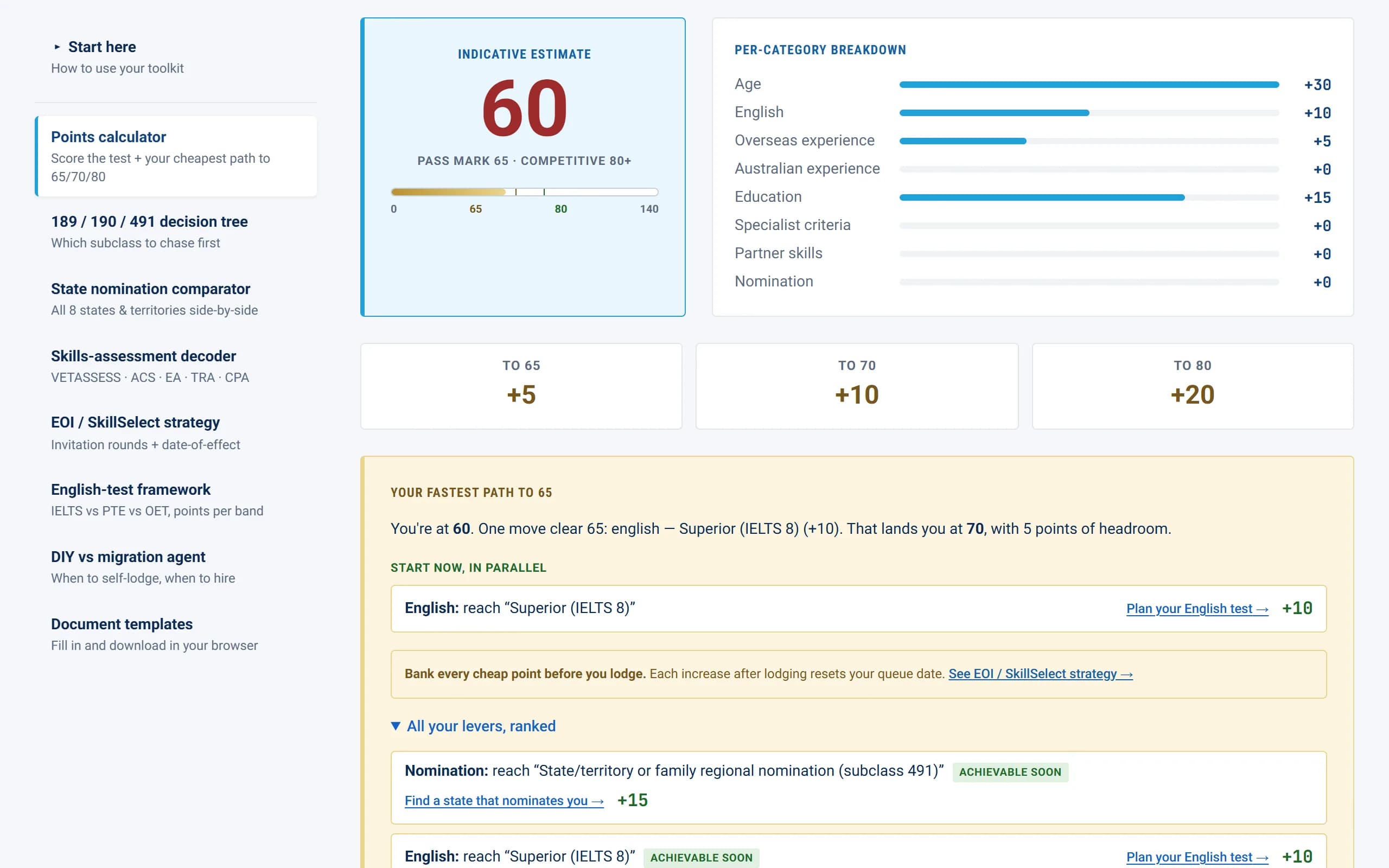
| Points Factor | Points | Notes |
|---|---|---|
| Age (25-32) | 30 | Most radiation oncology SIMGs are 33-39 (25 points) due to training length |
| Qualification (Master's/Specialist Fellowship) | 15 | RANZCR accepts overseas specialist qualifications |
| Qualification (PhD) | 20 | Common in academic radiation oncology |
| English (Superior — 8.0+) | 20 | Standard for fellowship-trained candidates |
| Overseas Experience (8+ years) | 15 | Easily reached by senior candidates |
| Australian Experience | 5-20 | Earned during the 482 peer-review period |
| State Nomination (190) | 5 | Available across most states |
| Regional (491) | 15 | Highest single boost |
| Partner Skills | 5-10 | Spouse with skilled occupation |
Realistic Score Scenarios
Scenario 1: Mid-career radiation oncologist, age 37, Superior English, 10 years post-fellowship
- Age 33-39: 25 + Fellowship: 15 + Superior English: 20 + Overseas Experience: 15 = 75 points
- Add 190 nomination (5): 80 points. Add partner skills (5): 85 — strong invitation prospect
Scenario 2: Senior consultant, age 44, Superior English, 16 years post-fellowship
- Age 40-44: 15 + Fellowship: 15 + Superior English: 20 + Overseas Experience: 15 = 65 points
- Add 491 regional nomination (15): 80 points. Direct path through a regional cancer centre
State Nomination for Radiation Oncologists
New South Wales
NSW's 2025-26 priorities include healthcare specialists. Chris O'Brien Lifehouse, Royal North Shore, Liverpool, Westmead and the Illawarra Cancer Care Centre anchor public capacity. GenesisCare and Icon Group operate multiple NSW sites. Regional NSW carries persistent demand in Newcastle, Wollongong, Coffs Harbour and Orange.
Victoria
Victoria's 2025-26 program allocates 2,700 places for subclass 190. Peter MacCallum Cancer Centre is the dominant public centre with international reputation; Alfred Health, Monash Health and Bendigo, Ballarat and Geelong regional centres also recruit. Healthcare priorities make Victoria a strong nominee for SIMGs with an Australian offer.
Queensland
Queensland's 2025-26 program more than doubled to 2,600 places. Princess Alexandra Hospital, Royal Brisbane and Women's, plus regional sites at Townsville and the Gold Coast carry demand. The state favours onshore applicants.
Western Australia
WA's 2026 program offers 5,000 places across subclasses 190 and 491. Sir Charles Gairdner Hospital is the major public radiation oncology centre; GenesisCare operates Perth and Bunbury facilities. The Contracted Medical Practitioner Agreement pathway accepts radiation oncology offers.
South Australia and Tasmania
Both states actively recruit for regional cancer centres. SA's Royal Adelaide Hospital and the Royal Adelaide Hospital's regional outreach, plus GenesisCare facilities, drive demand. Tasmania's Royal Hobart and Launceston General Hospitals operate radiation oncology services and prioritise SIMG candidates with a state-based offer.
Salary and Employment Outlook
What Can You Expect to Earn?
| Role | Typical Salary Range |
|---|---|
| Staff Specialist (Public, Early Career) | AUD $275,000-$360,000 |
| Senior Staff Specialist (Public) | AUD $360,000-$470,000 |
| Private Radiation Oncologist (GenesisCare, Icon) | AUD $400,000-$650,000 |
| Private Practice Partner / Director | AUD $550,000-$900,000+ |
| Locum Day Rate (Accredited Centre) | AUD $2,500-$4,500/day |
Sources: PayScale (2026) average AUD $275,000; Glassdoor (May 2026) average AUD $598,320 across the full distribution; SEEK Career Advice (2026) for advertised salaried roles. Total packages typically include superannuation (11.5%), CPD allowance, indemnity contribution and equity participation in private practice settings.
Highest-Earning Settings
- Private cancer networks — GenesisCare and Icon Group operate the largest private radiation oncology networks
- Private practice partnerships — partner equity in established practices materially shifts compensation
- Combined academic-clinical appointments — Peter MacCallum, Chris O'Brien Lifehouse and major teaching hospitals offer competitive packages with research time and academic appointments
- Regional cancer centres — rural loading and salary packaging make regional public consultant roles surprisingly competitive
Tips for a Successful Application
1. Document modality breadth and brachytherapy experience
The most common RANZCR partial-comparability finding for radiation oncology SIMGs is limited modality exposure — IMRT, VMAT, SBRT, SABR and brachytherapy across the major tumour streams. Treatment-planning portfolios that show only 3D conformal experience often trigger upskilling requirements.
2. Map your tumour stream experience to RANZCR competencies
RANZCR expects breadth across the major tumour streams (breast, prostate, head and neck, gynaecological, lung, gastrointestinal, lymphoma, paediatric exposure where applicable). If your overseas role was heavily subspecialised, document supervisory and multidisciplinary involvement in the streams you treated less directly.
3. Target an accredited training centre for peer review
Radiation oncology has fewer accredited training sites than diagnostic radiology. Peer review must occur in an accredited site — confirm accreditation status before negotiating an employment offer, particularly for regional positions. Centres like Townsville, Bunbury and Launceston are accredited, but smaller regional sites often are not.
4. Use the Specialist Skills 482 stream for fast onshore arrival
Consultant offers comfortably exceed the Specialist Skills Income Threshold (AUD $146,576 from July 2026), placing applicants in the fast-tracked 7-day median processing stream. This compresses the time between job offer and onshore arrival to a few weeks.
5. Use the skills assessment hub
MedBA + RANZCR + AHPRA registration involves multiple sequential applications. The hub documents the order, fees and timelines for each stage.
Step-by-Step Migration Roadmap
- Confirm your code — ANZSCO 253918 via the ANZSCO code finder
- Check list status — confirm 253918 on the CSOL and MLTSSL
- Lodge ECFMG EPIC — primary source verification, 4-6 months lead time
- Apply to RANZCR SIMG (radiation oncology) — assemble logbooks, treatment plans, references
- Receive comparability outcome — substantial, partial or not comparable
- Plan any required upskilling or Phase 2 exams
- Sit English test — Superior (8.0+) maximises points
- Secure an offer at a RANZCR-accredited centre — public, private network or hybrid
- Apply for AHPRA limited specialist registration — once RANZCR confirms outcome
- Lodge subclass 482 (Specialist Skills stream) — for peer review period
- Lodge EOI for 189/190/491 — in parallel where points support invitation
- Complete peer review, transition to subclass 186 — full AHPRA specialist registration follows
Frequently Asked Questions
Is radiation oncologist on the skilled occupation list for Australia in 2026?
Yes. ANZSCO 253918 Radiation Oncologist sits on both the Core Skills Occupation List (CSOL) and the Medium and Long-term Strategic Skills List (MLTSSL). All five mainstream skilled visas — 189, 190, 491, 482 and 186 — are available.
How is radiation oncology different from medical oncology for migration purposes?
Different ANZSCO codes, different colleges. Radiation Oncologist (253918) is assessed by RANZCR; Medical Oncologist (253913) is assessed by the RACP via the Faculty of Joint College Training. Both sit on the MLTSSL and CSOL with similar visa access, but the assessment processes and required exposure profiles differ materially.
Why is the radiation oncology workforce considered vulnerable?
Cancer incidence is projected to grow from 28,000 to 34,000 new cases annually by 2031 (AIHW). Workforce growth has not kept pace; average consultant age is 42 with significant retirement-driven attrition expected. The Department of Health categorises radiation oncology as a vulnerable workforce, which directly translates into state nomination priority and faster processing for healthcare migration files.
How long does the RANZCR radiation oncology SIMG assessment take?
The assessment timeline parallels diagnostic radiology: a comparability decision in the same application cycle, then 12 months of peer review for substantially comparable candidates, or 12-24 months of upskilling plus Phase 2 exams for partially comparable candidates. End-to-end from application to unrestricted fellowship is typically 18-30 months.
Can I do peer review in a private centre like GenesisCare?
Only if the centre is RANZCR-accredited for training. Many private centres are accredited, particularly the larger GenesisCare and Icon Group sites. Confirm accreditation status with RANZCR before accepting an employment offer for a peer review or upskilling position.
What's the salary outlook for radiation oncologists in Australia in 2026?
Strong. PayScale 2026 lists the average at AUD $275,000; Glassdoor cites AUD $598,320 across the full distribution including private practice partners. Combined with documented workforce shortages and projected cancer incidence growth, compensation and demand are both well-supported.