Pathologist Visa Pathway to Australia: Complete 2026 Guide
Updated: 16 August 2026
Australia classifies Pathologist under ANZSCO 253915. The Medical Board of Australia handles registration; the Royal College of Pathologists of Australasia (RCPA) is the AMC-accredited body for the specialist comparability assessment. The occupation sits on the MLTSSL and CSOL, opening subclasses 189, 190, 491, 482 and 186. Typical 2026 salaries range AUD $250,000-$500,000+, with chronic workforce shortages across anatomical pathology, microbiology and haematology.
Quick Facts: Pathologist Migration Pathway
| Detail | Information |
|---|---|
| ANZSCO Code | 253915 (Pathologist) |
| Skill Level | 1 (Bachelor degree plus five+ years specialist training, registration required) |
| Skills Assessment | MedBA (Medical Board of Australia) via RCPA SIMG pathway |
| Occupation List | MLTSSL and CSOL |
| Visa Options | 189, 190, 491, 482, 186 |
| Demand Level | Very high — median pathologist age is 43, over 25% of the workforce is aged 60+, and at least 70 training positions have been cut over the past decade |
| Salary Range | AUD $250,000-$500,000+ (SEEK 2026; PayScale 2026; senior consultants and group-practice partners exceed this) |
| Typical 189 Score | 80-90 points (medical specialties clear at lower scores than ICT) |
| Key Challenge | RCPA assessment involves an interview, optional written documentation and a 12-month peer-review period before unrestricted Fellowship |
Role Context: Pathology in Australia
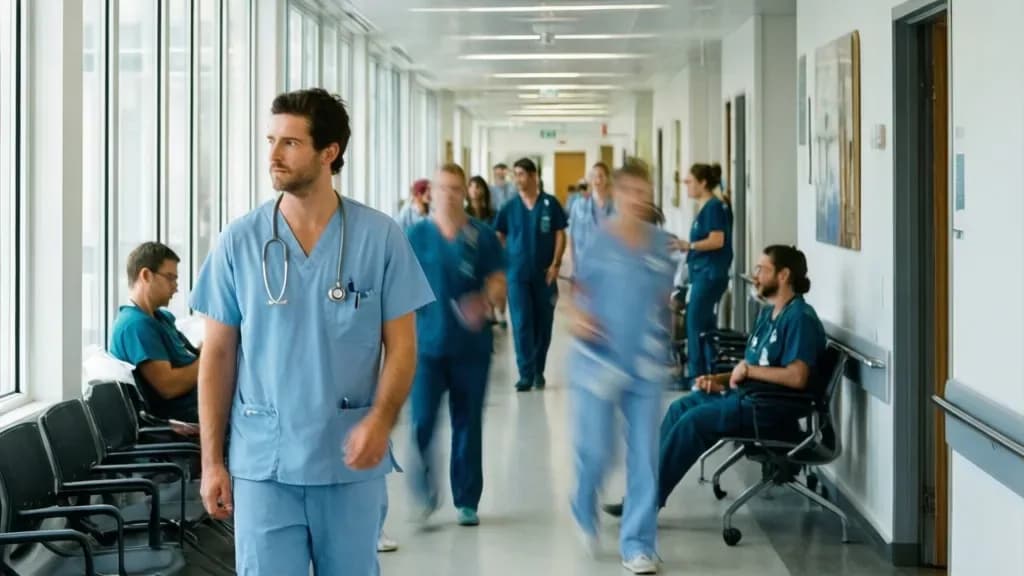
Pathologists in Australia provide the diagnostic backbone of medicine. They report histology, cytology and immunohistochemistry; oversee haematology and chemical pathology testing; supervise microbiology laboratories; and direct forensic and molecular pathology services. Most consultants work for private pathology providers (Sonic, Healius, Australian Clinical Labs), public hospital networks (NSW Health Pathology, Pathology Queensland, Royal Melbourne Hospital), or specialist forensic and research institutes.
Workforce demographics are the single most important context for any prospective SIMG. The Royal College of Pathologists of Australasia's workforce data shows median consultant age of 43 with more than a quarter of the workforce aged 60 or older. Training position cuts over the past decade — at least 70 lost — mean even with strong applicant interest, supply is constrained. Acute shortages are documented in anatomical pathology (cancer diagnosis), haematology, microbiology, chemical pathology and genetic pathology. Regional centres carry the steepest deficits and reporting delays have been raised publicly by the College.
ANZSCO Code 253915
ANZSCO 253915 covers specialists who study the nature, cause and development of disease and the structural and functional changes caused by them. Tasks include examining tissue specimens, supervising laboratory testing, reporting on diagnostic findings, conducting autopsies where applicable, and providing consultation to clinical colleagues on diagnosis and management. The code spans anatomical pathology, clinical (chemical) pathology, haematology, microbiology, immunology, forensic pathology and general pathology. There is no separate ANZSCO code for individual pathology subspecialties — all map to 253915.
Skills Assessment
Medical Board of Australia — Specialist Pathway
The Medical Board of Australia (MedBA) is the registering authority for all specialists in Australia. MedBA does not conduct the technical comparability assessment itself; for pathology, the Royal College of Pathologists of Australasia (RCPA) does that work under AMC accreditation. Primary source verification of your medical qualifications runs through ECFMG's EPIC service (approximately USD $145 for verification plus registration in 2026).
RCPA SIMG Assessment
RCPA assesses Specialist International Medical Graduates against the standard of an RCPA Fellow. Applications are reviewed by the College's SIMG committee, with most progressing to an interview. The committee then returns:
- Substantially comparable — invited to fellowship after up to 12 months of peer review in an accredited Australian or New Zealand laboratory
- Partially comparable — required to undertake further training or assessment (including possible exams) in an accredited department before fellowship eligibility
- Not comparable — must complete the full RCPA training program
There is also an Area of Need pathway for SIMGs sponsored to a specific declared shortage location. AoN applications are fast-tracked by RCPA and assess your qualifications for that particular position rather than for unrestricted Australian practice.
Common rejection or partial-comparability findings include logbooks lacking subspecialty breadth (e.g. only surgical histopathology with no cytology or autopsy work), training programs shorter than RCPA's five-year benchmark, and insufficient documentation of multidisciplinary team participation. The RCPA Schedule of Fees is published annually on the College website and confirmed in your application invoice.
Visa Pathways for Pathologists
Subclass 482 — Skills in Demand Visa (Specialist Skills stream)
The dominant pathway for incoming pathologists. Most consultant salaries clear the Specialist Skills Income Threshold (AUD $146,717 from 1 July 2026), which puts SIMGs into the fast-tracked stream during their RCPA peer review or upskilling period.
- Visa fee: AUD $3,210 primary applicant
- Processing time: 7-day median for the Specialist Skills stream; up to ~50 days at the 90th percentile (Home Affairs, April 2026)
- Duration: Up to 4 years
- Quirk: Specialist Skills stream now offers a clear two-year pathway to subclass 186 permanent residency
Subclass 186 — Employer Nomination Scheme
Permanent residency through employer sponsorship. Most pathologists transition from 482 once RCPA confirms substantial comparability and the peer-review period is underway.
- Visa fee: AUD $6,140 primary applicant
- Processing time: 12-19 months for Direct Entry stream (90th percentile, April 2026); healthcare and regional applications often receive priority
- Quirk: Employer pays the Skilling Australians Fund levy (AUD $3,000-$5,000)
Subclass 189 — Skilled Independent Visa
Permanent residency through the points-based system, available because 253915 is on the MLTSSL.
- Visa fee: AUD $6,135 primary applicant
- Processing time: 6-9 months for decision-ready healthcare applications under the March 2026 processing overhaul
- Quirk: Medical specialties clear invitations at lower thresholds than ICT — 80-85 points is often enough
Subclass 190 — State Nominated Visa
Adds five points and grants permanent residency in exchange for a two-year live-and-work commitment.
- Visa fee: AUD $6,140 primary applicant
- Best states: NSW, VIC, QLD and WA all prioritise healthcare specialists. WA and SA accept contracted medical practitioner agreements in lieu of standard work duration
Subclass 491 — Skilled Work Regional Visa
Adds 15 points. Five-year provisional visa with a pathway to permanent residency via subclass 191.
- Visa fee: AUD $6,140 primary applicant
- Processing time: 15-28 months at the 90th percentile (April 2026); decision-ready onshore healthcare files can finalise in 3-7 months
- Quirk: Regional pathology vacancies are persistent and rural retention loadings can be substantial
Points Test Strategy
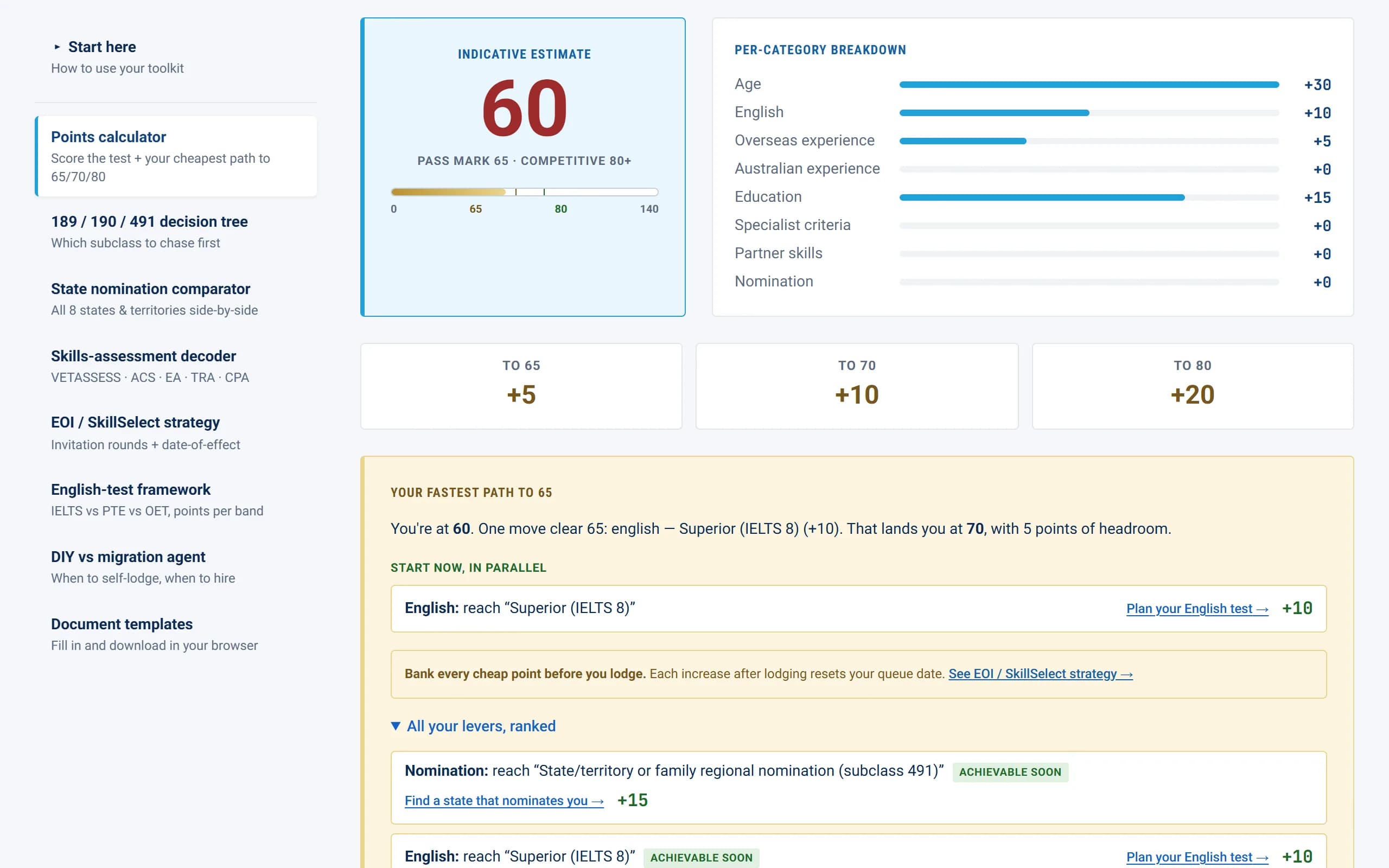
| Points Factor | Points | Notes |
|---|---|---|
| Age (25-32) | 30 | Many SIMG pathologists fall in 33-39 (25 points) due to long training |
| Qualification (Master's/Specialist Fellowship) | 15 | RCPA accepts overseas specialist qualifications |
| Qualification (PhD) | 20 | Common in academic and molecular pathology |
| English (Superior — 8.0+) | 20 | Standard for fellowship-trained candidates |
| Overseas Experience (8+ years) | 15 | Easily reached by mid-career consultants |
| Australian Experience | 5-20 | Earned during the 482 peer-review period |
| State Nomination (190) | 5 | Available across most states |
| Regional (491) | 15 | Best single boost; regional pathology demand is high |
| Partner Skills | 5-10 | Spouse with skilled occupation |
Realistic Score Scenarios
Scenario 1: Mid-career anatomical pathologist, age 37, Superior English, 10 years post-fellowship
- Age 33-39: 25 + Fellowship: 15 + Superior English: 20 + Overseas Experience: 15 = 75 points
- Add 190 nomination (5): 80 points. Strong invitation prospect
Scenario 2: Microbiologist, age 42, Proficient English, 14 years post-fellowship
- Age 40-44: 15 + Fellowship: 15 + Proficient English: 10 + Overseas Experience: 15 = 55 points
- Needs 491 (+15) = 70, plus Superior English upgrade or partner points to push above 80
State Nomination for Pathologists
New South Wales
NSW Health Pathology is one of the largest public pathology networks in the southern hemisphere with locations across metropolitan and regional NSW. Healthcare is a stated 2025-26 NSW priority sector. Expect to score 85-95 points to compete in the 190 stream.
Victoria
Victoria's 2025-26 program allocates 2,700 places for subclass 190. Royal Melbourne Hospital, the Peter MacCallum Cancer Centre and the Victorian Forensic Institute carry significant subspecialty pathology workloads. Regional Victoria has active recruitment in Geelong, Ballarat and Bendigo.
Queensland
Queensland's 2025-26 program more than doubled to 2,600 places. Pathology Queensland operates the state's public hospital pathology service and routinely advertises consultant vacancies. The state favours candidates already onshore in QLD.
Western Australia
WA's 2026 program offers 5,000 places across subclasses 190 and 491. PathWest and private providers have ongoing demand in Perth and across regional WA, and the Contracted Medical Practitioner Agreement pathway accepts pathology offers under Schedule 1.
South Australia, Tasmania and ACT
All three nominate medical specialists. Tasmania has a small but persistent shortage of anatomical and chemical pathologists; the ACT runs forensic and clinical pathology demand through Canberra Hospital. South Australia favours onshore applicants.
Salary and Employment Outlook
What Can You Expect to Earn?
| Role | Typical Salary Range |
|---|---|
| Staff Specialist (Public, Early Career) | AUD $250,000-$320,000 |
| Senior Staff Specialist (Public) | AUD $320,000-$420,000 |
| Private Pathologist (Group Practice) | AUD $350,000-$550,000 |
| Group Practice Partner / Director of Anatomical Pathology | AUD $500,000-$800,000+ |
| Locum Day Rate (Regional) | AUD $2,000-$3,500/day |
Sources: SEEK Career Advice (May 2026) — average pathologist salary AUD $135,000-$155,000 reflects entry positions only; PayScale (2026) medical pathologist average AUD $340,000; industry surveys for partner-level compensation. Total packages typically include superannuation (11.5%), CPD allowance and indemnity contribution.
Highest-Earning Settings
- Private pathology providers — Sonic Healthcare, Healius and Australian Clinical Labs employ the majority of Australia's pathologists at consultant level
- Group practice partnerships — equity in established practices materially shifts compensation
- Forensic institutes — state-funded forensic pathology roles offer competitive base plus on-call loadings
- Public teaching hospitals — predictable hours, salary packaging, academic appointments and access to subspecialty work
Tips for a Successful Application
1. Start ECFMG primary source verification 4-6 months early
The single most common cause of pathology SIMG delays is missing or delayed PSV. EPIC processing has tightened in 2026, with documented delays for certain origin countries. Begin verification before you assemble the RCPA application package.
2. Document subspecialty breadth in your logbook
RCPA expects evidence across the breadth of your declared subspecialty — surgical histopathology with cytology and autopsy, or microbiology with serology and infection control consultation. Logbooks that show only narrow exposure trigger partial-comparability outcomes.
3. Consider the Area of Need pathway for faster processing
If you hold an offer in a state-declared Area of Need, the AoN pathway is fast-tracked by RCPA. The trade-off is that AoN registration is location-specific until you complete the full SIMG pathway, but for regional roles it can shave months off the timeline.
4. Map your subspecialty to demand carefully
Anatomical pathology (cancer diagnosis), haematology and microbiology face the deepest shortages. Forensic pathology demand is concentrated in state institutes. Genetic pathology demand is growing fast. Use this to target regional roles and employer-sponsored offers strategically.
5. Use the skills assessment hub
MedBA + RCPA + AHPRA registration is a three-touchpoint process. The hub documents the order in which to lodge each application and which fees apply at each stage.
Step-by-Step Migration Roadmap
- Confirm your code — ANZSCO 253915 via the ANZSCO code finder
- Check list status — confirm 253915 on the CSOL and MLTSSL
- Lodge ECFMG EPIC — primary source verification, 4-6 months lead time
- Apply to RCPA SIMG — assemble logbooks, training certificates, referee reports
- Attend RCPA interview — when invited by the SIMG committee
- Receive comparability outcome — substantial, partial or not comparable
- Sit English test — Superior (8.0+) maximises points
- Secure an Australian position — staff specialist, group practice or AoN
- Apply for AHPRA limited registration — once RCPA confirms outcome
- Lodge subclass 482 — Specialist Skills stream for peer review period
- Lodge EOI for 189/190/491 — in parallel where points support invitation
- Complete peer review, transition to subclass 186 — full specialist AHPRA registration follows
Frequently Asked Questions
Is pathologist on the skilled occupation list for Australia in 2026?
Yes. ANZSCO 253915 Pathologist sits on both the Core Skills Occupation List (CSOL) and the Medium and Long-term Strategic Skills List (MLTSSL). This unlocks subclasses 189, 190, 491, 482 (Skills in Demand) and 186 (Employer Nomination Scheme).
How does the RCPA SIMG process work?
Apply to RCPA with primary source verified qualifications, logbooks and references. The College reviews and most candidates progress to an interview. Outcomes are substantial, partial or not comparable. Substantially comparable candidates complete up to 12 months of peer review in an accredited laboratory; partially comparable candidates undertake further training plus possible exams. Area of Need applications are fast-tracked.
Which pathology subspecialties have the strongest demand?
Anatomical pathology, haematology, microbiology and chemical pathology face the most acute shortages, with genetic pathology demand growing fast. Regional and rural centres carry the steepest deficits. Workforce data shows median pathologist age of 43 and more than 25% of practitioners aged 60 or older.
Can I work as a pathologist in Australia while my RCPA assessment is in progress?
You cannot practise as an unrestricted specialist before AHPRA registration. Once RCPA confirms substantial comparability, AHPRA can grant limited specialist registration matching the supervised peer-review plan, which lets you work in an accredited laboratory under defined oversight. The Area of Need pathway provides a parallel route for sponsored regional roles.
What's the demand outlook for pathologists in Australia in 2026?
Strong and sustained. The RCPA workforce data indicates significant retirement-driven attrition over the next decade, accredited laboratories are willing to train more registrars than government funding currently supports, and reporting delays have prompted public commentary by the College. Migration is the primary near-term lever.
How much do pathologists earn in Australia?
SEEK 2026 data shows advertised pathologist roles in the AUD $135,000-$155,000 range — these are predominantly trainee or non-fellowship positions. Fellowship-trained consultants in public roles earn AUD $250,000-$420,000 base, and private group practice or partnership earnings reach AUD $500,000-$800,000+ once procedure volume, item bundling and equity are factored in.