Neurologist Visa Pathway to Australia: Complete 2026 Guide
Updated: 16 August 2026
Australia classifies Neurologists under ANZSCO 253318. The Medical Board of Australia (MedBA) handles specialist registration through AHPRA, with the Royal Australasian College of Physicians (RACP) confirming comparability of overseas training. The occupation appears on the MLTSSL and Core Skills Occupation List, opening visas 189, 190, 491, 482 and 186. Jobs and Skills Australia classifies neurologists as a national shortage. Typical 2026 salaries range AUD $245,000-$535,000.
Quick Facts: Neurologist Migration Pathway
| Detail | Information |
|---|---|
| ANZSCO Code | 253318 (Neurologist) |
| Skill Level | 1 (Bachelor degree plus specialist medical training) |
| Skills Assessment | MedBA (Medical Board of Australia) via AHPRA; comparability through RACP |
| Occupation List | MLTSSL and CSOL |
| Visa Options | 189, 190, 491, 482, 186 |
| Demand Level | Critical — Jobs and Skills Australia identifies a national shortage; regional Australia has only 4.1% of the workforce for 31% of the population |
| Salary Range | AUD $245,000-$535,000 (ERI SalaryExpert 2026; private practice higher) |
| Typical 189 Score | 70-85 points |
| Key Challenge | Subspecialty fragmentation — stroke, epilepsy, MS and movement disorders are recognised differently across countries |
What Neurologists Do in Australia
Neurologists diagnose and treat disorders of the brain, spinal cord, nerves and muscles. Australian practice covers stroke, epilepsy, multiple sclerosis, headache, movement disorders, dementia, neuromuscular disease and general neurology. The workforce is small — approximately 570 practising neurologists nationally per Jobs and Skills Australia 2024 data — and concentrated in metropolitan tertiary centres.
Major neurology services operate at Royal Prince Alfred and Royal North Shore (Sydney), the Royal Melbourne and Alfred (Melbourne), Royal Brisbane and Women's, Sir Charles Gairdner (Perth) and Royal Adelaide. Stroke services have expanded rapidly with the rollout of telestroke and endovascular clot retrieval, lifting demand for interventional and acute neurology. Regional Australia carries 31% of the population but only 4.1% of neurologists, leaving large catchments — the NSW Central Coast, Gippsland, Northern Queensland, regional WA — chronically short-staffed.
ANZSCO 253318 — What the Code Covers
The ABS describes Neurologists as specialist physicians who investigate, diagnose and treat diseases and injuries of the human brain, spinal cord, peripheral nervous system and muscle tissue. Registration is required.
Typical duties recognised under the code:
- Diagnosing and managing neurological disease across the lifespan
- Interpreting EEG, EMG, nerve conduction studies and neuroimaging
- Treating stroke including acute reperfusion therapies
- Managing epilepsy, MS, movement disorders, headache and neurodegenerative disease
- Coordinating multidisciplinary care for complex conditions
Migrants with subspecialty training in stroke, epilepsy, MS or movement disorders nominate 253318. The code does not split by subspecialty.
Skills Assessment
Specialist Pathway — Medical Board of Australia
Overseas-trained neurologists apply through the specialist pathway administered by AHPRA. The RACP confirms comparability against the FRACP advanced training program. Detailed body-by-body context is on the skills assessment hub.
Requirements:
- Primary medical degree verified through EPIC (ECFMG)
- Recognised specialist qualification in neurology
- Evidence of recent specialist practice
- English at IELTS 7.0 each band, OET B, PTE 65 or TOEFL equivalent
- A sponsoring Australian position for workplace-based assessment if required
Cost: AHPRA specialist application AUD $989. RACP $1,096 initial application plus $6,184 assessment of comparability. Workplace-based assessment $4,802 annually if required.
Processing time: RACP comparability decisions issue within 6 months of a complete file in most cases. Total time to general specialist registration is typically 12-18 months. Candidates rated "partially comparable" complete top-up training of 6-24 months under supervision.
Common rejection reasons:
- Subspecialty-only training without sufficient general neurology exposure
- Training programs that bundle neurology with internal medicine but lack the dedicated three-year advanced training equivalent
- Insufficient clinical neurophysiology exposure for candidates trained in clinically-focused programs
Subspecialty Recognition and the FRACP Curriculum
The RACP recognises subspecialty interests within the broader FRACP (Neurology) Fellowship — stroke, epilepsy, MS, movement disorders, neuromuscular and clinical neurophysiology. Overseas candidates whose training mapped to a specific subspecialty should request comparability against the full FRACP curriculum rather than the subspecialty alone, otherwise the outcome will likely be "partially comparable" with required top-up.
Visa Pathways for Neurologists
Subclass 482 — Skills in Demand Visa
The most common entry route. Hospitals with active stroke or epilepsy programs run sustained offshore recruitment.
- Visa fee: AUD $3,210 (primary applicant)
- Stream: Specialist Skills (above $141,210) — qualifies for 7-11 day priority processing
- Duration: Up to 4 years, renewable
- Processing time: 7-14 days (Specialist Skills); 21-47 days (Core Skills)
- Quirk: Many neurologists enter via Area of Need positions in regional services, which unlocks conditional specialist registration ahead of full RACP comparability
Subclass 186 — Employer Nomination Scheme
The permanent residency pathway, typically via TRT after two years on the 482.
- Visa fee: AUD $6,140
- Streams: Direct Entry or TRT
- Processing time: 12-20 months (Direct Entry); TRT often faster
- Age exemption: Medical practitioners benefit from the 45-year age exemption in nominated shortage roles
Subclass 189 — Skilled Independent Visa
- Visa fee: AUD $6,135
- Minimum points: 65 — invitations for 253318 typically issue between 70-85 points
- Processing time: 8-14 months
Subclass 190 — Skilled Nominated Visa
- Visa fee: AUD $6,140
- Points boost: +5
- Processing time: 6.5-19 months
- Best states: WA, SA, TAS, regional NSW and QLD
Subclass 491 — Skilled Work Regional Visa
- Visa fee: AUD $6,140
- Points boost: +15
- Processing time: 12-15 months
- Reality: Regional neurology is a critical workforce gap. The Australian and New Zealand Association of Neurologists has modelled persistent shortfalls in regional supply to 2034. Regional Local Health Districts actively sponsor.
Points Test Strategy
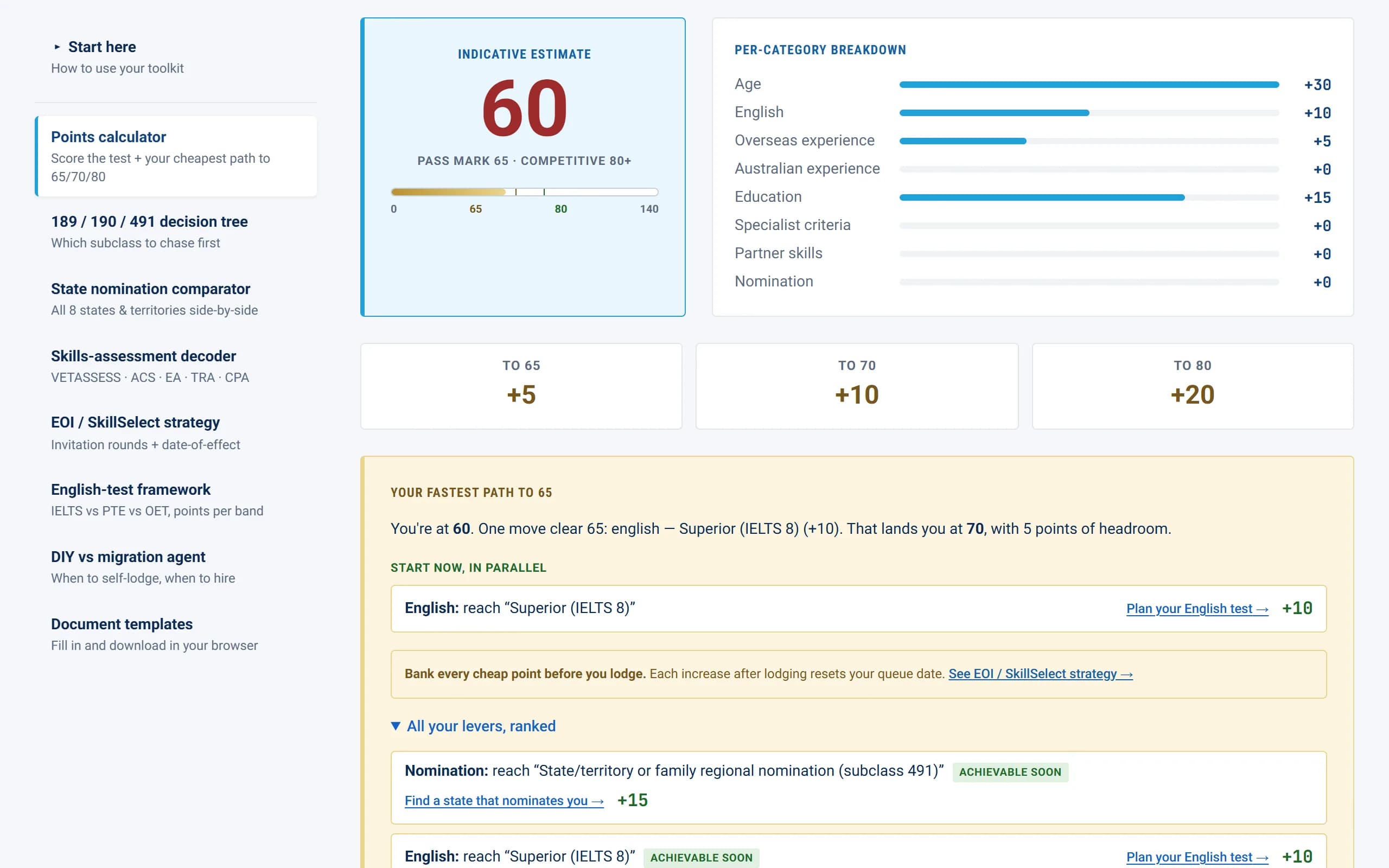
| Points Factor | Points | Notes |
|---|---|---|
| Age (25-32) | 30 | Maximum |
| Age (33-39) | 25 | Most consultants |
| Doctoral / Specialist Fellowship | 20 | FRACP equivalent |
| Bachelor / Postgraduate Medical Degree | 15 | Floor |
| English (Superior — 8.0+) | 20 | OET A |
| English (Proficient — 7.0) | 10 | OET B |
| Overseas Experience (8+ years) | 15 | Standard for consultants |
| State Nomination (190) | 5 | |
| Regional (491) | 15 | |
| Partner Skills | 5-10 |
Realistic Score Scenarios
Scenario 1 — Stroke neurologist 36-year-old neurologist, 8 years post-Fellowship, OET A: 25 + 20 + 20 + 15 = 80 points. Strong for 189 given the shortage classification.
Scenario 2 — Mid-career neurologist seeking regional pathway 42-year-old neurologist, 13 years post-Fellowship, OET B, no Australian work: 15 + 20 + 10 + 15 = 60 points. 491 with regional nomination (+15) reaches 75 — competitive given shortage status.
State Nomination
Western Australia
WA nominates 253318 across both metropolitan Perth and regional services. The WA Country Health Service runs visiting neurologist models in Albany, Bunbury, Geraldton, Kalgoorlie and Broome, and actively sponsors consultants for these networks.
South Australia
SA nominates neurologists under its health stream with offshore concessions. Adelaide's three tertiary networks plus regional services in the Riverland, Limestone Coast and Eyre Peninsula recruit consistently.
Tasmania
Tasmania has a critical neurologist shortage and nominates aggressively for both Hobart and Launceston. The state's small workforce sees long outpatient waiting lists, and the Department of Health prioritises candidates with confirmed offers.
Queensland
Queensland nominates 253318 under its shortage list, with strongest demand in Townsville, Cairns, Mackay and the Sunshine Coast. The Queensland Telestroke service expansion has added sustained subacute demand.
New South Wales
NSW nominates neurologists primarily through the Regional 491 stream. The Central Coast, Hunter New England, Mid North Coast and Far West Local Health Districts run the most active recruitment.
Victoria
Victoria nominates under its Health and Medical Research stream, with strongest demand at Monash Health, Western Health, Goulburn Valley Health and Latrobe Regional Hospital.
Salary and Employment Outlook
Typical Earnings
| Role | Typical Salary Range |
|---|---|
| Staff Specialist (Year 1-3) | AUD $245,000-$320,000 |
| Senior Staff Specialist | AUD $320,000-$430,000 |
| VMO / Public Sessional | AUD $370,000-$500,000 |
| Private Practice Consultant | AUD $400,000-$700,000+ |
| Locum Consultant | AUD $2,200-$2,800/day |
Source: ERI SalaryExpert Australia 2026 (median AUD $370k full-time), Glassdoor AU 2026, and state staff specialist enterprise agreements. Public salaries include 11.5% superannuation and salary packaging. Subspecialists in stroke and epilepsy who hold VMO contracts in addition to public appointments routinely exceed $500,000.
Highest-Paying Sectors
- Private neurology rooms — Sydney North Shore, Melbourne East, Brisbane CBD and Perth Western Suburbs run the highest-billing practices
- Tertiary stroke units — RPA, Royal Melbourne, RBWH, Sir Charles Gairdner
- Epilepsy monitoring units — Austin Health, Royal Melbourne, Westmead, Royal Adelaide
- MS centres — MS Centre at Brain and Mind Centre (Sydney), Melbourne MS clinic, Perron Institute (Perth)
- Regional VMO contracts — premium hourly rates for outreach clinics in regional NSW, Victoria and Queensland
Tips for a Successful Application
1. Map subspecialty training against the full FRACP curriculum
Stroke fellowships, epilepsy fellowships and MS fellowships are common worldwide, but the RACP assesses against the full neurology advanced training curriculum. Show that your training included general neurology rotations, not only subspecialty time, otherwise comparability outcomes default to "partially comparable".
2. Pursue Area of Need positions for the fastest entry
Regional neurologist shortages support standing Area of Need declarations across most states. These positions allow conditional specialist registration before full RACP recognition, collapsing the timeline from 18 months to under 6.
3. Document clinical neurophysiology exposure
EEG and EMG/NCS interpretation is core to Australian neurology practice. Programs from countries where neurophysiology is a separate specialty may show gaps here. Document supervised hours and reports interpreted.
4. Target the Specialist Skills stream of the 482
Neurologist salaries exceed the $141,210 Specialist Skills threshold in nearly all cases, qualifying for priority 7-11 day processing. There is no labour market testing requirement at this level.
5. Apply to both metropolitan and regional services simultaneously
Regional neurologist positions are easier to secure and offer faster RACP processing through Area of Need status. Many overseas consultants use a 12-24 month regional appointment as a stepping stone to a metropolitan post.
Step-by-Step Migration Roadmap
- Confirm Neurologist 253318 matches your training
- Verify list status on the 2026 SOL and CSOL
- Verify your primary medical degree through EPIC (ECFMG)
- Document subspecialty and general neurology rotation hours
- Sit OET — target A in all four bands
- Lodge the RACP comparability application ($1,096 initial fee)
- Apply to AHPRA for specialist registration ($989)
- Approach Australian employers, particularly regional and Area of Need services
- Lodge a subclass 482 Specialist Skills nomination through the employer
- Or, submit an EOI in SkillSelect for 189/190/491
- Apply for state nomination if relevant
- Receive invitation, lodge visa, complete health and character checks
Frequently Asked Questions
Is Neurologist a shortage occupation in 2026?
Yes. Jobs and Skills Australia classifies Neurologists as in national shortage with strong future demand. Modelling by the Australian and New Zealand Association of Neurologists projects persistent shortfalls in regional Australia through 2034. The shortage drives sustained sponsorship and state nomination demand.
Can I migrate as a stroke or epilepsy specialist rather than a general neurologist?
The ANZSCO code is 253318 (Neurologist) regardless of subspecialty. You will be assessed for migration purposes as a neurologist, with subspecialty training counted as part of the broader Fellowship comparability. There is no separate ANZSCO entry for stroke neurology, epilepsy or movement disorders.
Will my European or Indian neurology Fellowship be recognised?
The RACP assesses comparability case-by-case. European Diploma in Neurology and DM Neurology programs (3-year specialist tracks in India) are commonly rated "substantially comparable" with a workplace-based assessment of 6-12 months. Shorter programs and Diploma-level qualifications more commonly clear at "partially comparable" requiring 12-24 months top-up.
How quickly can I start practising under Area of Need?
Once a state Department of Health confirms Area of Need status for the specific position and AHPRA grants conditional specialist registration, you can start practising. The fastest cases close within 4-6 months from RACP application — typically through regional NSW, Tasmania or regional WA appointments.
What is the difference between subclass 189 and 482 for neurologists?
189 is permanent residency without employer sponsorship through the points test. 482 is temporary employer sponsorship that converts to permanent residency via 186 TRT after two years. For neurologists, 482 is faster (often under a year) while 189 requires a competitive points score in the 70-85 range and longer processing.
Which states have the most active regional neurology recruitment?
Western Australia, Tasmania, regional Queensland and regional NSW lead recruitment intensity. WA Country Health Service, Tasmania Department of Health and the NSW Central Coast Local Health District run named recruitment programs targeting offshore neurologists.