ICT Support and Test Engineers nec Visa Pathway to Australia: Complete 2026 Guide
Updated: 16 August 2026
Australia classifies ICT Support and Test Engineers nec under ANZSCO 263299. The Australian Computer Society (ACS) conducts the skills assessment. The occupation sits on the Core Skills Occupation List (CSOL), unlocking subclasses 190, 491, 482 and 186 but excluding the 189 independent pathway. Typical 2026 salaries range AUD $85,000-$130,000. Employer sponsorship is the dominant route because the 189 is not available.
Quick Facts: ICT Support and Test Engineers nec Migration Pathway
| Detail | Information |
|---|---|
| ANZSCO Code | 263299 (ICT Support and Test Engineers nec) |
| Skill Level | 1 (Bachelor degree or higher, or five years of relevant experience with vendor certification) |
| Skills Assessment | ACS (Australian Computer Society) |
| Occupation List | CSOL — STSOL equivalent. Not on MLTSSL. |
| Visa Options | 190, 491, 482, 186 |
| Demand Level | High — driven by enterprise IT, telco and cyber resilience programs |
| Salary Range | AUD $85,000-$130,000 (SEEK Australia, 2026) |
| Typical 190 Score | 75-85 points |
| Key Challenge | The "nec" catch-all is scrutinised closely by ACS — duties must not fit a primary ICT code |
What ICT Support and Test Engineers Do in Australia
The 263299 code captures ICT engineering work that does not fit cleanly into a primary unit-group code such as ICT Systems Test Engineer (263213), ICT Quality Assurance Engineer (263211) or ICT Support Engineer (263212). Applicants under this code typically work across blended functions: test automation that crosses into DevOps, support engineering that includes infrastructure design, or hybrid QA roles that include performance and security testing.
Demand sits in three clusters. The four major banks (CBA, Westpac, NAB, ANZ) run very large internal test and release engineering teams. Telecom carriers and managed service providers (Telstra, Optus, TPG, NCS Australia, DXC, Kyndryl) recruit support and test engineers in volume, particularly in Sydney, Melbourne and Brisbane. Government agencies and defence primes hire test engineers cleared to work on classified systems, with Canberra and Adelaide the main hubs.
Engineers who can move between supporting production environments, writing automated test suites in Python or JavaScript, and triaging complex incidents earn the strongest salaries. The role rewards generalists.
ANZSCO Code Mapping for 263299
The 263299 code is a "not elsewhere classified" residual within Unit Group 2632 (ICT Support and Test Engineers). The unit group's primary codes are:
- 263211 ICT Quality Assurance Engineer — develops standards and procedures to ensure quality of ICT systems
- 263212 ICT Support Engineer — investigates and resolves complex problems in ICT systems and applications
- 263213 ICT Systems Test Engineer — specifies, develops and writes test plans and scripts, and tests system modifications
The 263299 code is used when an engineer's duties span the unit group but do not cleanly match any primary code. ACS scrutinises these applications because misuse is common — applicants often try to fit under "nec" when their work clearly aligns with 263212 or 263213.
If you primarily write and execute test plans, nominate 263213. If you primarily resolve production incidents, nominate 263212. Only choose 263299 when the duties genuinely cross both areas in a way that no single primary code captures.
Skills Assessment with ACS
The Australian Computer Society is the sole assessing body for all 2632 unit group codes, including 263299.
Requirements:
- An ICT major bachelor degree (or higher) closely related to 263299 duties, or
- A non-ICT-major degree with four years of relevant ICT experience, or
- A diploma-level qualification with six years of relevant ICT experience, or
- No qualification with six years of relevant ICT experience plus vendor certifications
ACS experience deduction:
- 2 years deducted if your degree has an ICT major closely related to the nominated occupation
- 4 years deducted if your degree has an ICT major not closely related
- 6 years deducted if your degree is not ICT or you have no formal qualification
Assessment cost: AUD $530 (standard) or AUD $650 (RPL pathway), plus AUD $150 for priority processing Processing time: 8-12 weeks standard, 10 business days priority (for applicants with Australian visa expiry within 12 weeks)
Common rejection reasons for 263299 specifically: ACS often re-classifies applications under a primary code (263212 or 263213) where duties are clearer, or rejects because employment evidence describes generic IT support work below skill level 1. Applicants must show duties that genuinely span the unit group and require degree-level engineering judgment.
See our skills assessment complete guide for ACS-specific templates and evidence requirements.
Visa Pathways for ICT Support and Test Engineers nec
Because 263299 is on the CSOL but not the MLTSSL, the 189 independent visa is not available. Employer sponsorship and state nomination are the routes.
Subclass 482 — Skills in Demand Visa (Dominant Pathway)
The 482 is the most-used route for 263299 holders. Australian IT services firms and banks sponsor at volume.
- Visa fee: AUD $4,015 primary applicant
- Salary threshold: Core Skills stream AUD $79,423 (from 1 July 2026; previously AUD $76,515); Specialist Skills stream AUD $146,576 (from 1 July 2026; previously AUD $141,210)
- Duration: Up to 4 years
- Processing time: Core Skills median 35 days; Specialist Skills median 7 days
- PR pathway: 2 years on 482, then transition to 186 TRT stream
Subclass 186 — Employer Nomination Scheme
Direct permanent residency through an Australian employer.
- Visa fee: AUD $6,140 primary applicant
- Streams: Direct Entry (3 years relevant experience and skills assessment) or Temporary Residence Transition (after 2 years on 482)
- Processing time: Direct Entry currently 11-30 months; TRT typically faster
Subclass 190 — Skilled Nominated Visa
Available where a state or territory nominates 263299 on its current list. State coverage of the "nec" code is patchy and changes mid-cycle — verify the state's published list before lodging an EOI.
- Visa fee: AUD $6,140 primary applicant
- Points boost: +5 from state nomination
- Obligation: Live and work in the nominating state for at least 2 years
Subclass 491 — Skilled Work Regional Visa
Provisional visa with 15 nomination points and a pathway to PR via the 191 visa after 3 years.
- Visa fee: AUD $6,140 primary applicant
- Points boost: +15 from regional nomination
- Processing time: 90% of applications decided within 15-28 months (April 2026 snapshot)
Points Test Strategy
The 189 is not available for 263299. Points still matter for the 190 and 491 because state nomination is competitive and most states rank EOIs by points within the nominated occupation.
| Points Factor | Points | Notes |
|---|---|---|
| Age 25-32 | 30 | Maximum bracket |
| Age 33-39 | 25 | Common range |
| Bachelor degree | 15 | Minimum for skill level 1 |
| Master's degree | 15 | Same as bachelor — no extra points |
| PhD | 20 | Worth pursuing for high scorers |
| English Superior (8.0+) | 20 | Hard to achieve, big payoff |
| English Proficient (7.0) | 10 | More realistic |
| Overseas experience (8+ years after ACS deduction) | 15 | Maximum |
| Australian experience (3+ years) | 15 | Strong for onshore applicants |
| State nomination (190) | 5 | Required for 190 |
| Regional nomination (491) | 15 | Required for 491 |
| Partner skills | 10 | If partner under 45 with competent English and skilled occupation |
Realistic Scenario: Offshore Applicant, 30 years old
Bachelor's in computer science, 7 years overseas test engineering experience (ACS deducts 2 years, leaving 5 years counted), Proficient English (IELTS 7.0):
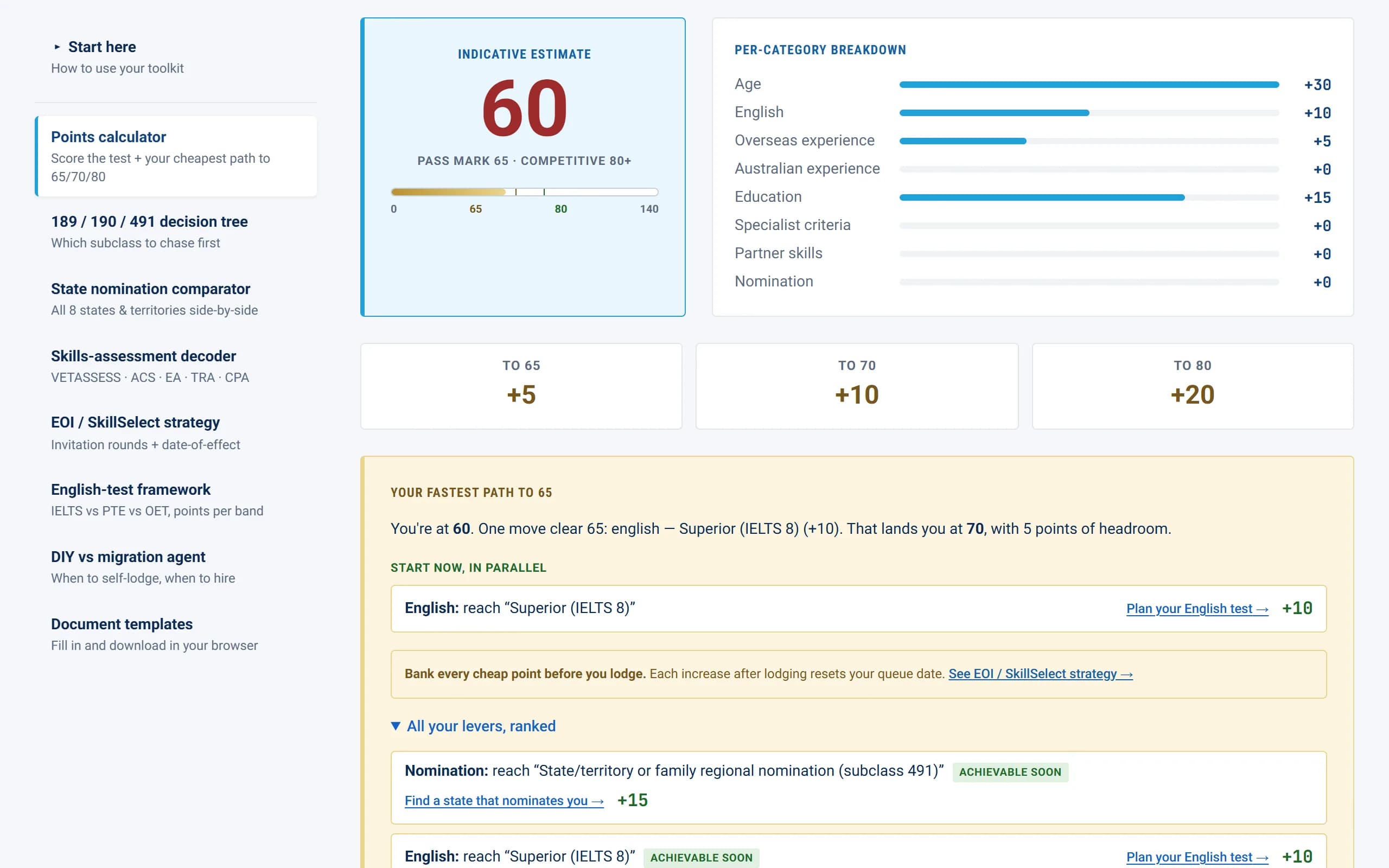
- Age 30 + Bachelor 15 + English 10 + Experience 10 = 65 points
- Add 190 nomination: 70 points
- Add 491 nomination: 80 points
Most states want 75+ for 190 nominations in 2026, so the 491 is the more realistic invitation pathway from a 65-point base.
State Nomination
State coverage for 263299 changes during the program year. Verify the current published list before lodging. As of 2026, ICT roles broadly are still nominated by NSW, Victoria, ACT, South Australia and Tasmania, but the "nec" code is not always included where the primary codes (263211, 263212, 263213) are.
Practical tips:
- NSW and Victoria prioritise applicants with an Australian job offer or recent Australian experience for ICT 190 nominations
- ACT uses a Matrix system that rewards Canberra work experience, partner skills and English
- South Australia offers more accessible nominations for offshore applicants who can show genuine intent to settle in Adelaide
- Tasmania runs a "Tasmanian Skilled Employment" pathway that requires a Tasmanian job offer
If 263299 is excluded from a state's current list, check whether you can re-nominate under 263212 or 263213 based on actual duties.
Salary and Employment Outlook
| Role | Typical Salary Range |
|---|---|
| Junior Test/Support Engineer | AUD $75,000-$95,000 |
| Mid-level Test Engineer | AUD $95,000-$120,000 |
| Senior Test/Support Engineer | AUD $115,000-$140,000 |
| Test Automation Lead | AUD $135,000-$170,000 |
| Contractor (day rate) | AUD $700-$1,100/day |
Source: SEEK Australia salary data for Support Engineer, Testing Engineer and IT Support Engineer roles, April-May 2026.
Total packages typically include 11.5% superannuation. Banks and consulting firms add 10-20% bonuses for senior staff. Equity is uncommon outside startups and scale-ups.
Highest-paying sectors
- Financial services — CBA, Westpac, NAB, ANZ run large internal test and release engineering teams
- Telecommunications — Telstra and Optus pay competitively for performance and reliability engineers
- Defence and government — Lockheed Martin, BAE Systems, DXC and Australian Public Service agencies in Canberra and Adelaide
- Managed service providers — DXC, Kyndryl, Atos and NCS Australia hire support engineers at volume
- Resources — BHP, Rio Tinto and Woodside operate large enterprise IT environments with strong testing requirements
Tips for a Successful Application
1. Justify the "nec" Choice in Your Reference Letters
ACS rejects 263299 applications that read like 263212 or 263213. Your employment references must describe duties that genuinely span the unit group. Show test design AND support, or QA AND infrastructure, with specific examples. If your role is actually pure testing, nominate 263213 — you will have a stronger case.
2. Calculate the ACS Deduction Honestly
If your degree is non-ICT (engineering, science, mathematics), ACS deducts 4 years. If you have no degree, 6 years. With 10 years of work, that can leave you with 4-6 years of "skilled" experience for points purposes. Run the maths before paying the AUD $530 fee.
3. Plan for the 482 Pathway First
Because 189 is closed and 190 is competitive for the "nec" code, employer sponsorship is the realistic primary route. Begin targeted job applications to Australian IT services firms 3-6 months before you finalise your skills assessment. Many will sponsor a strong candidate.
4. Get Australian Vendor Certifications
ISTQB, AWS, Azure, Google Cloud, ServiceNow and Salesforce certifications carry weight with Australian employers and can substitute for some experience gaps. They also help with ACS RPL pathway evidence if your formal qualifications are weak.
5. Sit IELTS or PTE for Superior English
The gap between Proficient (10 points) and Superior (20 points) is 10 points — the difference between an invitation and silence at 70 points. PTE Academic is often the easier path to Superior for ICT applicants.
Step-by-Step Migration Roadmap
- Compare 263299 against 263212 and 263213 using the ANZSCO code finder — make sure "nec" is justified
- Audit your employment evidence for duties that span the 2632 unit group
- Sit IELTS, PTE or TOEFL — aim for Superior (8.0+) if possible
- Apply for ACS skills assessment — AUD $530, allow 8-12 weeks
- Calculate points with ACS deduction factored in
- Decide between employer sponsorship and state nomination based on your score
- For 482: begin job applications to sponsoring employers; secure offer; nominate via the 482 subclass
- For 190/491: submit EOI in SkillSelect, then apply for state nomination
- Complete health checks and police certificates for all applicants
- Lodge the visa application within the invitation window
- Provide post-lodgement evidence if requested
- Receive grant and relocate to Australia
Frequently Asked Questions
Why is 263299 only on the CSOL and not the MLTSSL?
The Department of Home Affairs distinguishes between primary ICT codes (mostly on the MLTSSL) and "nec" residual codes (typically on the CSOL or STSOL). The MLTSSL is reserved for occupations with sustained, identifiable shortage. Because the "nec" code is broad and ambiguous, it sits one tier lower. The practical impact is that the 189 independent visa is unavailable.
Should I nominate 263299 or 263213 if I do mostly testing?
Nominate 263213 if your work is primarily test design, test automation, or performance testing. The primary code has stronger list access (it is on the MLTSSL) and faces less ACS scrutiny. Only choose 263299 when your duties genuinely span both testing and support engineering and no primary code captures the role.
Can I move from 482 to PR on the 263299 code?
Yes. After two years working in Australia on a 482 visa, you can apply for the 186 Temporary Residence Transition stream. Your employer must continue to nominate you, your salary must remain at or above the Core Skills Income Threshold, and you must still hold a valid skills assessment for 263299.
Which states currently nominate 263299?
State nomination of "nec" codes is volatile. ACT and South Australia have historically nominated 263299; NSW and Victoria typically prioritise the primary codes. Check the relevant state's current published list before lodging your EOI. The most in-demand occupations page tracks recent invitation trends.
How long does the full migration process take for this occupation?
From English test to visa grant: 482 employer-sponsored route typically completes in 6-12 months; 190 state nomination route in 12-18 months; 491 regional route in 18-30 months. ACS assessment adds 8-12 weeks at the start. The bottleneck is usually state nomination availability or finding a sponsoring employer.