Engineering Visa Pathway to Australia: Complete 2026 Guide
Engineers are consistently in demand across Australia's infrastructure, mining, construction, and manufacturing sectors. Most engineering occupations sit on the MLTSSL with full visa access, and Australia's massive infrastructure pipeline ensures this demand will continue. The key to a successful engineering migration is navigating the Engineers Australia assessment process, particularly the Competency Demonstration Report (CDR). Here's your complete guide.
Quick Facts: Engineering Migration Pathway
| Detail | Information |
|---|---|
| Key ANZSCO Codes | 233211 (Civil), 233512 (Mechanical), 233311 (Electrical), 233611 (Mining) |
| Skills Assessment | Engineers Australia (EA) |
| Assessment Method | CDR or Washington/Sydney/Dublin Accord |
| Occupation List | MLTSSL — most engineering codes |
| Visa Options | 189, 190, 491, 482, 186 |
| Processing Time | 4-12 weeks (EA assessment) |
Engineering Occupations on Skilled Lists
Most engineering occupations are on the MLTSSL:
| Occupation | ANZSCO | List |
|---|---|---|
| Civil Engineer | 233211 | MLTSSL |
| Structural Engineer | 233214 | MLTSSL |
| Mechanical Engineer | 233512 | MLTSSL |
| Electrical Engineer | 233311 | MLTSSL |
| Electronics Engineer | 233411 | MLTSSL |
| Mining Engineer | 233611 | MLTSSL |
| Chemical Engineer | 233111 | MLTSSL |
| Industrial Engineer | 233511 | MLTSSL |
| Environmental Engineer | 233915 | MLTSSL |
| Biomedical Engineer | 233913 | MLTSSL |
| Engineering Manager | 133211 | MLTSSL |
Engineers Australia Skills Assessment
Two Assessment Pathways
1. Accord Pathway (Fastest)
If your engineering degree is from a program accredited under one of the international accords:
- Washington Accord: Professional engineer qualifications (4-year degree). Members include Australia, UK, US, Canada, South Korea, Japan, South Africa, India (some programs), and others.
- Sydney Accord: Engineering technologist qualifications (3-year degree)
- Dublin Accord: Engineering associate qualifications (2-year diploma)
If your degree is from an accredited program under these accords, assessment is streamlined — you submit your qualification evidence and EA verifies the accreditation. No CDR required.
2. CDR Pathway (Non-Accord Degrees)
If your engineering degree isn't from an accord-accredited program, you must submit a Competency Demonstration Report (CDR).
The CDR: What's Involved
The CDR is a comprehensive package demonstrating your engineering competencies:
Three Career Episodes: Each 1,000-2,500 words, describing specific engineering projects or work you've undertaken. Each episode must demonstrate different engineering competencies.
Summary Statement: A matrix mapping specific paragraphs in your career episodes to the competency elements for your nominated engineering category.
Continuing Professional Development (CPD): A list of your professional development activities (courses, conferences, workshops, publications).
CV/Resume: Detailed career history.
CDR Tips
- Write career episodes about real projects you worked on
- Focus on YOUR contribution, not the team's work
- Use first person ("I designed," "I calculated," not "we designed")
- Include technical detail — calculations, methodologies, standards used
- Each episode should be from a different time period or project type
- Plagiarism detection is used — do not copy from templates or other people's CDRs
- Have your CDR professionally reviewed before submission
Common CDR Mistakes
- Generic descriptions that don't show personal contribution
- Copying from online templates (flagged by plagiarism software)
- Not mapping competency elements correctly in the Summary Statement
- Career episodes that are too short or lack technical depth
- Not demonstrating problem-solving and engineering judgement
EA Assessment Fees and Processing
Standard assessment fee: approximately AUD $670-$1,050 depending on pathway. Processing: 4-12 weeks for standard applications.
Visa Options for Engineers
Points-Tested Stream
- Subclass 189: Independent — no nomination, highest competition (80-90+ points for most engineering codes)
- Subclass 190: State nominated — 5 bonus points, states actively seek engineers
- Subclass 491: Regional — 15 bonus points, mining and infrastructure projects drive regional demand
Employer Sponsored
- Subclass 482: Temporary skill shortage, 4-year medium-term stream
- Subclass 186: Permanent residency through employer nomination
- Subclass 494: Regional employer sponsored
Engineering employer sponsorship is common, particularly in mining (WA, QLD), infrastructure (all states), and defence (ACT, SA, VIC).
Points Optimisation for Engineers
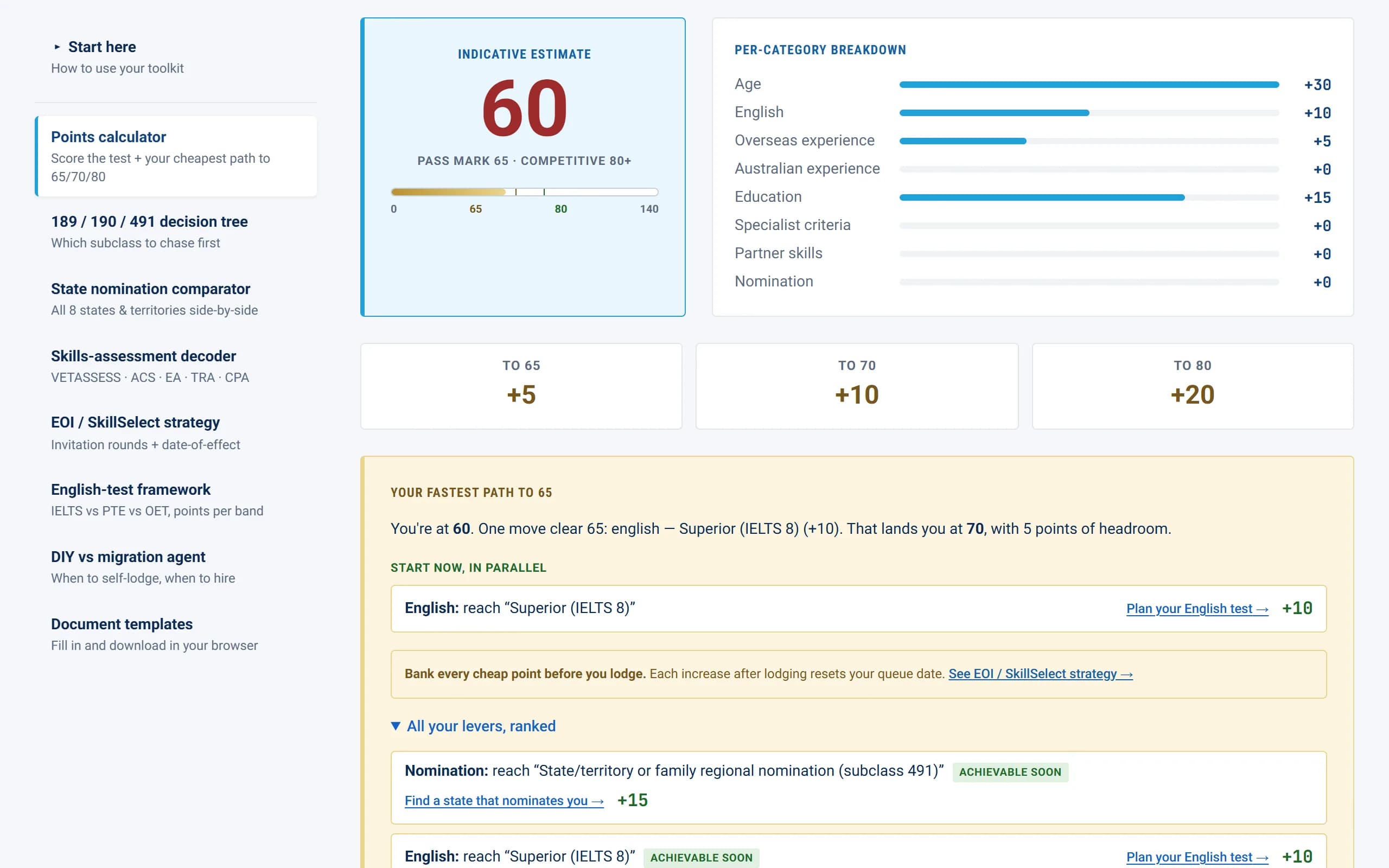
| Factor | Typical Score | Maximum |
|---|---|---|
| Age (25-32) | 25-30 | 30 |
| English | 10-20 | 20 |
| Overseas experience (8+ years) | 15 | 15 |
| Australian experience | 0-10 | 20 |
| Qualifications (Bachelor's/Master's) | 15-20 | 20 |
| State nomination (190) | 5 | 5 |
| Regional (491) | 15 | 15 |
Key Strategy: English
Many engineers from non-English-speaking countries score 10-20 points less on English than they could. Investing in test preparation to move from Competent (0 points above baseline) to Proficient (10 extra points) or Superior (20 extra points) can be transformative.
Industry Demand by Sector
Mining and Resources
Western Australia and Queensland dominate mining engineering demand. Mining engineers, geotechnical engineers, and mechanical engineers working in resources consistently find employer sponsorship opportunities.
Infrastructure
National infrastructure projects in transport (rail, road, bridges), water, and energy create sustained civil and structural engineering demand across all states.
Defence
Australia's defence build-up is creating demand for systems engineers, electrical engineers, and mechanical engineers, particularly in Adelaide (naval shipbuilding), Canberra, and northern Australia.
Renewable Energy
The transition to renewable energy drives demand for electrical engineers, environmental engineers, and energy specialists.
Construction
The 2032 Brisbane Olympics and ongoing urban development create demand for civil, structural, and construction engineers.
Frequently Asked Questions
Does the Washington Accord cover my degree?
Check Engineers Australia's website for the list of accredited programs under each accord. Not all programs within a member country are automatically accredited — the accreditation applies to specific programs at specific institutions.
How long should my CDR career episodes be?
Each career episode should be 1,000-2,500 words. Aim for 1,500-2,000 words for a thorough but focused description.
Can I get help writing my CDR?
You can have someone review your CDR for language and structure, but the content must be your own work. CDRs are checked for plagiarism, and using a ghost-writing service can result in a negative assessment or ban.
What English score do engineers need?
Minimum Competent English (IELTS 6.0 each band) for the visa. Higher scores earn more points. PTE Academic is popular among engineers as an IELTS alternative.
Is it hard for engineers to find work in Australia?
Engineers in shortage specialisations (civil, mechanical, electrical, mining) generally find employment relatively quickly, particularly if willing to work regionally. Competition is higher in metropolitan areas for some specialisations.
Can engineering technologists migrate too?
Yes. Engineering Technologist occupations (233914, 312999 etc.) are also on skilled lists, though with more limited options. The Sydney Accord provides streamlined assessment for technologist-level qualifications.