ICT Systems Test Engineer Visa Pathway to Australia: Complete 2026 Guide
Updated: 16 August 2026
Australia classifies ICT Systems Test Engineer under ANZSCO 263213. The Australian Computer Society (ACS) conducts the skills assessment. The occupation sits on the Core Skills Occupation List (CSOL), making subclasses 190, 491, 482 and 186 available. It is not on the MLTSSL, so the 189 independent route is closed. Typical 2026 salaries range AUD $95,000-$140,000, with senior automation and SDET roles reaching $160,000+.
Quick Facts: ICT Systems Test Engineer Migration Pathway
| Detail | Information |
|---|---|
| ANZSCO Code | 263213 (ICT Systems Test Engineer) |
| Skill Level | 1 (Bachelor degree or higher, plus relevant experience) |
| Skills Assessment | ACS (Australian Computer Society) |
| Occupation List | CSOL only (no MLTSSL — subclass 189 unavailable) |
| Visa Options | 190, 491, 482, 186 |
| Demand Level | High — strong in banking, government and SaaS, especially for automation and SDET specialists |
| Salary Range | AUD $95,000-$140,000 (SEEK, Indeed, SalaryExpert 2026) |
| Typical 482 Salary | Most testers sit between Core Skills ($79,423) and Specialist ($146,576) thresholds |
| Key Challenge | No 189 pathway — must secure state nomination or employer sponsorship |
What ICT Systems Test Engineers Do in Australia
ICT Systems Test Engineers design and execute test plans for software, hardware and integrated systems. The work covers functional testing, regression testing, performance and load testing, security testing, and increasingly test automation across CI/CD pipelines. In a modern Australian engineering team, the role often blends manual testing with scripting in Python, JavaScript or Java, plus tools like Selenium, Cypress, Playwright, Postman, JMeter and TestRail.
Demand concentrates in the four big banks (CBA, Westpac, NAB, ANZ), the federal and state government digital agencies, large insurers (IAG, Suncorp, QBE), and the SaaS sector built around Atlassian, Canva, Xero, MYOB, REA Group and SafetyCulture. The Department of Defence and intelligence agencies also recruit test engineers for cleared programs, though those roles usually require Australian citizenship. Consulting firms — Accenture, Deloitte, Capgemini, Infosys, TCS — are the largest sponsors of overseas test engineers and the most common entry point for migrants on 482 visas.
The geographic centre of gravity is Sydney, followed by Melbourne. Brisbane, Canberra and Adelaide all have growing test communities, particularly around defence and government work. Remote-friendly arrangements are common, but most sponsoring employers still require some office presence.
ANZSCO 263213 — The Code in Detail
The ABS describes ICT Systems Test Engineer as the role that specifies, develops and writes test plans and test scripts, produces test cases, performs regression testing, and uses automated test tools to verify the behaviour, functionality and integrity of computer systems.
Typical tasks include:
- Reviewing requirements and design documents to design test strategies
- Writing detailed test cases and test scripts
- Building and maintaining automated test suites
- Running functional, integration, regression, performance and security tests
- Logging, triaging and re-testing defects
- Producing test reports and quality metrics for project stakeholders
The closest adjacent codes are 261313 Software Engineer and 261311 Analyst Programmer. If your role is genuinely half coding and half testing, weigh the codes carefully. Software Engineer (261313) is on the MLTSSL and unlocks the 189, which testing does not. But ACS will fail an assessment where the duties on your reference letters do not match the nominated code — so do not stretch the description.
Skills Assessment — ACS
ACS conducts every skills assessment for 263213. The body's published fees apply across all ICT codes.
Application pathways and fees:
- Post Australian Study skills assessment: AUD $1,136
- General skills assessment: AUD $1,498
- Recognition of Prior Learning (for non-ICT degrees or unqualified applicants): AUD $625 (RPL component) on top of the relevant pathway fee
- Qualification-only assessment: AUD $625
Processing time: ACS publishes a standard processing window of 8-12 weeks once your application is paid and submitted. Cases requiring document follow-up routinely run longer.
ACS experience deduction. ACS deducts years from your total experience for points purposes, based on how closely your qualification matches the nominated occupation:
- 2 years deducted — ICT major closely related to 263213
- 4 years deducted — ICT major not closely related
- 6 years deducted — non-ICT major (a maths or engineering degree with limited ICT subjects falls here)
A common rejection pattern: applicants with electronics or mechanical engineering degrees who have moved into testing get hit with the 6-year deduction. If you have 8 years of testing experience, ACS may credit only 2 years toward points, which can drop you below the invitation threshold. Calculate this early.
The second common failure mode is reference letters that describe generic "QA work" without naming the specific testing activities tied to ANZSCO 263213. References should explicitly cover test planning, test case design, automation, defect management and reporting — in the applicant's own role, not the team's.
Visa Pathways for ICT Systems Test Engineer
Because 263213 sits on the CSOL only, the subclass 189 is unavailable. Your realistic options are 190, 491, 482 and 186.
Subclass 482 — Skills in Demand Visa
The dominant pathway for overseas test engineers. Sponsorship from a Standard Business Sponsor unlocks a temporary visa of up to 4 years.
- Visa application fee (primary): AUD $4,015
- Salary thresholds (to 30 June 2026): Core Skills Stream AUD $76,515; Specialist Skills Stream AUD $141,210. The Department of Home Affairs increased these to $79,423 and $146,576 from 1 July 2026.
- Eligibility for testers: Most mid-level testers earn within the Core Skills band; senior automation engineers and test architects often clear the Specialist threshold and benefit from faster processing.
- Processing: Core Skills typically 1-3 months; Specialist Skills usually under 1 month.
Subclass 190 — State Nominated Visa
Permanent residency through state nomination. Adds 5 points to your EOI. The catch with 263213 is that not every state nominates it every year. NSW and Victoria are the most active for ICT testing roles; both run targeted invitation rounds rather than open lists.
- Visa application fee: AUD $6,140 (primary applicant, 2025-26 schedule)
- Commitment: Live and work in the nominating state for at least 2 years
- Reality: With ACS deductions, most testers need either a high English score or an Australian study pathway to be competitive.
Subclass 491 — Skilled Work Regional (Provisional)
A 5-year provisional visa for regional Australia, with a pathway to PR through subclass 191 after meeting income and residence requirements. Adds 15 points to your EOI.
- Visa application fee: AUD $6,140
- Regional definition: Everywhere outside Sydney, Melbourne and Brisbane
- Best fit: Testers willing to base themselves in Canberra (technically regional for skilled migration), Adelaide, Hobart, Perth, Newcastle or the Gold Coast.
Subclass 186 — Employer Nomination Scheme
Permanent residency through employer sponsorship.
- Visa application fee: AUD $6,140
- Streams: Direct Entry (3 years experience + skills assessment) or Temporary Residence Transition (after roughly 2 years on a 482).
- Reality for testers: The TRT stream is the cleanest route — start on a 482 with a stable employer, then transition once eligible.
Points Test Strategy
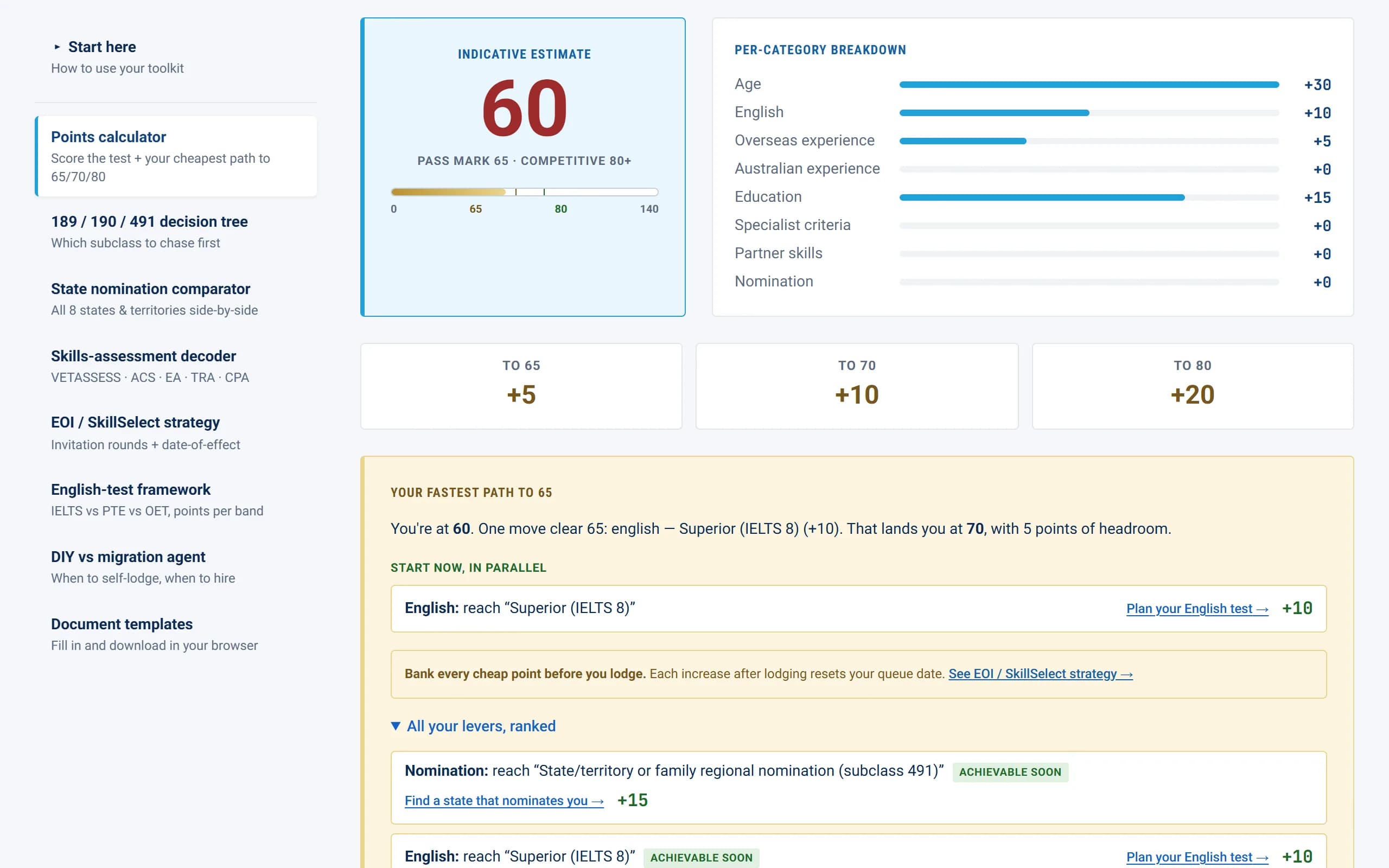
Because 263213 is not on the MLTSSL, the 189 is not an option — but the points test still matters for 190 and 491.
| Points Factor | Points | Notes |
|---|---|---|
| Age 25-32 | 30 | Maximum bracket |
| Age 33-39 | 25 | |
| Bachelor degree | 15 | Minimum for skill level 1 |
| Master's | 15 | Same as bachelor unless specialist |
| PhD | 20 | Uncommon for testers, but applies |
| English Proficient (IELTS 7) | 10 | |
| English Superior (IELTS 8) | 20 | Big lever |
| Overseas experience 5-8 years after ACS deduction | 10 | |
| Overseas experience 8+ years after deduction | 15 | |
| Australian study (CRICOS) | 5 | |
| State nomination 190 | 5 | |
| Regional nomination 491 | 15 | |
| Partner skills points | 5-10 | |
| NAATI CCL | 5 | Community language credential |
Realistic Scenarios
Scenario A — Mid-level tester, India: 30 (age 28) + 15 (bachelor) + 10 (IELTS 7) + 5 (3 years experience after 4-year deduction) = 60 points. With 491 regional nomination (+15) the total reaches 75 — competitive in most rounds for the right state.
Scenario B — Senior automation engineer, UK: 25 (age 35) + 15 (bachelor) + 20 (Superior English) + 15 (8 years after 4-year deduction) = 75. With 190 (+5) reaches 80, which has cleared NSW ICT rounds in 2025-26 for senior profiles.
State Nomination
Verify against each state's published occupation list before lodging an EOI — programs update annually and the activity for 263213 has historically been narrow.
New South Wales
NSW has nominated 263213 for both 190 and 491 in recent rounds, though invitations are issued selectively. Sydney remains the country's largest market for software testers, with strong demand in banking, fintech and insurance. NSW prioritises applicants with current local experience, so the path is realistically open to onshore candidates already on 482 visas or graduate visas.
Victoria
Victoria has 3,400 skilled visa places for 2025-26 and runs rolling invitation rounds. ICT occupations including software testing are part of the program, with stronger consideration for candidates working in Melbourne tech employers or holding clear ties to the state.
Australian Capital Territory
The ACT nominates ICT occupations on a "Critical Skills" basis. Test engineers with prior Australian experience — particularly in Canberra-based government, defence or consulting roles — find ACT among the most accessible programs.
South Australia and Tasmania
Both states include ICT occupations in their general skilled programs, with preference for offshore applicants holding genuine intent to relocate. Tasmania's program is the smallest but historically the lowest-points threshold for niche ICT codes.
Salary and Employment Outlook
| Role | Typical Range (AUD) |
|---|---|
| Junior Tester / QA Analyst (0-3 yrs) | $70,000-$95,000 |
| Mid-level Test Engineer | $95,000-$120,000 |
| Senior Test Engineer | $115,000-$140,000 |
| SDET / Automation Engineer | $120,000-$160,000 |
| Test Lead / QA Manager | $140,000-$180,000 |
| Performance / Security Test Specialist | $130,000-$170,000 |
| Day-rate contractor | $700-$1,100/day |
Sources: SEEK Career Advice (Apr-May 2026), Indeed Australia, SalaryExpert and PayScale 2026 data, cross-checked against current SEEK job-ad disclosures.
Superannuation is 12% on top of base. Banks and insurers typically add 10-20% annual bonuses for senior testers. SaaS employers like Atlassian and Canva offer equity which can be material at senior levels. Day-rate contracting through agencies (Talent International, Paxus, Peoplebank) is common for senior engineers — particularly into government and banking projects — and is one route to clearing $200k+ in a strong year.
Highest-paying domains: investment banking platform testing, payments and clearing, defence (citizenship-restricted), insurance core-systems migration, and AI/ML model evaluation roles which now sit on the boundary between traditional QA and data science.
Tips for a Successful Application
1. Choose between 263213 and 261313 carefully
If more than half your day is writing production code rather than testing it, Software Engineer (261313) opens the 189 and is worth considering. If your reference letters genuinely describe test planning, automation framework design and defect management, stay with 263213 — it is cleaner and ACS approves it readily for true test engineers.
2. Get reference letters written to the ANZSCO description
ACS rejects 263213 cases where references read like generic "I worked on QA in the team." References must describe what you personally did: which test cases you owned, which automation frameworks you built, which tools you used, which release cycles you supported.
3. Model the ACS deduction before sitting English
If you hold a non-ICT degree, the 6-year deduction can wipe out most of your experience points. Run the points calculator with the deduction applied first — then decide whether Superior English, an Australian study pathway, or shifting to 491 regional is the right lever.
4. Onshore beats offshore for state nomination
NSW, Victoria and ACT all favour candidates already living and working in their state. A 482 sponsored role for 18-24 months is the most reliable runway to a 190 nomination.
5. If you can clear the Specialist Skills threshold, take it
Salaries above the Specialist threshold ($146,576 from 1 July 2026, previously $141,210) get 482 applications processed in under a month and bypass labour-market testing. Senior automation roles in banking and fintech routinely clear this bar.
Step-by-Step Migration Roadmap
- Confirm your duties match ANZSCO 263213 — read the official description and compare against your last two job descriptions
- Choose ACS pathway (General, Post-Australian-Study, or RPL) — see our skills assessment bodies complete list
- Gather references covering test planning, scripting, automation and defect lifecycle
- Sit IELTS, PTE Academic or OET — target 79+ PTE (Superior) for maximum points
- Lodge ACS skills assessment (AUD $1,498 for General; 8-12 weeks)
- Calculate points with ACS deduction applied
- Decide route: 482 sponsorship (faster), or 190/491 nomination via EOI
- For sponsorship, target employers on the ACMA-published sponsor list active in tech hiring
- Lodge EOI in SkillSelect for 190/491 if pursuing nomination
- Apply for state nomination through the relevant state portal
- Receive invitation — lodge full visa application within 60 days
- Complete health and character checks, then await grant
Internal references: how to find your ANZSCO code, skilled occupation list 2026, CSOL hub.
Frequently Asked Questions
Why isn't ICT Systems Test Engineer on the MLTSSL?
Jobs and Skills Australia distinguishes between core skill shortages (CSOL) and long-term strategic shortages (MLTSSL). Test engineering is in genuine demand but the federal department reads the labour market as adequately supplied by the existing onshore talent pool plus 482 sponsorship. The MLTSSL is reserved for occupations the Department considers structurally undersupplied. The CSOL placement still unlocks the most common employer-sponsored route.
Is 263213 easier to get approved than 261313 by ACS?
Generally yes, if your duties genuinely fit. ACS scrutinises Software Engineer applications heavily because it is the highest-volume code. Test Engineer assessments tend to clear more cleanly when the reference letters are properly drafted. But picking 263213 to "avoid" ACS scrutiny when you actually work as a developer will fail — duties must match.
Can I switch from 263213 to 261313 later in my career?
You can — but each ACS assessment is occupation-specific. If you move into development, you would need a new assessment under 261313 to use that code for points or future visa applications. Many migrants assess under 263213 first because their current role fits, then re-assess under 261313 once their duties shift into engineering.
Which Australian employers most commonly sponsor 482 visas for testers?
The four big banks, the federal government's digital service agencies (DTA, Services Australia, ATO via contractors), the global consultancies (Accenture, Deloitte, Capgemini, Infosys, Wipro, TCS, Cognizant), and the larger SaaS employers including Atlassian, Canva and SafetyCulture. Standalone fintechs sponsor selectively, usually for senior automation specialists.
Is automation experience required, or is manual testing still enough?
Manual-only testers can still pass the ACS assessment for 263213 — the code does not require automation. But sponsoring employers and state nomination panels increasingly look for Selenium, Cypress, Playwright, API testing and CI/CD pipeline experience. A manual-only profile typically caps at $95k-$110k in the current market; automation specialists clear $120k-$160k.
Will the 1 July 2026 salary threshold change affect my application?
Yes. Nominations lodged before 1 July 2026 were assessed against the previous thresholds (AUD $76,515 Core Skills, AUD $141,210 Specialist). Nominations lodged from 1 July 2026 must meet AUD $79,423 (Core Skills) and AUD $146,576 (Specialist). If your offered salary sits between the old and new thresholds, it no longer qualifies — speak to your sponsoring employer about a salary review.