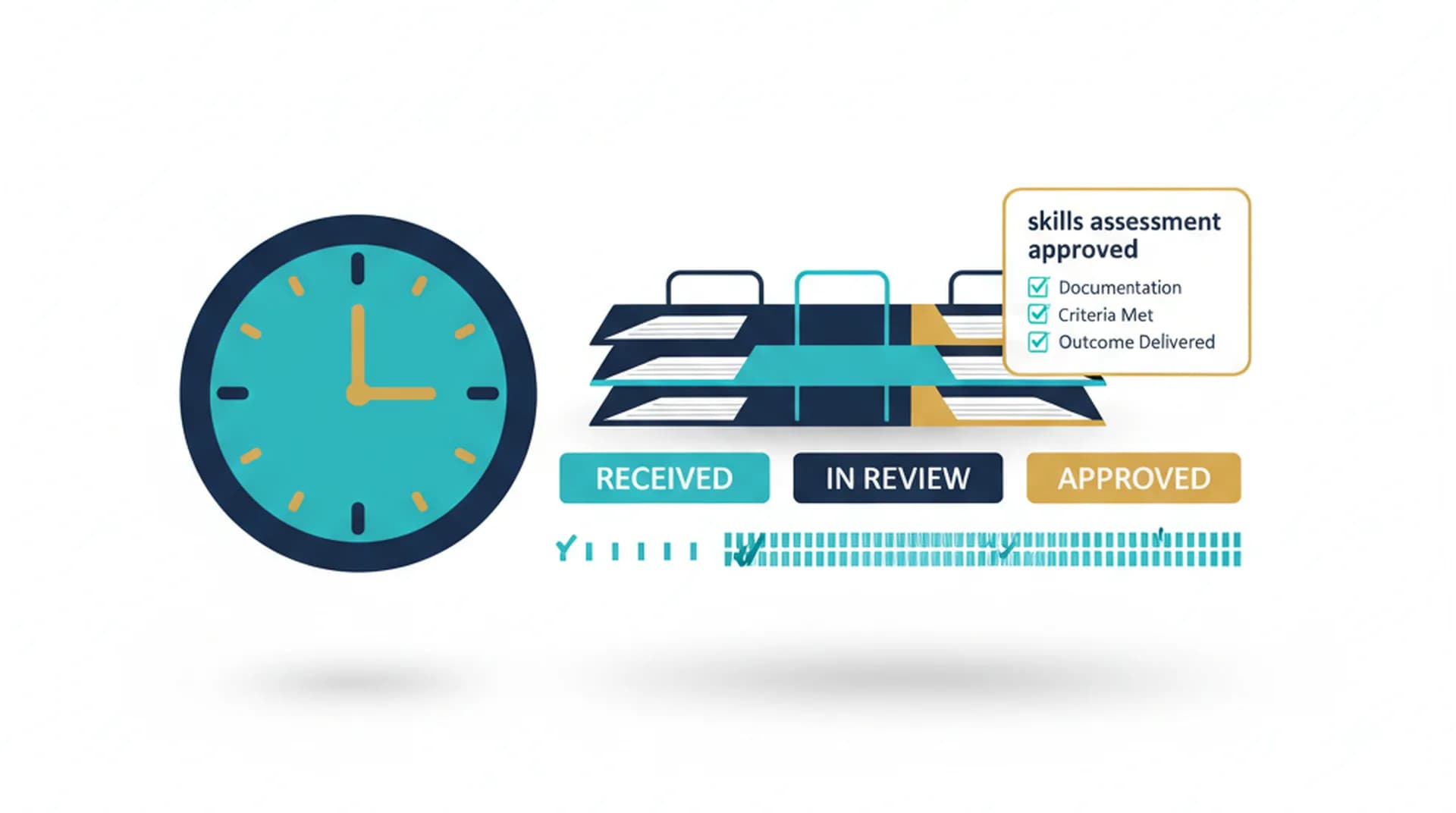
Skills Assessment Processing Times by Authority
Updated: 25 June 2026
Skills assessment processing times by authority vary widely because your occupation dictates which body assesses you, and each runs its own process. Document-based IT and engineering assessments resolve fastest; exam-based health pathways are slowest. This guide compares how each major assessing authority works, what slows it down, and how the outcome feeds your SkillSelect points.
Why Processing Times Differ Between Authorities
There is no single "skills assessment" with one clock. Australia routes each occupation to a designated assessing authority based on its ANZSCO code, and each authority runs its own process, document standards, and queues. That structure is why two applicants lodging on the same day — one a software engineer, one a doctor — can finish months apart.
Three structural factors drive the differences:
- Assessment type. A purely document-based review (qualification check plus employment evidence) is faster than a pathway that requires a written exam, a clinical examination, or a hands-on practical assessment.
- Pathway within the authority. Many bodies run a streamlined route for recognised qualifications and a longer route for everyone else — for example, an accredited-degree check versus a Competency Demonstration Report at Engineers Australia.
- Queue length and request-for-information loops. Even a fast authority slows down when documents are incomplete and the assessor has to pause and request more evidence.
For the current, authority-published time ranges, always check the official body and our visa processing times complete guide, because these figures move with demand and policy changes.
Comparison: Assessment Type by Authority
The single best predictor of how long your assessment takes is its type. Document-based assessments are generally the quickest; exam- and practical-based assessments are the longest because they depend on scheduled sitting dates and in-person attendance.
| Authority | Typical occupations | Assessment type | Relative speed |
|---|---|---|---|
| ACS | ICT / IT professionals | Document-based | Faster |
| Engineers Australia | Engineering occupations | Document, or CDR for non-accredited | Faster to moderate |
| VETASSESS | 350+ professional/managerial roles | Document-based (priority option) | Moderate |
| TRA | Skilled trades | Document + practical | Moderate to slower |
| ANMAC | Nurses, midwives | Document-based | Faster |
| AITSL | Teachers | Document-based (high English bar) | Moderate |
| CPA / CA ANZ / IPA | Accountants | Document-based | Faster |
| AACA | Architects | Portfolio review | Moderate to slower |
| AMC / ADC / APC (Pharmacy) | Doctors, dentists, pharmacists | Exam-based (often in Australia) | Slowest |
Relative speed is a structural guide, not a promise — actual durations shift with queues. Confirm live figures with the authority and the processing times guide.
Which Occupations Each Authority Covers
You don't choose your authority — your occupation's ANZSCO code assigns it. If you nominate the wrong code, you can end up at the wrong (and slower) authority, so confirming your code first is the highest-leverage step you can take. Use our guide to finding your ANZSCO code before anything else.
- ACS covers Information and Communications Technology roles — software and developer programmers, systems and business analysts, network and database administrators, ICT project managers, and related fields.
- Engineers Australia covers all engineering disciplines: civil, mechanical, electrical, chemical, mining, structural, environmental, electronics, and more.
- VETASSESS is the catch-all for professional, managerial, and technical occupations without a dedicated specialist body — scientists, marketing and HR specialists, economists, planners, and hundreds of others.
- TRA covers skilled trades — electricians, plumbers, motor mechanics, carpenters, welders, chefs, bakers, hairdressers, and similar.
- Specialist bodies cover regulated professions: ANMAC (nursing/midwifery), AITSL (teaching), the three accounting bodies, AACA (architecture), and the health boards (AMC, ADC, pharmacy, physiotherapy, and others).
Whether your occupation even appears on a current skilled list also matters. Cross-check the skilled occupation list and the Core Skills Occupation List (CSOL) to confirm your nominated occupation is eligible before you invest in an assessment.
The Assessment Process, Step by Step
While each authority differs in detail, the underlying sequence is consistent. Understanding it helps you see where delays creep in — and most are avoidable.
- Confirm occupation and authority. Identify your ANZSCO code, then the authority assigned to it. Getting this wrong is the most expensive mistake because it can mean restarting at a different body.
- Gather and certify documents. Qualifications, transcripts, detailed employment references, payslips or tax evidence, and identity documents. Incomplete or non-compliant references are the leading cause of delay across almost every authority.
- Choose your pathway. Where the authority offers options — a streamlined accredited-degree route versus a CDR or RPL route — your choice directly affects the timeline.
- Lodge and pay. Submit through the authority's portal. For current fee schedules, see the Australian visa fees complete schedule and the authority's own pricing rather than relying on quoted figures.
- Assessment and any request for information. The assessor reviews evidence and may pause to request more. Responding quickly and completely keeps your file moving.
- Outcome. A positive outcome lets you claim your occupation in SkillSelect; a negative one comes with reasons you can act on.
Document Requirements That Most Affect Speed
| Document | What assessors expect | Why it delays files |
|---|---|---|
| Employment references | Company letterhead, signed by supervisor/HR, with specific duties, exact dates, hours, full/part-time | Vague "to whom it may concern" letters trigger requests for more evidence |
| Academic transcripts | Full subject-by-subject record, not just the degree certificate | Missing transcripts stall qualification-level checks |
| Identity and name evidence | Certified passport copy plus name-change documents if applicable | Mismatched names across documents pause verification |
| Payslips / tax records | Independent corroboration of claimed employment periods | Reference-only claims with no corroboration invite scrutiny |
| Translations | Certified translations of any non-English documents | Uncertified or partial translations are rejected |
Getting these right the first time is the most reliable way to land at the faster end of any authority's published range.
Outcome Validity and Re-Assessment
A skills assessment is not permanent. Most authorities issue an outcome that is valid for a defined period — commonly around three years, though some are shorter — and your assessment must still be valid when you are invited to apply and when you lodge your visa. If you sit in a long Expression of Interest queue, your assessment can expire before an invitation arrives, forcing a re-assessment and a second wait.
This is where processing times by authority matter twice: once when you first apply, and again if you have to reassess. Faster, document-based authorities make re-assessment less painful; exam-based authorities make expiry a serious planning risk. Build the validity window into your timeline rather than treating the assessment as a one-off task.
How the Assessment Feeds SkillSelect and Your Points
A positive skills assessment is the gateway to the General Skilled Migration points system. Without it, you cannot claim your nominated occupation in your SkillSelect Expression of Interest, and you cannot lodge points-tested visas such as the subclass 189, 190, or 491.
Beyond simply unlocking the occupation, the assessment can shape your points in two ways:
- Skilled employment counting. Some authorities apply a "skills met" or deduction approach, treating only experience after a certain point as skilled. That directly affects how many years of skilled employment you can claim — and therefore your points score.
- Qualification recognition. The assessed level of your overseas qualification influences which qualification points you can claim.
Because the assessment outcome and your points are linked, a slow or negative assessment doesn't just cost time — it can change your competitiveness in the invitation rounds. For the full walkthrough of every authority's process, costs, and pitfalls, see our skills assessment complete guide.
Planning Around Your Authority's Timeline
A few practical moves keep your assessment on the faster track:
- Front-load your evidence. Most delays are self-inflicted through weak references and missing transcripts. Assemble a complete, compliant pack before you lodge.
- Use priority processing where it exists. Several document-based authorities offer a paid priority lane. If your timeline is tight, it is often worth it.
- Sequence exam-based pathways early. If your occupation requires written or clinical exams, book sittings as early as possible — these dates, not the queue, usually set your timeline.
- Watch your validity window. Track the expiry date against your expected EOI wait so you don't reassess unnecessarily.
Frequently Asked Questions
Which assessing authority is the fastest?
There is no fixed ranking, because times shift with demand. As a structural rule, purely document-based authorities (such as ACS for IT, the accounting bodies, and ANMAC for nurses) tend to resolve faster than exam- or practical-based pathways. Always confirm current ranges with the authority and our processing times guide.
Why do skills assessment processing times by authority vary so much?
Because each authority runs a different kind of assessment. A document review is inherently quicker than a process that requires a Competency Demonstration Report, a portfolio review, or a written and clinical exam scheduled on fixed sitting dates. Queue length and requests for additional information add further variation.
Can I speed up my skills assessment?
You cannot change the authority's published range, but you can avoid landing at the slow end. Submit complete, compliant employment references and full transcripts the first time, respond immediately to any request for information, and use priority processing if your authority offers it. Most delays come from incomplete documentation.
Does the assessment authority affect my visa processing time?
Indirectly. The skills assessment is a prerequisite step, not part of the visa decision itself — but a slow assessment delays when you can lodge your Expression of Interest and visa. The visa's own timeline is separate; see the visa processing times complete guide for that stage.
How long is a skills assessment valid before I have to redo it?
Validity is set by each authority and is commonly around three years, though some issue shorter periods. The assessment must be valid both when you are invited to apply and when you lodge your visa. A long EOI queue can outlast your assessment, so factor the expiry date into your overall plan.
Do I choose my assessing authority, or is it assigned?
For almost every occupation it is assigned by your ANZSCO code — you cannot pick a faster body. The main exception is accounting, where CPA Australia, CA ANZ, or IPA may all assess the same occupation. Confirm your code with our ANZSCO code finder before applying.