ICT Quality Assurance Engineer Visa Pathway to Australia: Complete 2026 Guide
Updated: 16 August 2026
Australia classifies ICT Quality Assurance Engineer under ANZSCO 263211. The Australian Computer Society (ACS) conducts the skills assessment. The occupation sits on the Core Skills Occupation List (CSOL) and the Short-Term Skilled Occupation List (STSOL), unlocking subclasses 190, 491, 482 and 186. Typical 2026 base salaries run AUD $105,000-$125,000 (SEEK, April 2026), with senior automation and SDET specialists in financial services reaching $135,000-$160,000. Demand is steady across banking, government, healthcare and the broader product engineering market.
Quick Facts: ICT Quality Assurance Engineer Migration Pathway
| Detail | Information |
|---|---|
| ANZSCO Code | 263211 (ICT Quality Assurance Engineer) |
| Skill Level | 1 (Bachelor degree or higher, plus relevant experience) |
| Skills Assessment | ACS (Australian Computer Society) |
| Occupation List | CSOL and STSOL |
| Visa Options | 190, 491, 482, 186 |
| Demand Level | Steady — every major bank, insurer and digital product team runs QA |
| Salary Range | AUD $105,000-$125,000 base (SEEK 2026); senior SDET to $160k |
| Typical 190 Score | 75-85 points realistic in 2026 rounds |
| Key Challenge | No MLTSSL access; manual-only testers harder to place in 2026 |
What an ICT Quality Assurance Engineer Does in Australia
ICT Quality Assurance Engineer covers the test engineers who plan, design and execute the QA processes that verify software systems behave correctly. In Australia in 2026, the role increasingly means test automation rather than pure manual scripting. Selenium, Cypress, Playwright, Appium, RestAssured, Postman, Karate, JMeter, Gatling, and CI/CD-integrated test execution through Jenkins, GitHub Actions or Azure DevOps are routine in mid-to-senior job descriptions. SDET (Software Development Engineer in Test) is the rebrand of the role in many Australian banks and digital product teams.
Demand clusters where software is being built. The four major banks (CBA, NAB, ANZ, Westpac) all run substantial in-house QA teams across mobile banking, digital platforms and core banking modernisation programs. Government digital transformation has expanded QA hiring at the ATO, Services Australia, Digital Transformation Agency, and state-level Service NSW and Service Victoria. Insurance providers (IAG, Suncorp, QBE, Allianz) and superannuation funds run continuous QA programs as core banking and member systems are replaced. The product technology sector — Atlassian, Canva, REA Group, SafetyCulture, Xero — looks for senior automation and quality engineering specialists rather than manual testers.
The geographic pattern follows tech jobs broadly. Sydney and Melbourne hold the bulk of senior roles. Brisbane, Perth, Adelaide and Canberra have meaningful mid-level markets, particularly in government and resources contexts.
ANZSCO 263211 — Code Mapping
Code 263211 belongs to Unit Group 2632 (ICT Support and Test Engineers). The official description covers creating, maintaining and managing technical quality assurance processes and procedures, assessing efficiency and functional performance of computer systems, and auditing systems to ensure compliance with internal and external quality standards.
If your role is closer to writing application code with QA as a secondary responsibility, ANZSCO 261313 (Software Engineer) on the MLTSSL is a stronger migration outcome. If you specialise in performance and load engineering, ANZSCO 263212 (Systems Analyst) sometimes fits. Use the ANZSCO code finder to compare.
Skills Assessment — ACS
ACS is the assessing authority for 263211 and all ICT codes in this unit group.
Requirements:
- Bachelor degree or higher with an ICT major (computer science, software engineering, information technology, information systems)
- Post-qualification work experience in QA engineering that closely matches the duty profile — test planning, test case design, automation development, defect lifecycle management, quality reporting
- Employment references describing specific QA methodologies (Agile, TDD, BDD), specific tools (Selenium, Cypress, Playwright, Appium, JMeter, etc.) and the actual quality engineering responsibilities held
ACS experience deduction:
- 2 years deducted — qualification closely related, major ICT content
- 4 years deducted — ICT major content but not closely related to QA
- 6 years deducted — non-ICT qualification (electrical engineering, mechanical, science generalist)
- 8 years deducted — no relevant qualification, RPL pathway
Common rejection reasons:
- References describe generic "testing" without specifying automation work, test planning ownership, or defect lifecycle responsibility
- Insufficient evidence of full-time QA-specific work versus mixed development-with-testing roles
- ICT content of the qualification assessed as Minor rather than Major
Assessment cost: AUD $1,498 (General Skills pathway, 2026) Processing time: ~8-12 weeks standard. Priority and Express services available for applicants on Australian visas expiring within 12 weeks.
Visa Pathways for ICT Quality Assurance Engineers
263211 is on CSOL and STSOL but not MLTSSL. The 189 independent visa is not available. Working pathways are 190, 491, 482 and 186.
Subclass 482 — Skills in Demand Visa
A common pathway for offshore QA engineers, particularly those with strong automation experience.
- Visa fee: AUD $4,015 (primary applicant)
- Streams: Core Skills ($79,423 minimum salary) and Specialist Skills ($146,576 minimum)
- Duration: Up to 4 years
- Processing: Specialist Skills stream — median 7 days. Core Skills — 6 to 14 months end-to-end
Most mid-level QA offers in Australia ($95k-$120k base) sit in the Core Skills stream. Senior SDET and automation specialists at the banks routinely clear $146,576 and benefit from the faster Specialist processing.
Subclass 190 — State Nominated Visa
Permanent residency through state nomination.
- Visa fee: AUD $6,140 (primary applicant — verify current charge before lodgement)
- Points boost: +5 from state nomination
- Obligation: Live and work in the nominating state for at least 2 years
- Typical clearance: 75-85 points in 2026 invitation rounds for ICT codes
Subclass 491 — Skilled Work Regional (Provisional) Visa
A 5-year provisional visa with a pathway to permanent residency via subclass 191 after 3 years of regional residence and earnings above the threshold.
- Visa fee: AUD $6,140 (primary applicant — verify current charge)
- Points boost: +15 from regional nomination
- Strong regions: Adelaide, Perth, Hobart, Canberra (regional postcodes), Gold Coast, Sunshine Coast, regional NSW and Victoria
- Strength for QA: Government and financial services QA work exists in every state capital outside the metro areas of Sydney, Melbourne and Brisbane
Subclass 186 — Employer Nomination Scheme
Permanent residency through employer sponsorship.
- Visa fee: AUD $6,140 (primary applicant)
- Streams: Direct Entry, Temporary Residence Transition (TRT)
- Common move: 482 first, then TRT to 186 after 2 years with the sponsoring employer
Points Test Strategy
| Points Factor | Points | Notes |
|---|---|---|
| Age 25-32 | 30 | Maximum bracket |
| Age 33-39 | 25 | Strong |
| English — Superior (IELTS 8.0 / PTE 79) | 20 | Major difference-maker |
| English — Proficient (IELTS 7.0 / PTE 65) | 10 | Common baseline |
| Qualification — Bachelor or Master | 15 | Standard |
| Overseas experience 8+ years (after ACS deduction) | 15 | |
| Australian work experience 8+ years | 20 | |
| State nomination (190) | 5 | |
| Regional nomination (491) | 15 | |
| Partner skills | 5-10 | |
| Australian study | 5 | Two-year Australian qualification |
Realistic Scenarios
Scenario 1: Offshore QA engineer, 30 years old, Bachelor in CS, 6 years experience, Proficient English
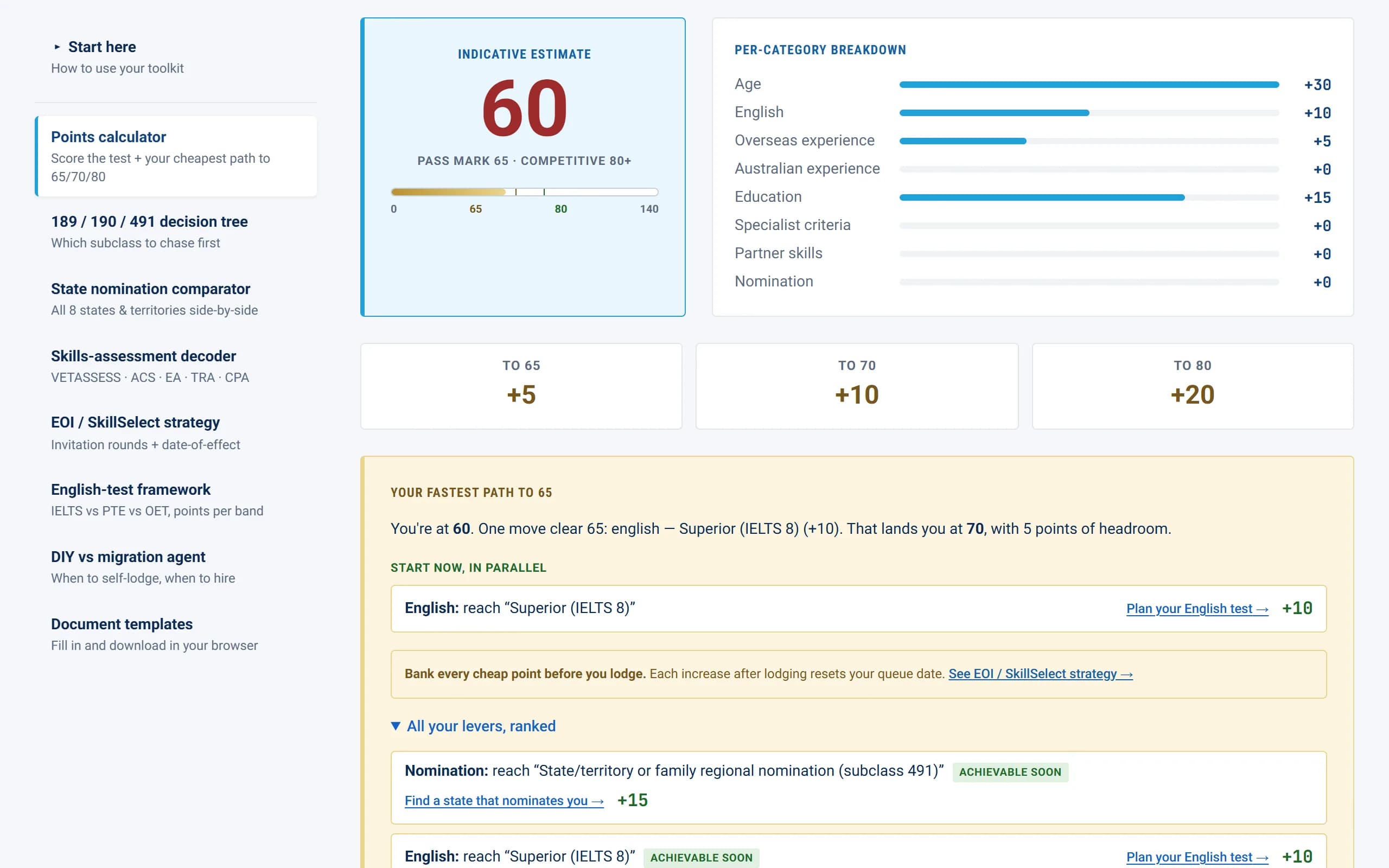
- Age 30 + Bachelor 15 + English 10 + Experience 5 (after 2-year ACS deduction = 4 skilled years) = 60 points
- Add 190: 65 points — likely too low for NSW or VIC
- Add 491: 75 points — competitive for SA, TAS, regional VIC
Scenario 2: Onshore SDET, 28 years old, Australian Master's, Superior English, 4 years experience including 2 in Australia
- Age 30 + Master's 15 + English 20 + Overseas 5 + Australian 5 + Australian Study 5 = 80 points
- Add 190: 85 points — competitive nationally
- Add 491: 95 points — very strong
State Nomination
Victoria
Victoria nominates ICT QA roles where state demand is clear, through the Live in Melbourne Registration of Interest system. Victoria charges no nomination fee. Melbourne's banking, insurance and product technology sector creates steady SDET and automation engineer demand.
New South Wales
Sydney's financial services and digital transformation programs create the largest QA market in Australia. NSW Stream 1 (Living and Working in NSW) is the most accessible route for onshore candidates already employed in Sydney. Stream 2 covers offshore applicants. Points thresholds are typically higher than other states because of Sydney market depth.
South Australia
SA's program targets offshore applicants in skill-shortage areas. ICT QA roles have appeared in recent SA nomination rounds, particularly for candidates with automation specialisations. Adelaide's growing tech and defence industry sectors provide consistent mid-level demand.
Australian Capital Territory
The ACT's Canberra Matrix rewards candidates already working in the territory. Federal government digital transformation programs at the ATO, Services Australia, and the Digital Transformation Agency drive QA demand. Many federal contract roles are accessible to applicants on a 491 with a clear PR pathway.
Tasmania
Tasmania's program is smaller but accessible. The state nominates ICT roles tied to demonstrated demand from state government and the University of Tasmania.
Salary and Employment Outlook
Base Salary by Seniority
| Role | Base Salary Range (AUD, 2026) |
|---|---|
| Junior QA Engineer / Manual Tester (0-2 yrs) | $70,000-$90,000 |
| Mid-Level QA Engineer | $95,000-$120,000 |
| Senior QA / Automation Engineer | $120,000-$140,000 |
| Lead QA / SDET | $135,000-$165,000 |
| QA Manager / Quality Engineering Lead | $150,000-$190,000 |
| QA Contractor day rate | $700-$1,100 per day |
Source: SEEK Salary Hub (April 2026), Indeed Australia, Robert Half 2026 IT Salary Guide.
Total Package Context
- Superannuation — 11.5% on top of base (rising to 12% from 1 July 2025 onwards)
- Bonus — 5-15% in financial services, lower in government, often zero in product startups (where equity replaces bonus)
- Equity — meaningful at Atlassian, Canva, Xero, SafetyCulture, and earlier-stage product companies
- Certification premium — ISTQB Advanced, AWS Certified DevOps Engineer, and Selenium / Playwright vendor credentials are the highest-value 2026 certifications
Highest-Paying Sectors
- Banking and financial services — CBA, NAB, ANZ, Westpac. Strong base salaries plus bonuses. Largest pool of senior SDET roles.
- Product technology — Atlassian, Canva, REA Group, Xero, SafetyCulture. Competitive packages including equity.
- Consulting — Accenture, Deloitte Digital, DXC, Infosys, TCS. High-volume hiring at mid-level, often for bank client engagements.
- Insurance and super — IAG, Suncorp, QBE, AustralianSuper, AwareSuper. Steady core systems modernisation work.
- Government — ATO, Services Australia, Digital Transformation Agency, state Service portals. Strong job security, slightly below-market salaries.
Tips for a Successful Application
1. Make your references describe QA-specific work
ACS rejections under 263211 most often happen when references read like generic developer or analyst work. Push your referees to use precise QA language — "owned end-to-end test strategy", "built and maintained Selenium WebDriver automation framework", "led defect triage and root cause analysis across 4 sprint teams". Specific tools and clear QA ownership matter.
2. The automation skill gap is real
A 2026 Australian QA job description that only requires manual testing is increasingly rare and pays at the lower end of the band. If you have only manual testing experience, build automation capability before applying — Cypress, Playwright and Selenium are the three most-asked tools. Even an introductory portfolio of automation work materially shifts placement opportunities.
3. Calculate the ACS deduction before lodging an EOI
A non-ICT degree triggers a 6-year experience deduction. A QA engineer with 8 years of experience and a B.Sc (general science) finishes with 2 years of skilled experience for points. Calculate this honestly before submitting an EOI.
4. SDET branding helps in Australia
Australian employers — particularly the banks and product companies — increasingly use SDET (Software Development Engineer in Test) rather than QA Engineer for the senior end of the role. If your work genuinely includes test automation development, framework design and CI/CD integration, lean into the SDET framing on your CV and LinkedIn. It opens a higher salary band.
5. Look beyond Sydney and Melbourne
Adelaide, Perth, Canberra and Hobart all have meaningful QA hiring markets with materially lower competition and better state nomination prospects. The 491 regional visa unlocks 15 additional points and is genuinely worth considering if you have flexibility on location.
Step-by-Step Migration Roadmap
- Confirm 263211 is the right code — compare against 261313 Software Engineer if your work includes meaningful production code
- Sit your English test — aim for Proficient (IELTS 7.0) minimum, Superior (8.0) for full points
- Build automation portfolio if needed — Cypress, Playwright, Selenium are the three priority tools
- Lodge the ACS assessment — nominate 263211, AUD $1,498
- Calculate points — factor the ACS experience deduction
- Decide on the route — 190/491 (state-nominated) or 482/186 (employer-sponsored)
- Submit EOI in SkillSelect — for 190 or 491
- Apply for state nomination — via the state's separate portal
- Alternative: secure sponsoring employer — focus on approved sponsors with active QA / SDET roles
- Receive invitation, lodge visa — within the invitation window (60 days)
- Complete health and character checks
- For 482 holders: lodge 186 TRT after 2 years — convert to permanent residency
Frequently Asked Questions
Is ICT Quality Assurance Engineer on the Skilled Occupation List for 189 visas?
No. ANZSCO 263211 ICT Quality Assurance Engineer is on the CSOL and STSOL but not the MLTSSL. The 189 Skilled Independent visa draws only from MLTSSL, so QA engineers cannot apply for the 189 under this code. The available routes are 190, 491, 482 and 186. See the SOL 2026 guide for the full list comparison.
Can I apply under Software Engineer if I'm primarily a QA engineer?
Only if your duties genuinely match the Software Engineer (261313) description. ACS assesses against your actual duties as described in your employment references, not your job title. If your day-to-day is a 70/30 split between automation framework development and test design, a Software Engineer nomination may be defensible. If your work is mainly test execution and defect management with limited code production, claiming Software Engineer is likely to result in a failed assessment. Software Engineer is on the MLTSSL and gives 189/190/491 access, so it's worth genuinely evaluating which code fits.
Do I need ISTQB certification for migration?
ISTQB is not a formal ACS requirement, but it is widely recognised by Australian employers and signals professional QA discipline. ISTQB Foundation level is close to a baseline expectation; ISTQB Advanced (Test Manager, Test Analyst, Technical Test Analyst) carries more weight in the senior salary bracket. It does not affect the skills assessment outcome directly, but it can affect the strength of your job market positioning.
How long does ACS assessment take for QA Engineer?
Standard processing time is 8 to 12 weeks from lodgement with all documents in order. Priority processing aims for 10 business days but is only available to applicants whose Australian visas expire within 12 weeks. Express service exists for tight timing windows but daily slots are capped.
Is manual testing experience enough for migration in 2026?
It's enough for the skills assessment itself — ACS does not differentiate between manual and automation QA at the assessment stage. But the job market does. A 2026 Australian QA role at mid-level or above almost always requires test automation skills. If you only have manual testing experience, expect to land in the Core Skills stream of the 482 (lower salary) rather than Specialist Skills, and expect a longer job search. Building automation capability before applying is one of the highest-ROI moves in the migration process.
Can I move from a 482 visa to permanent residency as a QA engineer?
Yes — via the 186 Temporary Residence Transition (TRT) stream. After 2 years on a 482 with an approved sponsor, you can lodge the 186 TRT. The visa fee is AUD $6,140. This is the most common permanent residency pathway for QA engineers, since 263211 is not on the MLTSSL and the 190/491 routes are not always available depending on state nomination cycles.