Medical Radiation Therapist Visa Pathway to Australia: Complete 2026 Guide
Updated: 16 August 2026
Australia classifies Medical Radiation Therapist under ANZSCO 251212 (Skill Level 1). The Australian Society of Medical Imaging and Radiation Therapy (ASMIRT) conducts the skills assessment, and the Medical Radiation Practice Board of Australia (under AHPRA) issues mandatory professional registration. The occupation sits on the MLTSSL, unlocking subclasses 189, 190, 491, 482 and 186. Typical 2026 salaries range AUD $90,000-$150,000 according to SEEK Salary Hub.
Quick Facts: Medical Radiation Therapist Migration Pathway
| Detail | Information |
|---|---|
| ANZSCO Code | 251212 (Medical Radiation Therapist) |
| Skill Level | 1 (Bachelor degree or higher) |
| Skills Assessment | ASMIRT (Australian Society of Medical Imaging and Radiation Therapy) |
| Professional Registration | Mandatory — Medical Radiation Practice Board of Australia (via AHPRA) |
| Occupation List | MLTSSL — full visa access |
| Visa Options | 189, 190, 491, 482, 186 |
| Demand Level | High — sustained cancer treatment demand and limited domestic training pipeline |
| Salary Range | AUD $90,000-$150,000 (SEEK Salary Hub, 2026) |
| Typical 189 Score | 75-85 points |
| Key Challenge | Two-stage approval: ASMIRT skills assessment plus AHPRA registration, both required before practising |
Role Context: Radiation Therapists in Australia
Australia treats more than 60,000 new cancer cases with radiation therapy each year. Treatment is delivered through public and private cancer centres: Peter MacCallum Cancer Centre (Melbourne), Royal North Shore (Sydney), Princess Alexandra (Brisbane), Sir Charles Gairdner (Perth), and the private Icon Cancer Centres and GenesisCare networks. Linear accelerators are the workhorse equipment; specialist centres also operate brachytherapy, proton therapy (planned), and stereotactic radiosurgery platforms.
The workforce is small. Australia trains roughly 200-250 radiation therapists per year through bachelor and master programs at Monash, Sydney, RMIT, QUT, Charles Sturt, Newcastle and Curtin. Attrition into other modalities and clinical leadership creates a steady call for migrant practitioners, particularly in regional cancer centres and the rapidly expanding private network. Jobs and Skills Australia lists Medical Radiation Therapist among occupations with ongoing recruitment difficulty.
The role is highly technical, sits adjacent to medical physics and radiation oncology, and increasingly involves AI-assisted treatment planning and adaptive radiotherapy workflows.
ANZSCO Code 251212: Medical Radiation Therapist
ANZSCO 251212 covers practitioners who plan and deliver radiation treatment for cancer and other conditions, working alongside radiation oncologists and medical physicists. Key tasks include assessing patient suitability, simulating treatment positions, generating treatment plans on dedicated planning systems, operating linear accelerators and brachytherapy equipment, monitoring patient response, and managing quality assurance.
The code is distinct from two related ANZSCO codes:
- 251211 Medical Diagnostic Radiographer — diagnostic imaging only (X-ray, CT, MRI)
- 251213 Nuclear Medicine Technologist — radioactive isotope imaging and therapy
If your work crosses modalities (some Australian practitioners are dual-trained), the assessing body will recognise the dominant scope and route the assessment accordingly. ASMIRT assesses all three codes.
Skills Assessment: ASMIRT
The Australian Society of Medical Imaging and Radiation Therapy is the sole assessing authority for ANZSCO 251212.
ASMIRT Overseas Qualifications Assessment Program (OQAP)
The OQAP confirms that an overseas radiation therapy qualification is equivalent to an Australian undergraduate degree in radiation therapy at the time it was awarded.
Requirements:
- Qualification equivalent to an Australian Bachelor of Radiation Therapy
- Clinical work experience appropriate to the qualification
- English language evidence: IELTS Academic 7.0 overall and per band (sat within 2 years), or OET Level B in each component, or PTE Academic 66+ overall and per band, or TOEFL iBT 94+ with section minimums
Assessment cost:
- AUD $1,041 for applicants residing overseas
- AUD $1,143 (incl. GST) for applicants residing in Australia
- Additional AUD $500 for dual modality assessment (e.g. radiation therapy plus diagnostic radiography)
Processing time: Pre-approved courses typically receive an outcome within one month. Standard migration assessments without pre-approval take longer; ASMIRT does not publish a fixed processing window — most applicants report 2-4 months.
Common rejection reasons:
- Qualification scope below Australian bachelor-level radiation therapy (some overseas qualifications are diploma-level or are diagnostic-only)
- English language certificates outside the two-year validity window
- Insufficient clinical experience documentation, especially treatment-planning hours
An ASMIRT favourable outcome does not authorise practice. Registration with the Medical Radiation Practice Board of Australia is a separate, mandatory step.
Professional Registration: Medical Radiation Practice Board of Australia (AHPRA)
Every practising radiation therapist in Australia must hold registration with the Medical Radiation Practice Board of Australia, administered by AHPRA.
Requirements for overseas-qualified applicants:
- Approved qualification (ASMIRT outcome is the standard evidence)
- English language requirements equivalent to those for skills assessment
- Identity, criminal-history and professional-standing checks
- Recency of practice — at least one of: current overseas registration in good standing, recent practice in the past five years, or a re-entry to practice program
Application and annual registration fees are published on the Medical Radiation Practice Board website and are payable in addition to the ASMIRT assessment fee. Processing of overseas-qualified applications typically takes 4-6 months end-to-end and runs in parallel with the skills assessment.
See the skills assessment bodies complete list for context on Australian assessing authorities.
Visa Pathways for Medical Radiation Therapists
Medical Radiation Therapist is on the MLTSSL, so all five mainstream skilled visas apply.
Subclass 482 — Skills in Demand Visa
Employer-sponsored temporary work visa. The most common entry pathway for offshore radiation therapists.
- Visa fee: AUD $4,015 (primary applicant)
- Salary threshold: Core Skills stream AUD $79,423 (CSIT); Specialist Skills stream AUD $146,576. Most radiation therapy roles clear the Core Skills threshold and senior roles clear Specialist.
- Duration: Up to 4 years
- Sponsors: Icon Cancer Centres, GenesisCare, Peter MacCallum, state public health services, and regional cancer centres all sponsor regularly
Public hospitals and the two largest private radiation oncology networks (Icon and GenesisCare) are experienced sponsors with internal migration teams.
Subclass 189 — Skilled Independent Visa
Permanent residency through the points-based system. Available because 251212 is on the MLTSSL.
- Visa fee: AUD $6,135 (primary applicant, 2026)
- Minimum points: 65, realistically 75-85 to receive an invitation
- Processing: 8-15 months depending on point score and queue
- Reality: 189 is achievable for radiation therapists with strong English, a Master's qualification, and overseas experience. Less competitive than ICT occupations.
Subclass 190 — Skilled Nominated Visa
Permanent residency through state nomination, adding 5 points.
- Visa fee: AUD $6,140 (primary applicant)
- Points boost: +5
- Obligation: Live in the nominating state for at least 2 years
- Best states: Queensland, South Australia, Western Australia and Tasmania actively nominate health workforce shortage occupations
Subclass 491 — Skilled Work Regional Visa
Regional state-nominated provisional visa, valid five years, pathway to 191 permanent residency.
- Visa fee: AUD $6,140 (primary applicant)
- Points boost: +15
- Quirk: Regional cancer centres (Townsville, Toowoomba, Bendigo, Geelong, Newcastle, Wagga Wagga, Launceston) have specifically driven 491 nomination of radiation therapists in past program years
Subclass 186 — Employer Nomination Scheme
Permanent residency through employer sponsorship. Common end-state for radiation therapists who entered on 482.
- Visa fee: AUD $6,140 (primary applicant)
- Streams: Direct Entry or Temporary Residence Transition (after 2 years on 482)
- Processing: Direct Entry 12 months at 50th percentile, 19 months at 90th percentile in 2026
Points Test Strategy
| Points Factor | Points | Notes |
|---|---|---|
| Age (25-32) | 30 | Maximum bracket |
| Age (33-39) | 25 | Still strong |
| Qualification (PhD) | 20 | Uncommon but adds 5 points over Master's |
| Qualification (Master's) | 15 | Common; many overseas radiation therapy degrees are Master-level |
| Qualification (Bachelor) | 15 | Minimum for Skill Level 1 |
| English (Superior — 8.0+) | 20 | Major points lever |
| English (Proficient — 7.0) | 10 | Minimum for AHPRA registration |
| Overseas Experience (5-8 years) | 10 | Capped at 15 points for 8+ years |
| Australian Experience (3+ years) | 10 | Boosts onshore applicants |
| State Nomination (190) | 5 | If invited |
| Regional (491) | 15 | For regional placements |
| Partner Skills | 5-10 | If partner has eligible skilled occupation |
| NAATI/CCL | 5 | Community language credential |
Realistic Score Scenarios
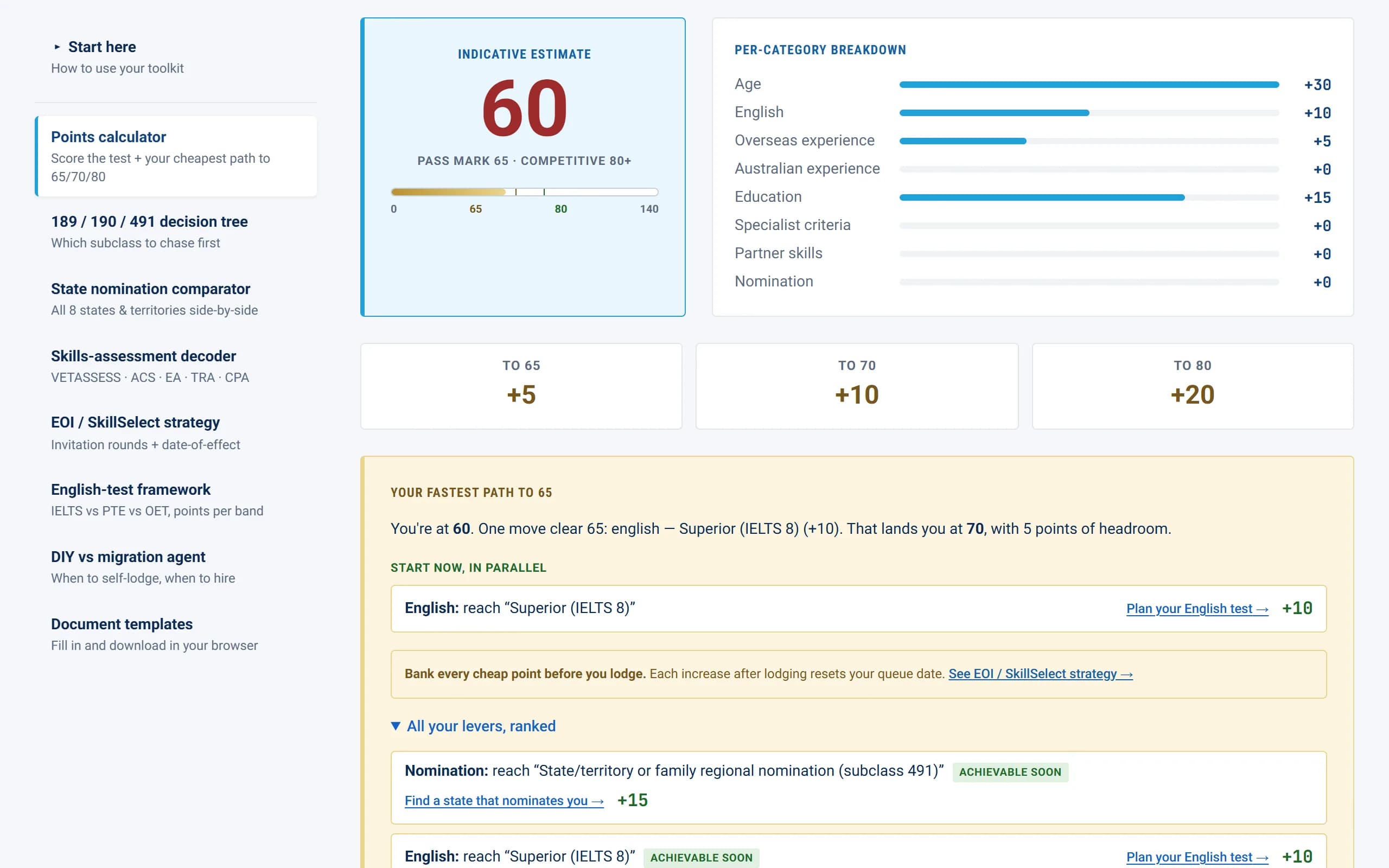
Scenario 1: Master's, 29 years old, Proficient English (7.0), 5 years overseas experience
- Age 30 + Master's 15 + English 10 + Experience 10 = 65 points
- Add 190 nomination (+5) → 70 points: competitive in shortage occupations
- Add 491 regional (+15) → 80 points: strong invitation likelihood
Scenario 2: Master's, 31 years old, Superior English (8.0), 5 years overseas experience plus 2 years Australian
- Age 30 + Master's 15 + English 20 + Experience 10 + Australian Experience 5 = 80 points
- Competitive for 189 in shortage occupations even without state nomination
State Nomination for Medical Radiation Therapists
Queensland
Queensland Health and private cancer centres in Brisbane, Gold Coast, Sunshine Coast and regional centres (Townsville, Cairns, Toowoomba, Rockhampton) regularly nominate radiation therapists. Migration Queensland favours candidates with confirmed Queensland job offers, and the regional 491 stream is heavily used for cancer centres outside Brisbane metro.
South Australia
South Australia nominates health workforce shortage occupations including radiation therapists. The Royal Adelaide Hospital and Calvary Adelaide are key public employers; GenesisCare operates a major Adelaide centre. Regional nomination through 491 is used for centres in the Adelaide Hills and Limestone Coast.
Western Australia
Sir Charles Gairdner Hospital, Fiona Stanley and the GenesisCare WA network create steady demand. Western Australia's Skilled Migration Occupation List includes radiation therapy roles, and the state has been receptive to applicants with confirmed job offers in Perth and regional centres including Bunbury.
Tasmania
The Royal Hobart Hospital and the W.P. Holman Clinic in Launceston regularly need radiation therapy staff. Tasmania's 491 program is strongest for applicants already living and working in Tasmania, with six months of recent Tasmanian employment in the occupation typically required.
Victoria
Victoria has nominated radiation therapists for both 190 and 491 in past program years, with Peter MacCallum Cancer Centre and Alfred Health as key public employers. Victoria's nomination criteria typically require 3+ years of recent experience.
Salary and Employment Outlook
Typical 2026 Radiation Therapist Salaries
| Role | Typical Salary Range |
|---|---|
| Graduate Radiation Therapist | AUD $80,000-$95,000 |
| Radiation Therapist (Mid-level) | AUD $95,000-$115,000 |
| Senior Radiation Therapist | AUD $115,000-$140,000 |
| Treatment Planning Specialist | AUD $120,000-$150,000 |
| Clinical Lead/Chief Radiation Therapist | AUD $140,000-$180,000+ |
Source: SEEK Salary Hub, April 2026 (average AUD $90,000-$100,000 advertised). Indeed reports an average of AUD $109,613 (Feb 2026 update). Entry-level and senior figures cross-checked against PayScale. Public sector salaries follow state health enterprise agreements; private centres pay slightly above award and typically offer additional CPD and equipment-bonus arrangements.
Total package adds superannuation (11.5%), salary packaging (significant for public hospital employees through tax-free fringe benefit caps), and on-call allowances where applicable.
Highest-paying sectors and employers
- Private radiation oncology networks — Icon Cancer Centres, GenesisCare
- Major public cancer centres — Peter MacCallum, Chris O'Brien Lifehouse, Royal North Shore, Princess Alexandra, Sir Charles Gairdner
- Regional public health services — generally offer relocation incentives and accelerated progression
- Treatment planning and quality assurance specialist roles — pay premium over standard clinical roles
Geographic notes
Metro Sydney, Melbourne, Brisbane and Perth have the highest absolute volumes but most competition for senior roles. Regional centres (Townsville, Toowoomba, Bendigo, Geelong, Wagga Wagga, Launceston, Hobart, Darwin) face more acute shortages, sponsor more readily, and frequently offer accelerated PR pathways through 491.
Tips for a Successful Application
1. Run ASMIRT and AHPRA in parallel, not sequentially
A common mistake is waiting for ASMIRT before starting AHPRA. The Medical Radiation Practice Board accepts the ASMIRT assessment as the qualification evidence, but the registration process itself includes identity, criminal-history, English-language and recency-of-practice checks that can begin immediately. Running both in parallel cuts total time-to-practise by 2-4 months.
2. Confirm English certificate validity windows
Both ASMIRT and AHPRA require English certificates sat within two years. Plan testing so the certificate is still valid at the point of visa lodgement. Migrants who pass IELTS too early frequently have to retake before visa grant.
3. Document treatment planning hours separately
ASMIRT and the Medical Radiation Practice Board look at clinical experience in detail. Treatment planning is a separately scored competency. Get your overseas employer to document hours spent on each modality and on planning vs treatment delivery.
4. Target Master's qualifications for points
Most overseas radiation therapy programs are 3-year bachelor degrees, which qualify for 15 points. A Master's also scores 15 points, but a research Master's or PhD scores 20. If you are early in your career and considering further study, a research-based Master's pays back in points.
5. Apply through a known sponsor for fastest entry
Icon Cancer Centres, GenesisCare and the major state health services have experienced migration teams and accredited sponsor status. Sponsorship through these employers moves faster than through standalone private practices.
Step-by-Step Migration Roadmap
- Confirm ANZSCO code 251212 via the ANZSCO code finder — distinguish from 251211 Diagnostic Radiographer and 251213 Nuclear Medicine Technologist
- Verify list status — confirm 251212 on the Skilled Occupation List 2026
- Sit English test — IELTS 7.0 each band (or OET B, PTE 66+, TOEFL iBT 94+)
- Apply for ASMIRT skills assessment — AUD $1,041 offshore or AUD $1,143 onshore
- Apply for AHPRA registration in parallel with ASMIRT
- Submit EOI in SkillSelect for 189, 190 or 491 — or secure 482 employer sponsorship
- Receive state nomination or invitation (190/491) or 482 sponsorship approval
- Lodge visa application within 60 days of invitation
- Complete health and character checks
- Receive visa grant
- Confirm AHPRA registration is finalised before commencing practice
- Start clinical role — most employers require AHPRA registration number before first shift
Frequently Asked Questions
Can I work as a radiation therapist on the 482 visa before AHPRA registration is granted?
No. The Medical Radiation Practice Board requires registration before any clinical practice. Employers who sponsor on 482 typically time the visa start date to coincide with confirmed AHPRA registration. ASMIRT assessment and visa grant alone are not sufficient to commence practice.
Are diagnostic radiographers and radiation therapists assessed separately?
Yes. ASMIRT issues separate skills assessments for ANZSCO 251211 (Medical Diagnostic Radiographer), 251212 (Medical Radiation Therapist) and 251213 (Nuclear Medicine Technologist). If you hold dual qualifications, ASMIRT offers a dual modality assessment (+AUD $500) but you must be eligible against the AHPRA registration standard for each modality.
Is the points-based system or employer sponsorship faster for radiation therapists?
For most overseas-qualified radiation therapists, employer sponsorship through 482 is faster to first practice in Australia — typically 6-9 months from application to grant. The 189 and 190 are faster to permanent residency but require points to be competitive. Most migrants enter on 482, complete two years of Australian practice, then transition to 186 TRT.
Which state has the strongest demand for radiation therapists in 2026?
Queensland and Western Australia consistently report the highest unfilled vacancy rates, driven by regional cancer centre expansion. Victoria has the largest absolute workforce (Peter MacCallum, Alfred, Olivia Newton-John) but a more competitive market for junior roles. Regional centres in any state offer the strongest sponsorship odds.
What happens if my overseas qualification is a 3-year diploma rather than a bachelor degree?
ASMIRT requires bachelor-level equivalence. A 3-year diploma will typically be assessed as not equivalent to an Australian Bachelor of Radiation Therapy, particularly if it lacks clinical placement hours or treatment-planning training. Applicants in this position often need to complete a bridging program through an Australian university before requalifying — typically a 1-2 year graduate-entry Master's. This adds significant time and cost; consider it carefully before lodging an unsupported ASMIRT application.