Obstetrician and Gynaecologist Visa Pathway to Australia: Complete 2026 Guide
Updated: 16 August 2026
Australia classifies Obstetricians and Gynaecologists under ANZSCO 253913. The Medical Board of Australia (MedBA) grants specialist registration after the Royal Australian and New Zealand College of Obstetricians and Gynaecologists (RANZCOG) assesses overseas-trained candidates. The occupation sits on the MLTSSL and CSOL, unlocking subclasses 189, 190, 491, 482 and 186. Typical 2026 salaries range AUD $300,000-$500,000+.
Quick Facts: Obstetrician and Gynaecologist Migration Pathway
| Detail | Information |
|---|---|
| ANZSCO Code | 253913 (Obstetrician and Gynaecologist) |
| Skill Level | 1 (Bachelor degree or higher plus specialist training) |
| Skills Assessment | RANZCOG (Royal Australian and New Zealand College of Obstetricians and Gynaecologists) plus MedBA specialist registration |
| Occupation List | MLTSSL and CSOL |
| Visa Options | 189, 190, 491, 482, 186 |
| Demand Level | High — specialist medical practitioners are persistent shortages, particularly in regional and rural maternity services |
| Salary Range | AUD $300,000-$500,000+ (SEEK Career Advice April 2026, MedRecruit, ERI SalaryExpert 2026) |
| Typical 189 Score | 80-90 points |
| Key Challenge | RANZCOG's Standard Initial Assessment is AUD $2,716 and the Interview Fee is AUD $5,317; the College recently flagged concerns about expedited SIMG pathways, so expect closer scrutiny in 2026 |
What Obstetricians and Gynaecologists Do in Australia
Obstetricians and gynaecologists in Australia provide antenatal care, intrapartum management, postnatal care and the full range of gynaecological surgery and medicine. The work spans low-risk and high-risk pregnancy management, caesarean and operative vaginal delivery, gynaecological oncology screening, infertility consultation, contraceptive and menstrual disorder management, and minimally invasive and open gynaecological surgery. Consultants split time between public hospital obstetrics, gynaecology theatre lists, private rooms and on-call birth suite cover.
Demand is heaviest outside metro Sydney and Melbourne. Regional and rural maternity services face persistent recruitment difficulty, and several rural hospitals have downgraded or closed birth suite operations in the past five years due to consultant gaps. The Royal Hobart, Launceston General, Royal Darwin, Townsville, Cairns, Mackay and Bendigo Health maternity services are reliable recruiters. Major metropolitan employers include the Royal Hospital for Women (Sydney), Westmead, Royal North Shore, Mercy Hospital for Women (Melbourne), Royal Women's Hospital (Melbourne), Royal Brisbane and Women's Hospital, and King Edward Memorial Hospital (Perth). Private maternity care concentrates in Sydney's north shore and eastern suburbs, inner Melbourne, Brisbane and the Gold Coast.
ANZSCO Code Mapping
ANZSCO 253913 is the correct code for fellowship-trained obstetricians and gynaecologists. The position description covers diagnosing and treating diseases and disorders related to pregnancy, childbirth, the postpartum period and the female reproductive system. Task summary includes antenatal consultation, ultrasound, intrapartum management, caesarean and operative vaginal delivery, gynaecological surgery, fertility management, and supervision of trainees.
Subspecialists in gynaecological oncology, maternal-fetal medicine, reproductive endocrinology and infertility, and urogynaecology hold the same ANZSCO code as general O&G consultants once they hold RANZCOG fellowship. There is no separate code for subspecialty practice. Trainees and non-specialist practitioners cannot use 253913.
Skills Assessment and Specialist Recognition
The pathway is a two-track process: RANZCOG specialist assessment, then MedBA specialist registration.
Royal Australian and New Zealand College of Obstetricians and Gynaecologists (RANZCOG)
RANZCOG offers two SIMG assessment pathways: the Standard Pathway for applicants with substantial training, and the Expedited Pathway for applicants from specifically recognised training programmes.
- Body: RANZCOG
- Requirements: Recognised specialist qualification in O&G, AMC primary source verification (EPIC), structured CV with detailed logbook, three referees, IELTS Academic 7.0 across bands or equivalent, recency of practice within the College's window.
- Assessment costs (current): Standard Pathway Initial Assessment Fee AUD $2,716; Standard Pathway Interview Fee AUD $5,317; Expedited Pathway Initial Assessment Fee AUD $1,358; Expedited Pathway Interview Fee AUD $2,658; Incomplete Application Fee AUD $303.
- Processing time: Initial Assessment 12-24 weeks; Interview 3-6 months after the Initial Assessment; outcome 8-12 weeks after interview
- Common rejection reasons: Training programme not substantially comparable to RANZCOG FRANZCOG; gaps in obstetric ultrasound, operative delivery or laparoscopic gynaecological surgery; insufficient recency of practice.
RANZCOG assigns one of three outcomes: Substantially Comparable (proceed to MedBA specialist registration), Partially Comparable (12-24 months of supervised practice in an accredited post, often with structured top-up assessment), or Not Comparable.
Note: RANZCOG publicly called for a pause on expedited SIMG pathways in late 2025 to address workforce and patient safety concerns. Expect tighter scrutiny of expedited applications through 2026; verify the current Expedited Pathway eligibility before paying the application fee.
Medical Board of Australia (MedBA)
- Body: Medical Board of Australia
- Requirements: Positive RANZCOG outcome, AMC-verified primary qualification, English evidence, criminal history check, recency of practice, professional indemnity insurance.
- Processing time: 4-8 weeks after RANZCOG outcome
- Common rejection reasons: Insufficient recency; English evidence outside the 24-month validity window.
Visa Pathways for Obstetricians and Gynaecologists
Subclass 482 — Skills in Demand Visa
The dominant entry route. Most overseas O&G consultants arrive on a 482 sponsored by a Local Health District, regional Hospital and Health Service or large private maternity group.
- Visa fee: AUD $3,210 (primary applicant)
- Salary thresholds: Specialist Skills stream from $141,210 (rising to $146,717 on 1 July 2026); Core Skills $76,515 (rising to $79,499)
- Processing time: Specialist Skills stream 7-11 days; Core Skills 4-7 months
- Eligibility note: Consultant O&G salaries clear the Specialist Skills threshold, which removes labour market testing
Subclass 186 — Employer Nomination Scheme
Permanent residency via employer sponsorship. Direct Entry requires three years of relevant experience and a positive RANZCOG assessment; TRT requires two years on a 482.
- Visa fee: AUD $6,140 (primary applicant)
- Processing time: 6-12 months
- Eligibility note: TRT is the standard route for SIMGs who entered on a 482
Subclass 189 — Skilled Independent Visa
Points-tested permanent residency.
- Visa fee: AUD $6,135 (primary applicant)
- Processing time: 6-12 months
- Eligibility note: Realistic invitation scores sit at 80-90 points for medical specialists
Subclass 190 — State Nominated Visa
Adds 5 points and grants permanent residency.
- Visa fee: AUD $6,140 (primary applicant)
- Processing time: 6-12 months
- Eligibility note: Two-year live-and-work commitment in the nominating state
Subclass 491 — Skilled Work Regional (Provisional)
Five-year provisional regional visa with a 15-point boost and subclass 191 PR transition after three years of qualifying regional income.
- Visa fee: AUD $6,140 (primary applicant)
- Processing time: 6-12 months
- Eligibility note: Regional maternity services are among the most consistent 491 nominators in the country; Tasmania, NT, regional Victoria, regional NSW and rural Queensland are particularly active
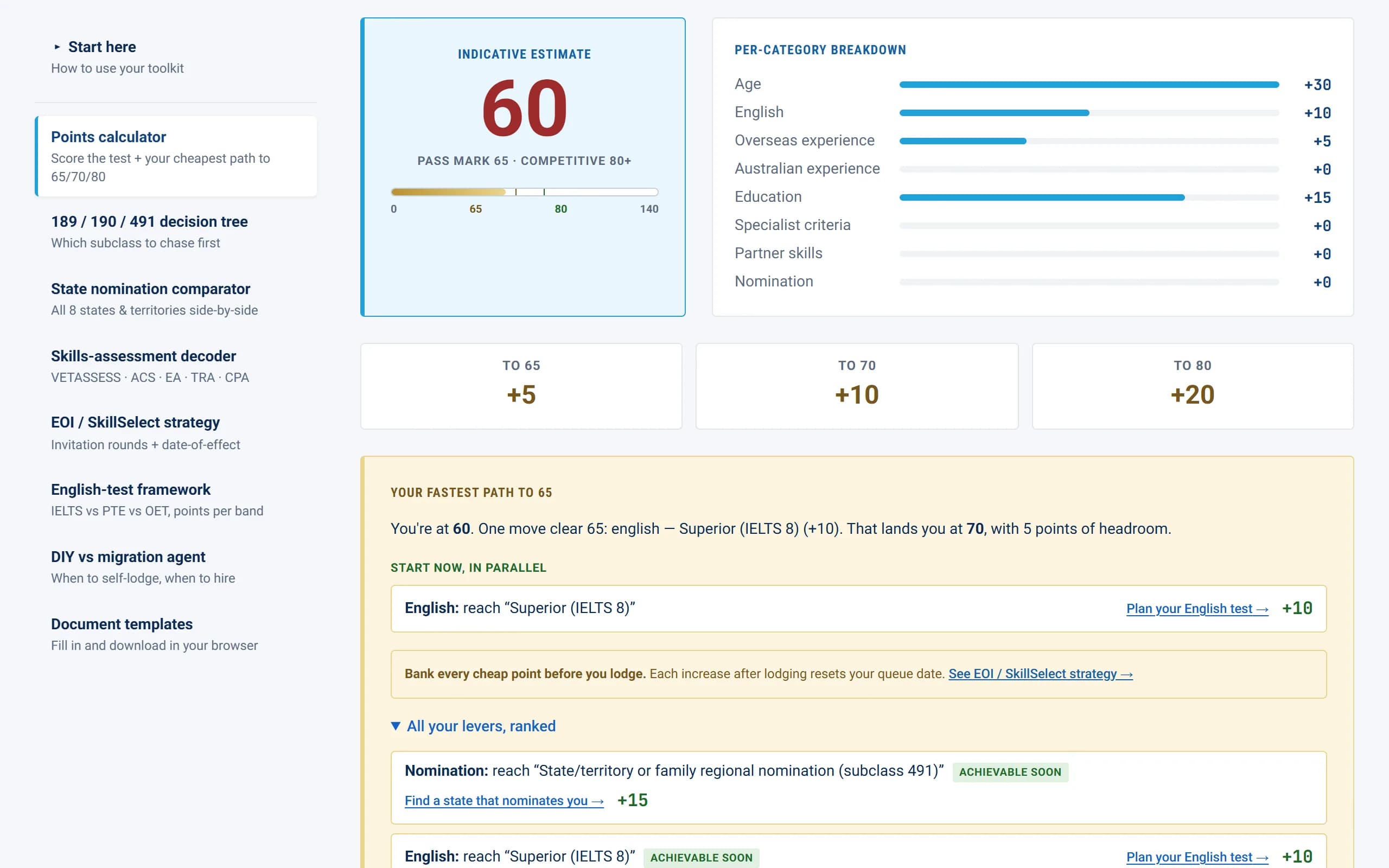
Points Test Strategy
| Points Factor | Points | Notes |
|---|---|---|
| Age (25-32) | 30 | Maximum bracket |
| Age (33-39) | 25 | Most SIMG O&G consultants |
| Qualification (Doctoral) | 20 | Fellowship-trained O&G specialists often score here via Vetassess equivalency |
| English (Superior 8.0) | 20 | Achievable for many SIMGs |
| English (Proficient 7.0) | 10 | Baseline |
| Overseas skilled experience (8+ years) | 15 | Maximum |
| State Nomination (190) | 5 | Apply if eligible |
| Regional (491) | 15 | Reliable for non-metro O&G posts |
| Partner Skills | 5-10 | If partner has skilled occupation |
Realistic Score Scenarios
Scenario 1: Senior consultant (37 years old, fellowship-trained, Superior English, 9 years post-fellowship)
- Age 25 + Doctoral 20 + English 20 + Experience 15 = 80 points
- Add 491 regional: 95 — competitive
Scenario 2: Early-career consultant (33 years old, Proficient English, 4 years post-fellowship)
- Age 25 + Bachelor's 15 + English 10 + Experience 5 = 55 points
- Needs 491 (+15), Superior English retest and/or partner skills to clear 85
- 482 employer sponsorship is the most efficient route
State Nomination
New South Wales
NSW Health's metro and regional Local Health Districts run continuous O&G recruitment. The NSW Skills List includes specialist medical practitioners and invitations are ranked within unit groups. Major recruiters include the Royal Hospital for Women, Westmead, John Hunter, Lismore Base and Wagga Wagga Base Hospitals.
Victoria
Victoria's ROI ranking system covers specialist medical practitioners. The Royal Women's Hospital, Mercy Hospital for Women and regional services in Bendigo, Ballarat, Geelong and Shepparton are active recruiters. The 2025-26 program closed early to new ROIs in April 2026 after exceeding capacity, so monitor the reopen date.
Queensland
Queensland's 1,850-place 190 allocation for 2025-26 expanded access significantly. Hospital and Health Services in Townsville, Cairns, Mackay, Bundaberg and the Sunshine Coast have persistent O&G workforce gaps.
Tasmania
Tasmania is one of the most reliable 491 nominators for O&G consultants. Royal Hobart, Launceston General and the North West Regional Hospital regularly recruit offshore consultants with state nomination support.
Northern Territory
The Royal Darwin Hospital and Alice Springs Hospital are continuous recruiters. The NT's 491 program prioritises emergency medicine, O&G, anaesthesia and general medicine.
South Australia
SA Health's Health Worker Sponsorship Program covers specialist medical practitioners. The Women's and Children's Hospital, Flinders Medical Centre and Royal Adelaide Hospital are the main metro employers.
Western Australia
King Edward Memorial Hospital, Royal Perth and Fiona Stanley Hospital are the WA Health metro recruiters; regional WA has acute maternity workforce shortages across the Pilbara, Kimberley and South West regions.
Salary and Employment Outlook
What Obstetricians and Gynaecologists Earn
| Role | Typical Salary Range |
|---|---|
| Junior consultant (public hospital) | AUD $280,000-$340,000 |
| Mid-career consultant (public hospital) | AUD $320,000-$420,000 |
| Senior consultant with VMO rights | AUD $400,000-$550,000 |
| Private obstetric practice (Sydney/Melbourne) | AUD $400,000-$800,000+ |
| Subspecialist (gyne onc, MFM, REI, urogyne) | AUD $450,000-$700,000+ |
| Locum consultant (per day) | AUD $2,000-$3,500 |
| Head of unit / clinical director | AUD $450,000-$600,000+ |
SEEK Career Advice's April 2026 data shows an average band of AUD $240,000-$250,000, which reflects advertised employment positions and understates private practice income. MedRecruit and aggregator data suggest a fuller range of AUD $200,000-$450,000 across employment modes. Subspecialists and senior private obstetricians frequently exceed AUD $500,000 once private rooms, private hospital VMO rights and Medicare billings are combined.
Sources: SEEK Career Advice (April 2026), MedRecruit (2026), ERI SalaryExpert (2026), Locum Life Australia (2026).
Highest-Paying Segments
- Established private obstetric rooms in Sydney's eastern suburbs, lower north shore and inner Melbourne
- Subspecialty practice — gynaecological oncology, maternal-fetal medicine, urogynaecology
- Locum cover for regional services — premium day rates and travel cover
- Public-private hybrid consultant roles with VMO rights at private hospitals
- Fertility clinic medical leadership — IVF Australia, Monash IVF, Genea
Tips for a Successful Application
1. Choose Standard or Expedited Pathway Deliberately
The Expedited Pathway is half the cost of Standard (Initial Assessment AUD $1,358 vs AUD $2,716) but is only available to applicants from specifically recognised training programmes. RANZCOG flagged concerns about expedited pathways in late 2025 — confirm your eligibility with the College before paying.
2. Document Operative Volume in Detail
RANZCOG scrutinises caesarean section numbers, operative vaginal delivery counts, laparoscopic surgery experience, hysterectomy logbook and antenatal ultrasound exposure. Structured supervisor letters covering each domain strengthen the application.
3. Verify Recency of Practice Before Applying
Time out of clinical practice (maternity leave, research, illness) can trigger a recency review. Confirm your recent clinical hours fall within the RANZCOG window before paying the Initial Assessment Fee.
4. Target Regional Maternity Services for Sponsorship
Regional maternity services have the most pressing workforce gaps and the strongest appetite for offshore consultants. A confirmed offer from a regional Hospital and Health Service or LHD typically unlocks 491 regional nomination and accelerates the visa timeline.
5. Plan for Partially Comparable Supervised Practice
Many SIMG O&G applicants receive Partially Comparable outcomes with 12-24 months of supervised practice in an accredited Australian post. Build your financial plan around a non-specialist consultant salary during this period; specialist income returns once fellowship is granted.
Step-by-Step Migration Roadmap
- Confirm 253913 is your code — review the ANZSCO code finder
- Verify list status — check the Skilled Occupation List 2026 and CSOL hub
- Lodge AMC EPIC verification — primary qualification and specialist qualification
- Sit IELTS Academic — 7.0 minimum for RANZCOG and MedBA; 8.0 for full points
- Determine Standard or Expedited Pathway eligibility — confirm with RANZCOG
- Submit RANZCOG Initial Assessment — Standard (AUD $2,716) or Expedited (AUD $1,358)
- Attend RANZCOG Interview — Standard (AUD $5,317) or Expedited (AUD $2,658)
- Receive outcome — Substantially, Partially or Not Comparable
- Apply to MedBA via Ahpra — specialist registration in O&G
- Secure Australian job offer — public LHD/HHS or aligned private group
- Lodge visa — 482 Specialist Skills, 189, 190, 491 or 186
- Complete medicals and police checks — Bupa Medical Visa Services, AFP and overseas police
For wider context, review the skills assessment bodies complete list and the most in-demand occupations 2026 hub.
Frequently Asked Questions
What is the difference between the RANZCOG Standard and Expedited Pathways?
The Standard Pathway is open to all overseas-trained O&G specialists and uses higher application and interview fees ($2,716 and $5,317 respectively). The Expedited Pathway is reserved for applicants from training programmes that RANZCOG specifically recognises as substantially comparable to FRANZCOG, and uses lower fees ($1,358 and $2,658). RANZCOG called for a pause on expedited pathways in late 2025, so confirm current eligibility before applying.
Will my UK CCT in O&G be recognised by RANZCOG?
UK CCT holders trained through the RCOG programme frequently receive Substantially Comparable or Partially Comparable outcomes. RCOG-FRANZCOG training is well-mapped and the College has a long track record of assessing UK applicants. The outcome depends on logbook depth, particularly in laparoscopic gynaecological surgery and high-risk obstetrics.
Can I work in Australia before RANZCOG completes its assessment?
Yes. With provisional or limited registration from MedBA you can work as a senior registrar or fellow in an accredited O&G department while RANZCOG processes your application. Many Local Health Districts sponsor a 482 for this role.
Is private obstetric practice profitable in Australia?
Yes, particularly in established Sydney, Melbourne, Brisbane and Gold Coast rooms. Private obstetricians charge known-gap fees averaging AUD $4,000-$10,000+ per pregnancy episode in addition to Medicare and private health fund payments. Establishment requires three to five years of rooms development. Subspecialty practice (urogynaecology, gynaecological oncology) is similarly remunerative.
Are there shortages in subspecialty O&G in Australia?
Yes. Gynaecological oncology, maternal-fetal medicine, urogynaecology and reproductive endocrinology and infertility all have small workforces and persistent recruitment gaps. SIMGs with subspecialty fellowship qualifications often have the strongest negotiating position with public hospitals and academic centres.
How does the late-2025 RANZCOG SIMG pathway review affect 2026 applicants?
RANZCOG echoed calls in late 2025 to pause expedited SIMG pathways pending review of workforce and patient safety considerations. The Standard Pathway remains open. Applicants targeting the Expedited Pathway in 2026 should confirm current eligibility with the College directly before lodging, since the criteria may change during the year.