Optometrist Visa Pathway to Australia: Complete 2026 Guide
Updated: 16 August 2026
Australia classifies Optometrist under ANZSCO 251411. The Optometry Council of Australia and New Zealand (OCANZ) conducts the Competency in Optometry Examination; AHPRA registration through the Optometry Board of Australia is the separate, parallel registration step. The role sits on the MLTSSL, unlocking subclasses 189, 190, 491, 482, and 186. Typical 2026 SEEK salaries range AUD $105,000-$200,000, with regional and senior roles reaching the top of the band.
Quick Facts: Optometrist Migration Pathway
| Detail | Information |
|---|---|
| ANZSCO Code | 251411 (Optometrist) |
| Skill Level | 1 (Bachelor or Master's degree in optometry) |
| Skills Assessment | OCANZ (Optometry Council of Australia and New Zealand) — Competency in Optometry Examination |
| Registration | AHPRA via the Optometry Board of Australia (separate from OCANZ) |
| Occupation List | MLTSSL + CSOL |
| Visa Options | 189, 190, 491, 482, 186 |
| Demand Level | Mixed — regional shortages persist, but Optometry Australia has flagged metropolitan oversupply concerns |
| Salary Range | AUD $105,000-$120,000 average; up to $200,000+ for experienced practitioners in high-demand areas (SEEK Salary Hub, April-May 2026) |
| Typical 189 Score | 70-85 points |
| Key Challenge | OCANZ examination is multi-stage and expensive (~AUD $12,000+); high English bar and AHPRA registration run in parallel |
What an Optometrist Does in Australia
An optometrist performs eye examinations, prescribes corrective lenses and contact lenses, diagnoses and manages ocular disease, and refers to ophthalmology where surgical or medical intervention is required. Australian optometrists with ocular therapeutic endorsement (the regulatory standard for new graduates since 2014) can prescribe scheduled medicines for conditions such as glaucoma, dry eye disease, and certain anterior segment infections. The role is regulated by AHPRA through the Optometry Board of Australia.
Practice settings split between three groups: independent practices and small chains (regional towns, suburban high streets), corporate retail networks (Specsavers, OPSM, Bailey Nelson, Eyecare Plus, George & Matilda Eyecare), and hospital and community health (limited compared with the UK, but present in specialist centres such as the Centre for Eye Health at UNSW and state public hospital eye clinics).
The demand picture in 2026 is nuanced. The number of registered optometrists rose from 5,399 in 2017 to 6,977 in 2023, and Optometry Australia has formally raised oversupply concerns with Jobs and Skills Australia. At the same time, regional and outer-metropolitan shortages persist. The practical effect for migrants: metropolitan Sydney and Melbourne are competitive, regional and outer-metro roles are accessible and well-paid.
ANZSCO Code Mapping
The single code is 251411 Optometrist. The ABS task list includes examining patients' eyes; testing visual acuity; identifying defects or disorders of vision; prescribing optical aids; managing ocular disease; and providing ocular therapeutic management within the scope of registration.
Related codes that are sometimes confused but are distinct occupations:
- 251412 Orthoptist — assessed by ANZCO (separate from OCANZ), works in clinical-team settings for paediatric vision, low vision, and post-surgical management
- 253914 Ophthalmologist — medical specialty, assessed by the Australian Medical Council, requires RACS/RANZCO Fellowship for unrestricted practice
- 251911 Health Promotion Officer and 251912 Orthotist or Prosthetist — unrelated health roles
The 251411 mapping is unambiguous if you hold an optometry degree and practise as an optometrist. The decisive question for migration is OCANZ examination success, not code disambiguation.
OCANZ Competency in Optometry Examination
OCANZ runs the Competency in Optometry Examination (COE) for overseas-trained optometrists who want to register and practise in Australia or New Zealand. The COE has written and clinical components.
Eligibility: Optometry qualification from a non-OCANZ-accredited program (i.e. outside Australia and New Zealand). Some UK, Canadian, and US-trained optometrists may have streamlined pathways depending on accreditation arrangements — check the OCANZ website at ocanz.org before assuming a full COE is required.
Components and fees (2025-26 schedule):
| Component | Fee (AUD) |
|---|---|
| Form 3 Application (overseas-trained) | $868 |
| Written examination (both papers) | $3,534 |
| Clinical examination (skills) | $2,863 |
| Clinical examination (patient) | $4,722 |
| Cultural Safety Training for Optometrists | $291 |
| Indicative total | ~AUD $12,278 |
All fees are per attempt and non-refundable. Supplementary fees of $287 may apply if the application is missing required information.
Ocular Therapeutics: Overseas-trained optometrists must demonstrate ocular therapeutic competencies before being eligible for general AHPRA registration with the standard prescribing scope. A separate Assessment of Competence in Ocular Therapeutics is available for candidates who have already passed the COE.
Processing: OCANZ runs the COE through scheduled examination cycles. Candidates should plan 6-12 months from application to scheduled exam date, plus revision time. Re-sits add at least 6 months per attempt.
Common rejection / failure reasons:
- Underestimating the clinical assessment — the patient-based clinical exam tests real-time history-taking, slit-lamp competence, fundus examination, and clinical reasoning under time pressure. Candidates from prescribing-restricted jurisdictions (e.g. some Asian and African training programs) frequently need additional supervised practice before sitting.
- English language gap — IELTS Academic 7 in each band is the AHPRA standard for optometry, and the COE assumes that level of language. Failing the English standard delays both OCANZ and AHPRA progression.
AHPRA Registration with the Optometry Board of Australia
AHPRA registration is a separate, mandatory step. The Optometry Board of Australia sets the standards.
Key requirements for overseas-qualified optometrists:
- Pass the OCANZ COE (written and clinical)
- Demonstrate ocular therapeutic competencies prior to general registration
- English language: IELTS Academic 7.0 in every individual band (not overall), OET equivalent, or recognised English-as-mother-tongue jurisdiction
- Certificate of Good Standing from every regulatory authority in which you have been registered
- International criminal history check if you have lived overseas for 6+ consecutive months as an adult
- Recent practice within the last 5 years (or completion of supervised practice for those out of practice longer)
Fees: Initial application AUD $447 (Form 1 for current OCANZ-accredited graduates); $868 (Form 3 for overseas-trained applicants); $291 Cultural Safety Training for Optometrists (non-refundable). Annual renewal fees apply thereafter.
Processing: Initial review within 30 days of complete application; full assessment 4-6 weeks. Peak period October to February.
Limited registration: Candidates who have passed the COE but are still completing approved ocular therapeutics training may apply for limited registration to practise under conditions while completing the training requirement.
Run OCANZ and AHPRA in sequence — OCANZ first, then AHPRA on the strength of the OCANZ result. Both have their own queues and fees.
Visa Pathways for Optometrists
The MLTSSL listing keeps all skilled subclasses open.
Subclass 189 — Skilled Independent
Permanent residency through the points test.
- Visa fee: AUD $6,135
- Minimum points: 65 (realistically 75-85 in 2026 for optometry)
- Processing time: Approximately 8-9 months for newer applications
- Quirk: Healthcare occupations are prioritised in the skilled allocation. Optometrists with strong points scores tend to receive invitations relatively quickly compared with ICT occupations at similar scores.
Subclass 482 — Skills in Demand
Common for corporate retail network sponsorship.
- Visa fee: AUD $4,015
- Salary requirement: Most full-time optometry roles exceed the Core Skills Threshold; senior and high-load practice roles often meet the Specialist Skills Threshold
- Processing time: Median 21-47 days for Core Skills; faster for Specialist Skills
- Quirk: Specsavers, OPSM, and Bailey Nelson sponsor regional and outer-suburban placements regularly. Independent practices in regional towns sponsor when the local recruitment market is unable to supply.
Subclass 190 — Skilled Nominated
- Visa fee: AUD $6,140
- Processing time: 6-12 months from invitation
- Points uplift: 5
- Quirk: Optometry has appeared on multiple state lists across recent program years, though metropolitan caps tighten when oversupply is signalled
Subclass 491 — Skilled Work Regional
The strongest pathway for offshore optometrists in 2026.
- Visa fee: AUD $6,140
- Processing time: 12-14 months
- Points uplift: 15
- Quirk: Regional optometry vacancies persist across NSW, Victoria, Queensland, SA, and WA. Many regional independent practices and corporate locations cannot fill positions from the metropolitan workforce.
Subclass 186 — Employer Nomination Scheme
- Visa fee: AUD $6,140
- Processing time: Direct Entry 12-20+ months; TRT shorter
- Quirk: Corporate networks frequently move 482 holders to 186 TRT after 2 years; independent practices often use Direct Entry once the candidate has 3 years of skilled employment
For deeper detail on the regional pathway see the 491 visa guide and the skills assessment hub.
Points Test Strategy
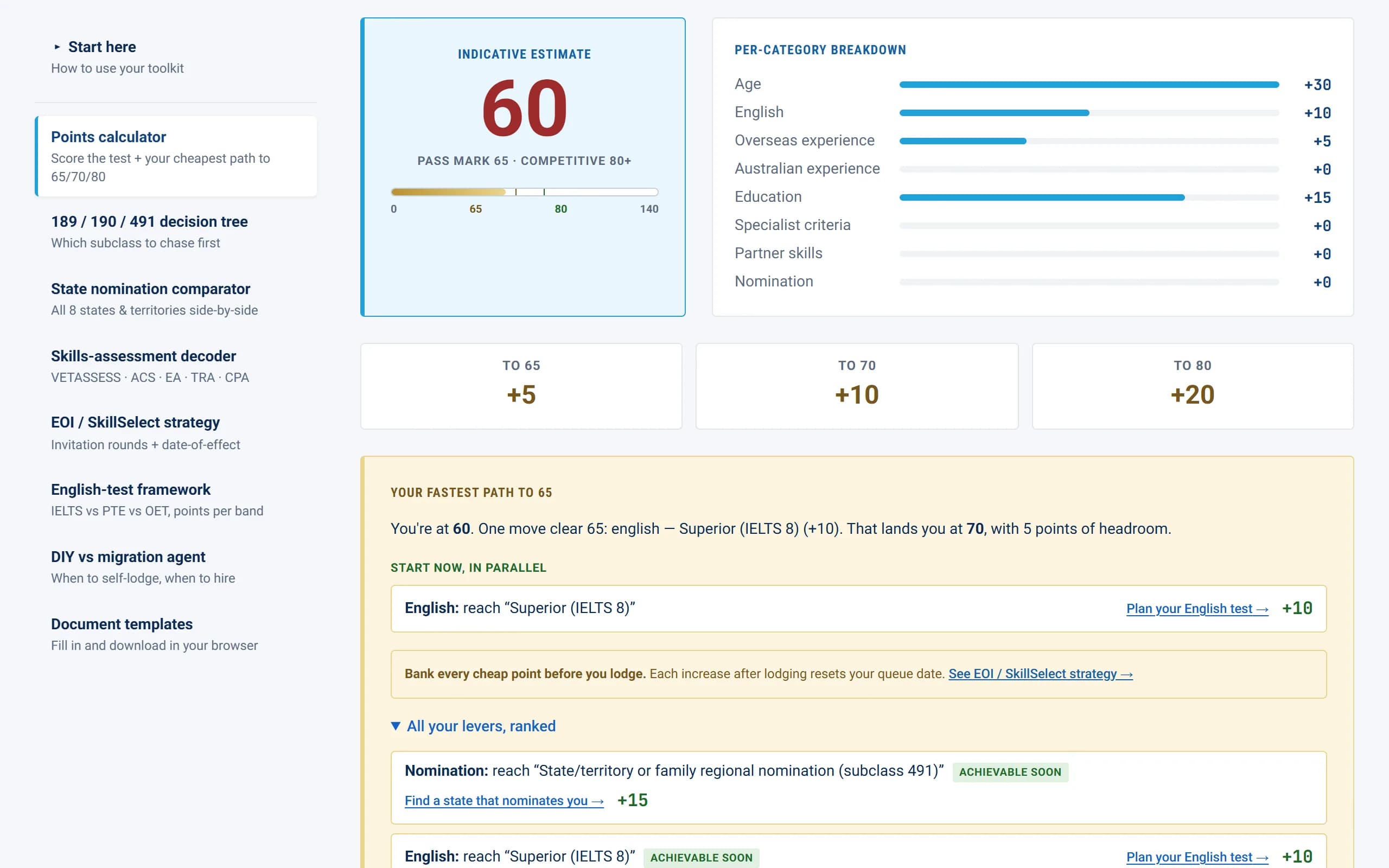
| Points Factor | Points | Notes |
|---|---|---|
| Age 25-32 | 30 | Achievable for many newly qualified optometrists |
| Age 33-39 | 25 | Realistic for mid-career |
| Qualification (Bachelor's optometry) | 15 | Skill Level 1 minimum |
| Qualification (Master's of Optometry) | 15 | Maintained — same points as Bachelor's at most universities |
| Qualification (PhD) | 20 | Strong claim |
| English (Proficient — IELTS 7 in each band) | 10 | AHPRA regulatory floor |
| English (Superior — IELTS 8+) | 20 | Significant differentiator |
| Overseas Skilled Experience (3-5 years) | 5-10 | |
| Overseas Skilled Experience (8+ years) | 15 | |
| Australian Skilled Experience (3-4 years) | 10 | Strong if on existing 482 |
| State Nomination (190) | 5 | |
| Regional Nomination (491) | 15 | |
| Partner Skills | 5-10 |
Realistic Scenarios
Scenario 1 — Mid-career offshore optometrist: Age 32 (30) + Master's of Optometry (15) + Superior English (20) + 5 years overseas (10) + 491 nomination (15) = 90 points. Strong candidate for regional placement.
Scenario 2 — Recently qualified offshore optometrist: Age 27 (30) + Master's of Optometry (15) + Proficient English (10) + 2 years overseas (5) + 491 nomination (15) = 75 points. Viable for 491; competitive for Specsavers/OPSM regional 482 sponsorship.
State Nomination for Optometrists
Optometry's appearance on state lists has tightened as metropolitan oversupply has been raised. The clearest opportunities are regional.
New South Wales
NSW periodically includes optometrist on its 491 stream for regional applicants and selectively on 190. Greater Sydney metropolitan optometry is increasingly competitive; regional NSW (Riverina, Far West, Northern Rivers, Mid North Coast) remains short of practitioners.
Victoria
Victoria's 491 stream has nominated optometrists in regional Victoria — Geelong, Ballarat, Bendigo, Goulburn Valley, Gippsland — when local recruitment cannot fill positions. Melbourne metropolitan nominations are limited.
Queensland
Queensland's 491 stream includes regional optometry roles, especially Far North Queensland (Cairns, Atherton Tablelands), Wide Bay (Bundaberg, Hervey Bay), and Outback Queensland. The state has allocated 750 places to the 491 stream for 2025-26.
South Australia
SA nominates regional optometrists under 491. Murray Bridge, Mount Gambier, Port Lincoln, Whyalla, and the Riverland all have persistent recruitment gaps.
Western Australia
WA's 491 stream includes optometrist for regional placements — the South West (Bunbury, Busselton, Margaret River), the Goldfields-Esperance, the Mid West, the Pilbara, and the Kimberley.
Tasmania and Northern Territory
Tasmania nominates optometrist under 491 for regional placements; the NT actively nominates given persistent shortages in Darwin's hinterland, Katherine, Alice Springs, and remote communities. Indigenous-focused eye care providers (the Brien Holden Vision Institute, the Lions Outback Vision) recruit through state nomination and direct sponsorship.
Salary and Employment Outlook
2026 Salary Bands
| Role | Typical Salary Range |
|---|---|
| New graduate optometrist (corporate) | AUD $95,000-$110,000 |
| Optometrist (2-5 years, metro) | AUD $105,000-$130,000 |
| Optometrist (regional) | AUD $120,000-$160,000 |
| Senior / lead optometrist | AUD $140,000-$180,000 |
| Therapeutic / specialty optometrist (myopia control, dry eye, orthokeratology) | AUD $150,000-$200,000 |
| Practice partner / equity holder | AUD $180,000-$250,000+ |
| Locum optometrist | AUD $800-$1,200/day |
Sources: SEEK Salary Hub (April-May 2026 average AUD $105,000-$120,000; Queensland state average ~$130,000), PayScale Australia (AUD $96,713 average, lagging indicator), recent practitioner remuneration data via Optometry Australia member surveys.
Total package includes the 11.5% superannuation guarantee. Corporate networks (Specsavers, OPSM) add KPI-linked bonuses; independent practices often pay above-base with profit-share arrangements at senior level.
Highest-paying employers and locations
- Regional independent practices — Cairns, Townsville, Mackay, the Riverland, the Pilbara, the Top End consistently pay above metropolitan rates with relocation allowances
- Specialty practices — myopia control clinics, behavioural optometry practices, dry-eye-focused practices pay premium for ocular therapeutic competency
- Indigenous and remote eye care providers — Brien Holden Vision Institute, Lions Outback Vision, ICEE pay strongly with remote-area packaging
- Corporate retail networks — Specsavers, OPSM, Bailey Nelson, George & Matilda Eyecare provide structured packages with relocation support for regional placements
- Hospital and academic — limited but present; UNSW Centre for Eye Health, Centre for Eye Research Australia, and state-based public hospital eye departments
Jobs and Skills Australia signal
The Jobs and Skills Australia 251411 occupation profile reports steady workforce growth (from 5,399 registered optometrists in 2017 to 6,977 by 2023). Optometry Australia's 2025 submission to the Occupation Shortage List process highlighted oversupply concerns in metropolitan areas, alongside continued regional shortages. The practical interpretation: regional and remote demand remains strong; metropolitan competition is rising for new graduate positions.
Tips for a Successful Application
1. Budget realistically for the OCANZ pathway
The COE plus AHPRA registration plus English testing plus visa fees plus relocation can easily exceed AUD $25,000 for a single-applicant pathway, before living costs in Australia. Costs increase materially on a re-sit. Plan finances and timelines for at least two clinical exam attempts if you trained in a prescribing-restricted jurisdiction.
2. Sit OET in addition to IELTS
OET is widely accepted by AHPRA and OCANZ, and many optometrists find OET easier than IELTS because the test content is clinically familiar. Both tests are accepted; sit whichever you score higher on.
3. Target regional Australia early
Metropolitan optometry positions in Sydney, Melbourne, and Brisbane are increasingly competitive. Regional independent practices and the corporate networks' regional placements both pay above metro rates and provide a stable migration pathway via 491 + 191 or 482 + 186 TRT. The lifestyle trade-off is real but financially favourable.
4. Complete ocular therapeutics training planning
Australian general registration includes ocular therapeutic prescribing. Candidates from training systems without prescribing scope (some Asian and African programs) should plan supervised therapeutic practice. The Optometry Board of Australia accepts approved ocular therapeutics programs delivered through Australian universities — UNSW, QUT, Deakin, and the University of Melbourne run accredited pathways.
5. Network through Optometry Australia and Cornea and Contact Lens Society events
Australian optometry is a small professional community. Membership of Optometry Australia (the peak body) and attendance at SRC, ODMA, and conferences such as the Australian Vision Convention rapidly opens job opportunities and mentor relationships that don't appear on SEEK.
Step-by-Step Migration Roadmap
- Confirm the ANZSCO match — verify duties match 251411 in the ANZSCO code finder
- Verify list status — confirm 251411 on the Skilled Occupation List
- Sit English — IELTS Academic 7 in each band or OET Grade B in each section
- Apply for OCANZ COE — pay Form 3 application fee, plan written and clinical sittings
- Complete written and clinical components of the COE — total approximately AUD $12,000+
- Apply for AHPRA registration — initial application AUD $447-$868 plus Cultural Safety Training $291
- Complete ocular therapeutics training — if not already qualified at general registration scope
- Submit EOI in SkillSelect — claim 189, 190, 491
- Apply for state nomination — particularly for regional 491
- Alternatively, secure 482 sponsorship — corporate retail networks or regional independent practices
- Receive ITA — lodge visa within 60 days
- Complete health and character checks, receive grant, register with the Optometry Board on arrival
Frequently Asked Questions
Can UK, Canadian, or US-trained optometrists skip the OCANZ exam?
Sometimes, partially. OCANZ has mutual recognition arrangements with the New Zealand Optometrists and Dispensing Opticians Board (automatic), and limited arrangements with certain accredited overseas programs. UK Aston, City University London, and Cardiff University graduates from accredited cohorts may receive partial credit; Canadian University of Waterloo and Université de Montréal graduates similarly. Most US-trained optometrists still complete the COE. Always confirm directly with OCANZ before assuming an exemption.
Why is the OCANZ examination so expensive?
The COE is a high-stakes, real-patient clinical examination delivered to international standards. The patient-based clinical component requires live patient recruitment, examiner panels, and equipment hire across multiple test centres. Australia and New Zealand maintain among the highest optometric prescribing standards in the world, and the COE fee reflects that examination overhead. Budget AUD $12,000+ as a baseline, plus revision course costs (typically AUD $3,000-$6,000 for major preparation providers).
Is optometry still a viable migration occupation in 2026?
Yes, but with caveats. Optometry Australia has formally raised metropolitan oversupply concerns, and the registered workforce has grown materially since 2017. The viable migration pathway in 2026 is overwhelmingly regional — 491 nomination or 482 sponsorship in regional and remote Australia. Metropolitan new-graduate optometry positions in Sydney and Melbourne are competitive enough that they are no longer a reliable entry point for offshore candidates without an Australian-qualified pathway.
What's the demand outlook for the next 5 years?
Mixed. Population ageing sustains demand for clinical optometry (cataract, glaucoma, macular disease, diabetic retinopathy). Myopia control is a fast-growing specialty area with strong demand for behavioural optometry. Counterbalancing factors include continued workforce growth (Australian optometry schools are producing ~300 graduates annually), corporate retail consolidation, and gradual encroachment of teleoptometry. The structural outcome is geographic — regional and outer-metropolitan demand will remain strong; inner-metropolitan markets will continue to tighten.
Can my ophthalmology background help me qualify as an optometrist?
Not directly. Ophthalmology and optometry are distinct professions in Australia. An overseas-trained ophthalmologist who wants to practise optometry must still complete the OCANZ COE and obtain AHPRA optometry registration — the medical qualification doesn't substitute. Alternatively, an overseas ophthalmologist may pursue medical recognition via the Australian Medical Council and RANZCO Fellowship, which is a different and longer pathway. The two routes are not interchangeable.