Registered Nurse (Community Health) Visa Pathway to Australia: Complete 2026 Guide
Updated: 16 August 2026
Australia classifies Registered Nurse (Community Health) under ANZSCO 254414. The Australian Nursing and Midwifery Accreditation Council (ANMAC) conducts the skills assessment and AHPRA handles registration with the Nursing and Midwifery Board of Australia. The occupation sits on the MLTSSL, unlocking subclasses 189, 190, 491, 482 and 186. Typical 2026 salaries range AUD $80,000-$130,000 by experience, with demand concentrated in regional and remote primary health.
Quick Facts: Registered Nurse (Community Health) Migration Pathway
| Detail | Information |
|---|---|
| ANZSCO Code | 254414 (Registered Nurse — Community Health) |
| Skill Level | 1 (Bachelor degree or higher) |
| Skills Assessment | ANMAC (Australian Nursing and Midwifery Accreditation Council) |
| Occupation List | CSOL and MLTSSL |
| Visa Options | 189, 190, 491, 482, 186 |
| Demand Level | High — chronic shortage in Aboriginal community-controlled health services, regional primary care and remote area services |
| Salary Range | AUD $80,000-$130,000 (Talent.com Australia and SEEK, April 2026) |
| Typical 189 Score | 70-80 (smaller invitation pool than aged care) |
| Key Challenge | Many community health RN roles in state services prefer onshore candidates with prior Australian Aboriginal cultural competency training |
What Community Health Nurses Do in Australia
Community Health Nurses (CHNs) deliver primary, preventive and continuing care outside hospital settings. The role spans school nursing, refugee health, sexual health, Aboriginal community-controlled health services (ACCHOs), correctional health, homeless health, mental health outreach, drug and alcohol services, and chronic disease management in primary care.
The single largest employer of CHNs is the network of Aboriginal Community Controlled Health Organisations and equivalent state-funded primary health services. These services cluster in regional and remote Australia — the Kimberley, the Pilbara, the APY Lands, Central Australia, Cape York, the Torres Strait, the Top End, and western NSW. Demand in those areas is structurally severe; turnover is high; salary packages include remote allowances, accommodation and travel.
In metropolitan areas, demand is steady in refugee health programs, school nursing, drug and alcohol clinical services, and chronic disease management within primary health networks. Pay scales are lower than residential aged care for entry-level CHNs but climb faster with experience.
ANZSCO Code 254414 — What's Covered
Code 254414 covers registered nurses providing nursing care, health support and advice to clients within community settings rather than acute hospital settings. Tasks include health assessment, health promotion, chronic disease management, immunisation, outreach to at-risk populations, case management, and care coordination across primary care, social services and acute hospital services.
The code is distinct from 254413 Child and Family Health (which targets the 0-5 age group and family wellbeing), from 254422 Mental Health, and from 254416 Developmental Disability or 254417 Disability and Rehabilitation. CHN work that overlaps significantly with another specialty should be nominated under the dominant specialty code rather than 254414.
If your work has predominantly been in Aboriginal health, refugee health, sexual health or other community-based primary care, 254414 is the correct code. ANMAC will assess based on documented duties.
Skills Assessment
ANMAC Skills Assessment
ANMAC Modified Skills Assessment (AUD $395)
For applicants with in-principle AHPRA approval. Processing 6-8 weeks.
ANMAC Direct Care Skills Assessment (AUD $545)
For applicants who completed an AHPRA-approved Outcomes Based Assessment.
ANMAC Full Skills Assessment (AUD $595)
For applicants without Australian or New Zealand registration who hold a Bachelor of Nursing (or higher) from Canada, Hong Kong, Ireland, the United Kingdom or the United States, with current home-country registration.
Common rejection reasons: Employment references describing acute hospital ward nursing rather than community-based delivery; insufficient evidence of autonomous nursing practice (community nursing typically involves substantial autonomous decision-making); qualifications without a public health or community health post-graduate component where the role requires one.
AHPRA Registration (NMBA)
CHNs register as general Registered Nurses with the NMBA. Internationally qualified candidates typically complete the Outcomes Based Assessment (OBA).
Initial registration fee: Approximately AUD $500 Annual renewal: AUD $193 (June 2026-May 2027) English: IELTS Academic 7.0 each band, OET B grade, or equivalent
Run AHPRA and ANMAC in parallel.
Visa Pathways for Community Health Nurses
Subclass 491 — Skilled Work Regional Visa (Often Dominant)
Community health RN demand sits disproportionately in regional and remote postings, which makes 491 the highest-probability pathway for many applicants.
- Visa fee: AUD $6,140
- Points boost: +15 from regional nomination
- Processing time: 12-15 months
- Quirk: Aboriginal community-controlled health services often sit in DAMA-eligible regions with additional concessions
Subclass 190 — Skilled Nominated Visa
State nomination grants permanent residency.
- Visa fee: AUD $6,140
- Processing time: 9-19 months
- Best states: NSW, VIC, QLD, SA, WA, NT all nominate community health RNs
Subclass 189 — Skilled Independent Visa
Available because 254414 is on the MLTSSL.
- Visa fee: AUD $6,135
- Typical invitation score: 70-80
- Processing time: 8-12 months; healthcare priority can compress to 3-6 months
Subclass 482 — Skills in Demand Visa
Available where the employer holds sponsor status. ACCHOs and large primary health networks are common sponsors.
- Visa fee: AUD $3,210
- Core Skills Income Threshold: AUD $76,515 (rising to $79,499 on 1 July 2026)
- Processing time: 2-3 months for healthcare priority
Subclass 186 — Employer Nomination Scheme
Permanent residency through employer sponsorship. Direct Entry available for candidates with 3+ years experience and a skills assessment.
- Visa fee: AUD $6,140
- Processing time: 4-12 months
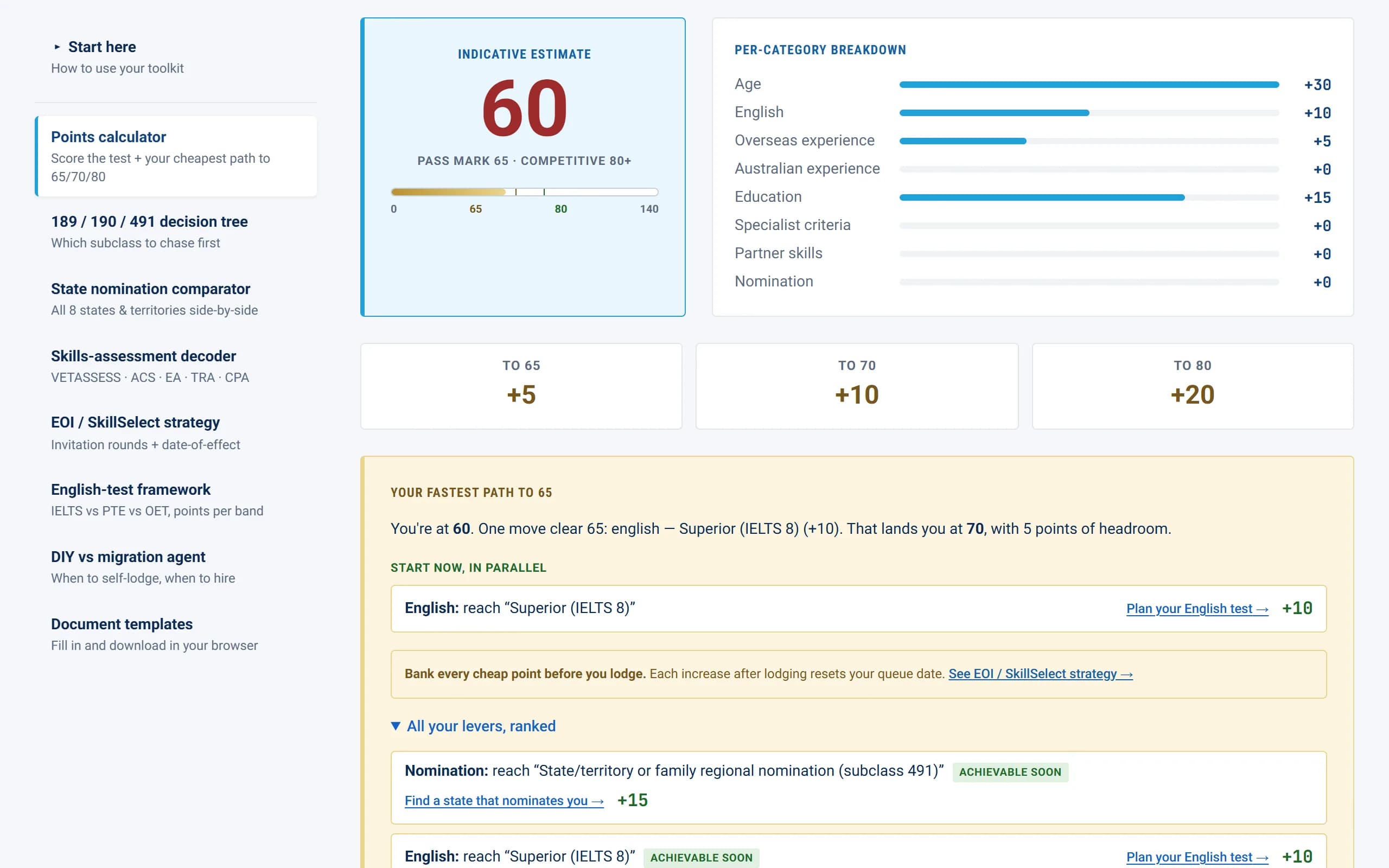
Points Test Strategy
| Points Factor | Points | Notes |
|---|---|---|
| Age (25-32) | 30 | |
| Age (33-39) | 25 | |
| English (Superior — 8.0) | 20 | |
| English (Proficient — 7.0) | 10 | |
| Qualification (Bachelor's) | 15 | |
| Qualification (Master's) | 15 | |
| Qualification (PhD) | 20 | |
| Overseas Experience (5-7 years) | 10 | |
| Overseas Experience (8+ years) | 15 | |
| Australian Experience (1-3 years) | 5-10 | |
| State Nomination (190) | 5 | |
| Regional (491) | 15 | |
| Partner Skills | 5-10 | |
| NAATI/CCL | 5 | Valuable for refugee health roles |
Realistic Scenarios
Scenario 1: 33-year-old Filipino community health RN, 9 years experience, IELTS 7.0
- Age 25 + Bachelor's 15 + English 10 + Experience 15 = 65 points
- Add 491: 80 points; add partner skills: 85 points — strong
Scenario 2: 28-year-old UK community staff nurse, 5 years experience, IELTS 8.0
- Age 30 + Bachelor's 15 + English 20 + Experience 10 = 75 points
- Add 190: 80 points — likely to invite
State Nomination for Community Health RNs
New South Wales
NSW Health employs community RNs through Local Health Districts (HealthOne, Aboriginal Health, Refugee Health, Sexual Health, Drug and Alcohol). Western Sydney, Western NSW and Mid North Coast LHDs are particularly active. NSW 190 healthcare invitations cleared at 75-85 points in early 2026.
Victoria
Victoria's community health centres are independent not-for-profits funded by the Department of Health. Cohealth, Merri Health, EACH and Star Health employ substantial CHN teams. The state's 2025-26 program closed to new EOIs on 28 April 2026.
Queensland
Queensland Health employs CHNs through Hospital and Health Services. Cape York, Torres Strait, Mount Isa and Cairns and Hinterland HHSs have chronic shortages.
South Australia
SA Health's Aboriginal Health Services, refugee health and community mental health programs employ CHNs across Adelaide and regional SA. The APY Lands face especially severe shortages.
Western Australia
WA Country Health Service's Kimberley, Pilbara, Goldfields and Midwest regions have the most acute CHN shortages in the country. Sponsorship is generous and the 491 pathway is particularly viable.
Tasmania
Tasmania's Aboriginal health, community drug and alcohol, and rural primary care services maintain ongoing recruitment. The Tasmanian 491 pathway is among the more achievable.
Northern Territory
NT has the most acute community health nursing demand of any jurisdiction. Aboriginal Medical Services Alliance of the NT, Central Australian Aboriginal Congress, Miwatj Health and Anyinginyi all sponsor and nominate. NT 190 and 491 offshore processing for healthcare can be six to eight months.
Salary and Employment Outlook
What Community Health Nurses Earn in 2026
| Role | Typical Salary Range |
|---|---|
| Entry CHN (1-3 years) | AUD $75,000-$90,000 |
| CHN (mid-level, 4-7 years) | AUD $95,000-$115,000 |
| Senior CHN / Clinical Nurse Specialist | AUD $115,000-$135,000 |
| Remote Area Nurse (with allowances) | AUD $130,000-$180,000 (incl. allowances and housing) |
| CHN Team Leader / Coordinator | AUD $120,000-$145,000 |
| CHN Locum | AUD $85-$120 per hour |
Salary base figures from Talent.com Australia and SEEK (April 2026). Salaries exclude superannuation (11.5 per cent). Remote area roles include accommodation, vehicle, travel allowances and remote zone tax offsets that can add substantially to the take-home figure.
Where the Money Sits
- Remote area nursing in NT, WA Kimberley, far north Queensland — base plus remote allowance plus housing
- Aboriginal community-controlled health services — competitive base plus cultural leave provisions
- Refugee health programs in Sydney and Melbourne — premium pay for trauma-informed care expertise
- Sexual health and BBV nursing — niche but well-paid in metropolitan health services
- Primary Health Network coordinator roles — premium for case management experience
Tips for a Successful Application
1. Document Autonomous Practice Carefully
Community nursing involves substantial autonomous decision-making — far more than hospital ward work. ANMAC and Australian employers both look for evidence of this autonomy. Reference letters should explicitly describe independent clinical decision-making, case management responsibility, and outreach work.
2. Consider Remote Area Nursing for Maximum Income
Remote area packages frequently double a metro CHN salary once accommodation, vehicle, allowances and tax offsets are factored. CRANAplus offers preparatory courses for prospective Remote Area Nurses, which improves both employability and on-the-job retention.
3. Target Aboriginal Community Controlled Health Services
ACCHOs are accredited 482 and 186 sponsors, they operate in 491-eligible regions, and they actively recruit internationally for hard-to-fill positions. The work is challenging but the application throughput is strong.
4. Run AHPRA and ANMAC in Parallel
Standard advice for all nursing migration: the two processes are independent. Sequential submission wastes six months.
5. Bring Cultural Safety Training to the Application
Australian community health employers heavily favour candidates who have completed (or are completing) cultural safety training, particularly in Aboriginal and Torres Strait Islander health. Cultural safety modules from CRANAplus or universities translate well into employer-readiness signals.
Step-by-Step Migration Roadmap
- Confirm 254414 fits your documented experience via the ANZSCO code finder
- Verify the occupation is on the 2026 Skilled Occupation List — it is
- Request employment references describing community-based autonomous nursing practice
- Sit OET or IELTS at AHPRA minimum (7.0 / B grade)
- Submit AHPRA self-check via IQNM portal
- Lodge ANMAC application in parallel
- Complete AHPRA OBA (MCQ then OSCE)
- Receive ANMAC outcome letter (valid 2 years)
- Apply to ACCHOs or remote-area employers OR submit EOI in SkillSelect for 189/190/491
- Receive sponsorship or state nomination
- Lodge visa application within deadline
- Complete health, character checks; receive grant
Frequently Asked Questions
Can I migrate as a community health RN if my background is acute hospital nursing?
Probably not directly on 254414. ANMAC and Australian employers expect documented community-based autonomous practice — outreach, case management, primary care — rather than acute ward nursing. With hospital-only experience, the better fits are 254418 Medical, 254423 Perioperative, 254424 Surgical or 254499 RNs nec.
What counts as "community health" for ANZSCO 254414?
Primary care nursing, Aboriginal community-controlled health, refugee health, sexual health, drug and alcohol clinical services, school nursing, correctional health, homeless outreach, chronic disease management in general practice, and similar community-based primary or preventive services. Practice nurses in single-doctor general practice are also typically a fit.
Why is the salary range so wide for this occupation?
Two factors: experience progression is steeper than in residential aged care (entry $80k climbs to senior $130k), and remote area roles command 30-80 per cent loading via allowances. A CHN in metro Melbourne and a Remote Area Nurse in the APY Lands can earn $50,000-$70,000 apart on essentially the same registration.
Is employer sponsorship realistic for community health roles?
Yes, particularly with ACCHOs and remote-area employers. Less common with metropolitan public health services, which often prefer onshore candidates who already have AHPRA registration. Plan around the employer type that matches your geographic preference.
What's the demand outlook for community health RNs in 2026?
High in regional and remote Australia; steady in metropolitan areas. Jobs and Skills Australia lists registered nurses as a shortage occupation nationally, and the community health subset shows acute pressure in Aboriginal health, refugee health and remote primary care.
Can my overseas community nursing qualification be recognised?
Bachelor of Nursing degrees from the UK, Ireland, NZ, Canada and the US are most readily recognised. Indian, Filipino and most African qualifications typically require completion of the OBA bridging assessment. Specialised community health post-graduate qualifications are assessed alongside the underlying Bachelor.