Orthotist or Prosthetist Visa Pathway to Australia: Complete 2026 Guide
Updated: 16 August 2026
Australia classifies Orthotist or Prosthetist under ANZSCO 251912. AOPA (the Australian Orthotic Prosthetic Association) conducts the two-stage skills assessment. The occupation sits on both the MLTSSL and the Core Skills Occupation List, unlocking subclasses 189, 190, 491, 482 and 186. Typical 2026 salaries range AUD $84,000-$147,000. The profession is not AHPRA-registered, so no separate clinical registration is required.
Quick Facts: Orthotist or Prosthetist Migration Pathway
| Detail | Information |
|---|---|
| ANZSCO Code | 251912 (Orthotist or Prosthetist) |
| Skill Level | 1 (Master degree level in orthotics and prosthetics) |
| Skills Assessment | AOPA (Australian Orthotic Prosthetic Association) |
| Occupation List | MLTSSL and CSOL |
| Visa Options | 189, 190, 491, 482, 186 |
| Demand Level | High — small profession, persistent national shortage, NDIS-driven growth |
| Salary Range | AUD $84,000-$147,000 (ERI, 2026); AOPA-listed clinical roles AUD $120,000-$140,000 inc super |
| Typical 189 Score | 65-80 (small-profession allied health typically clears at lower thresholds) |
| Key Challenge | Two-stage AOPA assessment with portfolio evidence; combined cost over AUD $2,200 if Stage 2 required |
What Orthotists and Prosthetists Do in Australia
Orthotists design, fit and supply orthoses (braces, splints and supports) for patients with musculoskeletal conditions, neurological impairment, sports injuries, paediatric conditions and post-surgical needs. Prosthetists design, fit and supply prostheses (artificial limbs) for patients following amputation or with congenital limb difference. Many practitioners work across both scopes — the title "Orthotist/Prosthetist" reflects the integrated training pathway in Australia.
Most clinicians work in NDIS-registered private practices, public hospital prosthetics and orthotics departments (Royal Melbourne Hospital, the Mater in Brisbane, Royal North Shore in Sydney), or specialist providers (APC Prosthetics, Ottobock, Ossur clinics). The National Disability Insurance Scheme has materially expanded clinical demand — the AOPA estimates ongoing workforce shortage across both adult and paediatric services. Regional Australia has the sharpest pressure, with several public health services running waitlists of months for routine orthotic appointments.
ANZSCO 251912 Mapping
Orthotist or Prosthetist (251912) sits within the ANZSCO 2519 Other Health Diagnostic and Promotion Professionals sub-group. It is a single code covering both orthotists and prosthetists. There is no separate code for paediatric versus adult practice or for sub-specialisation in upper-limb, lower-limb or spinal orthotics — all map to 251912.
ANZSCO requires Skill Level 1: a recognised qualification in orthotics and prosthetics. In Australia this is structured as a two-year Master of Clinical Prosthetics and Orthotics (La Trobe University) on top of a relevant undergraduate science or health degree. Overseas pathways vary widely — some countries train at bachelor level only, others through hospital apprenticeship — and AOPA assesses equivalence individually.
Tasks recognised under 251912 include clinical assessment of biomechanical and gait needs, design and prescription of orthoses or prostheses, fabrication or supplier liaison, fitting and adjustment, patient education, ongoing clinical review, and multidisciplinary collaboration with surgeons, physiotherapists and occupational therapists.
Skills Assessment
AOPA Two-Stage Skills Assessment
AOPA is the Department-gazetted assessing authority for 251912. The assessment is structured in two stages.
Stage One: Review of Eligibility
A desktop review of qualifications, English language outcomes and clinical experience.
Requirements:
- A recognised qualification in orthotics and prosthetics — typically Master degree level for current Australian-trained graduates; older bachelor-level overseas qualifications may be accepted with supporting clinical evidence
- English at IELTS Academic 7.0 across all four bands, OET B in each component, or equivalent
- CV completed on AOPA's mandatory template
- Certified copies of tertiary qualifications, academic transcripts and home-jurisdiction professional certification
Stage One Cost (overseas applicants): AUD $802 total — AUD $130 skilled migration application fee plus AUD $672 Stage One review fee.
Stage One Cost (within Australia, GST inclusive): AUD $882.20 — AUD $143 application fee plus AUD $739.20 review fee.
Stage Two: Portfolio of Evidence
Only invoked if Stage One is approved. A detailed portfolio demonstrating clinical competency against Australian practice standards.
Stage Two Cost: AUD $1,447.60 (same fee for overseas and Australian applicants).
Total fee for a full two-stage assessment: AUD $2,249.60 (overseas) or AUD $2,329.80 (within Australia, GST inclusive).
Processing time: Stage One review is generally completed within 8-12 weeks of a complete application; Stage Two portfolio review takes longer and varies based on portfolio depth.
Common rejection reasons: Overseas qualifications that lack the postgraduate or Master-level depth required by current Australian standards, insufficient clinical hours across both orthotics and prosthetics scopes, and English bands below AOPA's mandatory level. Applicants whose home-country training is heavily weighted to either orthotics or prosthetics (but not both) frequently require additional portfolio documentation at Stage Two.
No Separate AHPRA Registration
Orthotists and prosthetists are not registered through AHPRA. AOPA maintains the voluntary professional certification framework instead. Most NDIS-registered providers and public hospital networks require AOPA Certified Practitioner status as a condition of employment, so AOPA certification (separate from the migration skills assessment) is the de facto licence to practise.
Visa Pathways
Subclass 482 — Skills in Demand Visa
The most common pathway. NDIS-registered private practices and public hospital networks regularly sponsor overseas-qualified clinicians.
- Visa fee (primary applicant): AUD $3,210 (Core Skills stream)
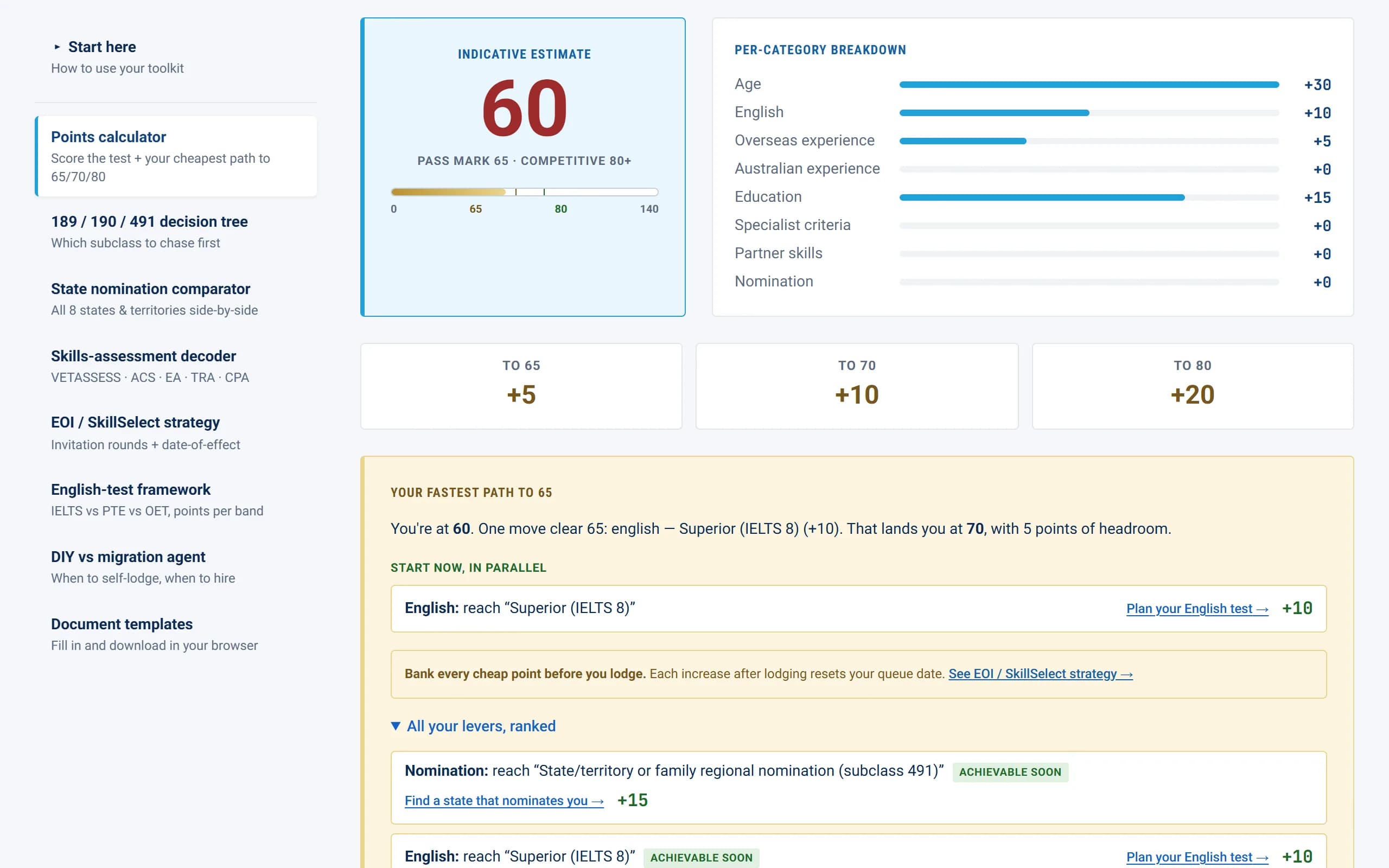
- Core Skills salary threshold: AUD $76,515 — comfortably met by entry-level clinical roles
- Specialist Skills threshold: AUD $141,210 — reached by senior or principal clinicians
- Processing time: Median 21-47 days for Core Skills; Specialist Skills stream processes faster
- Quirk: AOPA's job board frequently lists positions advertising sponsorship; the small size of the profession means employers and AOPA work closely on overseas recruitment
Subclass 186 — Employer Nomination Scheme
Permanent residency through employer sponsorship.
- Visa fee: AUD $6,140
- Processing time: Direct Entry stream currently 12-20+ months; TRT stream faster
- Quirk: Some larger NDIS providers and public hospital networks nominate directly via Direct Entry, particularly for senior clinical roles
Subclass 189 — Skilled Independent
Permanent residency through SkillSelect without sponsorship.
- Visa fee: AUD $6,135
- Minimum points: 65; small-profession healthcare invitations have generally cleared at 70-80 in 2025-26
- Processing time: Approximately 8-9 months after invitation
Subclass 190 — Skilled Nominated
State nomination adds 5 points and a two-year residence obligation.
- Visa fee: AUD $6,140
- Processing time: 6-12 months after invitation
- Quirk: Victoria, NSW, Queensland, WA and SA have all included 251912 in 2025-26 nomination pathways
Subclass 491 — Skilled Work Regional
Regional nomination adds 15 points; pathway to permanent residency via subclass 191.
- Visa fee: AUD $6,140
- Processing time: 12-15+ months for 90% of applicants
- Quirk: Regional orthotics and prosthetics services are among the most acute shortages — clinicians willing to work in regional Queensland, Tasmania or regional SA frequently command salary premiums
Points Test Strategy
Invitation thresholds for 251912 in 2025-26 have generally been below the ICT bands, reflecting the small applicant pool.
| Points Factor | Points | Notes |
|---|---|---|
| Age 25-32 | 30 | Maximum bracket |
| Age 33-39 | 25 | Common for established clinicians |
| Bachelor degree | 15 | May be accepted if combined with extensive experience |
| Master's degree | 15 | Standard for current Australian-trained clinicians |
| PhD | 20 | Rare in this profession |
| Superior English (IELTS 8.0) | 20 | Significant points advantage |
| Proficient English (IELTS 7.0) | 10 | Already required for AOPA |
| 8+ years skilled experience | 15 | Common for established clinicians |
| State nomination (190) | 5 | Multiple states active |
| Regional nomination (491) | 15 | Most non-metro Australia qualifies |
| Partner skills | 5-10 | If partner has positive skills assessment |
Realistic Score Scenarios
Scenario 1: Mid-career clinician, 33, Master's, Proficient English, 8 years experience Age 25 + Master's 15 + English 10 + Experience 15 = 65. With 190 nomination (+5) = 70 — competitive for 2025-26 healthcare invitations.
Scenario 2: Senior clinician, 30, Master's, Superior English (OET A), 6 years experience Age 30 + Master's 15 + English 20 + Experience 10 = 75. Sufficient for 189 in the small-profession healthcare bands.
State Nomination
Victoria
Victoria's 2025-26 nomination program includes orthotists/prosthetists across both 190 and 491 streams. The state hosts the only Australian Master of Clinical Prosthetics and Orthotics programme at La Trobe University, which has helped sustain a denser professional network in Melbourne. Victoria charges no nomination fee.
New South Wales
NSW Health and major Sydney private practices recruit internationally. NSW nomination involves a $330 fee and has prioritised allied health professions in 2025-26 invitation rounds.
Queensland
Queensland's 491 program supports allied health for regional centres including Townsville, Cairns and the Sunshine Coast. Mater Health and Queensland Health have publicly recruited orthotists for hospital-based services.
Western Australia
WA Country Health Service and the Perth tertiary hospital network have sponsored 251912 directly into 482 and 186 visas, alongside state-nominated pathways.
South Australia
South Australia nominates 251912 under 190 and 491 in 2025-26. SA's regional designation covers most of the state outside central Adelaide.
Salary and Employment Outlook
Salary by Seniority
| Role | Typical Salary Range |
|---|---|
| Graduate Orthotist/Prosthetist | AUD $75,000-$90,000 |
| Clinician (3-5 years) | AUD $90,000-$115,000 |
| Senior Clinician | AUD $110,000-$135,000 |
| Principal / Specialist Clinician | AUD $130,000-$155,000 |
| Service Manager / Clinical Lead | AUD $140,000-$175,000 |
| NDIS private practice (sole trader / partner) | Variable, frequently AUD $150,000+ |
Source: ERI SalaryExpert (2026), AOPA-listed positions, public health service award schedules.
Total packages typically include 12% superannuation (the SG rate from 1 July 2025); some AOPA-advertised positions specify 17.5% super inclusive in stated packages. Public hospital roles include salary packaging (up to AUD $9,010 tax-free under most state awards). NDIS-funded service growth has driven up private-sector remuneration meaningfully over the past three years.
Highest-Paying Settings
- NDIS private practice partnerships — sole-trader or partner-level clinicians frequently exceed AUD $150,000
- Specialist paediatric and complex-needs centres — premium for advanced clinical expertise
- Regional and remote services — base rates plus relocation, accommodation and retention bonuses
- Sub-specialty manufacturers and providers (Ottobock, Ossur) — clinical-commercial hybrid roles at strong rates
- Public hospital senior clinicians — strong award rates plus salary packaging benefits
Tips for a Successful Application
- Confirm Master-level equivalence before paying AOPA fees. Australian-trained clinicians complete a Master degree. Overseas bachelor-level qualifications may be accepted but require strong supporting clinical evidence at Stage One. Email AOPA with your qualification details before lodging.
- Document both orthotics and prosthetics clinical hours. The single ANZSCO code covers both scopes. Applicants with experience weighted heavily to one side frequently need a stronger Stage Two portfolio.
- Sit OET, not IELTS. OET is healthcare-specific and produces higher band scores for many non-native speakers. AOPA accepts OET B in each component.
- Target NDIS-registered employers for sponsorship. The NDIS has driven significant clinical demand growth. NDIS providers frequently sponsor and are familiar with the visa process.
- Budget for the full two-stage cost. Total AOPA fees can reach AUD $2,249 if Stage Two is invoked. Some applicants are caught out by the Stage Two trigger after a positive Stage One.
Step-by-Step Migration Roadmap
- Confirm ANZSCO 251912 fits your role — review the ANZSCO code finder
- Verify list status — 251912 sits on both the MLTSSL and CSOL
- Sit OET (preferred) or IELTS Academic — target B grade across all components for OET
- Lodge the AOPA Stage One application — AUD $802 (overseas), 8-12 weeks
- If Stage Two is required, prepare the portfolio — AUD $1,447.60
- Apply for AOPA Certified Practitioner status if planning to work in NDIS or public hospital settings — separate from the migration assessment but mandatory for most employers
- Decide your visa route — employer-sponsored (482/186) or skilled (189/190/491)
- For sponsored routes — target NDIS-registered providers and major public hospital networks
- For skilled routes — submit an EOI in SkillSelect and apply for state nomination
- Receive invitation or nomination — lodge the visa within 60 days
- Complete health and character checks — Bupa medical, AFP and overseas police clearances
- Receive grant and relocate — confirm AOPA certification is active before starting clinical practice
Frequently Asked Questions
Are orthotists and prosthetists registered with AHPRA?
No. The profession is not currently registered under the National Registration and Accreditation Scheme. AOPA maintains the voluntary professional certification framework, and most NDIS providers and public hospital networks require AOPA Certified Practitioner status as a condition of employment. AOPA campaigns periodically for AHPRA registration, but the regulatory framework remains self-regulated in 2026.
What's the difference between the migration assessment and AOPA certification?
The migration assessment is a one-off process to verify qualifications meet Australian standards for visa purposes. AOPA Certified Practitioner status is the ongoing clinical credential — it includes continuing professional development requirements and is recognised by NDIS and public health employers. Most overseas applicants need both: the migration assessment for the visa, and AOPA certification to actually work.
How long does the full migration journey take?
Realistically 12-18 months from first English test to landing in Australia. AOPA Stage One takes 8-12 weeks; Stage Two (if invoked) adds further time. Visa processing on the 482 averages 21-47 days, while 189/190 can take 6-12 months. Run English testing and Stage One concurrently to compress the timeline.
Can a UK or US prosthetist with bachelor-level training migrate?
Frequently yes, but not automatically. Older bachelor-level qualifications in orthotics and prosthetics may be accepted by AOPA if supported by substantial post-qualification clinical experience and continuing professional development. Newer applicants from countries where the training has moved to Master level have a more direct pathway. Stage Two portfolio evidence is more likely to be required for bachelor-only applicants.
Which state has the strongest demand?
Demand is national but Victoria has the densest professional network (driven by the La Trobe University training programme), NSW and Queensland have growing public hospital and NDIS-private sectors, and regional services across all states report the most acute shortages. Clinicians willing to relocate regionally generally find roles fastest.
Is the profession well-paid compared with other allied health?
Yes — the small workforce, NDIS-driven demand growth and clinical complexity translate to remuneration above many allied health roles. Senior and principal clinicians frequently out-earn occupational therapists, physiotherapists and speech pathologists at equivalent career stages. See most in demand occupations Australia 2026 for broader allied health comparisons.