Orthoptist Visa Pathway to Australia: Complete 2026 Guide
Updated: 16 August 2026
Australia classifies Orthoptist under ANZSCO 251412. VETASSESS conducts the migration skills assessment; the Australian Orthoptic Board handles professional registration, which is self-regulated rather than AHPRA-administered. The occupation sits on the STSOL and CSOL, unlocking subclasses 190, 491, 482 and 186 — not 189. Typical 2026 salaries range AUD $80,000-$130,000. Ophthalmology demand is rising as Australia's population ages.
Quick Facts: Orthoptist Migration Pathway
| Detail | Information |
|---|---|
| ANZSCO Code | 251412 (Orthoptist) |
| Skill Level | 1 (AQF Bachelor degree or higher in orthoptics) |
| Skills Assessment | VETASSESS (Group A professional occupation) |
| Occupation List | STSOL and CSOL — not on MLTSSL |
| Visa Options | 190, 491, 482, 186 (no 189) |
| Demand Level | High — ophthalmology demand grows with the ageing population |
| Salary Range | AUD $80,000-$130,000 (SEEK Salary Hub, 2026) |
| Typical 190 Score | 65-75 |
| Key Challenge | Self-regulated profession — Australian Orthoptic Board registration sits outside AHPRA |
Role Context in Australia
Orthoptists diagnose and manage eye-movement disorders, binocular vision problems and visual processing conditions. They work alongside ophthalmologists and optometrists in eye clinics, hospital ophthalmology departments, paediatric services and specialist private practices. Common conditions include strabismus, amblyopia, diplopia, low vision rehabilitation and the perimetry and biometry work that supports cataract, glaucoma and retinal disease management.
Australian demand is driven by demographics and clinical scope. The over-65 population is expanding, which lifts cataract surgery volume, macular degeneration management and glaucoma monitoring — all of which depend on orthoptic measurement. Public hospital ophthalmology departments in NSW, Victoria, Queensland and SA carry persistent vacancies. The private ophthalmology sector — Vision Eye Institute, Personal Eyes, Eye and Laser Centre and independent practices — actively recruits internationally where local supply falls short. Job growth in the profession is projected at around 15% over the next five years, faster than the broader allied health average.
ANZSCO Code Mapping: 251412
ANZSCO 251412 covers the diagnosis and management of eye-movement disorders and associated sensory deficiencies. Core tasks include taking case histories, measuring visual acuity, assessing ocular motility and binocular vision, performing visual field testing, conducting biometry for intraocular lens calculation, designing rehabilitation programs, and managing paediatric vision development.
The code is distinct from 251411 Optometrist (which requires AHPRA registration through the Optometry Board) and from 253914 Ophthalmologist (medical specialist). Orthoptists do not prescribe glasses or contact lenses independently and do not perform surgery — the scope is diagnostic and rehabilitative.
Skills Assessment: VETASSESS
VETASSESS is the migration skills assessing body for Orthoptist. The occupation is in Group A, which means VETASSESS requires both a qualification assessed as comparable to an Australian Bachelor degree or higher in a highly relevant field, and at least one year of post-qualification employment in a highly relevant role within the last five years.
VETASSESS requirements
- Qualification — Bachelor degree or higher in orthoptics, vision science or a closely related discipline. Optometry, optical dispensing or general health science qualifications do not satisfy the requirement on their own.
- Employment — Minimum 12 months of highly relevant post-qualification work in the last five years at the appropriate skill level. Internships and supervised clinical placements count if documented with employer letters.
- English — Not required by VETASSESS for the assessment itself, but the eventual visa application requires Competent English minimum.
Cost and timing
- Standard application fee: AUD $1,096 (offshore); AUD $1,205.60 incl. GST (onshore). Fee schedule updated October 2025.
- Priority processing: AUD $1,921 total (offshore); AUD $2,113.10 incl. GST (onshore)
- Processing time: 12-16 weeks standard; 10 business days with priority processing
Common rejection drivers: qualifications that are general optometry rather than orthoptics, employment evidence that does not demonstrate the diagnostic scope (e.g. work that was confined to dispensing or assistant duties), and gaps in employment within the five-year recency window.
Professional registration: Australian Orthoptic Board
Orthoptics is one of the few diagnostic health professions in Australia that is not regulated by AHPRA. The Australian Orthoptic Board (AOB) is a self-regulating professional body that accredits members against an approved university qualification. Registration with the AOB is not strictly mandatory to use the title "orthoptist," but it is required for:
- Access to Medicare provider numbers
- Access to NDIS funding
- State-based Drugs and Poisons authorisation (relevant for diagnostic drug administration)
- Recognition under the Sonography Act
- Most public hospital and major private clinic employment
In practice, every employer of consequence requires AOB registration. The AOB recognises accredited Australian programs (La Trobe University and University of Technology Sydney) and assesses overseas qualifications case-by-case. Overseas applicants should expect to complete a bridging program or supervised practice period before full registration is granted. Plan for 6-18 months of bridging, depending on the source country and qualification.
Visa Pathways for Orthoptists
Because Orthoptist sits on the STSOL and CSOL but not the MLTSSL, the 189 Skilled Independent visa is not available. The pathway runs through state nomination, regional nomination or employer sponsorship.
Subclass 482 — Skills in Demand (SID)
The most direct pathway for offshore-trained orthoptists with an Australian job offer. Employer sponsorship runs for up to four years.
- Visa fee: AUD $4,015 (Core Skills stream, primary applicant)
- Salary threshold: Core Skills Income Threshold AUD $79,423 (2026)
- Processing time: 1-3 months in Core Skills stream
- Quirk: Public hospital ophthalmology departments are experienced sponsors. Private practice sponsorship is faster but the salary threshold is the binding constraint for entry-level roles.
Subclass 190 — Skilled Nominated
State-nominated permanent residency. Adds 5 points and requires a two-year residency commitment to the nominating state.
- Visa fee: AUD $6,140
- Best states: NSW, Victoria, South Australia carry orthoptist on their 2025-26 health-priority lists
- Processing time: 6-12 months post-invitation
Subclass 491 — Skilled Work (Regional)
Five-year regional provisional visa with a PR pathway via subclass 191 after three years of regional residency and qualifying income. Adds 15 points.
- Visa fee: AUD $6,140
- Processing time: 6-9 months
- Quirk: Regional public hospitals (Newcastle, Geelong, Ballarat, Hobart, Townsville) often invite orthoptists faster than capital-city programs
Subclass 186 — Employer Nomination Scheme
Permanent residency via employer sponsorship. Direct Entry stream requires three years of skilled post-qualification experience plus the VETASSESS outcome. TRT stream typically follows two years on a 482.
- Visa fee: AUD $6,140
- Processing time: 3-7 months Direct Entry; 6-12 months TRT
Points Test Strategy
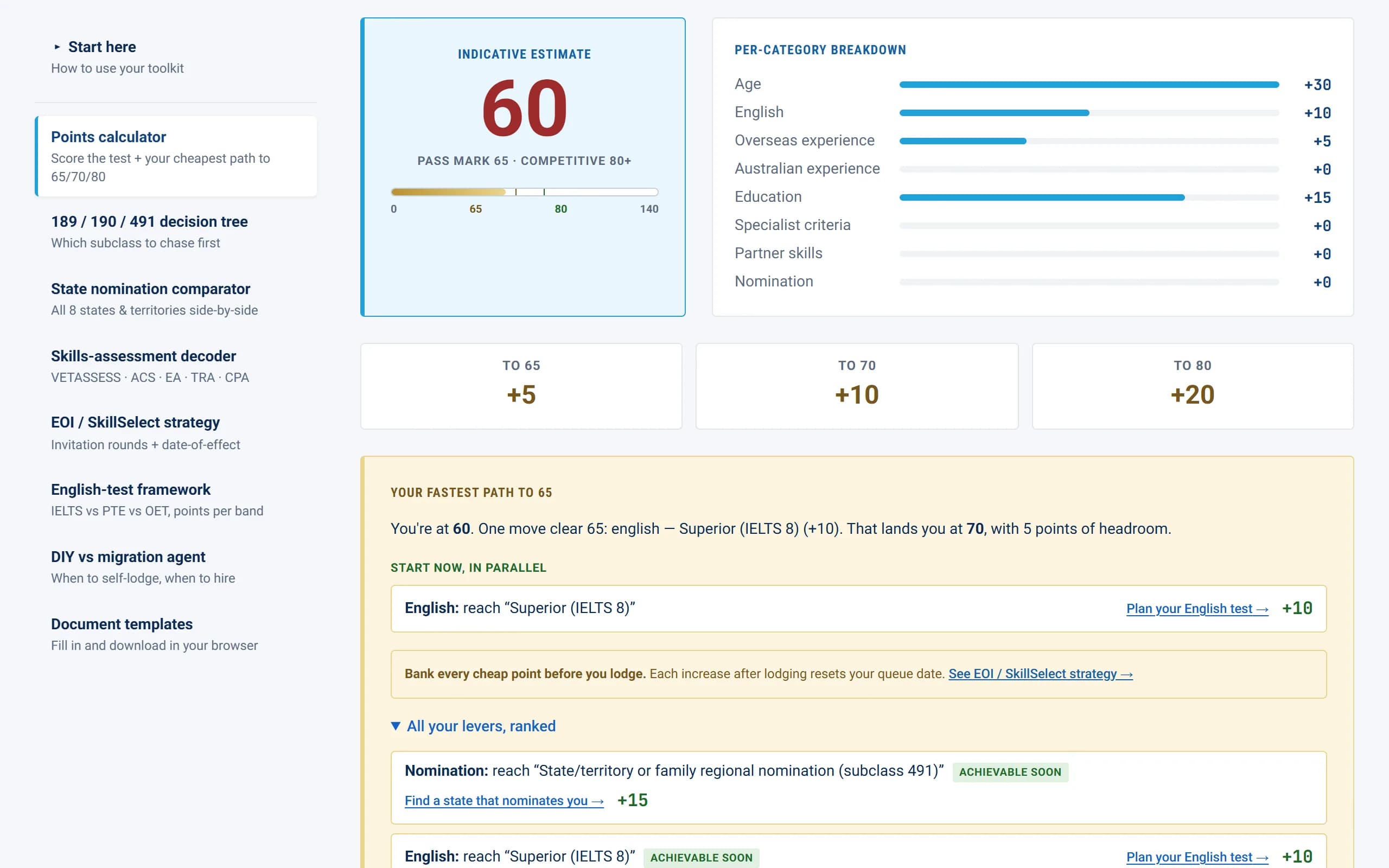
Although 189 is unavailable, 190 and 491 both rely on the points test plus state nomination. Most successful applicants land between 65 and 80 points after nomination.
| Points Factor | Points | Notes |
|---|---|---|
| Age 25-32 | 30 | Maximum band |
| Age 33-39 | 25 | |
| Bachelor degree | 15 | Floor for skill level 1 |
| Master's degree | 15 | Same as Bachelor unless field-relevant doctorate |
| Doctorate | 20 | Where field is closely related |
| English Competent (IELTS 6) | 0 | |
| English Proficient (IELTS 7) | 10 | |
| English Superior (IELTS 8) | 20 | Strong differentiator |
| Overseas work 3-5 yrs | 5 | After VETASSESS assessment of skilled years |
| Overseas work 5-8 yrs | 10 | |
| State 190 nomination | 5 | |
| Regional 491 nomination | 15 | |
| Partner skills | 5-10 |
Scenario A — 30-year-old orthoptist, Bachelor, 4 years experience, Proficient English Age 30 + Bachelor 15 + English 10 + Overseas exp 5 = 60. Add 190 nomination = 65. Competitive in a health-priority round.
Scenario B — 28-year-old, Master's, 5 years experience, Superior English Age 30 + Master's 15 + English 20 + Overseas exp 10 = 75. Add 491 (+15) = 90. Strong invitation position regardless of round dynamics.
State Nomination
New South Wales
NSW's 2025-26 priority sectors include allied health, with strong demand from Sydney's metropolitan ophthalmology services and the regional NSW Local Health Districts. Orthoptist sits on the NSW skills list and clears at moderate point thresholds compared to ICT roles.
Victoria
Victoria's 2025-26 program prioritises health, social services, education, construction, new energy and advanced manufacturing. Allied health professionals require evidence consistent with their professional registration — for orthoptists this means AOB registration or a clear pathway to it. La Trobe's Victorian-based orthoptics program means Melbourne has the largest local supply pool, but persistent vacancies remain.
South Australia
South Australia opened its 2025-26 program to all skilled occupations and treats allied health as a priority cluster. The Royal Adelaide Hospital ophthalmology service and the regional SA health networks both run orthoptist vacancies.
Queensland
Queensland's onshore skilled occupation list includes orthoptist for candidates with a confirmed Queensland job offer. The Royal Brisbane and Women's Hospital, Princess Alexandra Hospital, and regional services in Cairns and Townsville actively recruit.
Tasmania
Tasmania includes orthoptist on its 491 list. Tasmanian public hospitals run one of the most accessible regional pathways for allied health professionals.
Salary and Employment Outlook
| Role | Typical Salary Range (AUD) |
|---|---|
| Graduate orthoptist (HP1) | $70,000-$80,000 |
| Orthoptist 1-3 years (HP2) | $80,000-$95,000 |
| Senior orthoptist (HP3) | $95,000-$115,000 |
| Clinical lead / department head | $115,000-$135,000+ |
| Private practice orthoptist | $90,000-$130,000 |
| Research / academic | $90,000-$120,000 |
Source: SEEK Salary Hub 2026 and Jobs and Skills Australia occupation profile (median full-time earnings ~$100,776 for the unit group). Base pay; superannuation (11.5%) and public-sector allowances sit on top. Senior public hospital orthoptists progressing into management roles can exceed the figures above.
Top employer types:
- Public hospital ophthalmology departments — every tertiary hospital has an orthoptic service
- Private ophthalmology groups — Vision Eye Institute, Personal Eyes, Eye and Laser Centre, ASE, Sydney Eye Hospital affiliates
- Paediatric services — Royal Children's (Melbourne), Sydney Children's, Queensland Children's
- Research and academia — La Trobe, UTS, Centre for Eye Research Australia
- Industry — diagnostic equipment manufacturers (Carl Zeiss, Topcon, Heidelberg) employ orthoptists in clinical applications roles
Tips for a Successful Application
-
Confirm AOB registration is realistically achievable. A positive VETASSESS outcome qualifies you for the visa, but if you cannot secure AOB registration you cannot work clinically. Email the AOB before lodging VETASSESS — they will give a preliminary view on whether your qualification needs bridging study, supervised practice, or both.
-
Sit a Superior-band English test. Twenty points for Superior English is the single most efficient lever for orthoptists, because the qualification points are capped at 15 (or 20 for doctorate) and overseas experience caps lower than for ICT roles. The IELTS 8 / OET A path moves the file from marginal to competitive.
-
Document your clinical scope, not your job title. VETASSESS reads employment evidence against the orthoptist task list — visual field testing, ocular motility assessment, biometry, paediatric vision assessment, low vision rehabilitation. Employer letters that name the tasks survive scrutiny; letters that say "worked as eye care professional" do not.
-
Target 491 if your VETASSESS lands while you're offshore. Regional 491 invitations for allied health move faster than 190 invitations in the major capitals. Three years in regional Tasmania or regional SA is a clean route to PR via the 191 transition.
-
Time AOB bridging study against the visa timeline. AOB bridging usually requires you to be in Australia. Sequence the 482 employer-sponsored visa first if you have a job offer, complete bridging during the 482, then transition to 186 or 190.
Step-by-Step Migration Roadmap
- Confirm your qualification maps to orthoptics via the ANZSCO code finder
- Email the Australian Orthoptic Board for a preliminary view on registration pathway
- Sit your English test — aim for Superior (IELTS 8 / OET A)
- Lodge the VETASSESS skills assessment (AUD $1,096 standard)
- Receive the VETASSESS outcome (12-16 weeks standard)
- Lodge the SkillSelect EOI for 190 or 491 — or pursue 482 employer sponsorship in parallel
- Apply for state nomination (NSW, Victoria, SA, Queensland, Tasmania)
- Receive invitation and lodge visa within 60 days
- Begin AOB bridging study if required by the registration assessment
- Complete health and character checks, receive visa grant
- Complete AOB registration (Medicare provider number follows)
- Commence clinical employment
Frequently Asked Questions
Is orthoptist regulated by AHPRA?
No. Orthoptics is one of the diagnostic health professions that sits outside the National Registration and Accreditation Scheme. The Australian Orthoptic Board (AOB) is the self-regulating body. In practice AOB registration is required for Medicare provider eligibility, NDIS funding, drugs-and-poisons authorisation in most states, and almost all clinical employment.
Can I work as an orthoptist on a 189 visa?
No. Orthoptist is not on the MLTSSL — it sits on the STSOL and CSOL. The available pathways are 190 (state nominated), 491 (regional), 482 (employer sponsored) and 186 (employer permanent). The 189 Skilled Independent visa is not available for this code.
Is my overseas orthoptics qualification recognised in Australia?
It depends on the source country. UK, Canadian and New Zealand orthoptics qualifications are typically recognised after a structured bridging program. European, US and South African qualifications generally require both VETASSESS qualification recognition and a supervised practice period overseen by the AOB. South Asian and Middle Eastern qualifications usually require a longer bridging pathway. Contact the AOB before assuming your qualification will be recognised without supplementary study.
Which Australian states have the strongest orthoptist demand?
NSW, Victoria and Queensland concentrate the largest hospital-based ophthalmology services. South Australia and Tasmania run smaller services but have proportionally larger vacancy rates and faster state nomination invitations. Regional services across all states report persistent allied health shortages.
What is the best visa for an orthoptist with a confirmed Australian job offer?
The 482 Skills in Demand visa, ordinarily. It gets you on the ground inside 1-3 months and provides a stable platform for completing AOB registration and bridging study. Once you have two years on 482, transition to 186 TRT for permanent residency.
How long does the full pathway from VETASSESS to PR take?
Typically 18-30 months. VETASSESS itself runs 12-16 weeks. State nomination adds 2-6 months once the EOI is lodged. Visa processing for 190 or 491 runs 6-12 months. AOB registration can add 6-18 months for international applicants requiring bridging. The fastest route in practice is 482 + 186 TRT, which compresses the visa side of the equation while bridging runs in parallel.