Pharmacist Visa Pathway to Australia: Complete 2026 Guide
Pharmacists are in strong demand across Australia, with shortages in both community (retail) and hospital settings. If you're a qualified pharmacist looking to migrate, you'll find a clear pathway — but it comes with specific assessment and registration requirements that you need to plan for carefully. The KAPS exam, supervised practice, and AHPRA registration form a multi-step process that takes time but leads to excellent career opportunities. Here's your complete guide to making it happen.
Quick Facts: Pharmacist Migration Pathway
| Detail | Hospital Pharmacist (251511) | Retail Pharmacist (251513) |
|---|---|---|
| ANZSCO Code | 251511 | 251513 |
| Skill Level | 1 (Bachelor degree or higher) | 1 (Bachelor degree or higher) |
| Skills Assessment | APC (Australian Pharmacy Council) | APC (Australian Pharmacy Council) |
| Occupation List | MLTSSL — full visa access | MLTSSL — full visa access |
| 189 Eligible | Yes | Yes |
| 190 / 491 | Yes | Yes |
| 482 / 186 | Yes | Yes |
| Registration | AHPRA required | AHPRA required |
| Demand Level | High — nationwide shortage | High — especially rural/regional |
Why Australia Needs Pharmacists
The Healthcare Shortage Continues
Australia's healthcare workforce shortages extend well beyond doctors and nurses — pharmacists are a critical part of the picture. Community pharmacies across the country, particularly in regional and rural areas, struggle to recruit and retain pharmacists. Hospital pharmacies face similar challenges, with vacancy rates rising year on year.
Expanding Role of Pharmacists
What makes the demand even stronger is the expanding scope of pharmacy practice in Australia. Pharmacists are increasingly taking on roles that were previously the exclusive domain of doctors:
- Prescribing authority — some states are introducing limited prescribing rights for pharmacists
- Vaccination services — pharmacists now administer a wide range of vaccines
- Health screening — blood pressure checks, blood glucose monitoring, and medication reviews
- Mental health support — pharmacist-led mental health first aid programs
- Chronic disease management — structured medication management review services
This scope expansion means more pharmacists are needed, not fewer.
Rural and Regional Shortages
The shortage is most acute in rural and regional Australia. Some country towns have pharmacies that can't find a pharmacist to run them, forcing residents to travel hours for basic medication services. This creates strong migration opportunities for pharmacists willing to work outside capital cities — with corresponding salary premiums and state nomination advantages.
Skills Assessment: Australian Pharmacy Council (APC)
The APC is the designated skills assessing authority for pharmacists. The assessment process is more involved than many other professions because pharmacy is a registered health profession requiring strict quality standards.
APC Assessment Pathways
For Overseas-Qualified Pharmacists:
The standard pathway involves:
-
Application and Qualification Review — APC reviews your pharmacy degree and academic transcripts to confirm they're substantially equivalent to an Australian pharmacy degree
-
KAPS Exam — the Knowledge Assessment of Pharmaceutical Sciences
-
Supervised Practice (in some cases) — a period of supervised practice in an Australian pharmacy
-
Skills Assessment Outcome — positive assessment for migration purposes
The KAPS Exam Explained
The KAPS (Knowledge Assessment of Pharmaceutical Sciences) is the primary hurdle for overseas-qualified pharmacists. It's a written examination that tests your pharmaceutical knowledge against Australian standards.
KAPS Format:
- Multiple-choice and short-answer questions
- Covers pharmaceutical sciences including pharmacology, pharmaceutics, pharmaceutical chemistry, and pharmacy practice
- Conducted several times per year at designated centres
- Exam fee: approximately AUD $1,200-$1,500 per sitting
KAPS Content Areas:
- Pharmacology and pharmacotherapy
- Pharmaceutical chemistry
- Pharmaceutics (dosage form design and drug delivery)
- Pharmacy practice (dispensing, counselling, clinical pharmacy)
- Australian-specific content (PBS, scheduling, legislation)
Pass Rate: The KAPS pass rate varies but is typically around 50-60%. Many candidates take a preparatory course before sitting the exam. It's worth investing in preparation — failing and resitting is costly and time-consuming.
English Language Requirements
Pharmacists must demonstrate English proficiency at a level suitable for healthcare practice:
- IELTS Academic: Minimum 7.0 in each band (higher than many other occupations)
- OET: Minimum B in each component
- PTE Academic: Minimum 65 in each component
- TOEFL iBT: L24, R24, W27, S23
Note that pharmacy requires a higher English standard than most occupations. The IELTS 7.0 minimum in each band (not just overall) is a significant requirement. OET (Occupational English Test) is popular with healthcare professionals because its content is healthcare-specific.
AHPRA Registration
To practise as a pharmacist in Australia, you must be registered with AHPRA (Australian Health Practitioner Regulation Agency) through the Pharmacy Board of Australia.
Registration Types
| Type | Description | Who It's For |
|---|---|---|
| General Registration | Full, independent practice | Pharmacists who've completed all requirements |
| Provisional Registration | For completing supervised practice | Overseas pharmacists in their intern year |
| Limited Registration | Restricted to specific settings | Supervised practice in specific roles |
The Intern Year
Many overseas-qualified pharmacists need to complete a period of supervised practice (commonly called the "intern year") before achieving general registration. This involves:
- Working under the supervision of a registered pharmacist
- Completing the Pharmacy Board's intern training program
- Passing the intern oral examination or pharmacy practice assessment
The intern requirement depends on your assessment outcome and the gap between your overseas training and Australian standards. Some experienced pharmacists with qualifications from comparable countries may have a reduced or waived internship.
Timeline for Registration
From start to finish, getting fully registered as a pharmacist in Australia typically takes:
- KAPS preparation and exam: 3-6 months
- Supervised practice / intern year: 12 months
- Registration processing: 1-2 months
- Total: 18-24 months (some candidates complete faster)
This timeline is important for visa planning — you'll want to ensure your visa allows enough time to complete the registration process.
Visa Pathways for Pharmacists
Both Hospital Pharmacist and Retail Pharmacist are on the MLTSSL, which means full access to all skilled visa pathways.
Subclass 189 — Skilled Independent Visa
Permanent residency through the points test.
Key Details:
- Visa fee: AUD $6,135
- Minimum points: 65 (realistically 80+ in 2026)
- Processing: 6-12 months
- Benefit: No employer or state sponsor required
Subclass 190 — State Nominated Visa
State nomination adds 5 points and grants permanent residency.
Key Details:
- Visa fee: AUD $6,140
- Points boost: +5 from state nomination
- Obligation: Live in the nominating state for 2 years
- Availability: Most states nominate pharmacists
Subclass 491 — Skilled Work Regional Visa
Regional nomination adds 15 points. Perfect for pharmacists willing to work in regional areas where shortages are worst.
Key Details:
- Visa fee: AUD $6,140
- Points boost: +15 from regional nomination
- Pathway: 191 permanent visa after 3 years
- Bonus: Regional pharmacies often pay above-average salaries due to shortages
Subclass 482 — Temporary Skill Shortage Visa
Employer-sponsored temporary visa. Pharmacy chains and hospital pharmacy departments often sponsor overseas pharmacists.
Key Details:
- Visa fee: AUD $3,210 (SID stream)
- Salary threshold: Core stream AUD $76,515 / Specialist stream AUD $141,210
- Duration: Up to 4 years
- Pathway: Transition to 186 after 2 years
Subclass 186 — Employer Nomination Scheme
Permanent residency through employer sponsorship.
Key Details:
- Visa fee: AUD $6,140
- Streams: Direct Entry or TRT
- Common sponsors: Hospital networks, pharmacy chains, rural health services
Points Test Strategy for Pharmacists
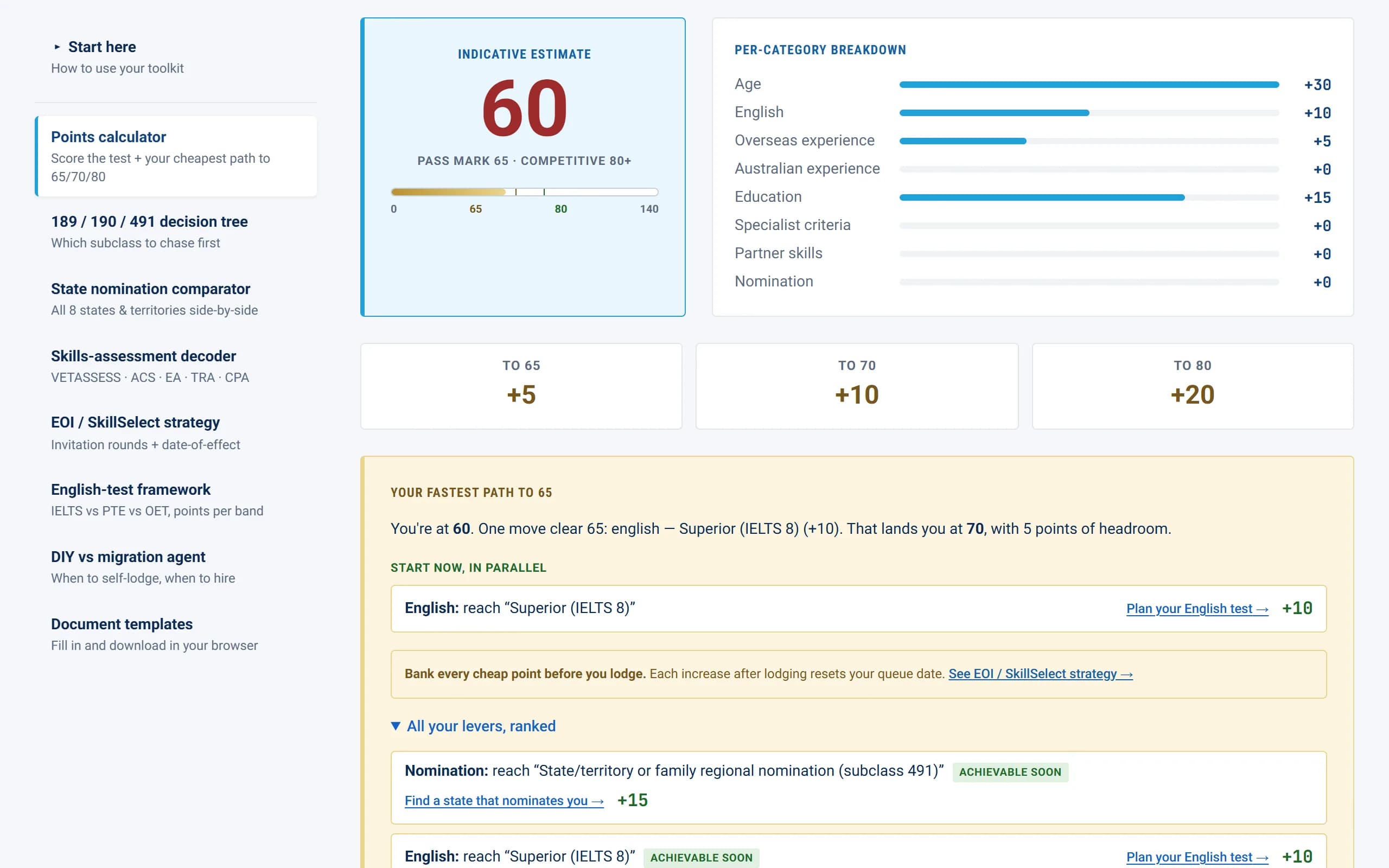
Pharmacists generally score well on the points test thanks to their degree-level qualification and the healthcare English requirements (which often push candidates toward Proficient or Superior scores).
| Points Factor | Points | Notes |
|---|---|---|
| Age (25-32) | 30 | Maximum bracket |
| Qualification (Master of Pharmacy) | 15 | Standard pharmacy qualification |
| Qualification (Bachelor of Pharmacy) | 15 | Same points as Master's |
| Qualification (PhD) | 20 | If applicable |
| English (Superior — 8.0+) | 20 | Achievable for many health professionals |
| English (Proficient — 7.0) | 10 | Already required for registration |
| Overseas Experience (8+ years) | 15 | Post-qualification experience |
| Australian Experience | 5-20 | If you've worked in Australia |
| State Nomination (190) | 5 | Available in most states |
| Regional (491) | 15 | Strong option for rural pharmacy |
| Partner Skills | 5-10 | If partner has skilled occupation |
| NAATI/CCL | 5 | Community language credential |
Key Advantage: Since pharmacists already need IELTS 7.0 each band for registration, you're automatically at Proficient English (10 points). Pushing to 8.0 each band for Superior (20 points) is an extra 10 points that could make the difference for a 189 invitation.
State Nomination Opportunities
Which States Nominate Pharmacists?
Most states include pharmacists on their nomination lists. The strongest opportunities are:
South Australia — actively recruits healthcare professionals, including pharmacists. SA's lower competition and proactive nomination program make it one of the easiest states for pharmacy nomination.
Tasmania — classified as regional for migration purposes (the entire state). Pharmacy shortages are pronounced, and Tasmania's nomination program is receptive to healthcare workers.
Western Australia — pharmacy shortages in regional WA (Pilbara, Kimberley, Great Southern) drive state nomination. Perth also has demand, though it's less acute than regional areas.
Queensland — regional QLD has significant pharmacy workforce gaps. The state nomination program includes pharmacists, particularly for regional and remote postings.
Northern Territory — the NT has some of the most severe healthcare shortages in Australia. Pharmacists willing to work in Darwin or remote communities will find nomination opportunities.
New South Wales — Sydney's large population creates demand, but competition for NSW nomination is higher. Regional NSW (Western NSW, Far West, North Coast) has stronger need.
Victoria — Melbourne has demand but also higher competition. Regional Victoria offers better nomination prospects.
Check the most in-demand occupations list for current state-by-state data.
Salary and Employment Outlook
What Can You Expect to Earn?
| Role | Typical Salary Range |
|---|---|
| Intern Pharmacist | AUD $55,000-$65,000 |
| Community Pharmacist (Employee) | AUD $75,000-$95,000 |
| Community Pharmacist (Manager) | AUD $90,000-$120,000 |
| Hospital Pharmacist | AUD $80,000-$110,000 |
| Senior Hospital Pharmacist | AUD $100,000-$130,000 |
| Clinical Pharmacist Specialist | AUD $110,000-$140,000 |
| Rural/Remote Pharmacist | AUD $90,000-$130,000+ (often with housing) |
| Pharmacy Owner | AUD $120,000-$200,000+ (variable) |
Community vs Hospital Pharmacy
Community (Retail) Pharmacy:
- Working in retail pharmacies (Chemist Warehouse, Priceline, TerryWhite Chemmart, independent pharmacies)
- Dispensing, patient counselling, health screening, vaccinations
- More patient-facing interaction
- Can lead to pharmacy ownership (requires permanent residency or citizenship)
Hospital Pharmacy:
- Working in public or private hospital pharmacy departments
- Clinical pharmacy, medication management, ward-based services
- More clinical focus and interaction with medical teams
- Structured career progression with defined pay scales
Rural Premiums
Pharmacists working in rural and remote areas often receive:
- Higher base salary — 10-30% above metropolitan rates
- Relocation assistance — employer-funded moving costs
- Housing support — subsidised or free accommodation in some remote areas
- Professional development — additional CPD funding
- Retention bonuses — incentive payments for staying in the role
Working as a Pharmacist in Australia
The PBS (Pharmaceutical Benefits Scheme)
Understanding the PBS is essential for practising pharmacy in Australia. The PBS is the government program that subsidises prescription medications for Australian residents. As a pharmacist, you'll be dispensing PBS medications daily and need to understand:
- PBS pricing and patient co-payments
- Safety Net thresholds
- Authority prescriptions and streamlined authority
- Special Access Scheme for non-PBS medications
- The difference between general and concessional patients
Scheduling and Legislation
Australia's medicines scheduling system is different from most other countries. Medications are classified into Schedules (S2, S3, S4, S8, etc.) that determine how they can be supplied:
- S2 (Pharmacy Medicine) — available without prescription from a pharmacy
- S3 (Pharmacist Only) — available without prescription but must be supplied by a pharmacist
- S4 (Prescription Only) — requires a prescription
- S8 (Controlled Drug) — restricted substances requiring additional controls
You'll learn the Australian scheduling system during your supervised practice, but it's worth familiarising yourself with the basics before arrival.
Step-by-Step Migration Roadmap
- Confirm your ANZSCO code — Hospital Pharmacist 251511 or Retail Pharmacist 251513, using the ANZSCO code finder
- Check APC requirements — review the APC website for current assessment pathways
- Prepare for and sit the KAPS exam — invest in preparation courses if available
- Sit your English test — OET or IELTS Academic, minimum 7.0 each band
- Apply for APC skills assessment — for migration purposes
- Calculate your points — factor in your qualification, English, and experience
- Submit EOI in SkillSelect — for 189, 190, or 491
- Apply for state nomination — if pursuing 190 or 491
- Alternatively, seek employer sponsorship — hospitals and pharmacy chains sponsor pharmacists
- Receive invitation and lodge visa — within 60 days
- Complete health and character checks
- Arrive in Australia — apply for AHPRA provisional registration
- Complete supervised practice / intern year — if required
- Achieve general AHPRA registration — begin independent practice
Frequently Asked Questions
How hard is the KAPS exam?
The KAPS exam is challenging, with a pass rate of approximately 50-60%. The exam tests pharmaceutical knowledge to Australian standards, including Australian-specific content like the PBS and medicines scheduling. Many candidates report that pharmacology and pharmacy practice sections are the most demanding. Preparation courses are available and highly recommended — candidates who take structured preparation courses generally have higher pass rates than those who self-study.
Can I work as a pharmacist while waiting for full registration?
It depends on your registration status. If you have provisional or limited registration with AHPRA, you can work under supervision. You cannot work independently as a pharmacist without general registration. Many overseas pharmacists work in pharmacy assistant or technician roles while completing their registration requirements — these roles don't require pharmacist registration but keep you in the pharmacy environment.
Do I need to redo my intern year even if I have years of experience?
Not necessarily. The APC and Pharmacy Board assess each case individually. If your overseas qualification and experience are considered substantially equivalent to Australian standards, the supervised practice requirement may be shortened or waived. However, most overseas-qualified pharmacists do need to complete some form of supervised practice to demonstrate familiarity with Australian pharmacy practice, even if it's less than a full intern year. Check the skills assessment guide for details on assessment bodies.
Which is better for migration — Hospital Pharmacist or Retail Pharmacist?
From a migration perspective, both are on the MLTSSL with identical visa access. Choose the code that genuinely matches your experience and intended role in Australia. Hospital pharmacists and retail pharmacists have different day-to-day work, and your employment references should align with your nominated code. If you have experience in both, choose the one you plan to practise in Australia.
Is pharmacy ownership an option for migrants?
Yes, but not immediately. You'll need permanent residency or citizenship, general AHPRA registration, and compliance with state-specific pharmacy ownership laws (which typically require the pharmacist-owner to be registered and actively involved in the business). Many overseas-qualified pharmacists work as employees for several years before exploring ownership. Pharmacy ownership can be financially rewarding — independent pharmacy owners often earn AUD $150,000-$200,000+ — but it also comes with significant business risk and regulatory obligations.