Industrial Pharmacist Visa Pathway to Australia: Complete 2026 Guide
Updated: 16 August 2026
Australia classifies Industrial Pharmacist under ANZSCO 251512. VETASSESS conducts the skills assessment. The occupation sits on the Core Skills Occupation List (CSOL) and the STSOL, unlocking subclasses 190, 491, 482 and 186. Typical 2026 salaries range AUD $113,000-$183,000. Industry roles do not require AHPRA registration, which separates this pathway from community pharmacy.
Quick Facts: Industrial Pharmacist Migration Pathway
| Detail | Information |
|---|---|
| ANZSCO Code | 251512 (Industrial Pharmacist) |
| Skill Level | 1 (Bachelor degree or higher in pharmacy or pharmaceutical science) |
| Skills Assessment | VETASSESS (Vocational Education and Training Assessment Services) |
| Occupation List | CSOL and STSOL — no 189 access |
| Visa Options | 190, 491, 482, 186 |
| Demand Level | Moderate — concentrated in pharma manufacturing hubs in NSW and VIC |
| Salary Range | AUD $113,629 (entry) - $183,418 (senior), average $164,232 (SalaryExpert 2026) |
| Typical 190 Score | 75-85 points after state nomination |
| Key Challenge | No 189 pathway — applicants depend on state nomination or employer sponsorship |
Role Context: What Industrial Pharmacists Do in Australia
Industrial pharmacists work inside drug development, manufacturing and quality control, not inside retail pharmacies. They sit on formulation teams, supervise GMP-compliant production, write regulatory submissions to the Therapeutic Goods Administration (TGA), validate manufacturing processes, and lead quality assurance inside pharmaceutical and biotech facilities. The role is laboratory-and-plant-based and rarely customer-facing.
Demand is geographically concentrated. The bulk of Australian pharmaceutical manufacturing sits in metropolitan Sydney, Melbourne and the Macquarie Park biotech precinct in NSW. Significant employers include CSL Behring, Mayne Pharma, GSK Australia, Pfizer Australia, Sun Pharma (Ranbaxy Australia), Sanofi and a growing cohort of contract manufacturers servicing TGA-registered medicines. The federal government's National Reconstruction Fund has earmarked AUD $1.5 billion for medical science and pharmaceutical manufacturing, which has lifted hiring in formulation, regulatory affairs and quality control through 2025-2026.
The role is distinct from a community pharmacist (ANZSCO 251513), who dispenses prescriptions to the public and must hold AHPRA registration. Industrial pharmacists are not patient-facing and, in most positions, are not required to register with the Pharmacy Board of Australia. This is a significant migration advantage — the registration bottleneck that delays community pharmacy migration by 12-18 months does not apply.
ANZSCO 251512 — Code Mapping and Tasks
The official ANZSCO description for Industrial Pharmacist covers research, testing and analysis tied to the development, production, storage, quality control and distribution of drugs and related pharmaceutical supplies. Typical tasks include:
- Developing new drug formulations and dosage forms
- Conducting stability testing and bioequivalence studies
- Writing and reviewing standard operating procedures (SOPs) for manufacturing
- Auditing GMP compliance and preparing for TGA inspections
- Compiling Common Technical Document (CTD) regulatory dossiers
- Validating analytical methods (HPLC, GC, dissolution, microbiology)
- Managing batch release and product recalls
The code sits inside ANZSCO Unit Group 2515 (Pharmacists) alongside 251511 Hospital Pharmacist, 251513 Retail Pharmacist and 251514 Pharmacists nec. If your duties span both industry and clinical hospital work, you must nominate the code that matches the majority of your time over the last five years — VETASSESS examines your job duties forensically against the descriptor.
Skills Assessment: VETASSESS
VETASSESS is the sole assessing body for ANZSCO 251512. Industrial Pharmacist is classified as a Group A occupation, which means a closely matched qualification is mandatory.
Qualification requirement:
- An AQF Bachelor degree or higher in Pharmacy, Industrial Pharmacy, or Pharmaceutical Science, OR
- An overseas qualification assessed by VETASSESS as comparable to that level in a highly relevant field
Employment requirement:
- At least one year of post-qualification employment at an appropriate skill level in the last five years
- Minimum 20 hours per week in roles highly relevant to industrial pharmacy duties
- Employment within the five years preceding the application date
Assessment fee: AUD $1,205.60 (within Australia, GST included) or AUD $1,096.00 (non-resident, GST excluded). Priority processing adds AUD $907.50 / $825.00.
Processing time: 7 weeks standard. Priority processing returns a decision within 10 business days of eligibility confirmation.
Common rejection reasons: Applications fail most often when the qualification is in a related but not highly relevant field (e.g. general chemistry, biotechnology, or biochemistry without a pharmacy component), or when employment evidence describes generic laboratory or QA work that could equally fit a chemist or biotechnologist role. Employment references must use industrial pharmacy terminology — formulation, GMP, regulatory affairs, batch release — to align cleanly with the descriptor.
No AHPRA registration is required for the migration skills assessment. Registration only becomes relevant if you later move into a role that involves dispensing or patient counselling.
Visa Pathways for Industrial Pharmacists
Subclass 482 — Skills in Demand Visa (Core Skills stream)
The 482 is the most reliable pathway for industrial pharmacists. Pharmaceutical employers in Australia are experienced sponsors.
- Visa fee: AUD $4,015 (Core Skills stream, primary applicant)
- Salary threshold: Core Skills Income Threshold AUD $79,423 (from 1 July 2026; previously AUD $76,515)
- Processing time: Median ~4 months, 90% within 7 months as of January 2026
- Quirk: Most industrial pharmacy roles exceed the AUD $146,576 Specialist Skills threshold, which can route experienced applicants through the faster Specialist Skills stream (median 7 days)
Subclass 190 — Skilled Nominated Visa
State nomination adds 5 points and grants permanent residency on grant.
- Visa fee: AUD $6,140 (primary applicant)
- Nominating states in 2026: NSW and Victoria publish ANZSCO Unit Group 2515 (Pharmacists) on their skilled occupation lists; eligibility for 251512 specifically depends on the state's published rolling list
- Processing time: 6-12 months after nomination and invitation
- Obligation: Commit to live and work in the nominating state for two years
Subclass 491 — Skilled Work Regional Visa
Regional nomination adds 15 points and is a 5-year provisional visa with a pathway to PR via subclass 191.
- Visa fee: AUD $6,140 (primary applicant)
- Note: Industrial pharmacy roles in regional Australia are rare — most pharmaceutical manufacturing sits in metropolitan Sydney, Melbourne and Adelaide. Check whether your target employer's site qualifies as regional under Designated Regional Area definitions before pursuing 491
Subclass 186 — Employer Nomination Scheme
Permanent residency through employer sponsorship, either Direct Entry or Temporary Residence Transition after two years on a 482.
- Visa fee: AUD $6,140 (primary applicant)
- Processing time: Direct Entry stream median 12-13 months, 90th percentile 18-19 months as of April 2026
- Quirk: TRT stream is the dominant 186 route for industrial pharmacists — most progress from 482 to 186 with the same sponsor
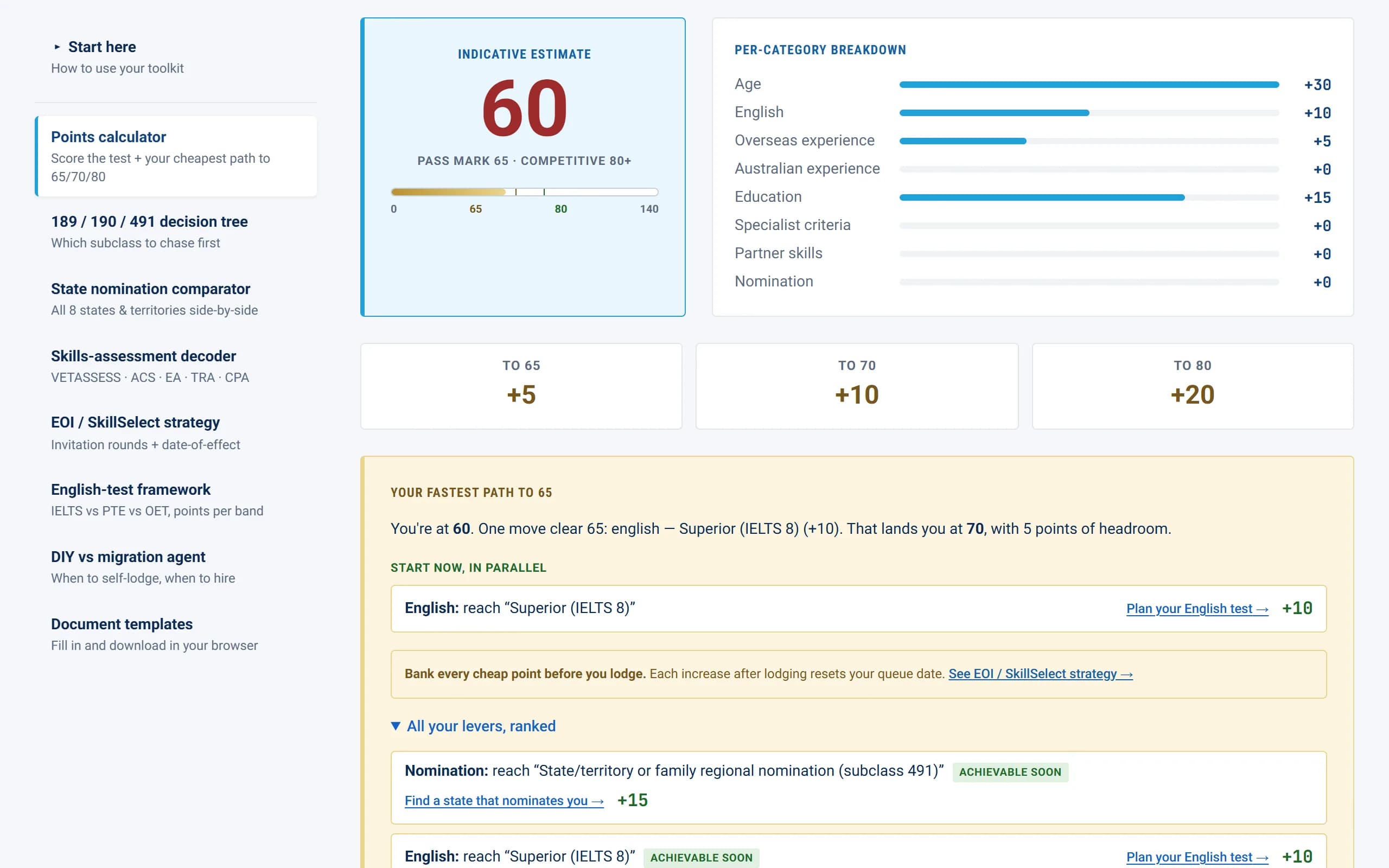
Points Test Strategy
Industrial Pharmacist is not on the MLTSSL, so 189 is unavailable. Points still matter for 190 and 491 invitation rounds.
| Points Factor | Points | Notes |
|---|---|---|
| Age 25-32 | 30 | Maximum bracket |
| Age 33-39 | 25 | Common for experienced industrial pharmacists |
| Bachelor degree | 15 | Pharmacy bachelor's |
| Master's | 15 | Many industrial pharmacists hold Master's of Industrial Pharmacy |
| PhD | 20 | Common in formulation and regulatory affairs |
| English Superior (8.0+) | 20 | Worth pursuing — significant point swing |
| English Proficient (7.0) | 10 | Adequate floor for assessment |
| Overseas experience 5-8 years | 10 | Standard for senior candidates |
| State nomination (190) | 5 | Often essential to reach competitive threshold |
| Regional (491) | 15 | Limited by geography of pharma manufacturing |
| Partner skills | 5-10 | Where applicable |
Realistic Scenarios
Scenario 1: Mid-career formulation scientist, 31, PhD, IELTS 7.5, 6 years experience
- Age 30 + PhD 20 + English 10 + Experience 10 = 70 points
- Add NSW 190 nomination (+5) = 75 points, competitive in late-2026 rounds for healthcare unit groups
Scenario 2: Senior regulatory affairs manager, 38, Master's, IELTS 8.0, 12 years experience
- Age 25 + Master's 15 + English 20 + Experience 15 = 75 points
- More likely to pursue employer sponsorship (482 → 186) given salary above the Specialist Skills threshold
State Nomination for Industrial Pharmacists
New South Wales
NSW publishes ANZSCO Unit Group 2515 on its 190 and 491 skills lists, with healthcare flagged as a priority sector under the Care Economy. Sydney hosts the largest concentration of pharma manufacturing in Australia, including CSL Behring at Broadmeadows, GSK at Boronia, and contract manufacturers across western Sydney. Invitations in 2026 have favoured candidates with at least three years post-qualification experience and a confirmed Australian role offer or commitment to settle.
Victoria
Victoria's nomination program lists Pharmacists in its priority sectors under health. Melbourne hosts Australia's largest pharmaceutical manufacturing precinct, including CSL Parkville, Sigma Healthcare and Sun Pharma. Victoria typically asks for evidence of intent to settle in the state — bond market signals such as job applications, recent employment offers, or relocation plans strengthen the case.
South Australia
South Australia's 2025-26 program allocates 2,250 nomination places across 190 and 491. Pharmaceutical manufacturing in Adelaide is smaller but growing, anchored by Mayne Pharma at Salisbury. SA's program is known for flexibility for offshore candidates with healthcare backgrounds.
Salary and Employment Outlook
What Industrial Pharmacists Earn in 2026
| Role | Typical Salary Range (AUD) |
|---|---|
| Entry-level industrial pharmacist (1-3 yrs) | $95,000-$120,000 |
| Formulation scientist (3-5 yrs) | $115,000-$140,000 |
| QA manager | $130,000-$170,000 |
| Senior regulatory affairs (8+ yrs) | $150,000-$200,000 |
| Head of quality / production manager | $180,000-$230,000+ |
| Regulatory affairs director | $200,000-$260,000+ |
Source: SalaryExpert ERI 2026 (Australian Industrial Pharmacist average AUD $164,232 with bonus AUD $3,794), cross-checked against SEEK Salary Hub Pharmacist data and industry placements in 2025-2026.
Total packages typically include superannuation at 11.5%, performance bonuses of 10-20% for regulatory and quality leadership roles, and (at multinationals like CSL) restricted stock units or long-term incentive plans.
Highest-Paying Sectors
- Biotech and biologics — CSL Behring leads on compensation, particularly for plasma fractionation and recombinant protein production
- Multinational pharma — Pfizer, GSK, Sanofi, AstraZeneca pay competitive market rates with global mobility options
- Contract manufacturing organisations — IDT Australia, Mayne Pharma and others offer broader exposure but slightly lower base salaries
- Regulatory consultancies — niche, with high contractor day rates of AUD $1,000-$1,500
- Medical devices and combination products — growing segment with crossover demand for pharmacists with TGA registration expertise
Geographic Variation
Sydney and Melbourne pay broadly comparable salaries for senior roles. Adelaide pays approximately 8-12% less for equivalent positions but offers lower living costs. Regional pharmaceutical roles are scarce; Perth and Brisbane host limited manufacturing.
Tips for a Successful Application
1. Avoid the Group A trap
VETASSESS rejects qualifications in chemistry, biochemistry or biotechnology when they lack a recognised pharmacy curriculum. If your degree is in pharmaceutical science or industrial pharmacy specifically, you are inside Group A. If it is in general chemistry with applied pharma electives, request a pre-assessment review before paying the full fee.
2. Tailor employment references to ANZSCO language
References should describe formulation development, GMP compliance, batch release, regulatory dossier preparation, stability testing and process validation. Generic "laboratory work" or "quality testing" wording invites misclassification as a Chemist (234211) or Quality Assurance Manager (139914).
3. Skip AHPRA registration if you are not patient-facing
For pure industry roles, Pharmacy Board of Australia registration is not required. Many migrants spend months on AHPRA documents they do not need. Confirm with your prospective employer whether the role involves any dispensing component before starting registration.
4. Target the Specialist Skills 482 stream where eligible
If your salary offer exceeds AUD $146,576 (the Specialist Skills threshold for FY2026-27), apply through the Specialist stream. Median processing is 7 days versus 4-7 months for Core Skills. Most senior regulatory and QA leadership roles clear this threshold comfortably.
5. Lock down English score early
For 251512, Proficient (IELTS 7.0 or equivalent) clears the visa floor. Superior (IELTS 8.0+) adds 10 points to the points test, which can be the difference between an invitation and silence in a CSOL-only occupation.
Step-by-Step Migration Roadmap
- Confirm your role maps to 251512 — review the ANZSCO code finder and the official descriptor against your duties
- Check list status — verify Industrial Pharmacist remains on the CSOL and the relevant state skills list
- Gather qualification evidence — pharmacy bachelor's transcripts, certificates and syllabus where the degree title is unfamiliar to VETASSESS
- Collect employment references — written, signed, on letterhead, covering duties in ANZSCO language
- Sit your English test — IELTS, PTE, OET, TOEFL or Cambridge; aim for Superior if pursuing 190
- Submit VETASSESS application — AUD $1,205.60, expect 7 weeks
- Submit EOI in SkillSelect for 190 or 491, or secure a sponsoring employer for 482/186
- Apply for state nomination if pursuing 190 or 491
- Receive invitation and lodge visa within 60 days
- Complete health and character checks including AFP and overseas police clearances
- Receive grant and relocate within the Initial Entry Date
Frequently Asked Questions
Why is Industrial Pharmacist not on the MLTSSL?
ANZSCO 251512 sits on the Core Skills Occupation List and STSOL, but not the MLTSSL. Jobs and Skills Australia assesses industrial pharmacy as a moderate-shortage role rather than a critical national shortage, so the 189 independent skilled visa is closed. Community-facing pharmacy roles (251511 Hospital Pharmacist, 251513 Retail Pharmacist) are on the MLTSSL.
Can I switch to Retail Pharmacist later for better visa options?
Yes, but it requires AHPRA registration through the Pharmacy Board of Australia, completion of the Pharmacy Board's competency exam where required, and 1,824 hours of supervised practice as an intern. The clinical pharmacy pathway is documented separately on the Pharmacist visa pathway page.
Do I need TGA experience to migrate as an industrial pharmacist?
No. Your overseas regulatory experience (FDA, EMA, MHRA, CDSCO, NMPA, PMDA) counts as relevant employment provided the duties match the ANZSCO descriptor. TGA-specific knowledge is valued by employers but not required for the skills assessment.
Is employer sponsorship faster than state nomination?
For most industrial pharmacy roles, yes — particularly under the Specialist Skills 482 stream (median 7 days) when the salary exceeds AUD $146,576. State nomination invitation rounds for ANZSCO 2515 occur monthly but require minimum 75-80 points after nomination to be competitive.
Which Australian employers actively sponsor industrial pharmacists?
CSL Behring, GSK Australia, Sanofi, Pfizer Australia, Mayne Pharma, Sun Pharma and Sigma Healthcare are the most consistent sponsors. Contract manufacturers like IDT Australia and Boehringer Ingelheim also recruit internationally. Roles appear on Seek, LinkedIn and direct careers pages; specialist recruiters such as i-Pharm Consulting and CSL's internal mobility team handle most senior placements.
What if my degree is in pharmaceutical science rather than pharmacy?
Pharmaceutical Science is explicitly listed by VETASSESS as a highly relevant field for 251512. The qualification must still assess as comparable to AQF Bachelor level or higher. Master's of Industrial Pharmacy and Master's of Pharmaceutical Science also qualify.