Registered Nurse (Child and Family Health) Visa Pathway to Australia: Complete 2026 Guide
Updated: 16 August 2026
Australia classifies Registered Nurse (Child and Family Health) under ANZSCO 254413. The Australian Nursing and Midwifery Accreditation Council (ANMAC) conducts the skills assessment and AHPRA handles registration with the Nursing and Midwifery Board of Australia. The occupation sits on the MLTSSL, unlocking subclasses 189, 190, 491, 482 and 186. Typical 2026 salaries range AUD $93,000-$110,000, with demand concentrated in state-run community health services.
Quick Facts: Registered Nurse (Child and Family Health) Migration Pathway
| Detail | Information |
|---|---|
| ANZSCO Code | 254413 (Registered Nurse — Child and Family Health) |
| Skill Level | 1 (Bachelor degree or higher, typically with post-graduate child and family health specialisation) |
| Skills Assessment | ANMAC (Australian Nursing and Midwifery Accreditation Council) |
| Occupation List | CSOL and MLTSSL |
| Visa Options | 189, 190, 491, 482, 186 |
| Demand Level | High — sustained shortage in state-run early childhood and family health services |
| Salary Range | AUD $93,000-$110,000 (SEEK and Talent.com Australia, April 2026) |
| Typical 189 Score | 70-80 (smaller invitation pool than aged care or generalist RN) |
| Key Challenge | Most overseas Bachelor of Nursing qualifications need post-graduate child and family health top-up before AHPRA recognises specialty practice |
What Child and Family Health Nurses Do in Australia
Child and Family Health Nurses (CFHNs) provide universal and targeted health services to children aged 0-5 and their families. They work primarily in state-funded community health services (Tresillian and Karitane in NSW, Maternal and Child Health Service in Victoria, Child Health Service in QLD, CaFHS in SA, CAH in WA), early parenting centres, and some primary care general practices.
Day-to-day work includes developmental health checks, immunisation, breastfeeding support, post-natal depression screening, sleep and settling consultations, family violence screening, and care coordination for at-risk families. The role sits at the intersection of community nursing, public health and family support.
Demand is structural rather than acute. State services have stable funded establishments but face chronic vacancy rates, particularly in growth-corridor suburbs (Western Sydney, Northern Adelaide, outer Melbourne, South-East Queensland) where birth rates are highest. Regional and remote services additionally struggle with attrition.
ANZSCO Code 254413 — What's Covered
Code 254413 covers registered nurses who provide health services to families with children, particularly from the antenatal period through to school entry. Tasks include developmental assessment, parenting support, family health promotion, immunisation, breastfeeding consultation, and referral to specialist services for clinical or psychosocial concerns.
The code is distinct from 254423 RN Perioperative or 254418 RN Medical and assumes a post-graduate specialty focus on the 0-5 age group plus family wellbeing. ANMAC assesses based on documented work in this specialty area — generalist paediatric ward experience does not, on its own, support a 254413 nomination.
If your experience straddles paediatric ward work and community-based child and family health, the code that fits best is the one your employment references can most clearly support. If neither dominates, consider 254425 Registered Nurses (Paediatrics) as an alternative.
Skills Assessment
ANMAC Skills Assessment
ANMAC Modified Skills Assessment (AUD $395)
For applicants with in-principle AHPRA approval. Processing 6-8 weeks.
ANMAC Direct Care Skills Assessment (AUD $545)
For applicants who completed an AHPRA-approved Outcomes Based Assessment.
ANMAC Full Skills Assessment (AUD $595)
For applicants from Canada, Hong Kong, Ireland, the UK or the US who hold a Bachelor of Nursing (or higher) and current home-country registration.
Common rejection reasons: Employment references that describe paediatric inpatient nursing rather than community-based child and family health; insufficient evidence of universal-care services delivery (developmental checks, immunisation, parenting support); qualification not assessed as equivalent to the post-graduate child and family health qualifications expected for the Australian role.
AHPRA Registration (NMBA)
CFHNs register as general Registered Nurses with the NMBA. The specialty focus is reflected in qualifications and employment record, not in a separate registration endorsement.
Initial registration fee: Approximately AUD $500 Annual renewal: AUD $193 (June 2026-May 2027) English: IELTS Academic 7.0 each band, OET B grade, or equivalent
Most overseas CFHNs complete the AHPRA Outcomes Based Assessment (OBA) to convert to Australian registration. Run AHPRA and ANMAC in parallel.
Visa Pathways for Child and Family Health Nurses
Subclass 190 — Skilled Nominated Visa
State nomination is the most common pathway because state health services run the largest CFHN establishments.
- Visa fee: AUD $6,140
- Processing time: 9-19 months
- Best states: NSW, VIC, QLD all run substantial state child and family health programs and nominate 254413
Subclass 491 — Skilled Work Regional Visa
Regional CFHN services in growth corridors actively recruit through 491.
- Visa fee: AUD $6,140
- Points boost: +15 from regional nomination
- Processing time: 12-15 months
- Quirk: Growth-corridor suburbs (Western Sydney, Casey/Wyndham in Victoria, Logan/Ipswich in Queensland) often fall inside 491-eligible postcodes
Subclass 189 — Skilled Independent Visa
Available because 254413 is on the MLTSSL.
- Visa fee: AUD $6,135
- Typical invitation score: 70-80 (small invitation pool)
- Processing time: 8-12 months; healthcare priority
Subclass 482 — Skills in Demand Visa
Less common because most CFHN roles sit in state government services rather than private hospital networks. Some non-government early parenting providers and a few general practices sponsor.
- Visa fee: AUD $3,210
- Core Skills Income Threshold: AUD $76,515 (rising to $79,499 on 1 July 2026)
- Processing time: 2-3 months for healthcare priority
Subclass 186 — Employer Nomination Scheme
Permanent residency through employer sponsorship. State government employers can use 186 Direct Entry where the role and salary support it.
- Visa fee: AUD $6,140
- Processing time: 4-12 months; healthcare priority
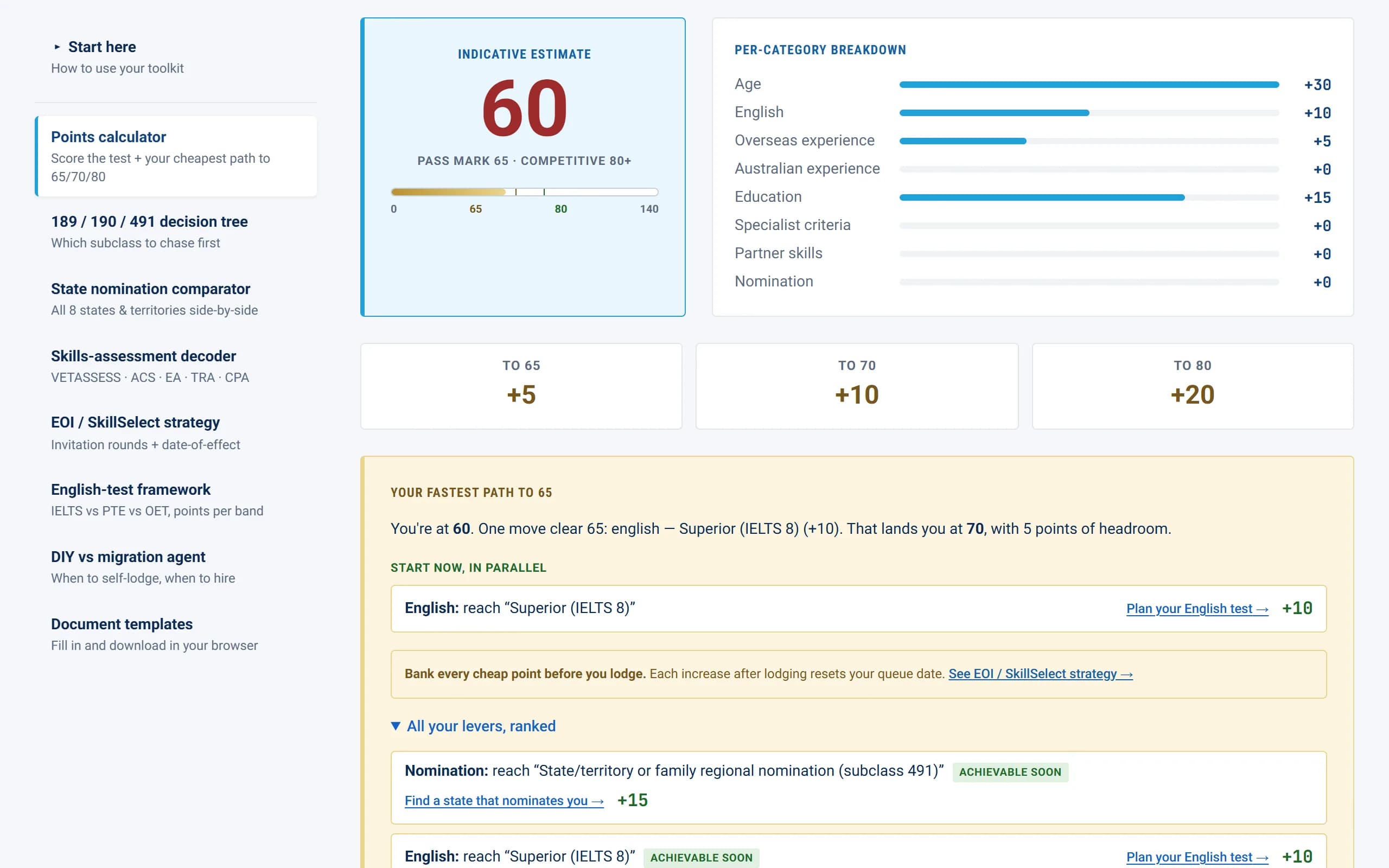
Points Test Strategy
| Points Factor | Points | Notes |
|---|---|---|
| Age (25-32) | 30 | |
| Age (33-39) | 25 | |
| English (Superior — 8.0) | 20 | |
| English (Proficient — 7.0) | 10 | |
| Qualification (Bachelor's) | 15 | |
| Qualification (Master's) | 15 | Common for CFHN given post-grad pathway |
| Qualification (PhD) | 20 | |
| Overseas Experience (5-7 years) | 10 | |
| Overseas Experience (8+ years) | 15 | |
| State Nomination (190) | 5 | |
| Regional (491) | 15 | |
| Partner Skills | 5-10 |
Realistic Scenarios
Scenario 1: 32-year-old UK Health Visitor, 8 years experience, IELTS 7.5
- Age 30 + Master's 15 + English 10 + Experience 15 = 70 points
- Add 190 nomination: 75 points — likely to invite
Scenario 2: 30-year-old Indian RN with post-grad child health diploma, 5 years experience, IELTS 7.0
- Age 30 + Master's 15 + English 10 + Experience 10 = 65 points
- Add 491: 80 points — competitive
State Nomination for Child and Family Health Nurses
New South Wales
NSW Health operates Child and Family Health services through Local Health Districts, with Tresillian and Karitane as the dominant specialist providers. Western Sydney, Hunter New England and Northern Sydney LHDs run the largest CFHN establishments. NSW 190 healthcare invitations sat at 75-85 points through early 2026.
Victoria
The Maternal and Child Health Service is run by local councils on behalf of the Victorian Department of Health. Demand is concentrated in growth corridor councils — Casey, Wyndham, Hume, Melton. Victoria's 2025-26 program closed to new EOIs on 28 April 2026.
Queensland
Queensland Health's Child Health Service covers metropolitan and regional centres. Logan, Ipswich, Brisbane North and Gold Coast face structural staff shortages.
South Australia
The Child and Family Health Service (CaFHS) operates statewide. Adelaide's northern suburbs and the Limestone Coast actively recruit. SA accepts IELTS 7.0 across the board rather than requiring Superior English.
Western Australia
Community Health (within WA Country Health Service) operates regional CFHN services across the Wheatbelt, South West and Goldfields. Sponsorship competitive in metro Perth, generous in regional WA.
Tasmania
Tasmania's small CFHN workforce faces sustained attrition. The Tasmanian 491 is one of the more achievable nomination routes for child and family health.
Northern Territory
NT Health's Child and Family Health team works with remote Aboriginal community-controlled health services. Salaries include remote allowances, and offshore 190/491 processing can be as quick as six to eight months.
Salary and Employment Outlook
What Child and Family Health Nurses Earn in 2026
| Role | Typical Salary Range |
|---|---|
| CFHN (entry, post-grad qualified) | AUD $90,000-$100,000 |
| CFHN (experienced) | AUD $100,000-$115,000 |
| Clinical Nurse Specialist (Child Health) | AUD $115,000-$130,000 |
| CFHN Team Leader / Coordinator | AUD $120,000-$140,000 |
| CFHN Locum | AUD $95-$110 per hour |
Salary base figures from SEEK and Talent.com Australia (April 2026). Salaries exclude superannuation (11.5 per cent), shift loadings (rarely material in this role given mostly business-hour clinic work) and on-call allowances.
Where the Best Roles Sit
- Tresillian and Karitane (NSW) — sector-leading enterprise agreements, strong post-graduate support
- Victorian Maternal and Child Health Service — universal-care model with steady caseload
- NT remote community child health — base plus remote allowance plus housing
- Specialist early parenting centres (Queen Elizabeth Centre, O'Connell Family Centre, Tresillian residential units) — premium pay for residential overnight work
- General practice with paediatric focus — small but growing private sector
Tips for a Successful Application
1. Match the ANZSCO Code to Documented Specialty Work
If your career has been mixed (paediatric ward + community), nominate the code your most recent employment references most strongly support. ANMAC reads what is on the page; titles in older positions matter less than the documented duties in the past five years.
2. Have Post-Graduate Qualifications Assessed Carefully
Australian CFHN roles typically expect a post-graduate certificate or diploma in Child and Family Health on top of the Bachelor of Nursing. UK Health Visiting, NZ Plunket nursing and certain Canadian community health qualifications often map well. Indian, Filipino and most African post-grad qualifications need detailed equivalency assessment.
3. Sit OET Where Possible
OET — Nursing version — is widely regarded as fairer than IELTS Academic for healthcare professionals. OET B grade meets AHPRA. Many CFHNs find the OET Speaking and Writing sub-tests less challenging than the corresponding IELTS components.
4. Apply Direct to State Services Rather Than Job Boards
CFHN positions rarely advertise on SEEK. They go through NSW Health Careers, careers.vic.gov.au, Queensland Health Smart Jobs, sa.gov.au careers, and the WA Department of Health careers portal. Apply there.
5. Use Regional 491 to Get Closer to the Jobs
Growth-corridor suburbs (Western Sydney, outer Melbourne, Logan, northern Adelaide) often fall inside 491-eligible postcodes. The +15 points are essentially free if those suburbs were always where the role would be.
Step-by-Step Migration Roadmap
- Confirm 254413 fits your documented experience via the ANZSCO code finder
- Verify the occupation is on the 2026 Skilled Occupation List — it is
- Request employment references describing universal-care CFHN tasks (developmental checks, immunisation, family support)
- Sit OET or IELTS at AHPRA minimum
- Submit AHPRA self-check via IQNM portal
- Lodge ANMAC application in parallel
- Complete AHPRA OBA (MCQ then OSCE)
- Receive ANMAC outcome letter (valid 2 years)
- Submit EOI in SkillSelect for 189, 190 or 491
- Apply for state nomination through target state's portal
- Lodge visa application within 60 days of ITA
- Complete health, character checks; receive grant
Frequently Asked Questions
Can I migrate as a CFHN if I have only paediatric ward experience?
Probably not on 254413. ANZSCO 254413 assumes documented community-based child and family health work — universal-care assessments, parenting support, immunisation programs — not inpatient paediatric nursing. With ward experience only, the better fits are 254425 Registered Nurses (Paediatrics) or 254499 RNs nec.
Do I need a post-graduate qualification before applying?
For ANMAC, no — a Bachelor of Nursing plus documented child and family health practice can be enough. For most Australian employers, yes — state CFHN services typically expect or sponsor a post-graduate qualification within the first two years of employment.
Why isn't health visitor a separate ANZSCO code?
ANZSCO uses 254413 to cover UK Health Visitors, NZ Plunket Nurses, Irish Public Health Nurses and equivalent international roles whose scope of practice maps to Australian Child and Family Health Nursing. The roles are not identical but ANMAC treats them as substantially equivalent in most cases.
What's the demand outlook for CFHNs in 2026?
High but stable rather than surging. State services have stable funded establishments; attrition and birth-rate-driven growth-corridor demand keep recruitment open year-round. Jobs and Skills Australia lists Registered Nurses broadly as a national shortage occupation.
What are the most common reasons CFHN applications fail?
Two patterns: insufficient documented community-based child health practice (where the actual work has been paediatric ward nursing); and post-graduate qualifications that ANMAC does not assess as substantially equivalent to the Australian post-graduate certificate or diploma in Child and Family Health.
Can my employer sponsor me before I arrive in Australia?
Yes, for non-government employers (Tresillian, Karitane, private early parenting centres). State government CFHN services typically recruit internationally but require AHPRA registration in hand before employment commences, which complicates 482 timing.