Australian Skilled Migration for Filipino Citizens: 2026 Guide
Updated: 16 August 2026
Filipino citizens migrate to Australia under the points-tested skilled programme through subclass 189 (Independent), 190 (State Nominated) and 491 (Skilled Work Regional). Nursing dominates the cohort, with ANMAC skills assessment and AHPRA registration the standard route. Engineers, IT and trades use Engineers Australia, ACS and TRA. Competent English (IELTS 6.0 each band) is the baseline; competitive scores need higher.
Quick Facts: Skilled Migration for Filipino Citizens
| Detail | Information |
|---|---|
| Main subclasses | 189 (Independent), 190 (State Nominated), 491 (Skilled Work Regional) |
| Minimum points | 65 (competitive scores are higher) |
| Skills assessment | Required from the relevant authority for your ANZSCO occupation |
| English baseline | Competent (IELTS 6.0 each band, OET B each section) |
| Points-boosting English | Proficient (IELTS 7.0) +10, Superior (IELTS 8.0) +20 |
| Top occupations for Filipinos | Registered nurses, midwives, aged-care workers, IT, engineers, accountants, trades |
| State nomination | Adds 5 points (190) or 15 points (491) |
| Police clearance | NBI Clearance plus any country lived in 12+ months since 16 |
| Health | Bupa panel medical, mandatory chest X-ray |
Who Migrates from the Philippines
Filipino skilled migration is dominated by nursing and aged care. The Philippines is the single largest source country for registered nurses in Australia, and the regulatory infrastructure (ANMAC for skills assessment and AHPRA for registration) is well-established for Filipino-trained nurses. Beyond healthcare, Filipinos migrate in significant numbers as:
- Engineers (civil, mechanical, electrical, mining)
- IT professionals (developers, business analysts, cyber specialists)
- Accountants
- Chefs and cooks
- Motor mechanics, electricians and other trades
- Teachers, social workers and other professionals
The pathway depends on the occupation, the points score and where you're willing to live.
The Three Points-Tested Subclasses
Subclass 189: Skilled Independent
The 189 is the most competitive route. You don't need a state nomination or an employer, but you do need:
- Your occupation on the Medium and Long-term Strategic Skills List (MLTSSL) or equivalent core skills list
- A positive skills assessment
- Competent English at minimum
- A points score high enough to receive an invitation through SkillSelect
- A successful EOI ranked against everyone else applying in your occupation
Realistic invitation thresholds for Filipino applicants in competitive occupations (software engineers, accountants, civil engineers) sit at 85-100+ points. Registered nurses are usually invited at lower scores.
Subclass 190: Skilled Nominated
State or territory nomination adds 5 points. Each state runs its own occupation list, points cut-off and selection criteria. For Filipino applicants, the strongest 190 opportunities are usually in:
- Healthcare occupations (nurses, midwives, aged-care nurses, allied health): most states
- IT: Victoria, NSW, ACT
- Engineering: across states
- Trades: most states
State nomination criteria change with each program year. The state nomination hub tracks which states currently take which occupations.
Subclass 491: Skilled Work Regional
The 491 is a five-year provisional visa that adds 15 points and requires you to live and work in a designated regional area. Sydney, Melbourne and Brisbane CBDs are excluded; nearly everywhere else, including Perth, Adelaide, Hobart, Canberra and most regional centres, is regional. After three years of qualifying regional residence and income, you can apply for the subclass 191 permanent visa.
For Filipino nurses and aged-care workers, the 491 is the most reliable pathway. State-nominated 491 invitations for nursing have historically issued at lower point thresholds than 189 or 190.
Skills Assessment
The right assessing body depends on your occupation:
| Occupation group | Assessing body |
|---|---|
| Registered nurses, midwives | ANMAC |
| Engineers | Engineers Australia |
| IT professionals | ACS |
| Accountants | CPA Australia, CA ANZ or IPA |
| Chefs, cooks, trades (electrical, mechanical, plumbing, carpentry) | TRA |
| Many general professional occupations | VETASSESS |
| Teachers | AITSL |
| Medical doctors | AMC |
| Pharmacists | APC |
A positive skills assessment confirms your Philippine qualification and experience match the Australian ANZSCO description for the occupation. The skills assessment complete guide details what each authority looks for.
For Filipino nurses, ANMAC assessment runs in parallel with the AHPRA registration process. The two are separate but interlocking: ANMAC confirms your training meets Australian standards; AHPRA registers you to practise. Most Filipino nurses also complete an Outcomes-Based Assessment (OBA) bridging assessment.
English Language Evidence
Competent English (IELTS 6.0 each band, or OET B each section) is the floor for the 189/190/491. To be competitive, you need more.
| Level | IELTS | OET | PTE Academic | Points |
|---|---|---|---|---|
| Competent | 6.0 each band | B each | 50 each | 0 |
| Proficient | 7.0 each band | B each (with stronger marks) | 65 each | +10 |
| Superior | 8.0 each band | A each | 79 each | +20 |
For Filipino nurses pursuing AHPRA registration, IELTS Academic 7.0 each band or OET B each section is the regulatory minimum, not just the visa minimum. The English language requirements guide covers conversions.
The Points Test
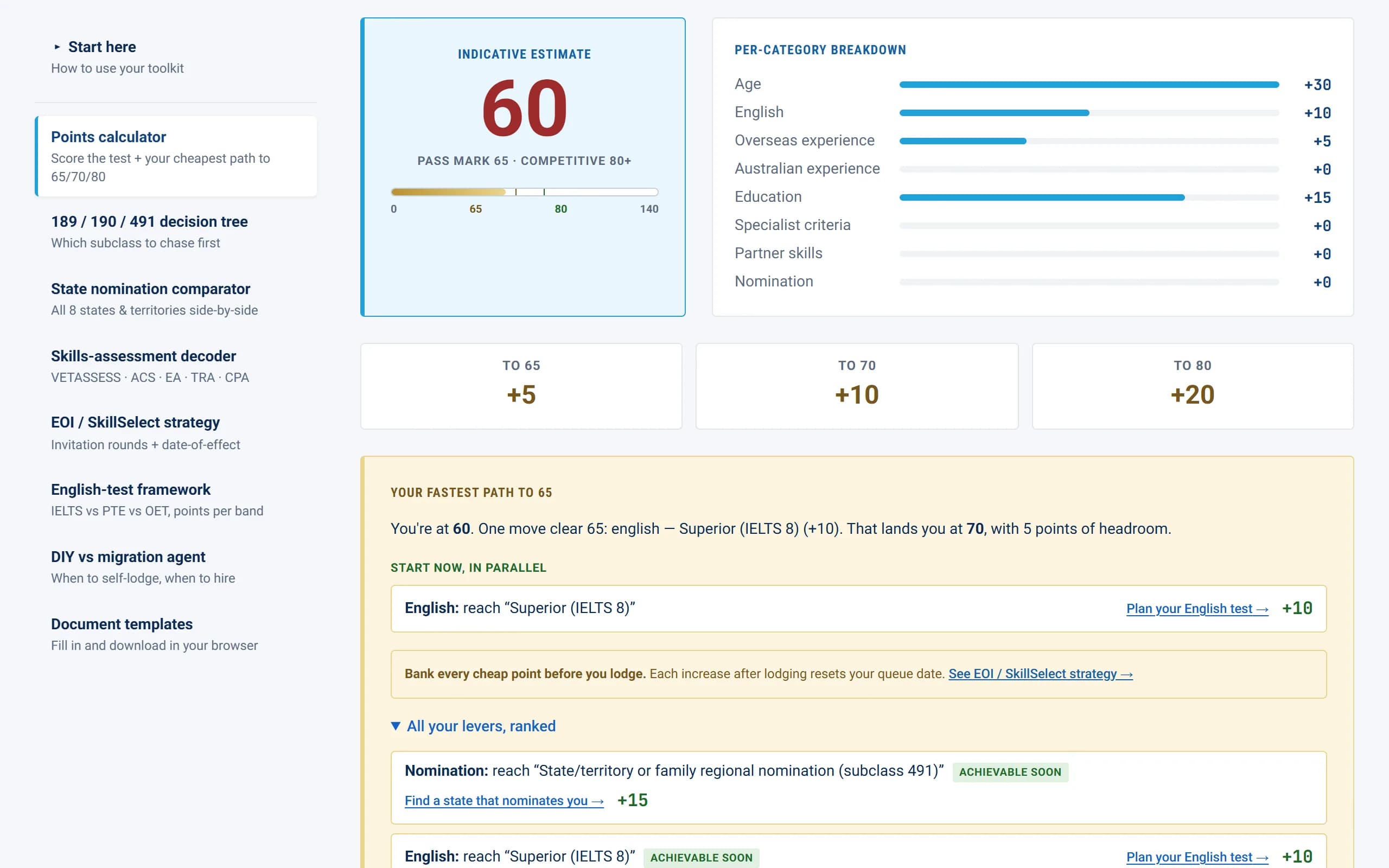
You need at least 65 points. Most Filipino applicants need 80+ to be competitive on a 189 invitation round. Points come from:
- Age: 25-32 gives 30 points; 33-39 gives 25; 40-44 gives 15; 18-24 gives 25
- English: 0/10/20 for Competent/Proficient/Superior
- Skilled employment in Australia: up to 20 points
- Skilled employment overseas: up to 15 points
- Qualifications: up to 20 points
- Australian study requirement: 5 points
- Specialist education (STEM): 10 points
- Regional study: 5 points
- Partner skills: up to 10 points
- Community language (NAATI): 5 points
- State nomination: 5 (190) or 15 (491) points
Filipino applicants commonly maximise scores by improving English to Proficient or Superior, securing a positive partner skills assessment, completing NAATI accreditation in Filipino, or moving to a 491 pathway. The how to maximise points score guide lays out which moves add the most points for the least time.
Cost and Processing Times
Application charges (primary applicant, current):
- Subclass 189: AUD $6,135
- Subclass 190: AUD $6,140
- Subclass 491: AUD $6,140
Add to this:
- Secondary applicant (partner): confirm the current charge on the official fee schedule
- Dependent child: confirm the current charge on the official fee schedule
- Skills assessment fee: AUD $500-$1,200 depending on authority
- IELTS or OET fee
- NBI Clearance and additional country police checks
- Bupa medical for the whole family
- State nomination application fee (varies by state)
Processing times shift constantly. Nursing and aged-care nominations from regional states have tended to be quickest; competitive 189 occupations slowest. Don't plan your move around a specific quoted figure.
What Filipino Applicants Need to Know
Nursing Pathway in Detail
For a Filipino registered nurse pursuing skilled migration, the practical sequence is:
- Achieve IELTS Academic 7.0 each band or OET B each section.
- Apply to AHPRA for an assessment of your nursing qualification.
- Complete the AHPRA-required pathway, typically an Outcomes-Based Assessment (OBA) involving a multiple-choice exam and an Objective Structured Clinical Examination.
- Obtain AHPRA registration.
- Apply to ANMAC for a skills assessment.
- Submit an EOI through SkillSelect.
- Receive an invitation and lodge the 189, 190 or 491 application.
- Complete medicals and police checks.
- Receive the grant.
The registered nurse visa pathway details current ANMAC and AHPRA timing. Many Filipino nurses combine the migration process with an offshore job offer through a state-nominated 491 for aged-care, which has been a high-volume route.
Police Clearance from the Philippines and Beyond
You need an NBI Clearance (multi-purpose) for every applicant aged 16+ in your application. The Philippines is one of the few countries where character checks regularly trigger "hits" on common names; allow time for manual verification. You'll also need police checks from any country you've lived in for 12 months or more cumulatively since age 16, including Saudi Arabia, the UAE, the UK and Singapore if you've worked overseas. The police clearance certificates guide covers each jurisdiction.
Document Authentication
PSA-issued birth and marriage certificates are standard. Academic transcripts should come directly from the institution, signed and sealed. Apostille via DFA may be requested for documents used overseas. All non-English documents need certified translations.
Family Members
You can include your spouse and dependent children. A partner with a positive skills assessment in a relevant occupation, competent English and the right age can add up to 10 points to your score. The partner skills points guide explains the qualifying criteria.
Common Pitfalls for Filipino Applicants
- AHPRA timing. Filipino nurses sometimes submit a visa EOI before they understand the OBA process. AHPRA registration is independent of and slower than the visa.
- Underestimating English. Competent English wins zero points. The competitive route requires Proficient or Superior.
- Wrong ANZSCO choice. A nurse working in aged care may map to "Aged or Disabled Carer" or "Registered Nurse" depending on duties. The wrong ANZSCO can fail a skills assessment.
- Overseas work experience not documented. ACS and Engineers Australia want named referees on company letterhead with dates and detailed duty statements. Generic certificates of employment don't pass.
- Forgotten country police checks. A two-year posting in Saudi Arabia at age 22 still triggers a Saudi police check requirement.
- Sponsor or agent shortcuts. Some unregistered agents in the Philippines promise outcomes they can't deliver. Use a MARA-registered migration agent or run your own application.
Frequently Asked Questions
How long does Australian skilled migration take from the Philippines?
End to end, expect 12-30 months, longer if AHPRA registration is part of the pathway. The visa application itself is usually decided within months once invitation is received; the slower steps are skills assessment, English testing and (for nurses) AHPRA registration.
What's the minimum IELTS for Australian skilled migration?
Competent English is IELTS 6.0 in each band, the visa floor. For nursing, AHPRA requires IELTS Academic 7.0 each band or OET B each section. Competitive points scores generally require Proficient (7.0 each band) or Superior (8.0 each band).
Can I apply for skilled migration as an aged-care worker?
Yes. Aged or Disabled Carer is on relevant core skills lists, with state nomination available in several regional states. The 491 is the most common pathway. Skills assessment is done by ANMAC (when paired with nursing) or VETASSESS (for stand-alone aged-care roles).
Do I need a job offer for skilled migration?
For the 189, no. For the 190, no, though state nomination criteria sometimes factor in employer connection. For the 491, no offer is needed, but you must live in a designated regional area. Employer-sponsored visas (482, 494, 186) do require a sponsoring employer.
Can I include my parents in my skilled visa application?
Parents aren't dependants on a skilled visa. Once you're a permanent resident, you can sponsor parents through one of the parent visa categories. The contributory parent visa and the sponsored parent visa are the main long-term routes.
Related Guides
- Australian visa for Filipino citizens: full overview
- Subclass 189 Skilled Independent visa
- Subclass 190 Skilled Nominated visa
- Subclass 491 Skilled Work Regional visa
- Skills assessment complete guide
- Registered nurse visa pathway
- English language requirements guide
- Police clearance certificates guide
- Subclass 189 pillar page