Health Diagnostic and Promotion Professionals nec Visa Pathway to Australia: Complete 2026 Guide
Updated: 16 August 2026
Australia classifies Health Diagnostic and Promotion Professionals nec under ANZSCO 251999 — the "not elsewhere classified" residual code for skill-level-1 health roles without a dedicated ANZSCO. VETASSESS conducts the skills assessment as a Group A occupation. The code sits on STSOL and CSOL, unlocking subclasses 190, 491, 482 and 186 — not 189. Typical 2026 salaries range AUD $80,000-$120,000 depending on the specific role mapped to the code.
Quick Facts: 251999 Migration Pathway
| Detail | Information |
|---|---|
| ANZSCO Code | 251999 (Health Diagnostic and Promotion Professionals nec) |
| Skill Level | 1 (AQF Bachelor degree or higher in a highly relevant field) |
| Skills Assessment | VETASSESS (Group A professional occupation) |
| Occupation List | STSOL and CSOL — not on MLTSSL |
| Visa Options | 190, 491, 482, 186 (no 189) |
| Demand Level | High — many roles within the code (genetic counsellors, exercise physiologists) sit in persistent shortage |
| Salary Range | AUD $80,000-$120,000 (Jobs and Skills Australia + SEEK, 2026) |
| Typical 190 Score | 70-80 |
| Key Challenge | The "nec" classification requires a cover letter justifying why your role fits no dedicated ANZSCO code |
Role Context in Australia
The "not elsewhere classified" code is a catch-all for skill-level-1 health roles where the specific occupation does not have its own ANZSCO entry. The most common applicants under 251999 are:
- Genetic counsellors — increasingly in demand as genomic medicine, prenatal screening and oncology genetics expand
- Exercise physiologists — Medicare-funded chronic disease and rehabilitation work
- Clinical perfusionists — heart-lung bypass specialists in cardiothoracic surgery
- Music therapists, art therapists, drama therapists — accredited allied mental health roles
- Diabetes educators — credentialed nurse-adjacent roles
- Lactation consultants (IBCLC) with advanced clinical scope
- Clinical bioinformaticians in the medical research sector
Demand varies sharply by sub-occupation. Genetic counsellors are in acute national shortage as every state expands cancer genetics, prenatal screening and rare disease services. Exercise physiologists have grown into a large allied health workforce on the back of Medicare's chronic disease management items. Clinical perfusionists are a small workforce of around 200-250 nationally with persistent recruitment difficulty in cardiothoracic centres. Music therapy and art therapy roles have expanded inside NDIS-funded services since 2019.
ANZSCO Code Mapping: 251999
ANZSCO 251999 captures skill-level-1 health diagnostic and promotion professionals where no dedicated four-digit unit group applies. Tasks listed under the parent unit group 2519 cover clinical assessment, diagnostic procedures, health promotion programs, individual counselling, evidence-based intervention design, and education across diverse health domains.
The key question for any applicant: should you really be applying under 251999, or is there a more specific ANZSCO code that fits your work? Wrong-coding is the single most common reason for negative outcomes. Check the dedicated codes first:
- 252114 Audiologist — for diagnostic hearing assessment
- 251412 Orthoptist — for eye movement and vision diagnostics
- 252712 Speech Pathologist — for communication and swallowing
- 234914 Physicist (Medical) — for radiation oncology and diagnostic physics
- 252211 Acupuncturist — for AHPRA-registered Chinese medicine
- 251211 Medical Diagnostic Radiographer — for X-ray, CT, MRI
- 252311 Dental Specialist — for dental specialties
Only after confirming none of those fits should you proceed under 251999. VETASSESS requires a cover letter explicitly justifying the nec mapping.
Skills Assessment: VETASSESS
VETASSESS is the assessing body for 251999. The occupation sits in Group A — the strictest VETASSESS category — which requires both a closely matched qualification and a closely matched employment history.
VETASSESS requirements
- Qualification — AQF Bachelor degree or higher in a field highly relevant to the specific health discipline you work in. For genetic counsellors this means a postgraduate qualification in genetic counselling. For exercise physiologists, an accredited exercise physiology degree. Generic health science or biomedical science degrees are insufficient on their own.
- Employment — Minimum one year of highly relevant post-qualification work within the last five years at the appropriate skill level.
- Cover letter — Mandatory for nec assessments. Must explain why your role is not captured by any dedicated ANZSCO code, with reference to the specific tasks of your position.
- English — Not required by VETASSESS for the assessment itself; the visa application requires Competent English minimum.
Cost and timing
- Standard application fee: AUD $1,096 (offshore); AUD $1,205.60 incl. GST (onshore). Updated October 2025.
- Priority processing: AUD $1,921 (offshore); AUD $2,113.10 incl. GST (onshore)
- Processing time: 12-16 weeks standard; 10 business days priority
Common rejection drivers include qualification mismatch (the degree was too general for the specific health discipline claimed), employment evidence that did not demonstrate the diagnostic or interventional scope of skill level 1, and weak cover letters that failed to address why no dedicated ANZSCO code applied. VETASSESS is unforgiving on the cover letter — applicants who recycle generic templates often draw an unfavourable outcome that could have been avoided.
Professional registration
The 251999 code spans roles with very different registration architectures:
- Genetic counsellors — credentialed through the Human Genetics Society of Australasia (HGSA), not AHPRA. The Australasian Board of Certified Genetic Counsellors administers certification.
- Exercise physiologists — Accredited through Exercise & Sports Science Australia (ESSA). Not AHPRA. ESSA accreditation is required for Medicare provider eligibility.
- Clinical perfusionists — Certified through the Australasian Society of Cardio-Vascular Perfusionists (ASCVP).
- Music therapists — Registered through the Australian Music Therapy Association (AMTA).
- Art therapists — Registered through the Australian, New Zealand and Asian Creative Arts Therapies Association (ANZACATA).
- Diabetes educators — Credentialed through the Australian Diabetes Educators Association (ADEA).
Confirm the registration body that applies to your specific role before lodging VETASSESS. The visa side of the file will pass without registration evidence, but no Australian employer will hire you without it.
Visa Pathways
Because 251999 is on the STSOL and CSOL but not the MLTSSL, the 189 Skilled Independent visa is unavailable. The route runs through state nomination, regional nomination or employer sponsorship.
Subclass 482 — Skills in Demand (SID)
The most direct pathway with an Australian job offer. Up to four years of employer-sponsored employment.
- Visa fee: AUD $3,210 (Core Skills stream, primary applicant)
- Salary threshold: Core Skills Income Threshold AUD $73,150 (2026)
- Processing time: 1-3 months in Core Skills stream
- Quirk: Genetic counsellor and clinical perfusionist roles routinely sit well above the CSIT. Exercise physiology roles in private practice can come in close to the threshold — verify the offer carefully.
Subclass 190 — Skilled Nominated
State-nominated permanent residency. +5 points. Two-year state residency commitment.
- Visa fee: AUD $6,140
- Best states: NSW, Victoria, South Australia for genetic counselling and clinical perfusion; all states for exercise physiology
- Processing time: 6-12 months post-invitation
Subclass 491 — Skilled Work (Regional)
Five-year regional provisional visa, +15 points, PR pathway via subclass 191 after three years.
- Visa fee: AUD $6,140
- Processing time: 6-9 months
- Quirk: Regional services run heavier vacancies for allied health than capital-city services. 491 in regional SA, Tasmania or northern NSW is often faster than 190 in Sydney.
Subclass 186 — Employer Nomination Scheme
Permanent residency via employer sponsorship. Direct Entry stream needs three years of skilled post-qualification experience plus VETASSESS. TRT stream after two years on 482.
- Visa fee: AUD $6,140
- Processing time: 3-7 months Direct Entry; 6-12 months TRT
Points Test Strategy
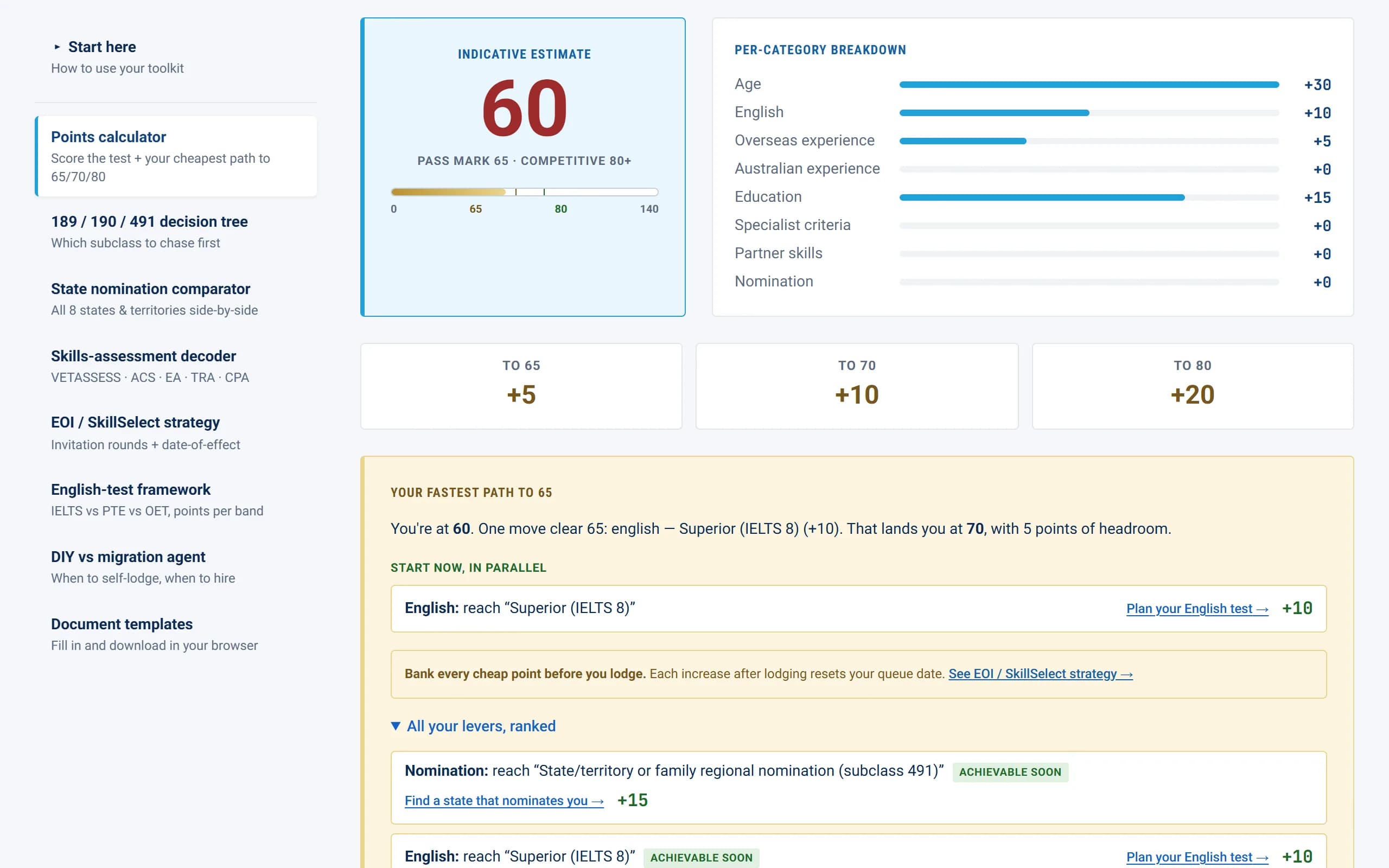
Although 189 is unavailable, 190 and 491 still depend on the points test. Most successful applicants land between 65 and 85 points after nomination.
| Points Factor | Points | Notes |
|---|---|---|
| Age 25-32 | 30 | Maximum band |
| Age 33-39 | 25 | |
| Bachelor degree | 15 | Floor for skill level 1 |
| Master's degree | 15 | |
| Doctorate (closely related) | 20 | Common for genetic counsellors |
| English Competent (IELTS 6) | 0 | |
| English Proficient (IELTS 7) | 10 | |
| English Superior (IELTS 8) | 20 | |
| Overseas work 3-5 yrs | 5 | |
| Overseas work 5-8 yrs | 10 | |
| State 190 nomination | 5 | |
| Regional 491 nomination | 15 | |
| Partner skills | 5-10 |
Scenario A — 30-year-old genetic counsellor, Master's, 4 years experience, Proficient English Age 30 + Master's 15 + English 10 + Overseas exp 5 = 60. Add 190 (+5) = 65. Competitive in a health-priority round.
Scenario B — 32-year-old exercise physiologist, Bachelor + Honours, 6 years experience, Superior English Age 30 + Bachelor 15 + English 20 + Overseas exp 10 = 75. Add 491 (+15) = 90. Strong invitation position.
State Nomination
New South Wales
NSW's 2025-26 priority sectors include allied health and digital health. Genetic counsellors and clinical perfusionists in particular sit on the priority allocation. Sydney's clinical research institutes (Garvan, Children's Cancer Institute) and tertiary hospitals run persistent vacancies.
Victoria
Victoria prioritises health professionals consistent with the applicable professional registration. The Victorian Comprehensive Cancer Centre, Royal Children's Hospital and the Murdoch Children's Research Institute drive demand for genetic counsellors. Exercise physiology is broadly listed under primary care priorities.
South Australia
South Australia opened all skilled occupations to its 2025-26 program. Allied health and rehabilitation are priority clusters. SA Health and the Adelaide research network sponsor regularly.
Queensland
QSOL lists 251999 for candidates with confirmed Queensland employment. Brisbane's major tertiary hospitals, Mater Health and Queensland Genomics Health Alliance are the principal employers.
Western Australia and Tasmania
WA includes 251999 on its skilled migration list for confirmed offers. Tasmania runs an accessible 491 pathway for allied health roles where regional residency is acceptable.
Salary and Employment Outlook
| Sub-occupation | Typical Salary Range (AUD) |
|---|---|
| Exercise physiologist (entry, private) | $70,000-$85,000 |
| Exercise physiologist (5+ years) | $85,000-$110,000 |
| Genetic counsellor (entry) | $90,000-$105,000 |
| Genetic counsellor (senior / lead) | $115,000-$140,000 |
| Clinical perfusionist | $110,000-$160,000 |
| Music / art therapist (NDIS-funded) | $75,000-$100,000 |
| Diabetes educator | $90,000-$115,000 |
| Median across the 2519 unit group | ~$100,000 |
Source: SEEK Salary Hub 2026, PayScale 2026, Jobs and Skills Australia 2519 occupation profile (median full-time earnings ~AUD $100,776 / year). Base pay; superannuation (11.5%) sits on top, with public health system overtime, on-call allowances (perfusionists) and Medicare bulk-billing volume (exercise physiologists, diabetes educators) materially shifting take-home.
Top employer types:
- Tertiary public hospitals — Royal Melbourne, Royal Prince Alfred, Royal Brisbane, Royal Adelaide
- Specialist research institutes — Garvan, Walter and Eliza Hall, Murdoch Children's, QIMR Berghofer
- NDIS allied health providers — large networks employ music therapists, art therapists and exercise physiologists
- Cardiothoracic surgical centres — for clinical perfusionists, a small group of 8-12 centres nationally
- Private practice and corporate health — for exercise physiologists, diabetes educators
Tips for a Successful Application
-
Stress-test the nec mapping before lodging. Email VETASSESS with your role description before paying the application fee. If a dedicated ANZSCO code exists (Audiologist, Orthoptist, Speech Pathologist, Medical Diagnostic Radiographer, etc.) you must use it instead of 251999. A wrong-coded application costs the full fee with no refund.
-
Write the cover letter from scratch. Generic templates almost always fail. VETASSESS wants to see you reason from your specific role to the conclusion that no dedicated ANZSCO code fits. Reference the tasks of the relevant adjacent codes and explain how your work differs. Two pages, paragraphs not bullets.
-
Pair the qualification evidence with credentialing evidence. Even though Australian professional registration is not required for VETASSESS, attaching evidence of equivalent registration in your home country (e.g. HGSA-equivalent body, ACSM exercise physiology certification, ABCP perfusion certification) materially strengthens the file.
-
Sit a Superior English test if your sub-occupation pool is small. Twenty points for English moves files from 65 to 85 faster than waiting for more experience. For roles where competition is light (perfusionists, genetic counsellors), this is the cheapest path to a 190 invitation.
-
Identify your Australian registration body early. Each sub-occupation under 251999 has its own registration body — HGSA, ESSA, ASCVP, AMTA, ANZACATA, ADEA. Begin the credentialing application before the visa is granted so you can start clinical employment immediately on arrival.
Step-by-Step Migration Roadmap
- Determine whether a dedicated ANZSCO code applies (use the ANZSCO code finder)
- If 251999 genuinely fits, draft a custom cover letter justifying the nec mapping
- Sit your English test — aim for Superior (IELTS 8 / OET A) where competition is moderate to high
- Lodge the VETASSESS skills assessment with cover letter (AUD $1,096)
- Receive the VETASSESS outcome (12-16 weeks standard)
- Lodge the SkillSelect EOI for 190 or 491, or pursue 482 employer sponsorship
- Apply for state nomination (NSW, Victoria, SA, Queensland)
- Receive invitation and lodge visa within 60 days
- Begin the Australian professional registration application with the relevant body
- Complete health and character checks, receive visa grant
- Complete Australian credentialing (HGSA, ESSA, AMTA, etc.)
- Commence clinical employment
Frequently Asked Questions
Should I use 251999 or look for a dedicated ANZSCO code?
Always check the dedicated codes first. Audiologist (252114), Orthoptist (251412), Speech Pathologist (252712), Medical Diagnostic Radiographer (251211), Dental Specialist (252311), Medical Physicist (234914) and Acupuncturist (252211) all have their own codes. Only if your role genuinely falls outside every dedicated unit group should you apply under 251999. The wrong code is the most common reason an otherwise strong file fails.
Can I migrate as a genetic counsellor without postgraduate qualifications?
No, in practice. The Human Genetics Society of Australasia certification requires a master's degree in genetic counselling (or equivalent), and VETASSESS expects evidence that your qualification matches the specific health discipline. Bachelor-only applicants without further training rarely clear the assessment for genetic counselling claims under 251999.
What's the deal with the cover letter for nec occupations?
VETASSESS requires a custom cover letter explaining why your role is not captured by any dedicated ANZSCO code. The letter must reference your actual duties and reason against the adjacent codes. Without a credible cover letter, VETASSESS will either reject the application or insist on reassessment under a different code. Treat the cover letter as the central document of the file, not a formality.
Can I work in private practice on a 482 visa?
Yes, provided the sponsoring employer is on the Standard Business Sponsorship register or holds an accredited sponsor status. Most large allied health groups (exercise physiology chains, NDIS providers, cardiothoracic centres) are experienced sponsors. Smaller private practices may need to set up sponsorship from scratch, which adds 6-10 weeks to the timeline.
Which sub-occupation under 251999 has the strongest demand outlook for 2026?
Genetic counsellors lead on growth — every state has expanded cancer genetics, prenatal screening and rare disease services since 2022, and the workforce remains under 500 nationally. Clinical perfusionists are a small but persistent shortage cohort. Exercise physiology has the largest absolute job pool but the most competitive entry-level market. The right answer depends on your specific qualification and clinical scope.
How is the 251999 pathway different from a dedicated allied health code?
Mostly the documentary burden. A dedicated code (Orthoptist, Audiologist, Speech Pathologist) lets VETASSESS apply a standard template assessment. The nec code requires the assessor to evaluate your specific role against the broader unit group definition. Files succeed where the cover letter, qualification and employment evidence form a coherent story. Files fail where any of the three is generic.