Resident Medical Officer Visa Pathway to Australia: Complete 2026 Guide
Updated: 16 August 2026
Australia classifies the role of Resident Medical Officer under ANZSCO 253112. The Medical Board of Australia (MedBA) handles registration via the Australian Medical Council (AMC), which assesses international medical graduates. The occupation sits on the Core Skills Occupation List (CSOL) and the Short-term Skilled Occupation List (STSOL), unlocking subclasses 190, 491, 482 and 186. Typical 2026 RMO salaries range AUD $79,000-$140,000.
Quick Facts: Resident Medical Officer Migration Pathway
| Detail | Information |
|---|---|
| ANZSCO Code | 253112 (Resident Medical Officer) |
| Skill Level | 1 (Bachelor degree or higher plus medical registration) |
| Skills Assessment | MedBA (Medical Board of Australia) via the AMC pathway |
| Occupation List | CSOL and STSOL — not on MLTSSL |
| Visa Options | 190, 491, 482, 186 |
| Demand Level | Critical — junior doctor pipeline persistently undersupplied across public hospitals |
| Salary Range | AUD $79,000-$140,000 base; locum AUD $85-$130/hr (state award data, 2026) |
| Typical 189 Score | Not applicable — 189 access is not available for 253112 |
| Key Challenge | Securing an accredited intern or RMO hospital placement before visa lodgement |
What an RMO Actually Does in Australia
A Resident Medical Officer is a hospital-based junior doctor who has completed internship and is working under supervision before entering specialist training. In the Australian system, the formal training ladder runs intern (PGY1) → resident (PGY2-3) → registrar (specialist trainee) → consultant. The RMO band covers postgraduate years 2 and 3 in most states, although the title is used loosely across the country and some hospitals call PGY1s "junior house officers" or "interns" and PGY2 onwards "RMOs".
RMOs rotate through inpatient medical and surgical wards, emergency departments, intensive care, paediatrics, anaesthetics, psychiatry and general practice terms. Each rotation typically lasts 10-13 weeks. The role is service-heavy: ward rounds, admissions, discharge summaries, after-hours cover, procedural assistance and managing the day-to-day care of admitted patients. Decisions sit with the registrar or consultant above.
Demand is structural. Australia's public hospitals depend on a continuous pipeline of RMOs to function, and the domestic graduate intake from 21 medical schools does not fully cover service load — particularly in regional and outer-metro hospitals. Queensland, Western Australia, the Northern Territory, regional NSW and Tasmania run annual recruitment campaigns aimed at international medical graduates already in Australia or eligible for the Competent Authority pathway.
ANZSCO Code Mapping
The 6-digit code is 253112 — Resident Medical Officer, sitting inside Unit Group 2531 General Practitioners and Resident Medical Officers. The role is defined as a medical practitioner who provides medical care to hospital inpatients under the supervision of senior medical staff and assists with clinical management as part of their post-internship training.
A common confusion: 253112 RMO is not the same as 253111 General Practitioner. GPs hold fellowship of either RACGP or ACRRM and work in primary care, typically in community practice. RMOs are pre-fellowship hospital doctors. Specialists in training who have entered a college program (anaesthetics, surgery, internal medicine, paediatrics, etc.) map to specialist codes from 253211 onwards, not to 253112.
If you are an offshore-trained doctor still completing your AMC exam pathway or supervised-practice year, you generally apply on temporary visas as a doctor on the standard or competent authority pathway. The RMO ANZSCO code becomes relevant once you have been offered an accredited PGY2+ hospital position.
Skills Assessment
MedBA Registration via the AMC
The skills assessment for migration is effectively your registration outcome with the Medical Board of Australia. MedBA delegates verification and examination assessment to the Australian Medical Council (AMC). Three pathways exist:
Competent Authority Pathway — for international medical graduates who hold registration with a recognised competent authority (US ECFMG, GMC United Kingdom, Medical Council of Canada, Medical Council of New Zealand, Medical Council of Ireland). These applicants bypass the AMC examinations but still complete 12 months of supervised practice in Australia.
Standard Pathway — for all other overseas-trained medical graduates. Requires passing:
- AMC MCQ examination — computer-adaptive test, 150 questions, AUD $2,920 sitting fee
- AMC Clinical examination — OSCE format, AUD $3,000 in-person or AUD $3,400 online
- Plus 12 months supervised practice in an approved Australian hospital setting
Specialist Pathway — for IMGs with completed specialist training in their home country. Goes through the relevant Australian college (RACS, RACP, ANZCA etc.) and does not apply to RMO-level positions.
For an RMO migration application, the MedBA outcome — limited or provisional registration tied to an accredited training position — serves as the skills assessment for visa purposes.
Common rejection reasons: primary source verification via ECFMG EPIC not completed; English test scores below IELTS Academic 7.0 in every band or OET grade B in each subtest; supervised practice job offer that is not from an AMC-accredited hospital posting.
For the full overview of medical and allied health assessing bodies, see the complete list of skills assessment bodies.
Fees Summary
- ECFMG EPIC primary source verification: ~USD $145
- AMC MCQ examination: AUD $2,920
- AMC Clinical examination: AUD $3,000-$3,400
- MedBA limited registration application: approximately AUD $625
- AHPRA annual registration: approximately AUD $914 (general/limited 2025-26 medical practitioner fee)
End-to-end the AMC standard pathway typically costs AUD $8,000-$12,000 before factoring travel, English testing and exam preparation.
Visa Pathways for Resident Medical Officers
RMO sits on the CSOL and STSOL, so the 189 visa is closed. The dominant routes are 482 and 491, with 186 used as the permanent transition once a hospital sponsors for a long-term position.
Subclass 482 — Skills in Demand Visa
The most common pathway for IMGs accepted into accredited RMO positions at Australian hospitals.
- Visa fee: AUD $3,210 (Core Skills stream, primary applicant)
- Salary threshold: AUD $76,515 CSIT (rising to AUD $79,499 from 1 July 2026) — all RMO awards exceed this
- Processing: 75% of Core Skills cases decided within 2 months
- Quirk: Limited or provisional MedBA registration must be confirmed before grant. State health departments often manage both the registration and visa coordination centrally.
Subclass 190 — Skilled Nominated Visa
State-nominated permanent residency where the state lists RMO on its occupation list. The Australian Capital Territory has carried 253112 on its Critical Skills List since 2023, which scores well under the Canberra Matrix.
- Visa fee: AUD $6,140 (primary applicant)
- Points boost: +5 from state nomination
- Processing: 75% within 6 months
- Obligation: Live in the nominating state for 2 years
Subclass 491 — Skilled Work Regional (Provisional)
Regional state nomination route. Queensland, Tasmania and South Australia have included RMO across recent program years for hospitals outside metropolitan areas.
- Visa fee: AUD $6,140 (primary applicant)
- Points boost: +15 from regional nomination
- Duration: 5 years provisional with subclass 191 PR pathway after 3 years
- Processing: 75% within 11 months
Subclass 186 — Employer Nomination Scheme
Permanent residency via hospital sponsorship. Most commonly used by RMOs already on a 482 transitioning through the Temporary Residence Transition stream after 2+ years.
- Visa fee: AUD $6,140 (primary applicant)
- Processing: 75% within 5 months
- Quirk: TRT stream is significantly faster and cheaper than Direct Entry for most RMOs.
Points Test Strategy
The 189 is closed for RMO. Points still matter for 190 and 491 routes.
| Points Factor | Points | Notes |
|---|---|---|
| Age 25-32 | 30 | Typical for PGY2-PGY4 doctors |
| Age 33-39 | 25 | Late-career-entry IMGs |
| Bachelor degree (MBBS) | 15 | Standard medical degree |
| Master's | 15 | Specialist diplomas, MPH |
| PhD | 20 | Academic or research medical |
| English Proficient (IELTS 7) | 10 | MedBA registration floor |
| English Superior (IELTS 8) | 20 | Strong leverage if achievable |
| Overseas experience 3-4 years | 5 | After AMC year-of-practice deductions |
| Australian experience 1-2 years | 5 | If already on a 482 RMO role |
| State nomination (190) | 5 | ACT runs Critical Skills List |
| Regional nomination (491) | 15 | QLD, TAS, SA pathways |
| Partner skills | 5-10 | Common for medical couples |
Realistic Score Scenarios
Scenario 1 — UK-trained doctor on competent authority pathway, 31, IELTS 8, currently working as RMO in NSW Age 30 + Degree 15 + English 20 + Australian experience 5 + 491 nomination 15 = 85 points. Strongly competitive in regional NSW or QLD invitation rounds.
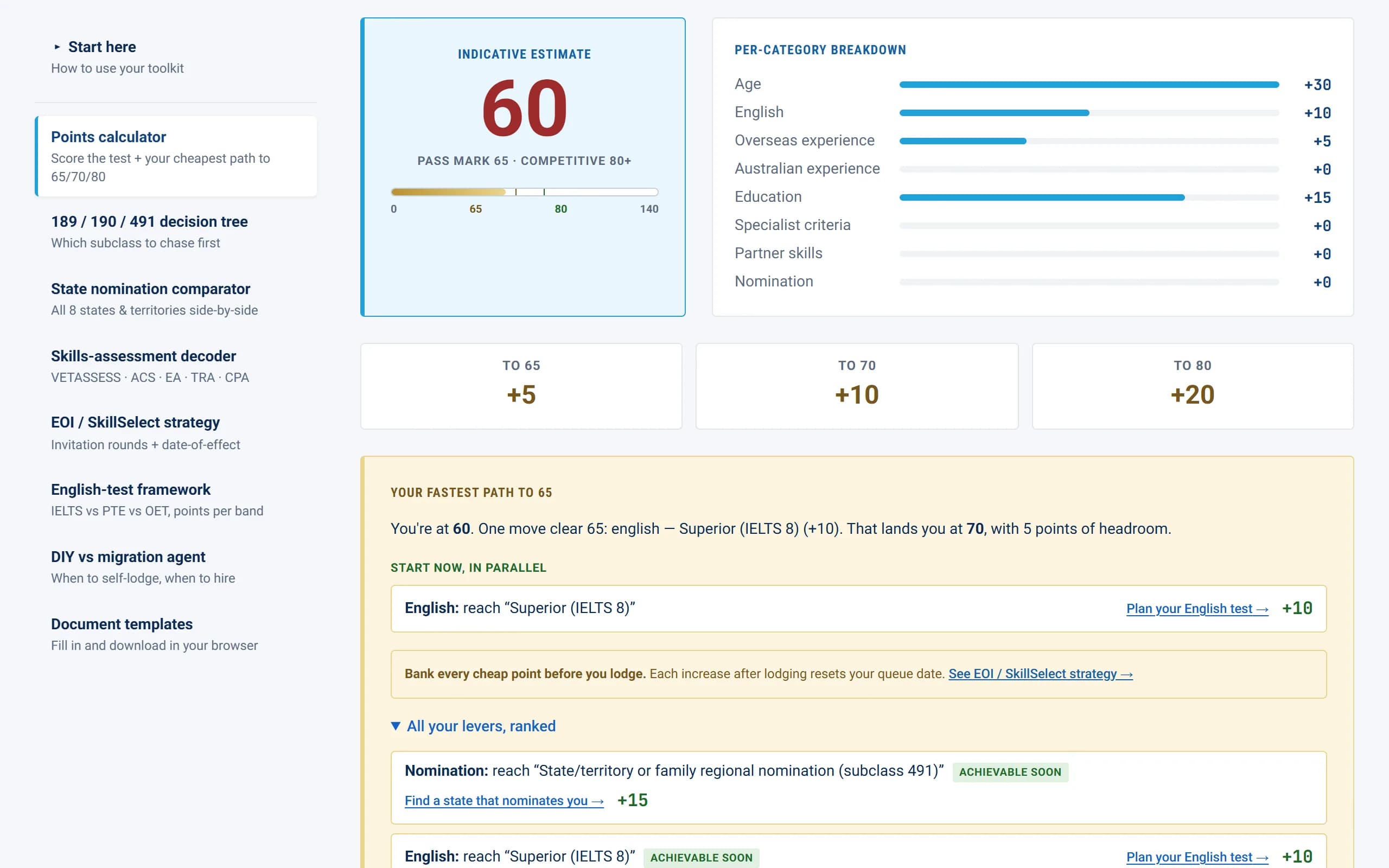
Scenario 2 — India-trained doctor on standard pathway, 29, IELTS 7, just completed 12 months supervised practice Age 30 + Degree 15 + English 10 + Australian experience 5 = 60 points. Add 491 regional nomination (+15) = 75 points. Add partner with skilled occupation (+10) = 85 points. Competitive in regional rounds for ACT, Queensland and Tasmania.
State Nomination
Australian Capital Territory
The ACT lists Resident Medical Officer (253112) on its Critical Skills List, the highest-priority band under the Canberra Matrix. Applicants with ACT residence and work for 6+ months, or a confirmed Canberra Hospital or Calvary Public Hospital placement, score strongly. See ACT state nomination 2026 and Canberra Matrix.
Queensland
Queensland health districts in Cairns, Townsville, Mackay, Rockhampton and Toowoomba run annual junior medical officer campaigns specifically targeting IMGs. Migration Queensland nominates RMOs onshore under both 190 and 491 streams. See Queensland state nomination 2026.
Tasmania
Tasmania nominates RMOs through the Tasmanian Health Service, with Royal Hobart Hospital and Launceston General Hospital sponsoring directly. The state runs both 190 and 491 streams for medical occupations. See Tasmania state nomination 2026.
South Australia
SA includes Resident Medical Officer in its priority healthcare list with wider eligibility for offshore applicants. Royal Adelaide Hospital, the Women's and Children's, and regional health networks recruit through the SA Health pipeline. See South Australia state nomination 2026.
Western Australia
WA includes RMO in its General Stream nominations where applicants hold a confirmed WA Country Health Service or metropolitan hospital offer. The Pilbara, Kimberley and Goldfields run constant locum and RMO recruitment.
Northern Territory
The NT runs one of the broadest nomination programs for medical occupations including RMO, with Royal Darwin Hospital, Alice Springs Hospital and remote health services sponsoring IMGs through both 482 and 491 routes.
Salary and Employment Outlook
Typical 2026 Salary Ranges
| Role / PGY Band | Typical Annual Salary |
|---|---|
| Intern (PGY1) | AUD $76,000-$82,000 |
| RMO PGY2 | AUD $89,000-$95,000 |
| RMO PGY3 | AUD $96,000-$108,000 |
| Senior RMO / unaccredited registrar | AUD $115,000-$140,000 |
| Locum RMO (hourly) | AUD $85-$130/hr |
| Locum RMO (daily, QLD/regional) | AUD $880-$1,018/day |
State awards govern base salary. NSW Health, Queensland Health, Victoria Health and WA Country Health each publish their own medical officer wage rates. Most awards top up base pay with rostered overtime, on-call allowances, professional development allowances and salary packaging via state arrangements. Total earnings for an active RMO covering after-hours can reach 30-50% above base salary.
Highest-Paying Locations
- Remote and regional locum — Northern Territory, far-north Queensland and remote WA pay the highest hourly rates because of structural under-staffing
- Queensland Health regional districts — Cairns, Townsville and Mackay run salary loading on top of award rates
- Private hospital RMO roles — limited but lucrative; usually only available to PGY3+ on visa pathways
- Mining-town hospital coverage — Karratha, Mount Isa, Roxby Downs
Demand Outlook
Jobs and Skills Australia flags General Practitioners and Resident Medical Officers (unit group 2531) as the most under-supplied medical unit group in the September 2025 Labour Supply Index. Public hospital RMO vacancy rates run at 8-12% nationally and considerably higher in regional postings. The structural shortage extends to 2030 on current graduate output projections.
For broader context on the most in-demand medical and health occupations, see most in-demand occupations Australia 2026.
Tips for a Successful Application
1. Begin EPIC Verification Before You Sit Anything
Primary source verification through ECFMG EPIC is required before MedBA accepts your AMC results. It typically runs 8-12 weeks but can stretch to 6 months if your medical school is slow to respond. Start it the day you decide to migrate.
2. Pursue the Competent Authority Pathway if Eligible
If you completed your degree and at least one year of post-graduate practice in the UK, Ireland, Canada, NZ or US, the competent authority pathway saves you the AMC MCQ and clinical examinations entirely. The financial and timing saving is roughly AUD $7,000 and 12-18 months.
3. Match Your English Test to Both AHPRA and Visa Requirements
AHPRA accepts IELTS Academic, OET, PTE Academic and TOEFL iBT. The required score is IELTS 7 in every band or OET grade B in every subtest. Aim once for Superior (IELTS 8 or equivalent) — it covers AHPRA, MedBA, the visa points test and any future state nomination in one sitting.
4. Apply Directly to State Health Department Junior Medical Officer Campaigns
Queensland Health, NSW Health, Tasmania Health and WA Country Health run centralised JMO/RMO recruitment campaigns. These campaigns coordinate registration, visa and hospital placement as a single package. Applying directly through these portals is more efficient than approaching individual hospitals.
5. Plan the Visa and Registration Timelines Together
Limited or provisional MedBA registration must be in place before the 482 grant. Build your timeline so the registration outcome lands 2-4 weeks before your visa decision is expected. A common failure mode is having the visa nomination ready while registration is still pending, which delays grant by months.
Step-by-Step Migration Roadmap
- Confirm your ANZSCO mapping — 253112 is for hospital RMO posts. See how to find your ANZSCO code.
- Start ECFMG EPIC primary source verification — required for all AMC pathways.
- Confirm your pathway — competent authority, standard or specialist depending on training country.
- Sit your English test — IELTS Academic 7 across all bands, or OET B.
- Sit AMC MCQ examination — AUD $2,920 (standard pathway only).
- Sit AMC Clinical examination — AUD $3,000-$3,400 (standard pathway only).
- Apply for MedBA limited or provisional registration through AHPRA.
- Secure an accredited RMO position at an Australian hospital.
- Hospital sponsors a 482 nomination — or apply through a state JMO/RMO campaign.
- Lodge visa application in ImmiAccount. See the ImmiAccount guide.
- Complete supervised practice year if on the standard or competent authority pathway.
- Transition to 186 or 491 PR pathway once eligibility is met.
Frequently Asked Questions
Can I apply for a 189 visa as a Resident Medical Officer?
No. ANZSCO 253112 sits on the CSOL and STSOL only, not on the MLTSSL. The 189 Skilled Independent visa is not available. The dominant pathways for RMOs are 482 employer-sponsored, 491 state-regional and 186 employer-nominated permanent residency.
Do I need to pass the AMC exams before I can come to Australia?
It depends on your pathway. Standard pathway applicants must pass the AMC MCQ before applying for limited registration with a hospital, then complete the AMC clinical exam during their supervised practice year. Competent authority pathway applicants — UK, Ireland, US, Canada, NZ trained — can come to Australia on limited registration without sitting AMC exams.
How long does the whole process take from decision to first hospital shift?
Standard pathway: 18-30 months end-to-end. Competent authority pathway: 8-14 months. The largest variables are EPIC primary source verification turnaround (8-26 weeks), AMC examination scheduling and the hospital recruitment cycle, which is annual in most states.
Which state offers the best chance of an RMO nomination?
In 2025-26 the most accessible programs for RMOs have been the ACT (Critical Skills List), Tasmania and the Northern Territory. Queensland Health remains the largest sponsor by volume but is more selective. The trade-off is regional commitment — the easier programs require you to work outside metropolitan Brisbane, Adelaide or Perth for the duration of the provisional visa.
What's the difference between a Resident Medical Officer and a General Practitioner for visa purposes?
253112 (RMO) is for hospital-based junior doctors who have not yet entered specialist training. 253111 (General Practitioner) is for GPs who hold fellowship of RACGP or ACRRM and work in community practice. The skills assessment, college recognition, salary band and demand profile are all different. Do not interchange the codes.
Can my MBBS from India or Pakistan be recognised?
Yes, through the AMC standard pathway. Indian, Pakistani, Bangladeshi and Sri Lankan medical degrees are recognised at the qualification level for AMC examination eligibility. Holders complete EPIC verification, the AMC MCQ, the AMC clinical examination and 12 months of supervised practice to qualify for general MedBA registration.