Family Support Worker Visa Pathway to Australia: Complete 2026 Guide
Updated: 16 August 2026
Australia classifies Family Support Workers under ANZSCO 411713. The Australian Community Workers Association (ACWA, now operating as Community Work Australia) conducts the skills assessment. The role sits on the STSOL and CSOL, unlocking subclasses 190, 491, 482 and 186. Typical 2026 salaries range AUD $70,000-$85,000. State-funded child and family services are the dominant employer base.
Quick Facts: Family Support Worker Migration Pathway
| Detail | Information |
|---|---|
| ANZSCO Code | 411713 (Family Support Worker) |
| Skill Level | 2 (AQF Diploma or higher in community services or related field) |
| Skills Assessment | ACWA / Community Work Australia |
| Occupation List | STSOL and CSOL — not on MLTSSL |
| Visa Options | 190, 491, 482, 186 |
| Demand Level | Moderate to high — state child protection systems, NDIS family services, and youth justice all recruit |
| Salary Range | AUD $70,000-$85,000 (SEEK 2026; Talent.com average $77,538) |
| Typical 190 Score | 65-75 (state nomination clears at lower scores than mainstream professional codes) |
| Key Challenge | English requirement is high — IELTS 7.0 each band — and qualifications must show family services specialisation |
What Family Support Workers Actually Do in Australia
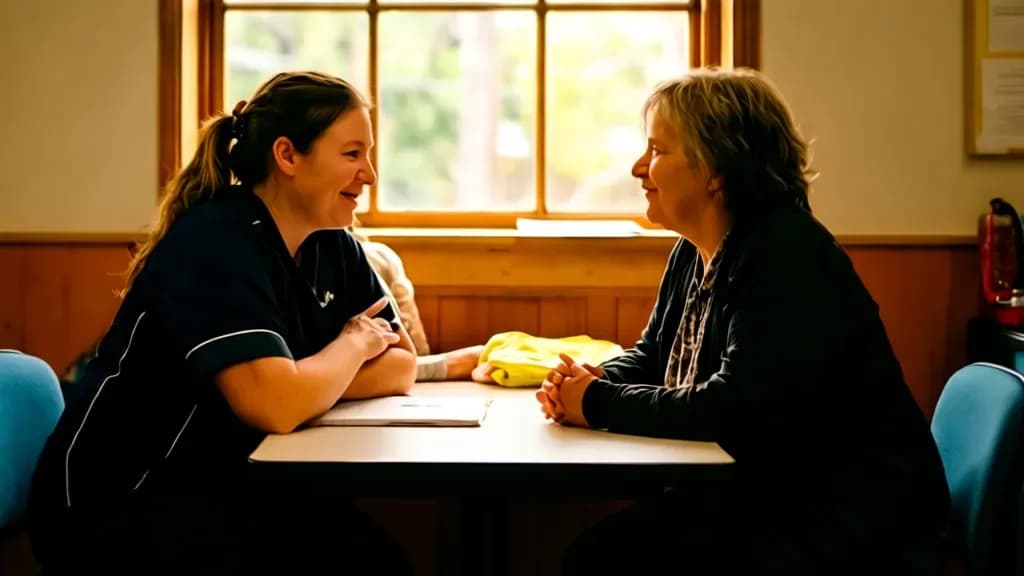
Family Support Workers are frontline workers in the social welfare system. The role assesses family functioning, runs parenting programs, supports families through child protection processes, advocates for children's interests, and links families to housing, health, financial counselling and education services. Most positions sit inside state child protection departments (NSW Department of Communities and Justice, Victoria DFFH, Queensland Department of Child Safety) or in non-profit child and family services (Anglicare, Mission Australia, Save the Children, Berry Street, MacKillop Family Services).
Demand is structurally embedded. Every Australian state runs a child protection system, and every system runs perpetually understaffed. Federal funding through the Family Support Program and the National Framework for Protecting Australia's Children drives sustained demand for trained family workers in early intervention, intensive family support and post-removal contact services. The National Disability Insurance Scheme (NDIS) adds a second layer of demand for family workers supporting children with disabilities and their parents or carers.
The work is hard. Caseloads are heavy, secondary trauma exposure is real, and turnover is high. That is precisely why the workforce is open to qualified overseas applicants.
ANZSCO 411713 — What the Code Covers
411713 falls under Unit Group 4117 (Welfare Support Workers). It is distinct from 411711 (Community Worker), 411712 (Disabilities Services Officer), 411714 (Parole or Probation Officer), 411715 (Residential Care Officer) and 411716 (Welfare Worker).
Core tasks recognised by ANZSCO:
- Assessing family circumstances and identifying support needs
- Developing and implementing family support plans
- Running parenting education programs and group work
- Supporting families involved in child protection processes
- Advocating for children, parents and carers with government agencies
- Coordinating with social workers, psychologists, schools and health services
- Maintaining case notes and statutory documentation
The closest adjacent codes are 411716 (Welfare Worker — broader scope) and 272613 (Welfare, Recreation and Community Arts Worker — Skill Level 1). If you hold a four-year social work degree and your role involves clinical case management rather than support work, you are likely closer to 272511 Social Worker, which sits on the MLTSSL and unlocks different pathways.
Skills Assessment
ACWA / Community Work Australia
The Australian Community Workers Association — recently rebranded as Community Work Australia — is the listed assessing authority for 411713 and several adjacent welfare support codes.
Qualification requirement: Applicants must hold one of:
- A relevant diploma or higher with specialisation in family services or children and families
- A Community Work Australia accredited diploma or higher in family services
- A relevant qualification (non-specialised) at AQF Level 5 or higher in community services
Experience substitution: At least three years of relevant post-qualification employment may substitute for the formal qualification.
English language requirement: IELTS 7.0 each of the four bands, or equivalent. ACWA also accepts PTE Academic 65 each, Advanced CAE 185 each, or TOEFL 24L / 24R / 27W / 23S (total 98+). This is meaningfully higher than the typical visa English threshold of IELTS 6.0.
Assessment cost: AUD $965 for the standard skills assessment.
Processing time: 8-12 weeks.
Common rejection reasons: Two are recurring. First, applicants with a generalist community services qualification (without a specific family services major or stream) often fail the specialisation test — ACWA wants to see family-focused subjects, child protection content, or supervised practice in a family services agency. Second, English scores at 6.5 (with one or two bands at 6.0) are technically eligible for the 482 visa but do not meet ACWA's standard, so the assessment fails before the visa stage is reached.
Visa Pathways
411713 sits on STSOL and CSOL, which gives it broader visa access than CSOL-only codes.
Subclass 190 — Skilled Nominated Visa
State nomination plus permanent residency. Available because 411713 is on the STSOL.
- Visa fee: AUD $6,140 (primary applicant)
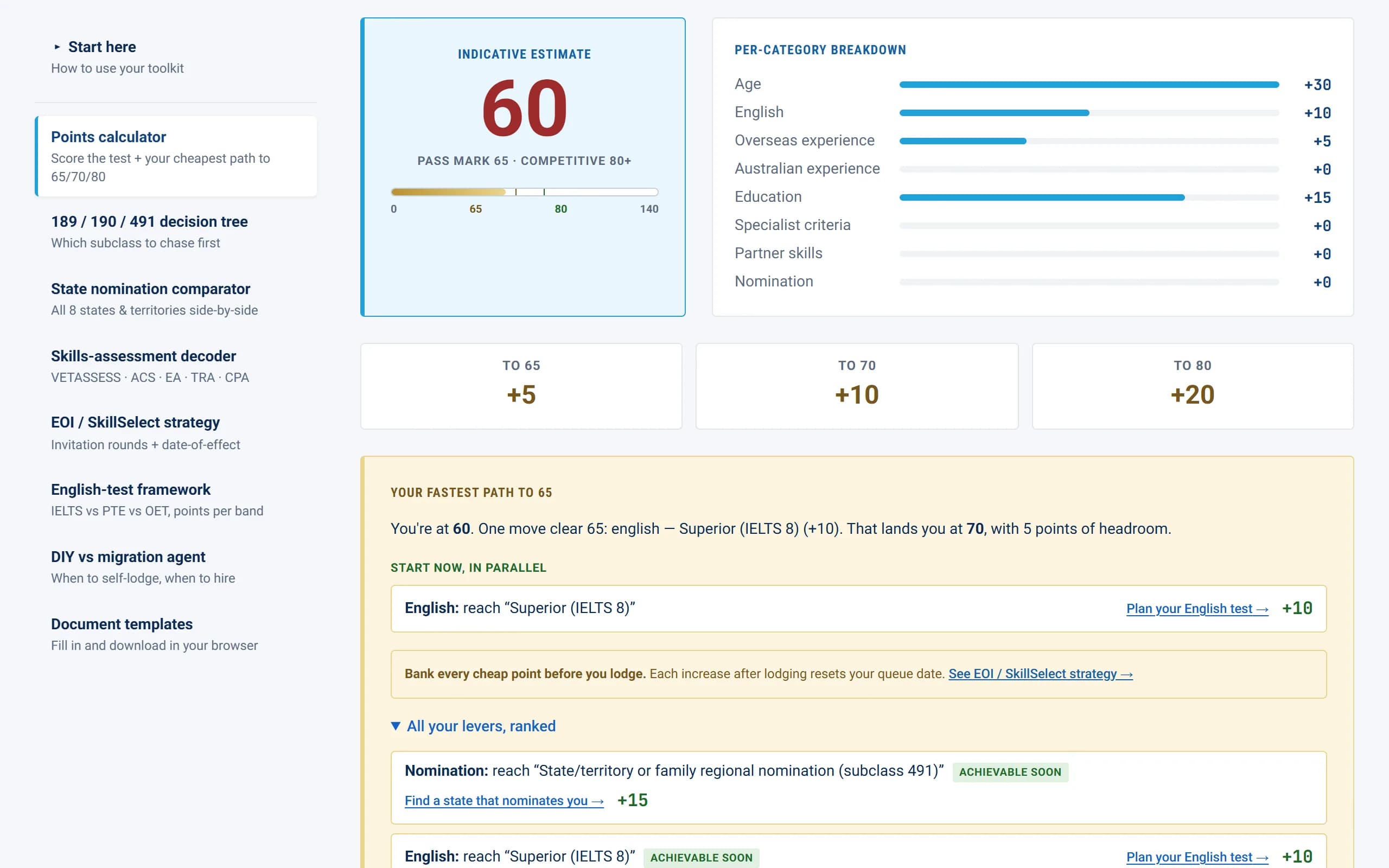
- Points boost: +5 from state nomination
- Processing time: 8-14 months
- Quirk: Several states actively nominate this occupation because state child protection systems are short-staffed. NSW, Victoria and South Australia run regular invitation rounds for welfare support occupations.
Subclass 491 — Skilled Work Regional Visa
Regional nomination plus 5-year provisional residency with a PR pathway to 191.
- Visa fee: AUD $6,140 (primary applicant)
- Points boost: +15 from regional nomination
- Quirk: Regional and rural Australia has the deepest family services workforce gaps — Aboriginal community-controlled organisations in regional NSW and Queensland, and rural Victorian DFFH offices, are persistent recruiters. The 491 visa is the more accessible nomination route here.
Subclass 482 — Skills in Demand Visa
Employer-sponsored temporary visa.
- Visa fee: AUD $4,015 (primary applicant)
- Salary threshold: Core Skills Income Threshold AUD $76,515 until 30 June 2026, then AUD $79,423
- Duration: Up to 4 years
- Quirk: Average family support worker salaries cluster around the threshold. Sponsors must structure the nominated salary above CSIT. Many non-profit employers are NDIS-funded and operate on tight margins, which constrains their ability to sponsor at threshold-clearing rates. State child protection departments are easier sponsors because public sector pay scales clear the threshold.
Subclass 186 — Employer Nomination Scheme
Permanent residency via an employer.
- Visa fee: AUD $6,140 (primary applicant)
- Streams: Direct Entry (3+ years experience, age under 45) or Temporary Residence Transition (after 2 years on 482)
Points Test Strategy
| Points Factor | Points | Notes |
|---|---|---|
| Age (25-32) | 30 | Maximum bracket |
| Age (33-39) | 25 | Still strong |
| Qualification (Diploma) | 10 | Minimum for 411713 |
| Qualification (Bachelor) | 15 | Common for trained social workers in support roles |
| Qualification (Master's) | 15 | Same as Bachelor |
| English (Superior — 8.0+) | 20 | Maximum English score |
| English (Proficient — 7.0) | 10 | Equal to ACWA's mandatory threshold |
| Overseas Experience (3-4 years) | 5 | Minimum after ACWA assessment |
| Overseas Experience (5-7 years) | 10 | Common bracket |
| Overseas Experience (8+ years) | 15 | Maximum |
| State Nomination (190) | 5 | If nominated |
| Regional (491) | 15 | For regional nomination |
| Partner Skills | 5-10 | Where partner has skilled occupation |
Realistic Score Scenarios
Scenario 1: Diploma-qualified applicant with state nomination
A 30-year-old with a Diploma of Community Services (family specialisation), 6 years' experience and IELTS 7.0 each. Age 30 + Diploma 10 + English 10 + Experience 10 + 190 nomination 5 = 65 points. Competitive for STSOL state allocations because the applicant pool is thinner than mainstream professional codes.
Scenario 2: Bachelor's holder targeting regional 491
A 33-year-old with a Bachelor's degree, 8 years' experience and IELTS 7.0 each. Age 25 + Bachelor 15 + English 10 + Experience 15 + 491 regional 15 = 80 points. Strong invitation prospects.
State Nomination
New South Wales
NSW's Department of Communities and Justice runs Australia's largest child protection system and faces persistent recruitment challenges. NSW state nomination includes welfare support occupations and accepts applications from family support workers in 190 and 491 rounds. Sydney-based roles are competitive; regional NSW (Western Sydney, Hunter, Mid-North Coast, Far West) clears more easily.
Victoria
Victoria has prioritised health and community services as a #1 nomination sector in 2025-26. Family Support Worker sits within the priority bracket. The DFFH child protection workforce is the major public employer; non-profits like Berry Street, MacKillop and Anglicare Victoria are the major non-government employers.
South Australia
South Australia consistently nominates community and welfare workers under 190 and 491. Regional South Australia (Riverland, Murray Bridge, Whyalla, Mount Gambier) clears most easily. The state's commitment to Aboriginal child and family services in regional areas drives part of this demand.
Queensland
Queensland nominates 411713 in years where its priority sector allocation covers community services. Regional 491 nominations in Cairns, Townsville, Mackay and Toowoomba are more reliable than 190 Brisbane allocations.
Northern Territory
The NT runs structural shortages in family services, particularly in Aboriginal communities. Nominations under 190 and 491 are available and competition is low. The NT's 491 program is one of the most accessible regional pathways.
Salary and Employment Outlook
| Role / Experience | Typical Annual Salary (AUD) |
|---|---|
| Entry-level family support worker | $65,000-$72,000 |
| Experienced family support worker | $75,000-$85,000 |
| Senior practitioner / case lead | $85,000-$95,000 |
| Team leader / coordinator | $95,000-$110,000 |
| National average (SEEK 2026) | $70,000-$85,000 |
| Talent.com 2026 average | $77,538 |
Source: SEEK Career Advice Family Support Worker salary April 2026; Talent.com Australia 2026; PayScale 2026.
Total packages typically include 11.5% superannuation. Non-profit employers commonly offer fringe benefits tax (FBT) salary packaging up to AUD $15,900 per year, which effectively adds AUD $4,000-$5,000 to take-home pay — a meaningful uplift in a sector where base pay is moderate.
Highest-paying contexts:
- State child protection departments at senior practitioner band
- Specialised intensive family support programs (federally funded)
- Aboriginal community-controlled family services organisations (often higher base + remote allowances)
- Forensic or court-ordered family support roles
Tips for a Successful Application
1. Plan the English Test Early
IELTS 7.0 each band is a real hurdle and is non-negotiable for ACWA assessment. Many applicants who would otherwise be eligible fail because their Writing band sits at 6.5. Budget 6-12 months of preparation if your current scores are not at 7.0 across all four bands.
2. Get the Family Services Specialisation Right
ACWA looks for evidence of family-specific training and supervised practice. If your diploma is in generic community services without a family stream, your work history must clearly demonstrate three or more years of family-focused practice — child protection cases, parenting programs, family preservation work. Generic case management experience does not count.
3. Use Salary Packaging in Your Sponsorship Maths
Non-profit employers can offer salary packaging worth AUD $4,000-$5,000 effective on take-home pay. When negotiating with a 482 sponsor whose base offer sits near the CSIT, factor packaging into your decision — but note that packaging does not count toward the visa salary threshold. The base salary alone must clear CSIT.
4. Target Public Sector Sponsorship First
State child protection departments are accredited 482 sponsors with stable pay scales and clear career progression. Non-profits are more variable. If you can secure a public sector offer, your visa pathway is materially smoother — both for 482 and for the eventual 186 transition.
5. Document Your Practice Framework
ACWA assessors look for evidence that you work within a recognised practice framework — Signs of Safety, Strengths-Based Practice, Trauma-Informed Care, the Practice Framework used in your home jurisdiction's child protection system. Including this in your professional reference letters strengthens the assessment.
Step-by-Step Migration Roadmap
- Confirm 411713 is the right code — review your duties via the ANZSCO code finder; rule out 411716 (Welfare Worker) and 272511 (Social Worker)
- Verify STSOL listing — check the current Skilled Occupation List
- Prepare qualification evidence — transcripts showing family services subjects and supervised practice
- Sit IELTS or PTE — minimum 7.0 each band for ACWA
- Prepare employment evidence — reference letters specifying caseload type, practice framework, statutory or non-statutory setting
- Lodge ACWA / Community Work Australia assessment — AUD $965
- Submit Expression of Interest in SkillSelect — for 190 or 491
- Apply for state or regional nomination — NSW, Victoria, SA, Queensland or NT
- Receive invitation — within 60 days, lodge visa
- Alternatively pursue 482 sponsorship — through public child protection departments or large non-profits
- Complete health and character checks — including Working with Children Check in relevant state
- Receive visa grant and relocate
Frequently Asked Questions
What's the difference between Family Support Worker (411713) and Social Worker (272511)?
Social Workers (272511) sit on the MLTSSL with Skill Level 1 and require a four-year accredited degree assessed by the Australian Association of Social Workers (AASW). They work in statutory case management, clinical practice and policy roles. Family Support Workers (411713) sit on the STSOL with Skill Level 2 and are assessed by ACWA. They work in support, advocacy and program delivery roles, often alongside Social Workers. If you hold a four-year social work degree, you almost certainly belong under 272511, which has stronger migration outcomes.
Why is the English requirement higher for ACWA than for the visa?
ACWA's English standard reflects the reality of the role. Family support work requires sophisticated communication — running parenting groups in English, writing statutory case notes, advocating for families with judges, doctors and school principals. ACWA sets IELTS 7.0 because the workforce reality demands it. Some applicants meet the visa English threshold (6.0) but cannot clear ACWA, which means the assessment becomes the binding constraint.
Which states actively nominate Family Support Workers in 2026?
NSW, Victoria, South Australia, Queensland and the Northern Territory all include welfare support occupations in their nomination programs at various points in the 2025-26 program year. Regional 491 nominations are more reliable than metropolitan 190 nominations. Allocations and priorities change each program year, so check the latest state government skilled migration pages before lodging your Expression of Interest.
Can my overseas social work or family services qualification be recognised?
Yes, if it includes specific family services content or you can demonstrate three or more years of post-qualification practice in a family-focused setting. ACWA assesses qualifications individually against the AQF benchmark. Common recognised qualifications include UK BA Social Work (with family practice), Indian Master of Social Work (with family welfare specialisation), Filipino BS Social Work, and Canadian BSW with relevant practicum.
Is employer sponsorship realistic for Family Support Workers?
It depends on the employer. State child protection departments are realistic 482 sponsors — they are accredited, their pay scales clear the income threshold, and they have established overseas recruitment programs. Smaller non-profits are more difficult because their salary structures sit close to the threshold and their HR teams are not always experienced with sponsorship. Aboriginal community-controlled organisations are an underutilised pathway, particularly in regional Australia.