Business Machine Mechanic Visa Pathway to Australia: Complete 2026 Guide
Updated: 16 August 2026
Australia classifies Business Machine Mechanic under ANZSCO 342311. Trades Recognition Australia (TRA) conducts the skills assessment. The occupation sits on both the Core Skills Occupation List (CSOL) and the Short-term Skilled Occupation List (STSOL), unlocking subclasses 190, 491, 482, and 186. Typical 2026 salaries range AUD $60,000-$95,000, with senior managed-print and MFD specialists at the top of the band. The role centres on multi-function devices, photocopiers, scanners, EFTPOS terminals, and point-of-sale equipment.
Quick Facts: Business Machine Mechanic Migration Pathway
| Detail | Information |
|---|---|
| ANZSCO Code | 342311 (Business Machine Mechanic) |
| Skill Level | 3 (AQF Certificate III/IV with at least 2 years on-the-job training) |
| Skills Assessment | TRA (Trades Recognition Australia) via OSAP or JRP |
| Occupation List | CSOL + STSOL |
| Visa Options | 190, 491, 482, 186, 494 |
| Demand Level | Moderate — steady B2B service contracts despite paper-light office trend |
| Salary Range | AUD $60,000-$95,000 (SalaryExpert Australia 2026; SEEK Service Technician data) |
| Typical 190 Score | 65-80 points |
| Key Challenge | Documented field-service hours on specific MFD/printer platforms |
What Business Machine Mechanics Do in Australia
A Business Machine Mechanic installs, maintains, and repairs electronic business equipment. The role covers multi-function devices (MFDs combining print, copy, scan, fax), production print systems, photocopiers, label printers, EFTPOS terminals, point-of-sale (POS) systems, cash registers, and document scanners. It's predominantly field-based service work — travelling to client sites, diagnosing faults on-site, swapping components, calibrating image quality, and managing planned preventive maintenance schedules.
Demand sits with the managed print services (MPS) sector and large OEM-aligned service organisations. Major employers include Konica Minolta Australia, Ricoh Australia, Canon Australia, Fuji Business Innovation (formerly Fuji Xerox), Kyocera Document Solutions, Sharp Electronics Australia, and Brother International Australia, plus their dealer networks. Independent MPS providers like Upstream Print Solutions, Pinpoint Print, and Inkwell-style regional operators also recruit. Roles cluster in metro Sydney, Melbourne, Brisbane, Perth, and Adelaide, with regional technicians servicing wider service zones.
The "office paperless" trend has thinned demand at the low end of the market but raised it for high-volume production print, secure document workflow, and B2B managed-services contracts. Healthcare, legal, government, and education sectors maintain heavy printing needs and pay premium service rates. Jobs and Skills Australia tracks this as a small but stable occupation with replacement demand exceeding new entrants — which is why it retains both CSOL and STSOL listings.
ANZSCO Code Mapping
342311 sits inside Unit Group 3423 (Communications and Electronic Equipment Trades Workers). Adjacent codes:
- 342111 Cabler (Data and Telecommunications)
- 342211 Electrical Linesworker
- 342212 Technical Cable Jointer
- 342313 Communications Operator
- 342314 Electronic Equipment Trades Worker
- 342315 Electronic Instrument Trades Worker (General)
If your work covers broader electronic instrument calibration or biomedical equipment, 342314 or 342315 may be the cleaner code. 342311 is specifically the office equipment, MFD, and POS-equipment trade.
Tasks captured by 342311:
- Installing and configuring multi-function devices, printers, and POS hardware at customer sites
- Diagnosing electromechanical and electronic faults using diagnostic tools and OEM service software
- Replacing components (drums, fusers, transfer belts, paper-feed assemblies, control boards)
- Calibrating image quality, paper-path mechanics, and finishing units (staplers, hole-punchers, booklet makers)
- Maintaining planned preventive maintenance schedules per OEM service intervals
- Updating firmware, configuring network and security settings, integrating with print management software
- Training end users on basic operation and reporting
Skills Assessment with TRA
TRA assesses 342311 via two pathways.
Offshore Skills Assessment Program (OSAP)
For applicants from OSAP-eligible countries with overseas qualifications and experience.
Requirements:
- Qualification comparable to AQF Certificate III in business equipment, electronics, or office machine servicing
- Minimum 3 years' full-time post-qualification employment if your qualification is overseas-issued
- Currency: 12 months' full-time work in the previous 3 years
Cost: Approximately AUD $1,140 for the OSAP application (TRA 2026 schedule).
Processing time: 8-12 weeks from complete submission.
Job Ready Program (JRP)
For onshore applicants holding an Australian Certificate III in electronics, business equipment, or related field. Four stages: PSA, JRE (12 months supervised), JRWA (~AUD $2,845), JRFA (~AUD $65). Total ~AUD $3,250.
Common rejection reasons: Reference letters describing helpdesk or remote troubleshooting work rather than hands-on field service. Insufficient evidence of work on specific equipment platforms (TRA looks for documented service hours on Canon, Konica, Ricoh, Kyocera, Xerox, or similar OEM equipment). Roles that are predominantly sales or account management rather than technical service. Recognition gaps where the qualification is in general electronics but the work history doesn't link to business machines specifically.
For broader context see our skills assessment bodies complete list.
Visa Pathways
342311's presence on both the CSOL and STSOL means employer-sponsored and points-based state nomination routes are open.
Subclass 482 — Skills in Demand Visa (Core Skills Stream)
The dominant pathway for this trade.
- Visa fee (primary applicant): AUD $4,015
- Salary threshold: Core Skills Income Threshold AUD $79,423 (from 1 July 2026; previously AUD $76,515)
- Duration: Up to 4 years
- Pathway to PR: Convert to 186 (TRT stream) after 2 years
- Reality: Konica Minolta, Ricoh, Canon, Kyocera, and Fuji Business Innovation have used 482 sponsorship to fill regional service-zone gaps
Subclass 190 — Skilled Nominated Visa
PR via state nomination.
- Visa fee: AUD $6,140 (primary applicant)
- Points boost: +5 from state nomination
- Obligation: 2 years in the nominating state
- Reality: Selective — verify each state's 190 list; SA and Tasmania more likely than NSW or Victoria
Subclass 491 — Skilled Work Regional (Provisional)
Five-year provisional with PR pathway via subclass 191.
- Visa fee: AUD $6,140 (primary applicant)
- Points boost: +15 from regional nomination
- Reality: Regional service zones (Hunter, Illawarra, Geelong, Newcastle, regional QLD) suit this trade well — many MPS dealers operate regional teams
Subclass 186 — Employer Nomination Scheme
Direct PR through employer.
- Visa fee: AUD $6,140 (primary applicant)
- Streams: Direct Entry or TRT (after 2 years on 482)
Subclass 494 — Skilled Employer Sponsored Regional
For regional employer sponsorship.
- Visa fee: AUD $4,910 (primary applicant)
- Requirement: Regional employer, 3 years' experience, age under 45
189 is not available because 342311 is not on the MLTSSL.
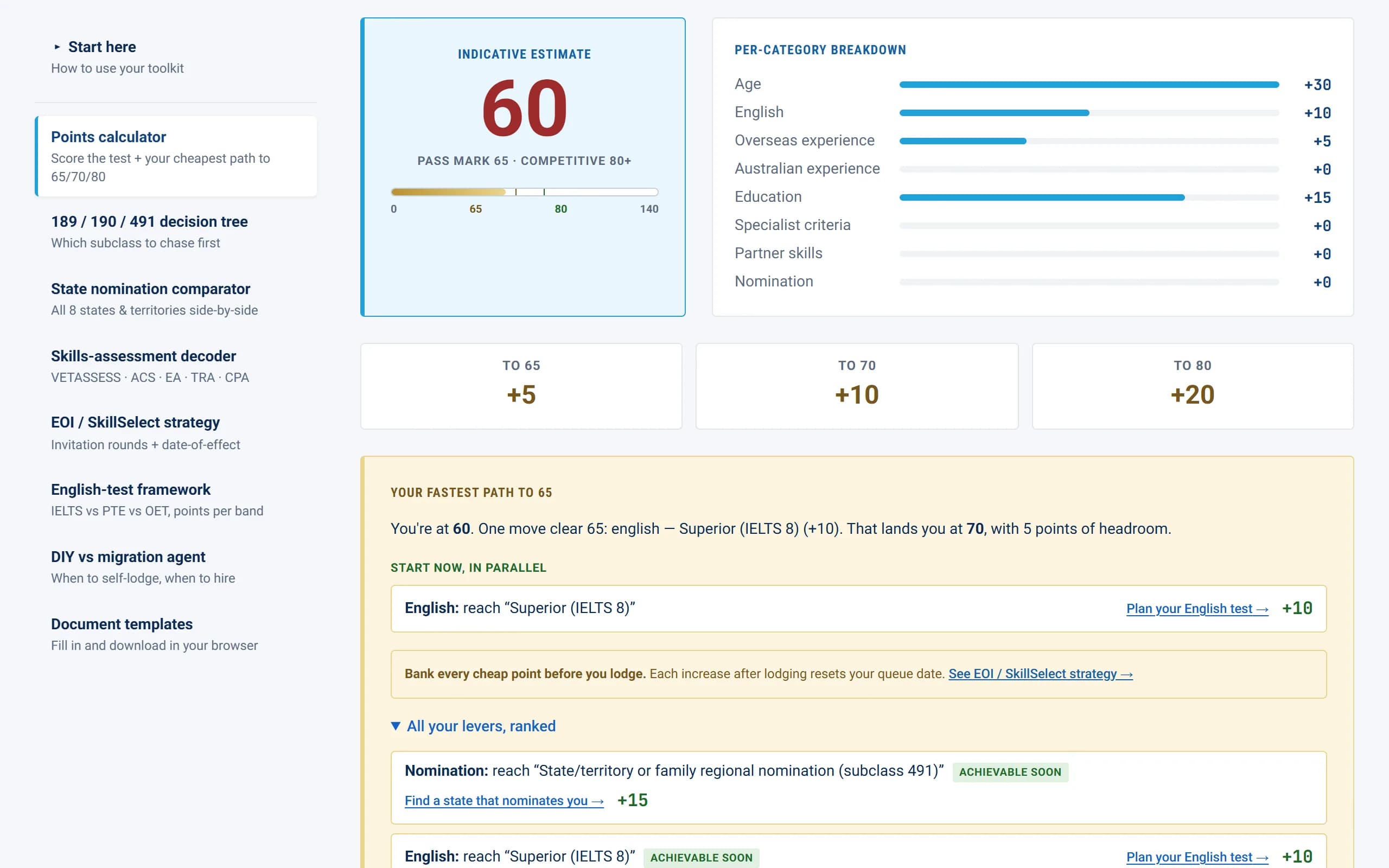
Points Test Strategy
For 190 and 491 streams:
| Points Factor | Points | Notes |
|---|---|---|
| Age (25-32) | 30 | Maximum |
| Age (33-39) | 25 | |
| AQF Cert III/IV (trade) | 10 | Standard for trades |
| AQF Diploma | 10 | |
| AQF Bachelor | 15 | Less common for this trade |
| English Competent (IELTS 6) | 0 | Minimum |
| English Proficient (IELTS 7) | 10 | Realistic |
| English Superior (IELTS 8) | 20 | Stretch |
| Overseas experience 5-7 yrs | 10 | |
| Overseas experience 8+ yrs | 15 | |
| Australian experience 1-2 yrs | 5 | |
| State nom (190) | 5 | |
| Regional nom (491) | 15 | |
| Partner skills | 5-10 |
Realistic Scenarios
Scenario 1: Offshore MFD technician, 10 years' experience, 32 years old Age (30) + Cert III (10) + Proficient English (10) + 8+ years overseas (15) + state 190 nom (5) = 70 points. Workable for 190 in SA or TAS.
Scenario 2: Onshore graduate visa holder transitioning to employer sponsorship Skip the points test — go 482 with a confirmed sponsor, then 186 TRT after 2 years.
State Nomination
Verify each state's current list directly before lodging — 342311 sits on the CSOL and STSOL federally, but state inclusion on 190/491 streams varies year on year.
South Australia
SA has shown the most consistent nomination interest in 342311 across the 2025-26 program year, particularly tied to its growing managed-services and government IT-services sector. Adelaide's regional service-zone coverage (Yorke Peninsula, Riverland, Limestone Coast) also supports 491 nomination cases.
Tasmania
Tasmania includes office equipment service trades in its 491 program where the applicant has Tasmanian connection (job offer, six months' residence, or family). Hobart and Launceston dealer networks recruit regularly.
Queensland
Brisbane metro nomination is selective. Regional Queensland (Townsville, Cairns, Toowoomba, Mackay) is more receptive under 491, supporting service-zone coverage for managed print providers across the state.
Western Australia
Perth metro and regional WA both nominate selectively. Pilbara and Goldfields service-zone roles are usually employer-sponsored (482) rather than 491 nominated.
Northern Territory
NT's small market has periodically nominated office equipment trades under its skilled migration program, with a confirmed Darwin job offer as the typical entry point.
For full list context see the Core Skills Occupation List and the Skilled Occupation List 2026.
Salary and Employment Outlook
| Role | Typical Salary Range |
|---|---|
| Junior service technician | AUD $55,000-$65,000 |
| Qualified field service technician | AUD $65,000-$80,000 |
| Senior MFD / production print technician | AUD $80,000-$95,000 |
| Service team leader / field supervisor | AUD $90,000-$115,000 |
| National service manager | AUD $115,000-$145,000 |
Source: SalaryExpert Australia "Office Machine Technician" (2026) and SEEK "Service Technician" salary data (May 2026). Total packages include 12% superannuation (effective 1 July 2025), company vehicle or vehicle allowance for field-based roles, on-call loadings, and overtime.
Highest-paying niches
- Production print specialists — Indigo, Versant, AccurioPress, Iridesse high-end production systems
- Managed print services contract managers
- Healthcare and legal sector dedicated technicians (security-cleared, compliance-aware)
- POS and EFTPOS specialists in retail-chain dedicated service teams
Geographic variation: Sydney and Melbourne base salaries trend AUD 5,000-10,000 higher than other metros. Regional and FIFO-style remote-zone work pays a meaningful premium where it exists.
Tips for a Successful Application
1. Document specific equipment platforms
TRA assessors and Australian employers both look for evidence of work on specific OEM platforms. Reference letters should name the equipment ranges you've serviced (e.g. "Konica Minolta bizhub C658, Canon imageRUNNER ADVANCE DX series, Kyocera TASKalfa 6053ci, Xerox AltaLink C8170"). Generic "office equipment service" descriptions fail at the depth bar.
2. Separate field service from helpdesk work
Field service work (on-site repair, parts replacement, calibration) is the core of 342311. Phone or remote helpdesk troubleshooting alone doesn't satisfy Skill Level 3 hands-on requirements. If your role splits 50/50, document the field hours explicitly.
3. Target managed print service employers
Australia's MPS market is dominated by Konica Minolta Australia, Ricoh Australia, Canon Australia, Kyocera Document Solutions, and Fuji Business Innovation. These are the largest 482 sponsors in the trade. Independent MPS providers and dealers are secondary targets. Approach with a specific platform competency rather than a generic CV.
4. Hold OEM certifications where you have them
Konica Minolta, Canon, Ricoh, and Kyocera all run technician certification programs in source-country markets. If you've completed OEM-specific training in your home country, list the certification code and renewal date — these are recognised by the Australian arms of the same OEMs.
5. English at Proficient level lifts your case materially
Field service is customer-facing. Australian employers favour technicians who can explain faults to non-technical clients clearly. IELTS 7 / PTE 65 across all bands isn't strictly required for the 482 but significantly improves your case in the sponsorship market.
Step-by-Step Migration Roadmap
- Confirm 342311 fits your work — test against 342314 (Electronic Equipment Trades Worker) and 342315 (Electronic Instrument Trades Worker General) using the ANZSCO code finder
- Check OSAP country eligibility on TRA's website
- Gather evidence — qualification certificate, references, payslips, OEM training certifications
- Sit IELTS General or PTE — aim for Proficient
- Lodge OSAP (AUD ~$1,140) or enrol in JRP if onshore
- Complete practical assessment or progress JRP stages
- Receive positive TRA outcome — valid 3 years
- Submit EOI in SkillSelect for 190 or 491 if going points-based
- Apply for state nomination in SA, TAS, QLD, WA, or NT
- Or — approach Australian MPS employers for 482 sponsorship
- Receive invitation, lodge visa within 60 days (190/491) or employer lodges nomination (482)
- Health checks and AFP/Interpol police clearances
- Visa grant — relocate
Frequently Asked Questions
Is the business machine mechanic trade dying out?
No, but it's reshaping. Volume office printing has declined, but managed print services contracts to mid-market and enterprise customers are steady. Healthcare, legal, education, and government sectors maintain heavy print demand. High-end production print (commercial print shops, in-plant departments) is a growth niche with premium pay. The trade is small but stable.
Can I apply for a 189 visa as a business machine mechanic?
No. 342311 is on the CSOL and STSOL but not the MLTSSL, which closes subclass 189. State nomination (190 and 491) is available where the state includes the code on its program list. Employer sponsorship (482, leading to 186) is the most common pathway.
How is this different from an electronic equipment trades worker?
342314 (Electronic Equipment Trades Worker) covers a broader scope of electronic equipment — radio, audiovisual, broadcast, industrial controls. 342311 is specifically business and office equipment. If you've worked on a broader range of electronic systems, 342314 may be the cleaner code. Match honestly against your actual work.
Does experience with retail POS and EFTPOS count?
Yes — point-of-sale equipment, cash registers, and EFTPOS terminals are listed in the ANZSCO description for 342311. Field service technicians at NCR, Toshiba TEC, Diebold Nixdorf, Verifone, and dealer networks have been positively assessed under 342311 when the work is hands-on hardware service rather than software support.
Will my overseas qualification be recognised?
If your qualification is comparable to AQF Certificate III in electronics or business equipment servicing, and your post-qualification experience is documented, TRA will assess via OSAP (for eligible countries) or by Recognition of Prior Learning through an Australian RTO. Strong post-qualification work history compensates for qualification-comparability gaps in many cases.
What's the demand outlook for business machine mechanics in Australia in 2026?
Stable replacement demand rather than growth demand. The Australian managed-print services sector continues to consolidate around large OEMs and major dealer groups, all of whom maintain field service teams nationally. Pay is at the moderate end of the trades spectrum but the work is metro-based, technically interesting, and offers clear progression into team leadership and specialist production-print roles. See the most in-demand occupations 2026 hub for comparison with adjacent trades.