Cabler (Data and Telecommunications) Visa Pathway to Australia: Complete 2026 Guide
Updated: 16 August 2026
Australia classifies Cablers (Data and Telecommunications) under ANZSCO 342411. Trades Recognition Australia conducts the skills assessment. The occupation is on the CSOL and STSOL, unlocking visa subclasses 190, 491, 482, and 186. Typical 2026 salaries range AUD $69,000-$95,000. A Cabling Provider Rules registration (ACMA endorsement) is required to work on customer cabling in Australia.
Quick Facts: Cabler (Data and Telecommunications) Migration Pathway
| Detail | Information |
|---|---|
| ANZSCO Code | 342411 (Cabler — Data and Telecommunications) |
| Skill Level | 3 (AQF Certificate III with at least two years on-the-job training, or Certificate IV; ACMA Cabler Registration required) |
| Skills Assessment | TRA (Trades Recognition Australia) — JRP onshore, OSAP offshore |
| Occupation List | CSOL and STSOL — not on MLTSSL or ROL |
| Visa Options | 190, 491, 482, 186 |
| Demand Level | High — NBN remediation, 5G fixed-wireless rollout, and data-centre buildout continue to consume skilled cablers |
| Salary Range | AUD $69,000-$95,000 (Jobs and Skills Australia and SEEK 2026) |
| Typical 189 Score | Not applicable — occupation is not on MLTSSL |
| Key Challenge | ACMA cabler registration is mandatory and runs in parallel with the TRA process |
What Cablers Do in Australia
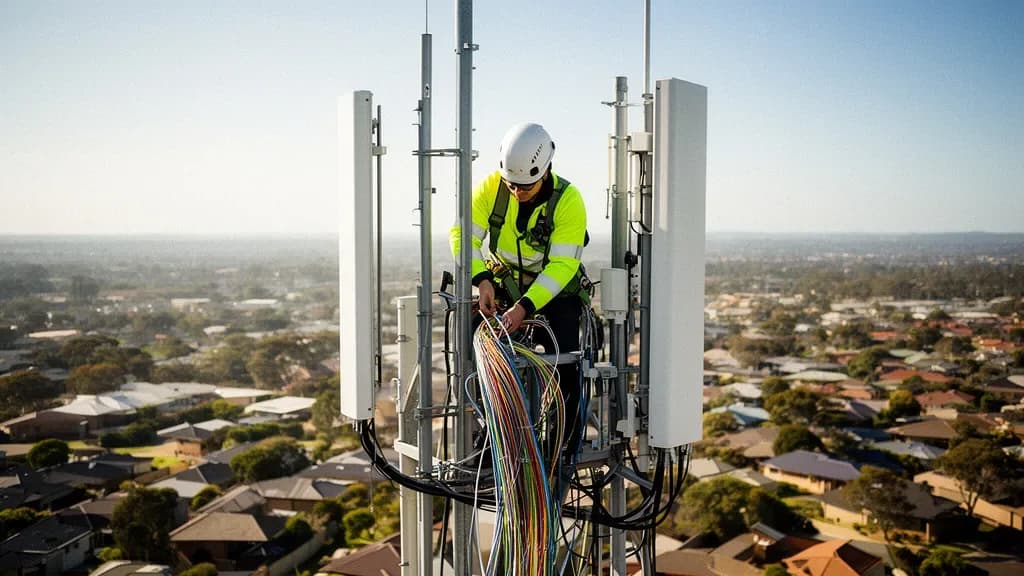
Cablers install, maintain, and repair data, voice, and fibre-optic cabling for residential, commercial, industrial, and customer premises. The work covers structured cabling for offices and data centres, fibre to the premises (FTTP) and fibre to the curb (FTTC) installations under the NBN program, indoor distribution for 5G in-building systems, and traditional copper for legacy services. Most cablers operate inside the customer side of the network boundary — from the wall socket back through the building — rather than on overhead lines, which sit with Telecommunications Linesworkers (342413).
Demand is concentrated in metropolitan capitals because that is where new office construction, hyperscale data centres, and large multi-dwelling residential builds happen. Sydney's western data-centre corridor (Macquarie Park, Eastern Creek), Melbourne's Tullamarine and Truganina data-centre clusters, and Brisbane's outer metropolitan growth corridors are the heaviest hiring zones. Major employers include NBN Co's subcontractor networks, telco-aligned contractors like Service Stream, Lendlease Services, Visionstream, and Ventia, plus integrators such as NEXTDC, AirTrunk, and Telstra Business Technology Services.
ANZSCO Code 342411 — What the Code Covers
The 342411 code covers people who lay out, terminate, and test copper and fibre-optic data and telecommunications cabling. Tasks include reading cabling plans, running cable through ceilings, conduits, and risers, terminating connectors and patch panels, fusion splicing fibre, and certification testing using OTDR, BERT, and structured cabling test sets.
342411 is distinct from Telecommunications Cable Jointer (342412), which covers field jointing of carrier-grade copper and fibre cables in pits and underground systems. It is also distinct from Telecommunications Linesworker (342413), which covers external aerial and underground carrier cabling. If your work is mainly customer-side and building-internal, 342411 is the correct code. Cross-check against the ANZSCO code finder before assessment.
Skills Assessment: Trades Recognition Australia
TRA assesses 342411 through OSAP or JRP. The trade is also regulated by ACMA's Cabling Provider Rules — a separate registration that you must hold to work on cabling connected to the carrier network in Australia.
Offshore Skills Assessment Program (OSAP)
OSAP applies to applicants outside Australia. The pathway requires a relevant qualification (Certificate III or equivalent) plus at least three years of full-time relevant employment, including the most recent 12 months.
- Assessment cost: approximately AUD $1,015 documentary plus technical assessment fees set by the approved offshore provider
- Processing time: 8-12 weeks documentary; technical assessment scheduling adds 4-8 weeks
- Common rejection reasons: employment evidence that mixes electrical and cabling duties without separating them; qualifications focused on carrier-grade external work rather than customer cabling; missing fusion-splicing or termination evidence
Job Ready Program (JRP)
JRP is the onshore pathway, common for holders of an Australian Certificate III in Telecommunications.
- Provisional Skills Assessment (PSA) — verifies qualification and prior experience. Valid for three years.
- Job Ready Employment (JRE) — register 1,725 hours of paid work in 12 months. Fee: AUD $490.
- Job Ready Workplace Assessment (JRWA) — practical assessment at your workplace. Fee: AUD $2,845.
- Job Ready Final Assessment (JRFA) — final positive outcome. Fee: AUD $75.
Total JRP fees through steps 2-4: approximately AUD $3,410. Plan for 14-18 months from PSA to JRFA.
ACMA Cabler Registration — Mandatory Parallel Step
ACMA's Cabling Provider Rules require every cabler who works on cabling connected to a carrier network in Australia to hold a registration. Three competency classes exist: Open (most cabling work), Restricted (single-premises only), and Lift (lift cabling). Open registration is the standard. The registration is issued by ACMA-accredited registrars (RIA, BICSI, ACA) and requires evidence of competency equivalent to the relevant Certificate III. Plan to apply for registration in parallel with the TRA process, not after — you cannot work commercially without it.
Visa Pathways for Cablers
342411 is on the CSOL and STSOL, which means subclass 189 is not available, but 190 nomination is — a more accessible route than for occupations on the ROL alone.
Subclass 482 — Skills in Demand
The 482 is the dominant pathway for cablers, especially for data-centre construction and NBN remediation programs.
- Visa fee: AUD $4,015 (Core Skills stream, primary applicant)
- Salary requirement: Core Skills Income Threshold AUD $79,423 from 1 July 2026 (previously AUD $76,515). Most data-centre and senior commercial cabling roles clear this.
- Duration: up to 4 years
- Processing time: 50% of Core Skills stream applications in 2-4 months
- Quirk: entry-level residential NBN cabling roles often pay below CSIT, which makes 482 sponsorship harder. Target data-centre, structured cabling, and commercial contractor roles instead.
Subclass 190 — Skilled Nominated
The 190 is available because 342411 sits on the STSOL. It is the cleanest points-based pathway to permanent residency.
- Visa fee: AUD $6,140 (primary applicant)
- Points boost: +5 from state nomination
- Obligation: live in the nominating state for 2 years
- Quirk: Victoria and NSW are the most active nominators of trades through 190 when state shortage data justifies the placement
Subclass 491 — Skilled Work Regional (Provisional)
The 491 is competitive in regional postcodes where data-centre construction or large infrastructure projects are running.
- Visa fee: AUD $6,140 (primary applicant)
- Points boost: +15 from regional nomination
- Duration: 5 years provisional with pathway to 191 permanent residency
- Processing time: 50% in 6-20 months; 90% in 15-28 months
Subclass 186 — Employer Nomination Scheme
Permanent residency through employer nomination, available via TRT after 2 years on a 482 or via Direct Entry with a TRA assessment.
- Visa fee: AUD $6,140 (primary applicant)
- Processing time: 12-18 months TRT; 12-20+ months Direct Entry
- Quirk: Direct Entry requires a positive TRA assessment plus a 3-year skilled experience minimum
State Nomination for Cablers
Verify 342411 on each state's current list before lodging. Listings change between program years.
New South Wales
NSW Skills Lists include trades that support critical infrastructure. Cablers supporting Sydney's data-centre corridor and major commercial construction projects are nominated for 190 when shortage data supports the listing. NSW prioritises onshore applicants with confirmed employment.
Victoria
Victoria's 2025-26 program has 3,400 places (2,700 for 190 and 700 for 491). Trade and infrastructure occupations have been included in 491 rounds through 2026. Victoria emphasises onshore profiles, strong English, and partner skills points.
Queensland
Queensland's 2,600-place program (1,850 for 190, 750 for 491) targets healthcare, trades, and construction. Brisbane's outer-metropolitan growth and data-centre projects drive cabler demand.
South Australia
South Australia operates a broad regional 491 list with 900 places. Priority is given to applicants onshore in SA, graduates of SA institutions, and those with job offers.
Salary and Employment Outlook
What Cablers Earn in 2026
| Role / Specialisation | Typical Salary Range |
|---|---|
| Entry-level residential NBN cabler | AUD $55,000-$70,000 |
| Commercial structured cabler | AUD $70,000-$90,000 |
| Senior data-centre cabler | AUD $85,000-$110,000 |
| Fibre splicing specialist | AUD $85,000-$105,000 |
| Cabling supervisor / project lead | AUD $100,000-$130,000+ |
Source: Jobs and Skills Australia occupation profile, SEEK Cabler salary career advice 2026. The reported national average sits around AUD $69,193 per year, but this average is pulled down by entry-level residential NBN work. Commercial and data-centre cablers earn substantially more. Total packages include 11.5% superannuation; some employers add tool allowances, vehicle, and overtime loadings.
Highest-Paying Sectors
- Hyperscale data centres — NEXTDC, AirTrunk, Equinix, CDC have ongoing project demand
- Commercial fitouts — Lendlease Services, Programmed, ISGM
- Telco infrastructure contractors — Service Stream, Visionstream, Ventia
- NBN remediation and upgrade programs — copper-to-fibre conversion through 2026-2028
- 5G in-building systems — neutral host operators rolling out distributed antenna systems
Tips for a Successful Application
1. Separate Cabling Duties From Electrical Duties on Your References
Many overseas cablers also do general electrical work. TRA assesses 342411 strictly against cabling duties. Ask employers to write a duty statement that mirrors the ANZSCO description and avoids language like "general electrical work" or "wiring of any kind." Specify Cat 5e/6/6A copper, fibre type (OS2, OM4, OM5), and the standards you worked to (ISO/IEC 11801, AS/NZS 3080).
2. Lodge ACMA Cabler Registration Early
You cannot work commercially without it. Application is via accredited registrars (RIA, BICSI, ACA) and typically takes 4-8 weeks. Begin once your TRA PSA is positive — many migrants are surprised to find that holding a TRA assessment alone does not let them start work.
3. Target Commercial and Data-Centre Roles, Not Residential NBN Sub-Contracting
Entry-level NBN sub-contracting often pays piece-rate and may sit below CSIT, which complicates 482 sponsorship. Commercial fitout and data-centre contractor roles clear the threshold consistently and offer the cleanest sponsorship route.
4. Get Your Splicing Certifications Documented
Fusion splicing on single-mode fibre is the single most marketable skill within 342411. Maintain training records and equipment certifications (Fujikura, Sumitomo). Many Australian employers will favour a candidate with documented splicing experience even with less total years on the tools.
5. Use the 190 If You Have It Available
The 190 is the cleanest permanent residency path for 342411 because the occupation is on the STSOL. Many cablers default to 482 because their employer offers it, but if you have the points and a willing state, 190 saves the multi-year sponsor-dependence of the 482→186 sequence.
Step-by-Step Migration Roadmap
- Confirm your duties match ANZSCO 342411 — see the ANZSCO code finder
- Confirm 342411 is current on the CSOL and STSOL — see the 2026 Skilled Occupation List hub
- Choose your pathway — OSAP if offshore, JRP if onshore with an Australian qualification
- Lodge the TRA application — documentary stage with qualification and employment evidence
- Begin ACMA Cabler Registration application — via RIA, BICSI, or ACA in parallel
- Complete the technical or workplace assessment — offshore technical or JRWA onshore
- Sit your English test — IELTS 6.0 minimum for points-based pathways
- For employer sponsorship: secure a 482 offer — commercial or data-centre contractor
- For points-based: submit EOI in SkillSelect — for 190 or 491 with nomination
- Apply for state nomination — NSW, VIC, QLD, or SA
- Receive invitation and lodge the visa — within 60 days
- Complete health and character checks, then receive grant
For the broader process, see the skills assessment bodies guide and the most in-demand occupations hub.
Frequently Asked Questions
Do I need an ACMA cabler registration before I get a visa?
No, registration is needed to work, not to hold a visa. But you should apply for registration immediately after your TRA assessment is positive — typically before you arrive in Australia if you are sponsored. Working on cabling connected to a carrier network without registration is a regulated offence, and most sponsoring employers will not let you start work until registration is confirmed.
Is Cabler (342411) better than Telecommunications Linesworker (342413) for migration?
Different scopes of work, different pathways. 342411 is on the CSOL and STSOL, giving access to 190 and 482. 342413 is on the CSOL and STSOL too, with similar visa options. The right code is the one that matches your actual day-to-day duties — customer-side cabling for 342411, external aerial and underground carrier cabling for 342413. Using the wrong code is the most common cause of TRA rejection.
Can I bring my overseas BICSI or ICT cabling certifications?
Yes, certifications such as BICSI ITS Installer, RCDD, and manufacturer-specific qualifications strengthen your TRA assessment and the ACMA registration application. They do not substitute for the underlying competency assessment, but they are accepted as supporting evidence.
What's the demand outlook for cablers in Australia?
Steady-to-high through 2028. Data-centre construction continues to accelerate (AirTrunk, NEXTDC, Equinix, CDC, STT, and others have announced multi-gigawatt project pipelines). NBN's copper-to-fibre upgrade program is funded through 2028. 5G in-building distributed antenna systems are scaling. Demand is firm in capital cities; regional demand is patchy.
Which is faster — 482 sponsorship or 190 nomination?
Usually 482, by a wide margin. A sponsoring employer with an approved nomination can secure a 482 Core Skills decision in 2-4 months at median. The 190 typically takes 9-15 months from EOI through nomination to visa grant. The 482 is dependent on the employer; the 190 is permanent residency from day one.
Can residential NBN sub-contracting work toward my migration?
It counts toward the TRA experience requirement, but the piece-rate income often sits below CSIT, which makes 482 sponsorship difficult. If you plan to migrate through 482, target commercial or data-centre contractors from the start rather than residential NBN sub-contracting.