Community Worker Visa Pathway to Australia: Complete 2026 Guide
Updated: 16 August 2026
Australia classifies Community Worker under ANZSCO 411711. The Australian Community Workers Association (ACWA, trading as Community Work Australia) conducts the skills assessment. The occupation sits on the Core Skills Occupation List (CSOL), opening subclasses 190, 491, 482 and 186. Typical 2026 salaries range AUD $70,000-$95,000 according to SEEK.
Quick Facts: Community Worker Migration Pathway
| Detail | Information |
|---|---|
| ANZSCO Code | 411711 (Community Worker) |
| Skill Level | 2 (AQF Diploma or higher, or 3+ years of relevant experience) |
| Skills Assessment | ACWA (Australian Community Workers Association) |
| Occupation List | CSOL (Core Skills Occupation List) |
| Visa Options | 190, 491, 482, 186 |
| Demand Level | High — persistent shortages across NDIS, family services and regional community programs |
| Salary Range | AUD $70,000-$95,000 (SEEK 2026, full-time) |
| Typical 190/491 Score | 65-80 points with state nomination |
| Key Challenge | ACWA requires paid (not voluntary) post-qualification experience and currency of skills |
Role Context in Australia
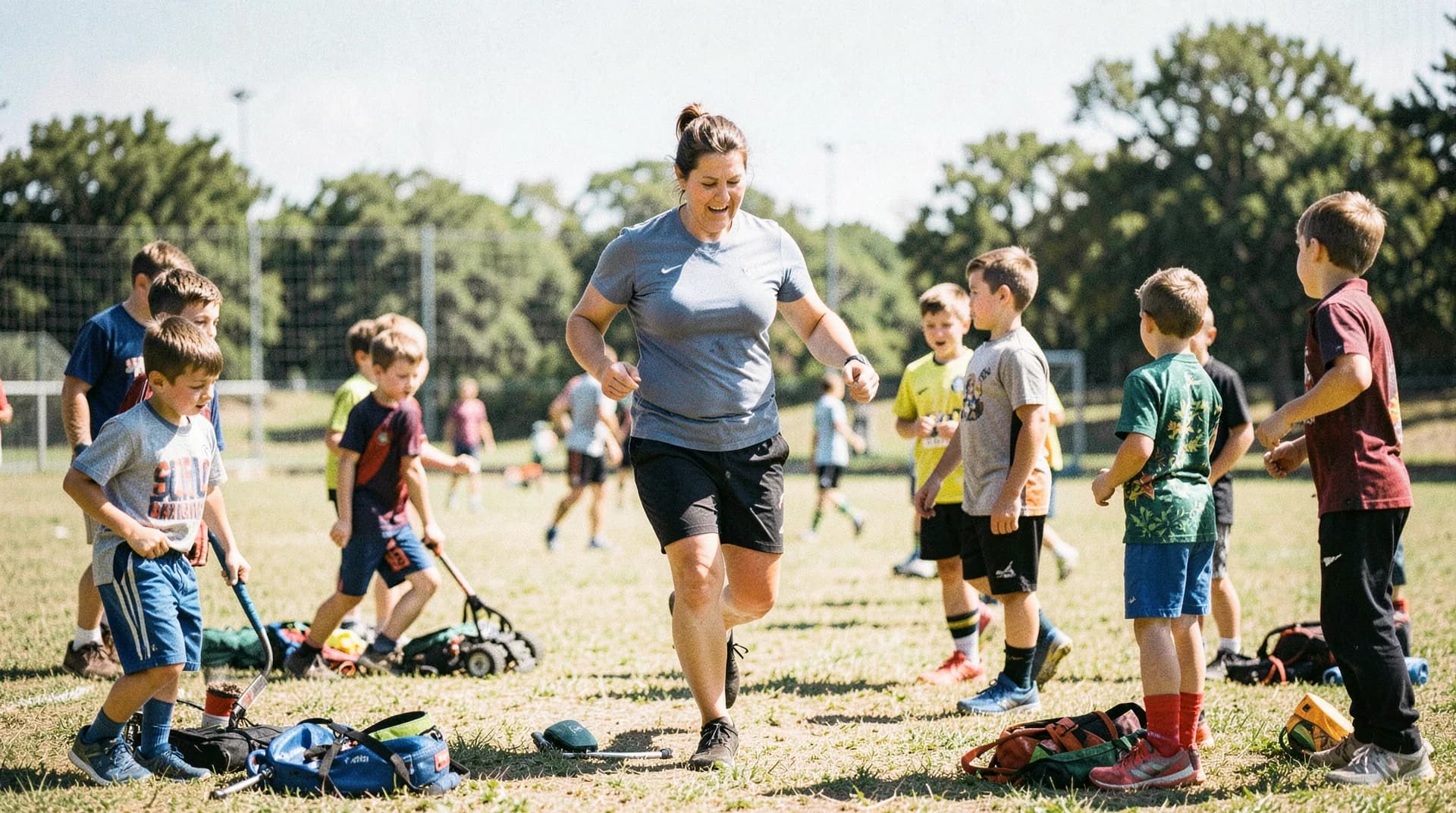
Community Workers in Australia plan, develop and run programs that respond to social, economic and welfare needs at a community level. The work spans government, not-for-profit and faith-based organisations. Day-to-day, a community worker might run a youth engagement program in a regional town, coordinate housing support for newly arrived migrants in Sydney's west, or facilitate community-led responses to drug and alcohol harm in a remote First Nations community.
The sector is funded through a mix of state grants, federal contracts (notably under NDIS, Department of Social Services and Closing the Gap programs) and philanthropic capital. Demand is broad and sustained. Jobs and Skills Australia flags persistent shortages across welfare support work, particularly in regional and remote areas where staff churn is high and qualified workers are hard to attract.
The work is emotionally demanding and the salary band reflects sector funding constraints rather than weak demand. Pay rises through the band as workers move into program coordination, team leadership and policy roles.
ANZSCO 411711 Code Mapping
ANZSCO 411711 covers Community Worker. The official description centres on planning, developing and implementing programs to assist community groups, working with individuals and groups in their community, and acting as a referral point between communities and service providers.
The unit group 4117 Welfare Support Workers contains several adjacent codes:
- 411711 Community Worker — generalist program design and community development
- 411713 Family Support Worker — case-managed family support, often statutory referrals
- 411715 Residential Care Officer — residential group-home care
- 411716 Youth Worker — programs and case work with young people
ACWA assesses each at the 6-digit level. Choose the code that matches the duties in your employment references. A community worker job title in your home country does not automatically map to 411711 — read the ANZSCO description and the related codes via the ANZSCO code finder before lodging.
Skills Assessment — ACWA
Community Work Australia (operating as ACWA) is the assessing authority for ANZSCO 411711 and the rest of unit group 4117.
Qualification requirements:
- AQF Level 5 (Diploma) or higher in a relevant discipline
- Acceptable qualifications include ACWA-accredited courses, professionally accredited courses recognised as equivalent to an AQF Level 7 degree, and diplomas in community services or closely related fields
- Recognition of Prior Learning (RPL) capped at 40% of the qualification — above this cap, the qualification is not recognised
Employment requirements:
- Minimum one year of full-time (or part-time equivalent) paid industry experience in the last 4 years
- Voluntary, internship and unpaid placement hours do not count
Currency of skills:
- Qualification less than 4 years old, or
- At least 3 months of recent full-time (or equivalent) employment in a relevant role at the required skill level
English language requirements:
- Results must be current within 3 years
- For IELTS, multiple test sittings within a 12-month window can be combined
Assessment cost: AUD $965 for the general skills assessment (GST inclusive).
Processing time: 12 weeks for general skills assessment. Add up to 4 weeks during peak periods.
Common rejection reasons: Voluntary work claimed as experience. RPL exceeding 40% of the qualification. Employment references that describe administrative or reception duties rather than community work. Lapsed currency where the applicant has been out of the field for several years.
Visa Pathways for Community Workers
Community Worker sits on the CSOL, so subclass 189 is not available. The viable routes are state-nominated visas and employer sponsorship.
Subclass 190 — Skilled Nominated Visa
Permanent residency through state nomination.
- Visa fee: AUD $6,140 (primary applicant)
- Points boost: +5 from state nomination
- Two-year residency obligation in the nominating state
- Processing: Currently 7-20 months across recent cases
NSW lists unit group 4117 Welfare Support Workers in its 2025-26 skills list, which captures 411711.
Subclass 491 — Skilled Work Regional Visa
Five-year provisional visa with a pathway to permanent residency via subclass 191.
- Visa fee: AUD $6,140
- Points boost: +15 from regional or family-sponsored nomination
- Three-year regional residency and employment requirement for the 191 transition
Victoria's 2025-26 program explicitly prioritises social services and healthcare for 491 nomination, which materially improves the invitation odds for 411711.
Subclass 482 — Skills in Demand Visa
Employer-sponsored temporary visa.
- Visa fee: AUD $3,210 (primary applicant, Core Skills stream)
- Salary threshold: Core Skills stream AUD $76,515 (rising to AUD $79,499 from 1 July 2026)
- Duration: Up to 4 years
- Eligibility note: Many community sector roles pay just below the Core Skills threshold. Senior community workers, program coordinators and NDIS team leaders are the typical 482-eligible roles
The 482 pathway is straightforward for senior roles but the income threshold rules out a significant number of frontline positions.
Subclass 186 — Employer Nomination Scheme
Permanent residency through employer sponsorship.
- Visa fee: AUD $6,140
- Streams: Direct Entry (3 years full-time post-qualification experience) or Temporary Residence Transition (2+ years on 482)
- Processing: Direct Entry stream is currently running at 12-19 months across recent cases
Points Test Strategy
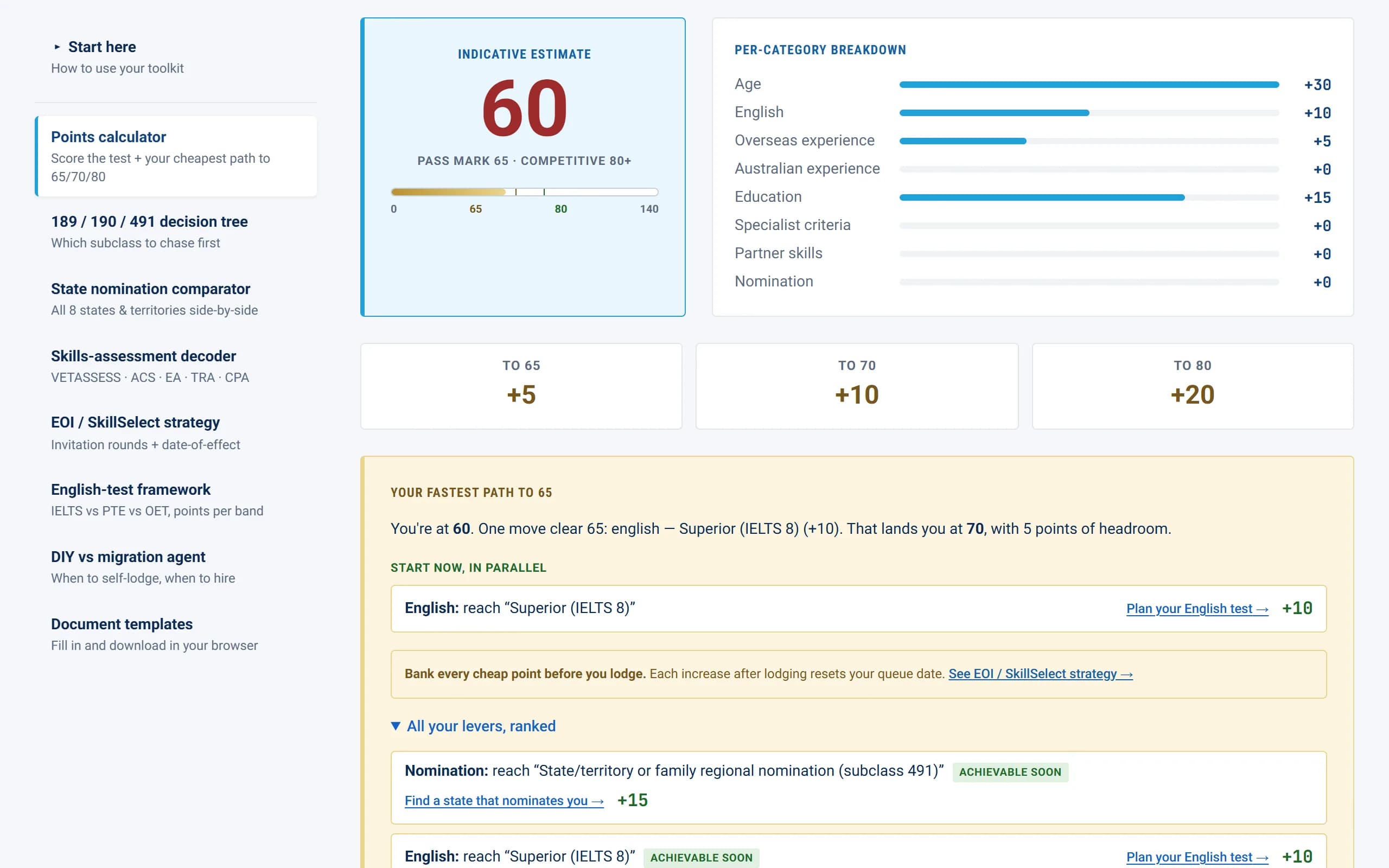
For most community workers, the realistic target is the 190 or 491. Here is how scoring typically plays out:
| Points Factor | Points | Notes |
|---|---|---|
| Age 25-32 | 30 | Maximum bracket |
| Age 33-39 | 25 | Common for mid-career applicants |
| Qualification (Bachelor) | 15 | Most common qualification level |
| Qualification (Master's) | 15 | Social work and community development Masters |
| Qualification (PhD) | 20 | Rare in this occupation |
| English (Superior 8.0) | 20 | Strong differentiator |
| English (Proficient 7.0) | 10 | More common |
| Overseas Experience (5-8 years) | 10 | Maximum 15 |
| State Nomination (190) | 5 | Apply if eligible |
| Regional Nomination (491) | 15 | Strong points boost |
| Partner Skills | 5-10 | If partner has a skilled occupation |
Realistic Score Scenarios
Scenario 1: 31-year-old, Bachelor in Social Work, IELTS 7.0, 6 years overseas experience
Age 30 + Bachelor 15 + English 10 + Experience 10 = 65 points base. Add 491 nomination (+15) = 80 points. Competitive for regional invitation in priority states.
Scenario 2: 36-year-old, Master's in Community Development, IELTS 8.0, 8 years experience
Age 25 + Master's 15 + English 20 + Experience 15 = 75 points base. Add 190 nomination (+5) = 80 points. Strong position for NSW or Victoria 190 invitation.
State Nomination
New South Wales
NSW includes unit group 4117 Welfare Support Workers on its 2025-26 skills list. The Care and Support Economy is one of NSW's named priority sectors, which spans health, aged care, disability and education. Sydney's western and south-western suburbs run major community-services hiring programs through councils and large NGOs like Mission Australia, The Smith Family and Settlement Services International.
Victoria
Victoria has allocated 700 places to the subclass 491 program for 2025-26, with explicit prioritisation of social services. 411711 candidates with regional intent have a stronger position in Victoria than in most states. The state's regional centres — Geelong, Ballarat, Bendigo, Shepparton, Latrobe Valley — have active community services workforces.
South Australia, Tasmania and the Northern Territory
Each of these jurisdictions runs targeted programs that have historically included welfare-support occupations. Eligibility shifts annually. The Northern Territory in particular has chronic shortages in remote community services, often with DAMA (Designated Area Migration Agreement) pathways. Confirm against the current published state list before lodging.
Salary and Employment Outlook
Typical Earnings by Role
| Role | Typical Salary Range |
|---|---|
| Entry Community Worker | AUD $65,000-$75,000 |
| Experienced Community Worker | AUD $75,000-$90,000 |
| Program Coordinator | AUD $90,000-$110,000 |
| Team Leader / Senior Practitioner | AUD $100,000-$120,000 |
| Community Services Manager | AUD $110,000-$140,000+ |
| Policy and Program Officer (Government) | AUD $95,000-$130,000 |
Source: SEEK Salary Guide, Australia, April 2026, cross-referenced with Jobs and Skills Australia occupation profile for 411711. Most positions include 11.5% superannuation. Many community sector roles also offer salary packaging (Section 57A FBT exemption for registered charities), which can add the equivalent of $4,000-$8,000 in take-home value annually.
Highest-paying contexts
- Commonwealth and state government policy and program roles
- Large national NGOs with executive-track programs (Mission Australia, Anglicare, Uniting, The Salvation Army)
- NDIS program coordinator and team-leader positions
- First Nations program coordinators in remote contexts (often with location loading)
- Local government community development officer positions
Tips for a Successful Application
1. Distinguish your duties from social work
Social Worker (272511) is a separately listed AHPRA-equivalent occupation assessed by the AASW (Australian Association of Social Workers), with full MLTSSL access. If your degree is in Social Work and your duties are case work and counselling, AASW may be a stronger pathway than ACWA. Read both descriptions and choose based on duties, not on what scores best.
2. Document paid hours, not just roles
ACWA disqualifies voluntary experience. Many community workers carry strong volunteer track records — ACWA will not count them. Build employment references that quantify weekly paid hours.
3. Watch the RPL ceiling
If your home-country qualification was awarded with more than 40% Recognition of Prior Learning, ACWA will not accept it. Check the transcript carefully. If RPL is over the limit, consider topping up with an Australian-recognised qualification before lodging.
4. Maintain currency before applying
If you have been out of the sector for more than 4 years, ACWA expects 3 months of recent full-time relevant employment to demonstrate currency. Plan the timing of your skills assessment around your current employment status.
5. Target regional 491 for invitation speed
NSW and Victoria 190 invitations are competitive across most occupations. Welfare support workers willing to commit to regional locations have markedly better invitation odds through 491, particularly in Victoria's named priority sectors.
Step-by-Step Migration Roadmap
- Map your duties to ANZSCO 411711 — confirm the work is community development rather than case-managed family support (411713) or youth work (411716)
- Audit your qualification against AQF Diploma minimum and the 40% RPL ceiling
- Compile paid employment evidence with weekly hours and detailed duty statements
- Sit IELTS, PTE Academic or equivalent — Proficient (IELTS 7.0) for points, Competent (IELTS 6.0) for nomination minimum
- Lodge ACWA skills assessment (AUD $965; 12 weeks)
- Calculate points realistically
- Submit EOI in SkillSelect for 190 or 491
- Apply for state or territory nomination when your target program opens
- Receive invitation and lodge the visa application within 60 days
- Alternatively, pursue employer sponsorship (482) with an organisation that meets the Core Skills threshold
- Complete health and character checks
- Move to Australia and start work — pursue ACWA full membership for ongoing professional recognition
The skills assessment hub compares ACWA against other welfare-sector assessing bodies. The most-in-demand occupations guide places community work in the broader care-economy context.
Frequently Asked Questions
Is Community Worker on the MLTSSL or the CSOL in 2026?
ANZSCO 411711 sits on the Core Skills Occupation List (CSOL). Subclass 189 is not available. Eligible subclasses are 190, 491, 482 and 186. See the CSOL hub for context.
What's the difference between Community Worker (411711) and Social Worker (272511)?
Community Worker focuses on program design, community development and group-level interventions. Social Worker is a regulated profession assessed by AASW, focusing on individual case work, counselling and statutory intervention. Social Worker sits on the MLTSSL with full visa access. Community Worker sits on the CSOL with no 189 access.
Can my degree from outside Australia qualify for ACWA assessment?
Yes, if it is assessed as comparable to AQF Diploma or higher and no more than 40% of credit came from RPL. ACWA accepts qualifications in community services, social welfare, community development, human services, and closely related disciplines.
What's the demand outlook for community workers in 2026?
Demand is high and sustained. Jobs and Skills Australia identifies persistent welfare workforce shortages, particularly in regional and remote contexts and within NDIS providers. Federal funding commitments to family violence, mental health, NDIS and Closing the Gap continue to drive hiring.
What are the most common reasons community worker applications fail?
Three issues account for most negative outcomes: counting voluntary or unpaid placement hours as employment; an offshore qualification awarded with more than 40% RPL; and a duty description in references that reads as administrative or reception work rather than community development practice.