Youth Worker Visa Pathway to Australia: Complete 2026 Guide
Updated: 16 August 2026
Australia classifies Youth Worker under ANZSCO 411716. The Australian Community Workers Association (ACWA) conducts the skills assessment. The occupation sits on the Core Skills Occupation List (CSOL), unlocking subclasses 190, 491, 482 and 186. Typical 2026 salaries range AUD $70,000-$90,000. Tasmania and regional Victoria nominate this code more readily than Sydney or Melbourne.
Quick Facts: Youth Worker Migration Pathway
| Detail | Information |
|---|---|
| ANZSCO Code | 411716 (Youth Worker) |
| Skill Level | 2 (Diploma or higher) |
| Skills Assessment | ACWA (Australian Community Workers Association) |
| Occupation List | CSOL and STSOL (state/regional pathways only) |
| Visa Options | 190, 491, 482, 186 |
| Demand Level | Moderate — strong in regional and remote communities |
| Salary Range | AUD $70,000-$90,000 (SEEK, May 2026) |
| Typical 491 Score | 65-75 points (lower in Tasmania) |
| Key Challenge | Diploma-level skill level limits 189 access — state nomination is essential |
What a Youth Worker Does in Australia
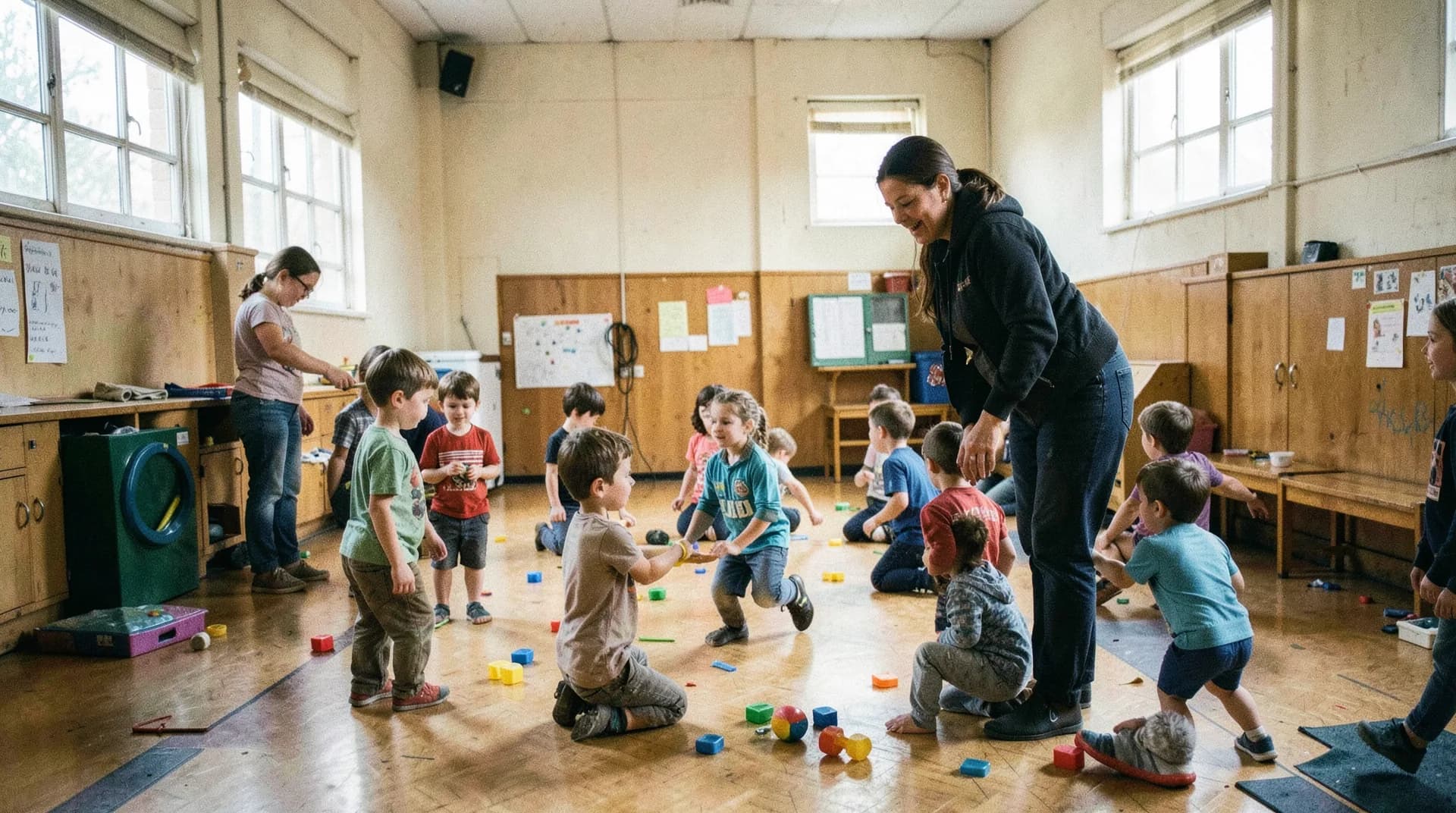
Youth workers support young people aged 12-25 through case management, counselling, advocacy, group programmes and crisis response. The role spans drug and alcohol services, homelessness outreach, juvenile justice, refugee resettlement, school-based wellbeing teams, residential care and Aboriginal community-controlled organisations. Employers include state government departments (Communities NSW, DFFH Victoria), large NGOs (Mission Australia, Anglicare, The Salvation Army, Yfoundations), local councils and Aboriginal Community Controlled Organisations.
Demand is strongest in regional and remote Australia. Tasmania, the Northern Territory, regional Victoria and regional New South Wales have persistent shortages of qualified youth workers, particularly bilingual or culturally specific workers who can engage with refugee, First Nations or CALD young people. Metropolitan markets are more saturated, but specialist roles in youth justice, alcohol and other drugs (AOD) and homelessness still recruit.
The sector is funded primarily by state and federal government grants, which means most positions are award-based. Pay sits under the Social, Community, Home Care and Disability Services Industry (SCHADS) Award, levels 3-5 for most roles, with senior practitioners and team leaders on level 6 or above.
ANZSCO 411716 — Code Mapping
The official ANZSCO description for 411716 covers professionals who provide support, information and assistance to help young people address personal and social development needs. Common tasks include:
- Assessing young people's needs and developing case plans
- Running group programmes (drug education, life skills, employment readiness)
- Advocating with schools, courts, police, housing providers and Centrelink
- Crisis response and short-term counselling
- Linking young people with mental health, AOD and accommodation services
The role is distinct from Welfare Worker (411711), Social Worker (272511) and Counsellor (272199). If your work is primarily clinical counselling or therapy, the Counsellor or Social Worker codes may fit better. If you work with mixed-age client groups rather than specifically 12-25, Welfare Worker (411711) is more accurate.
Skills Assessment — ACWA
The Australian Community Workers Association is the designated assessing authority for Youth Worker (411716). ACWA assesses qualifications, experience and English proficiency against three pathways.
Eligibility pathways (Youth Worker)
- Category A — Relevant diploma (AQF 5) or higher with a specialisation in youth work, plus at least 1 year full-time relevant industry experience in the last 5 years.
- Category B — ACWA-accredited diploma or higher with a specialisation in youth work, no experience required.
- Category C — Community services, social work or human services qualification, plus at least 2 years full-time youth work experience in the last 5 years.
All applicants must also demonstrate English proficiency (typically IELTS 6.0 each band or equivalent, though ACWA may accept other evidence for native English speakers).
Assessment cost: AUD $965 (general skills assessment) Processing time: 12 weeks standard, sometimes extended by up to 4 weeks after holiday periods
Common rejection reasons:
- Qualification not specialised in youth work — generic social science or psychology degrees often fall short of Category A unless paired with explicit youth work units or extensive experience under Category C.
- Employment references that read as generic "support worker" duties rather than youth-specific work with 12-25 year olds. ACWA looks for tasks like case management of young people, group programmes, advocacy with schools or courts, and crisis response.
If your qualification was completed overseas, ACWA will compare it to the Australian Qualifications Framework. Many UK, Irish, Canadian and US social science degrees are recognised at AQF 7 (bachelor) level, but a comparable units assessment is run against the Australian youth work curriculum.
Visa Pathways for Youth Workers
Youth Worker is on the CSOL and STSOL but not on the MLTSSL, which means subclass 189 (Skilled Independent) is not available. State nomination or employer sponsorship is required.
Subclass 491 — Skilled Work Regional (Provisional)
The dominant points-based pathway. Five-year provisional visa with a transition to permanent residency through subclass 191.
- Visa fee: AUD $6,140 (primary applicant, as of 1 July 2025)
- Points boost: +15 from regional nomination
- Processing: 15-28 months at 90th percentile (Home Affairs, April 2026); 6-20 months at median
- Reality: Tasmania has invited 491 applicants at 40 base points in recent rounds — the lowest threshold of any state. Regional NSW, regional Victoria and the NT also nominate Youth Worker.
Subclass 190 — Skilled Nominated
Permanent residency via state nomination. Adds 5 points.
- Visa fee: AUD $6,140
- Eligibility: Occupation must be on the nominating state's list — currently Tasmania, regional South Australia and the ACT are the most consistent nominators for 411716.
- Obligation: Live and work in the nominating state for at least 2 years.
Subclass 482 — Skills in Demand
Employer-sponsored temporary visa. Less common for youth work because award salaries often sit close to or below the Core Skills Income Threshold.
- Visa fee: AUD $4,015 (primary applicant, all streams)
- Core Skills Income Threshold (CSIT): AUD $79,423 from 1 July 2026 (AUD $76,515 until 30 June 2026)
- Processing: Core Skills stream up to 8 months (90th percentile, April 2026)
- Quirk: Senior practitioner and team leader roles in Aboriginal-controlled organisations and youth justice agencies often clear the threshold; entry-level frontline roles usually don't.
Subclass 186 — Employer Nomination Scheme
Permanent residency through employer sponsorship.
- Visa fee: AUD $6,140
- Streams: Direct Entry (requires positive ACWA assessment and 3 years post-qualification experience) or Temporary Residence Transition (after 2 years on a 482).
- Salary threshold: Same CSIT as the 482 from 1 July 2026.
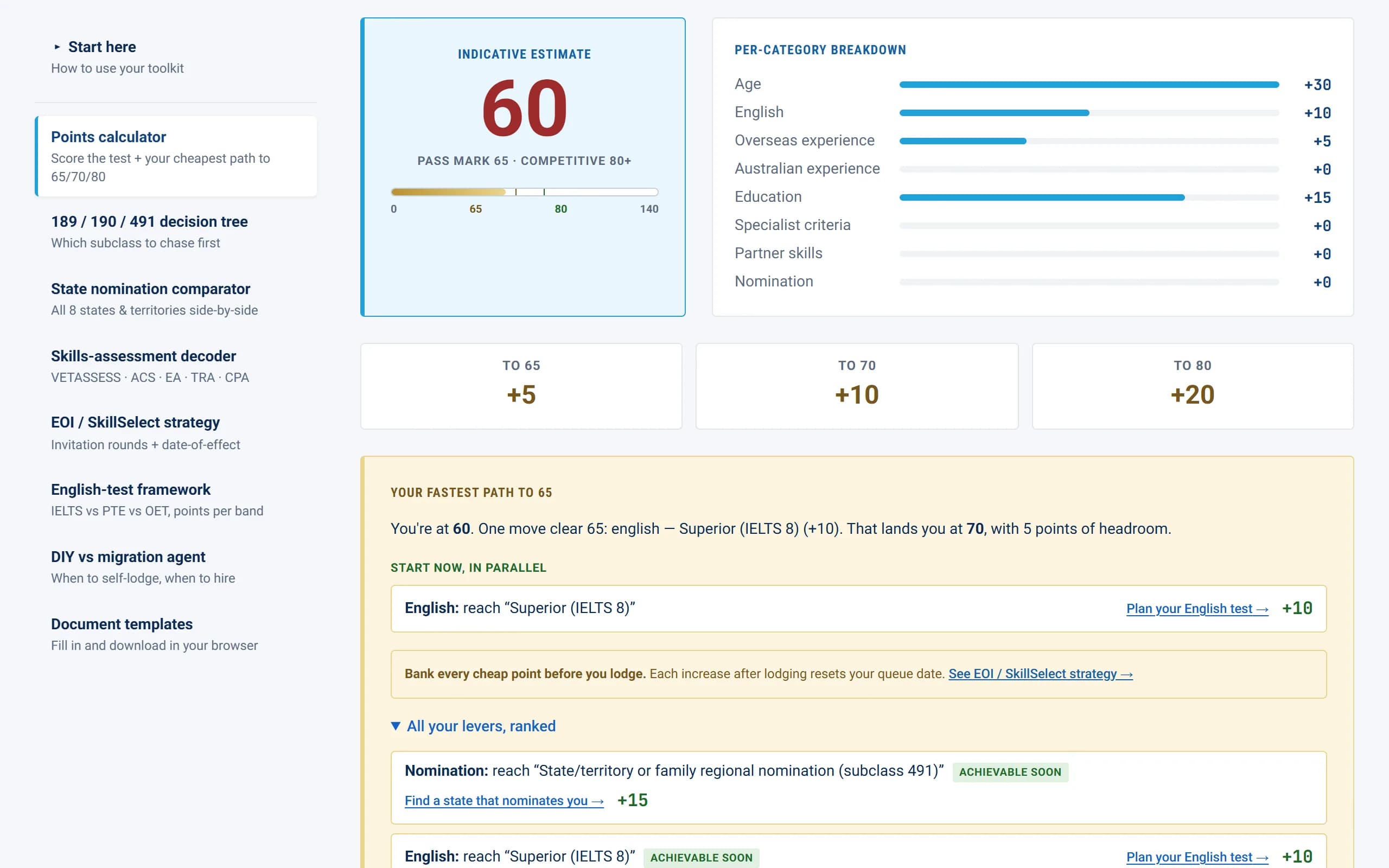
Points Test Strategy
| Points Factor | Points | Notes |
|---|---|---|
| Age (25-32) | 30 | Maximum bracket |
| Age (33-39) | 25 | Common for mid-career youth workers |
| Qualification (Bachelor) | 15 | Skill Level 2 floor is diploma, but degree adds points |
| Qualification (Diploma) | 10 | The most common Youth Worker qualification |
| English (Proficient — 7.0) | 10 | Realistic for most candidates |
| English (Superior — 8.0) | 20 | Significant uplift |
| Skilled employment (3-4 yrs overseas) | 5 | |
| Skilled employment (5-7 yrs overseas) | 10 | |
| State nomination (190) | 5 | |
| Regional nomination (491) | 15 | The standard pathway |
| Partner skills | 5-10 | If partner has skilled occupation |
Scenario 1 — Tasmania 491 applicant, diploma, 28 years old, 4 years' experience, Proficient English
Age 30 + Diploma 10 + English 10 + Experience 5 + 491 nomination 15 = 70 points. Competitive for Tasmania, which has invited at 40-65 points in recent 2026 rounds.
Scenario 2 — Regional Victoria 491 applicant, bachelor, 32 years old, 6 years' experience, Proficient English
Age 30 + Bachelor 15 + English 10 + Experience 10 + 491 nomination 15 = 80 points. Strong score in any state.
State Nomination for Youth Workers
Tasmania
Tasmania consistently nominates Youth Worker under both 190 and 491. The state has acute shortages in youth justice (Ashley Youth Detention Centre transition), out-of-home care and rural communities. Hobart and Launceston employers actively recruit through skilled migration. Tasmania's 491 cut-off has been the lowest in Australia in 2026, often inviting at 40-65 base points.
South Australia
South Australia's regional nomination pathway includes Youth Worker for applicants willing to settle outside metropolitan Adelaide. Regional shortages in the Riverland, Limestone Coast and Eyre Peninsula drive demand. SA also has a "designated area" pathway with relaxed requirements for applicants with confirmed regional job offers.
Regional Victoria
Victoria's 491 stream includes Youth Worker for applicants committed to regional placement. Geelong, Ballarat, Bendigo, Shepparton and Mildura have active youth services sectors. Victoria typically requires a registration of interest (ROI) plus an offer of nomination — direct EOI submission alone does not trigger an invitation.
Northern Territory
The NT has standing demand for youth workers across Darwin, Alice Springs, Katherine and remote Aboriginal communities. The MINT (Migration NT) programme nominates Youth Worker for candidates with relevant experience and a willingness to work in remote settings.
Australian Capital Territory
The ACT's Matrix system awards points for occupation demand, English, experience and Canberra connections. Youth Worker has appeared on the Critical Skills list in past cycles, particularly for candidates with experience in juvenile justice or youth mental health.
Salary and Employment Outlook
| Role | Typical Salary Range |
|---|---|
| Youth Worker (entry, SCHADS L3) | AUD $65,000-$72,000 |
| Youth Worker (experienced, SCHADS L4-5) | AUD $72,000-$85,000 |
| Senior Youth Worker / Team Leader (L6) | AUD $85,000-$100,000 |
| Youth Justice Worker (state government) | AUD $80,000-$110,000 |
| AOD Specialist Youth Worker | AUD $85,000-$105,000 |
| Youth Programme Manager | AUD $100,000-$130,000 |
Source: SEEK Career Advice (May 2026), SCHADS Award rates, state government job ads.
Total package includes superannuation (11.5%), salary packaging (up to $15,899 tax-free per FBT year at most NGOs and Aboriginal-controlled organisations) and shift loadings. NGO salary packaging effectively adds 6-10% to take-home pay and is one of the strongest sector-specific incentives.
Highest-paying employers
- State government departments — DFFH Victoria, Communities NSW, Department for Child Protection SA. Award-plus pay scales.
- Youth justice agencies — Higher pay with shift loadings; intensive role with custodial or court-based clients.
- Aboriginal Community Controlled Organisations — Salary packaging often pushes effective pay above stated base rates.
- Specialist AOD services — Drug and alcohol funding streams pay at the upper end of SCHADS.
- Large national NGOs — Mission Australia, Anglicare, The Salvation Army — consistent but mid-range pay.
Tips for a Successful Application
1. Pick the right qualification pathway with ACWA
If your overseas qualification is generic (general social work, psychology, education), the Category C pathway is usually the right entry point — but you need 2 years of documented youth-specific work. Don't assume a social work degree alone gets you a Category A outcome. Read ACWA's youth worker guidelines carefully before submitting.
2. Write employment references that match ANZSCO 411716
References should describe work specifically with young people aged 12-25, not generic "client" work. Include case management examples, group programmes you ran, schools or courts you advocated with, and crisis incidents you handled. ACWA reads references closely.
3. Target Tasmania or regional Australia first
If your points are under 80, metropolitan 190 nomination is unlikely. Tasmania, regional Victoria, regional SA and the NT have nominated Youth Worker at points scores in the 40-70 range during 2026. A regional commitment dramatically increases your chances.
4. Plan for the 491-to-191 transition
The 491 is provisional. After 3 years of living and working in a regional area with the required minimum income, you become eligible for the subclass 191 permanent visa. Keep clean tax records and stay in your nominated region to preserve the pathway.
5. Consider salary packaging in your job search
Many youth work roles are with NGOs and Aboriginal Community Controlled Organisations that offer salary packaging. A $75,000 base with packaging is roughly equivalent to $82,000 with no packaging. This matters for both lifestyle and 482 salary threshold conversations.
Step-by-Step Migration Roadmap
- Confirm your role matches ANZSCO 411716 using the ANZSCO code finder
- Check current state nomination lists — Tasmania, NT, SA, regional Vic
- Prepare employment references in the ACWA format with youth-specific duties
- Sit your English test — IELTS 7 across all bands for maximum points
- Lodge ACWA skills assessment (AUD $965) and wait 12 weeks
- Submit EOI in SkillSelect once you have the positive assessment
- Register interest with target states (Tasmania ROI, Victoria ROI, MINT NT)
- Receive state nomination — review the skilled occupation list
- Lodge subclass 190 or 491 visa within 60 days
- Complete health checks and police clearances
- Receive visa grant and relocate to the nominated state
- Live and work in regional Australia for the required period (2 years for 190, 3 years for 491-to-191)
Frequently Asked Questions
Why is Youth Worker on the CSOL but not the MLTSSL?
The MLTSSL is reserved for occupations facing long-term national shortage at the professional (Skill Level 1) level. Youth Worker is a Skill Level 2 occupation and shortages are regionally concentrated rather than national. The CSOL covers occupations needed for the broader Australian labour market through state and employer-sponsored pathways, which is where most Youth Worker demand sits.
Can I get permanent residency as a Youth Worker without state nomination?
Not directly through points-tested skilled migration — subclass 189 is closed for Youth Worker because the code isn't on the MLTSSL. Your three realistic routes to PR are: subclass 190 (state-nominated PR), subclass 491 transitioning to 191 after 3 years, or subclass 186 through an employer.
Which state is easiest for Youth Worker nomination in 2026?
Tasmania has been the most accessible state in 2026, with 491 invitations issued at base scores as low as 40 points. The Northern Territory and regional South Australia are also strong. Metropolitan Sydney and Melbourne rarely nominate this code under their 190 streams.
Will my overseas youth work qualification be recognised by ACWA?
ACWA compares your qualification to the Australian Qualifications Framework and the youth work content of accredited Australian programmes. UK, Irish, Canadian and US qualifications with specific youth work units generally fare well under Category A. Generic social science or psychology degrees usually require the Category C pathway with documented experience.
Is employer sponsorship realistic for Youth Workers on a 482?
Yes, but only where the salary clears the Core Skills Income Threshold (AUD $76,515 until 30 June 2026, AUD $79,423 from 1 July 2026). Senior practitioner, team leader, youth justice worker and AOD specialist roles often qualify. Entry-level frontline roles typically do not.