Cybersecurity Professional Visa Pathway to Australia: Complete 2026 Guide
Cybersecurity is one of Australia's fastest-growing and most strategically important sectors. With the Australian Cyber Security Strategy 2023-2030 driving massive government investment, high-profile data breaches raising public awareness, and every industry racing to shore up its defences, qualified cybersecurity professionals are in extraordinary demand. If you're an ICT security specialist considering Australia, you're looking at one of the most favourable migration profiles in the entire skilled occupation system.
Quick Facts: Cybersecurity Migration Pathway
| Detail | Information |
|---|---|
| ANZSCO Code | 262112 (ICT Security Specialist) |
| Skill Level | 1 (Bachelor degree or higher) |
| Skills Assessment | ACS (Australian Computer Society) |
| Occupation List | MLTSSL — full visa access |
| Visa Options | 189, 190, 491, 482, 186, 494 |
| Demand Level | Very high — national priority |
| Typical 189 Score | 80-90 points |
| Salary Range | AUD $100,000-$180,000+ |
Why Cybersecurity Is a National Priority
The Australian Cyber Security Strategy 2023-2030
The federal government has made cybersecurity a top-tier national priority. The Australian Cyber Security Strategy 2023-2030 commits over $2.3 billion in funding and explicitly identifies the cybersecurity skills shortage as a primary barrier to national security. The strategy aims to make Australia a world leader in cybersecurity by 2030 — and it can't get there without importing talent.
High-Profile Breaches Driving Demand
The Optus breach (2022), Medibank attack (2022), and subsequent incidents affecting government agencies, healthcare providers, and financial institutions made cybersecurity front-page news. These breaches didn't just embarrass companies — they triggered regulatory reform, board-level accountability, and a dramatic increase in cybersecurity spending across every sector.
The Skills Gap in Numbers
AustCyber (the Australian Cyber Security Growth Network) has estimated that Australia needs an additional 30,000 cybersecurity workers by 2026 to meet demand. The domestic training pipeline produces only a fraction of that number annually. Universities are expanding cybersecurity programs, but the gap between supply and demand continues to widen.
This isn't just an Australian problem — it's global. But Australia's combination of high demand, competitive salaries, and accessible visa pathways makes it one of the most attractive destinations for cybersecurity professionals worldwide.
Skills Assessment: ACS (Australian Computer Society)
The ACS is the designated assessing authority for ICT occupations in Australia, including cybersecurity.
What ACS Assesses
ACS evaluates whether your qualifications and experience are suitable for the nominated ANZSCO occupation. For ICT Security Specialist (262112), they look at:
- ICT qualifications — your degree or diploma must have a major in ICT or a closely related field
- Work experience — must be closely related to the nominated occupation
- Recency — recent experience is weighted more heavily
ACS Assessment Pathways
1. ICT Major — With Required Experience
If you hold a bachelor's degree or higher with an ICT major, you'll need:
- 2 years of relevant post-qualification experience (if qualification closely related to nominated occupation)
- 4 years of relevant experience (if qualification only has an ICT major but isn't closely related)
2. Non-ICT Qualification — With Additional Experience
If your degree isn't in ICT but you've been working in cybersecurity:
- 6 years of relevant experience (with a non-ICT qualification)
- This pathway recognises that many cybersecurity professionals come from non-traditional educational backgrounds
3. No Formal Qualification
If you don't have a formal degree:
- 6-8 years of relevant experience required
- ACS can recognise extensive professional experience in lieu of formal qualifications
- Industry certifications (CISSP, CISM, CEH, etc.) strengthen your application significantly
Documentation for ACS Assessment
- Certified copies of qualifications (degree certificates, academic transcripts)
- Detailed employment references (statutory declarations or company letterhead references)
- Resume/CV outlining your career history
- Passport and identity documents
Assessment Cost: AUD $550 for a standard skills assessment.
Processing Time: 6-8 weeks for standard processing, with priority processing available.
The Experience Deduction
One important wrinkle: ACS deducts a number of years from your total experience when calculating "skilled employment" for points purposes. This is called the "suitability criteria" deduction. Depending on your qualification and its relevance to your nominated occupation, ACS may deduct 2, 4, or 6 years from your total experience.
This means if you have 8 years of total experience and ACS deducts 4 years, only 4 years count as "skilled employment" for points calculation. Plan your points estimate accordingly.
Industry Certifications — Do They Help?
While ACS doesn't require specific industry certifications, holding recognised credentials strengthens your application and demonstrates specialisation. Key certifications valued in Australia include:
- CISSP (Certified Information Systems Security Professional)
- CISM (Certified Information Security Manager)
- CEH (Certified Ethical Hacker)
- CompTIA Security+
- OSCP (Offensive Security Certified Professional)
- CCSP (Certified Cloud Security Professional)
- CRISC (Certified in Risk and Information Systems Control)
These certifications don't earn points directly in the points test, but they make your ACS assessment stronger and make you more competitive in the job market.
Visa Pathways for Cybersecurity Professionals
Subclass 189 — Skilled Independent Visa
Permanent residency through the points-based system. ICT Security Specialist is on the MLTSSL, giving full access to the 189.
Key Details:
- Visa fee: AUD $6,135
- Minimum points: 65 (realistically 80-90 in 2026)
- Processing: 6-12 months
- Benefit: Live and work anywhere in Australia, no strings attached
Subclass 190 — State Nominated Visa
State nomination adds 5 points and grants permanent residency.
Key Details:
- Visa fee: AUD $6,140
- Points boost: +5 from state nomination
- Obligation: Live in the nominating state for 2 years
- Strong states: NSW, VIC, QLD, ACT
Subclass 491 — Skilled Work Regional Visa
Regional provisional visa with 15 bonus points and a pathway to permanent residency (191).
Key Details:
- Visa fee: AUD $6,140
- Points boost: +15 from regional nomination
- Pathway: 191 permanent visa after 3 years
- Note: Some cybersecurity roles are available in regional centres, especially in government and defence
Subclass 482 — Temporary Skill Shortage Visa
Employer-sponsored temporary visa.
Key Details:
- Visa fee: AUD $3,210 (SID stream)
- Salary threshold: Core stream AUD $76,515 / Specialist stream AUD $141,210
- Duration: Up to 4 years
- Pathway: Transition to 186 permanent visa
- Reality: Most cybersecurity salaries exceed the Specialist stream threshold
Subclass 186 — Employer Nomination Scheme
Permanent residency through employer sponsorship.
Key Details:
- Visa fee: AUD $6,140
- Streams: Direct Entry or Temporary Residence Transition
- Common sponsors: Banks, telcos, government contractors, consulting firms, Big 4
Points Test Strategy for Cybersecurity Professionals
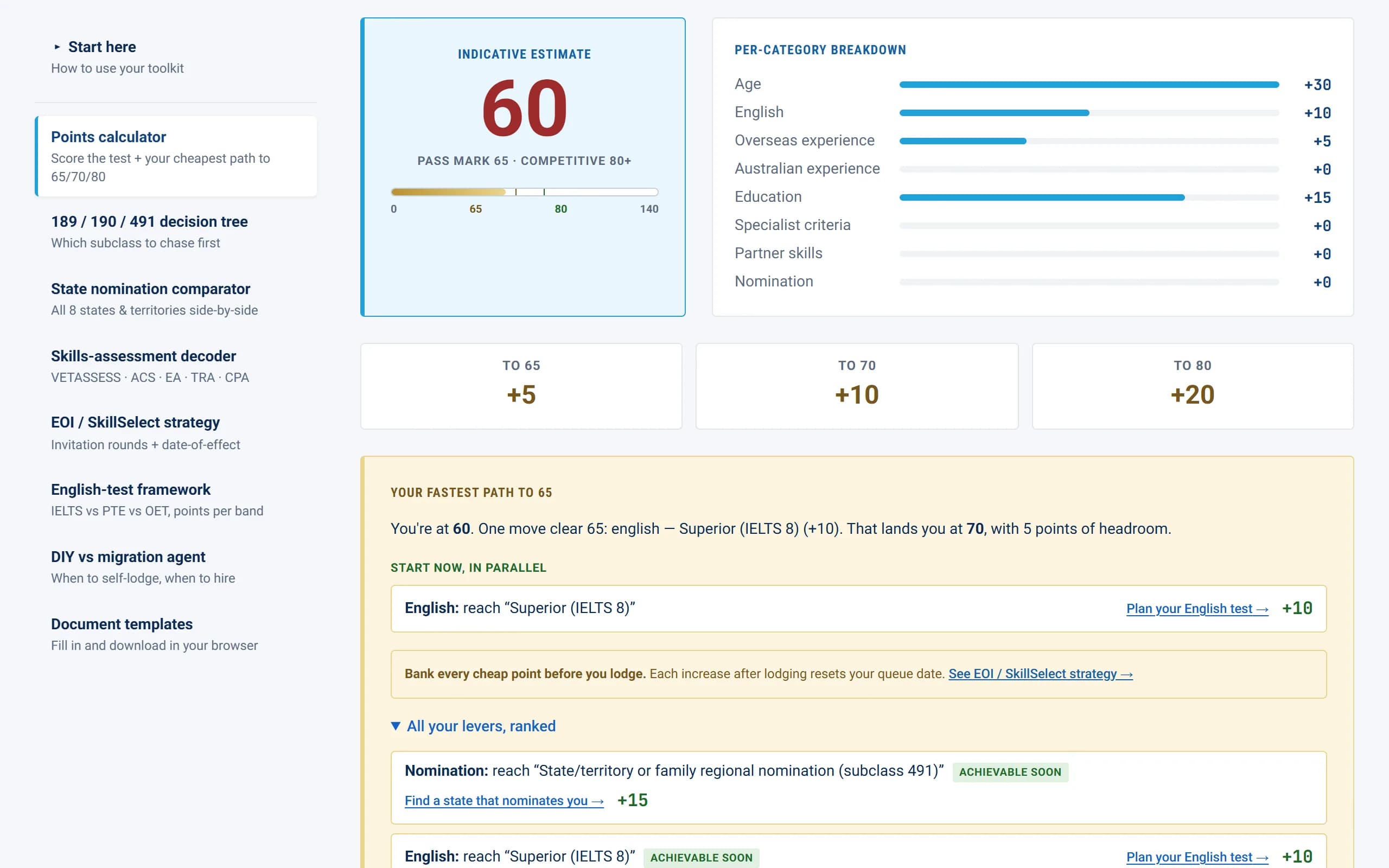
Cybersecurity professionals generally score well on the points test due to high qualifications and English proficiency. But the ACS experience deduction can catch people off guard.
| Points Factor | Points | Notes |
|---|---|---|
| Age (25-32) | 30 | Maximum bracket |
| Qualification (PhD) | 20 | If applicable |
| Qualification (Bachelor's) | 15 | Most common |
| English (Superior — 8.0+) | 20 | Many IT professionals achieve this |
| English (Proficient — 7.0) | 10 | Solid option |
| Overseas Experience (8+ years after deduction) | 15 | Remember the ACS deduction |
| Australian Experience (3+ years) | 10 | If you've worked in Australia |
| State Nomination (190) | 5 | Available in most states |
| Regional (491) | 15 | For regional areas with cyber roles |
| Partner Skills | 5-10 | If partner has skilled occupation |
| NAATI/CCL | 5 | Community language credential |
| Professional Year | 5 | ACS Professional Year program (if completed in Australia) |
Watch Out for the Experience Deduction
Here's a common scenario: You have 10 years of cybersecurity experience and expect 15 points for it. But ACS deducts 4 years (because your degree was ICT-related but not closely related to the specific nomination). Now you have 6 years of "skilled" experience, which earns 10 points instead of 15. That 5-point difference can matter.
Pro Tip: Factor the ACS deduction into your points calculation before you invest in the assessment. If the deduction puts you below competitive levels for a 189, consider the 190 (+5) or 491 (+15) pathways.
State Nomination Opportunities
New South Wales
NSW is the cybersecurity capital of Australia. Sydney houses the headquarters of most major banks, insurance companies, and technology firms. The Australian Signals Directorate (ASD) and the Australian Cyber Security Centre (ACSC) have significant Sydney-based operations. NSW actively nominates ICT Security Specialists and typically has the highest allocation.
Victoria
Melbourne's growing tech sector and financial services industry create strong demand. Victoria's state nomination program consistently includes cybersecurity roles, and Melbourne offers a slightly lower cost of living than Sydney while maintaining a strong job market.
Australian Capital Territory
Canberra is the epicentre of government cybersecurity. Defence, intelligence agencies, government departments, and the contractors that serve them are all based in the ACT. If you're interested in government or defence-related cybersecurity, Canberra is the place. The ACT's nomination program often includes ICT Security Specialists, though allocation numbers can be smaller.
Queensland
Brisbane's tech sector is growing rapidly, and Queensland's state nomination program includes cybersecurity. Government investment in the state's digital infrastructure, plus the growth of Brisbane as a tech hub, is increasing demand.
Salary and Employment Outlook
What Can You Expect to Earn?
| Role | Typical Salary Range |
|---|---|
| Security Analyst (Junior) | AUD $80,000-$100,000 |
| Security Engineer | AUD $110,000-$140,000 |
| Penetration Tester | AUD $100,000-$150,000 |
| Security Architect | AUD $150,000-$180,000 |
| CISO (Chief Information Security Officer) | AUD $200,000-$350,000+ |
| Security Consultant | AUD $120,000-$170,000 |
| GRC (Governance, Risk, Compliance) | AUD $100,000-$140,000 |
| Incident Response Specialist | AUD $110,000-$150,000 |
These are base salary figures. Total packages often include superannuation (11.5%), bonuses, and sometimes equity — particularly in larger tech companies and fintechs.
Highest-Paying Sectors
- Financial services — banks and insurers pay premium rates for cybersecurity talent
- Government / Defence — competitive salaries with strong job security and clearance premiums
- Consulting (Big 4) — Deloitte, PwC, EY, KPMG all have large cybersecurity practices
- Technology — Atlassian, Canva, and other Australian tech companies offer competitive packages
- Mining / Resources — operational technology (OT) security is a growing niche
Contracting vs Permanent
The cybersecurity contracting market in Australia is robust. Contract rates for experienced professionals range from AUD $800-$1,500+ per day, which can translate to annual earnings of $180,000-$350,000. However, contracting doesn't include employer-paid superannuation, leave entitlements, or job security.
For visa holders, permanent employment is usually more straightforward — especially on employer-sponsored visas where your sponsor needs to be your direct employer.
The Australian Cybersecurity Ecosystem
Understanding where cybersecurity fits in Australia helps you target your applications and state nomination choices.
Key Employers
- Big 4 consulting firms — all have large cybersecurity practices
- Major banks — CBA, NAB, ANZ, Westpac, Macquarie
- Telcos — Telstra, Optus (now Singtel-owned)
- Government agencies — ASD, ACSC, Home Affairs, Defence
- Defence primes — BAE Systems, Lockheed Martin, Northrop Grumman
- Tech companies — Atlassian, Canva, REA Group, Xero
- Managed security service providers — CyberCX, Tesserent, Penten
Security Clearances
If you're interested in government or defence cybersecurity, you'll likely need an Australian security clearance (Baseline, NV1, NV2, or PV). Clearances are only available to Australian citizens or permanent residents, so you'll need to be on a pathway to PR before you can access these roles. This makes the 189 or 190 visa particularly valuable for government-focused cybersecurity careers.
Step-by-Step Migration Roadmap
- Confirm your ANZSCO code — ICT Security Specialist 262112, using the ANZSCO code finder
- Gather documentation — qualifications, employment references, certifications
- Sit your English test — IELTS, PTE, or TOEFL, aiming for Superior (8.0+) if possible
- Apply for ACS skills assessment — AUD $550, processing 6-8 weeks
- Factor in the experience deduction — recalculate your points based on ACS suitability criteria
- Calculate your total points — determine your competitive position
- Submit EOI in SkillSelect — target 189, 190, or 491
- Apply for state nomination — if pursuing 190 or 491
- Alternatively, seek employer sponsorship — many companies actively recruit internationally
- Receive invitation and lodge visa — within 60 days of invitation
- Complete health and character checks — medical exam and police clearances
- Receive visa grant — start planning your move to Australia
- Check the occupation demand list for the latest shortage data
Frequently Asked Questions
Is there a specific cybersecurity ANZSCO code?
The closest match is ICT Security Specialist (262112), which covers professionals who plan, implement, and manage cybersecurity controls. This code is used for roles including security analysts, security engineers, penetration testers, and security architects. If your role is more management-focused (like CISO), you might map to ICT Security Specialist or potentially ICT Managers (135111), but 262112 is the standard choice for cybersecurity migration.
Do industry certifications like CISSP count toward the points test?
Not directly — the points test awards points for formal qualifications (degrees), not industry certifications. However, certifications strengthen your ACS assessment, make you more competitive for employer sponsorship, and significantly boost your job prospects in Australia. If you don't already hold CISSP or CISM, they're worth pursuing before your move.
How competitive is the 189 visa for cybersecurity professionals?
Competitive but achievable. In 2026, most successful 189 applicants in ICT occupations score 80-90 points. If your score is below 80, the 190 (+5 points) or employer sponsorship (482/186) are practical alternatives. The demand for cybersecurity is so high that employer sponsorship is relatively easy to arrange if you have strong credentials.
Can I work remotely for an overseas company while on an Australian visa?
Technically yes, but there are complications. Your visa conditions allow you to work in Australia, and working remotely for an overseas employer while physically in Australia is generally permitted. However, tax implications are significant — you'll be taxed as an Australian resident on worldwide income. If you're on an employer-sponsored visa (482), you must work for your sponsoring employer, not a remote overseas company.
What's the outlook for cybersecurity migration beyond 2026?
Extremely positive. Cybersecurity demand is structural, not cyclical. As digital transformation continues, regulatory requirements increase, and threat actors become more sophisticated, the need for cybersecurity professionals will only grow. The Australian government has committed to making the country a "cyber-resilient" nation by 2030, and skilled migration is explicitly part of that plan. This isn't a field where demand is going to disappear.