Taxation Accountant Visa Pathway to Australia: Complete 2026 Guide
Updated: 16 August 2026
Australia classifies Taxation Accountants under ANZSCO 221113. Skills assessments are conducted by CAANZ, CPA Australia, or IPA. The occupation appears on both the MLTSSL and the Core Skills Occupation List (CSOL), unlocking subclasses 189, 190, 491, 482, and 186. Typical 2026 salaries range AUD $80,000-$140,000. CA ANZ has identified Taxation Accountant as the accounting occupation at highest national shortage risk.
Quick Facts: Taxation Accountant Migration Pathway
| Detail | Information |
|---|---|
| ANZSCO Code | 221113 (Taxation Accountant) |
| Skill Level | 1 (Bachelor degree or higher in Accounting; English at IELTS 7.0/7.0 minimum) |
| Skills Assessment | CAANZ, CPA Australia, or IPA (any one of the three) |
| Occupation List | MLTSSL and CSOL |
| Visa Options | 189, 190, 491, 482, 186 |
| Demand Level | High — CA ANZ identifies Taxation Accountant as the accounting occupation at highest risk of national shortage, with vacancy fill rates around 59% |
| Salary Range | AUD $80,000-$140,000 (SEEK 2026, Indeed 2026, PayScale 2026) |
| Typical 189 Score | 85-95 points (competitive but less severe than ICT Business Analyst rounds) |
| Key Challenge | The competency mapping — many offshore accounting degrees do not cover all nine required competency areas, triggering a CA Program top-up |
What a Taxation Accountant Does in Australia
Taxation Accountants prepare returns and advise on tax matters for individuals, partnerships, trusts, companies, and superannuation funds, and represent clients in disputes with the Australian Taxation Office. The work splits between compliance — return preparation and lodgement — and advisory — structuring, transactions, ATO rulings, and disputes. Senior taxation accountants frequently lead engagement teams and partner with lawyers on complex matters.
The Australian tax system is unusually complex by international standards: the federal Income Tax Assessment Acts, GST regime, FBT, capital gains tax, transfer pricing, R&D incentive, and a maze of state-based stamp duty and payroll tax regimes all require specialist attention. This complexity drives demand. Most Taxation Accountants work in public practice (Big 4, mid-tier firms like BDO, RSM, Grant Thornton, William Buck, and independents), with smaller cohorts in corporate tax functions, the ATO, and academia.
Sydney and Melbourne dominate the senior end of the market; Brisbane, Perth, and Adelaide carry strong regional accountancy hubs. Regional centres also hire continuously — rural and farming clients need tax advisors, and the SMSF sector is concentrated in regional offices.
CA ANZ's 2024 member survey identified Taxation Accountants as the occupation at highest national shortage risk, accounting for approximately 29% of accounting advertised roles with a 59% vacancy fill rate. The federal government added taxation accountants to the Occupation Shortage List, accelerating migration approvals.
ANZSCO Code 221113
The ANZSCO description for Taxation Accountant covers analysing, reporting, and providing advice on taxation issues to organisations and individuals, preparing taxation returns and reports, and handling disputes with taxation authorities. Typical tasks include analysing taxable income; preparing income tax returns; advising on capital gains tax, GST, FBT, and superannuation tax; representing clients before the ATO; and assisting with tax planning, structuring, and compliance.
Adjacent codes within unit group 2211 are 221111 Accountant (General) and 221112 Management Accountant. The general code is broader and accepts a wider range of duties; the management code is for internal management reporting and budgeting. Candidates whose work focuses on tax compliance, advisory, and ATO representation belong under 221113. The choice matters because state nomination invitation rates differ between the three codes — some states open more rounds for 221111 than for 221113.
Skills Assessment
Taxation Accountant has three possible assessing bodies. Choose one — the application cannot run in parallel.
CA ANZ (Chartered Accountants Australia and New Zealand)
Requirements:
- A degree assessed as equivalent to at least an Australian Bachelor degree (AQF level 7 or higher) covering nine required competency areas: Accounting Systems and Processes, Financial Accounting and Reporting, Management Accounting, Finance and Financial Management, Audit and Assurance, Business Law, Economics, Quantitative Methods, and Taxation Law.
- English: IELTS Academic 7.0 overall with 7.0 in each component, within the last three years (or equivalent PTE/TOEFL/CAE/OET scores). Exemptions apply for citizens of UK, Ireland, USA, Canada, NZ, or South Africa with a degree completed entirely in English in those countries.
Processing time. Standard processing typically completes within 10 business days. The "Fast Track" route returns a result within 10 business days from confirmation for a higher fee.
Cost. Confirm the current fee schedule on the CA ANZ Migration Assessment page before lodging — fees were scheduled to rise approximately 2% from 1 July 2026.
Common rejection reasons. Missing competency areas — many offshore commerce or business degrees omit Audit, Business Law, or Quantitative Methods, requiring a top-up via the CA Foundations programme. The other recurring issue is the English requirement: 7.0 in each component is genuinely harder than the test-design publicity suggests, particularly for the Writing band.
CPA Australia
CPA Australia uses the same nine competency areas and the same IELTS 7.0/7.0 minimum. Some offshore qualifications map more cleanly to the CPA framework than to CA ANZ — agents often recommend CPA where a candidate's degree was completed in India, Philippines, Pakistan, Bangladesh, or Sri Lanka.
IPA (Institute of Public Accountants)
IPA conducts a Migration Skills Assessment for the same accounting occupations and is the most lenient of the three for candidates with non-accredited or older qualifications. The IPA pathway typically pairs with the IPA Program (a six-subject postgraduate-level course) where the degree lacks one or two competencies.
The choice between bodies is rarely about price — fees are broadly similar — and more about which body maps an applicant's exact qualification cleanest.
Visa Pathways
Subclass 189 — Skilled Independent
Permanent residency through SkillSelect. Available because 221113 is on the MLTSSL. The dominant pathway for offshore taxation accountants with strong points.
- Visa fee: AUD $6,135 primary applicant (Home Affairs, indexed July 2025)
- Realistic points: 90-95 for invitation in 2026 rounds — accounting is competitive
- Processing time: 8-14 months on the published global processing-times page
- Quirk: the inclusion of Taxation Accountant on the Occupation Shortage List has driven invitation rounds at lower scores than the broader Accountant (General) code in some 2026 rounds
Subclass 190 — Skilled Nominated
State nomination adds 5 points. SA is the most consistent nominator for accounting occupations; NSW and Victoria run smaller rounds.
- Visa fee: AUD $6,140 primary applicant
- Obligation: two-year commitment to live and work in the nominating state
- Quirk: NSW typically requires applicants to have been employed in NSW for at least 12 months in the nominated occupation before applying
Subclass 491 — Skilled Work Regional (Provisional)
Adds 15 points. Tasmania, regional NSW, regional Victoria, regional SA, and regional Queensland all nominate Taxation Accountants in 491 rounds.
- Visa fee: AUD $6,140 primary applicant
- Quirk: the 491 is a strong route for taxation accountants because public-practice firms in regional Australia struggle to fill senior compliance roles
Subclass 482 — Skills in Demand
Employer-sponsored temporary visa. Used by Big 4 firms, mid-tier firms, and some larger corporates to hire offshore.
- Visa fee: AUD $3,210 primary applicant
- Sponsor requirements: approved sponsor, labour market testing, salary at or above the TSMIT
- Processing time: typically 1-3 months for standard processing, faster for accredited sponsors
Subclass 186 — Employer Nomination Scheme
Permanent residency via employer sponsorship.
- Visa fee: AUD $6,140 primary applicant
- Quirk: the 186 Direct Entry stream requires a positive skills assessment and three years of relevant experience; many Big 4 senior managers and partners arrive this way
Points Test Strategy
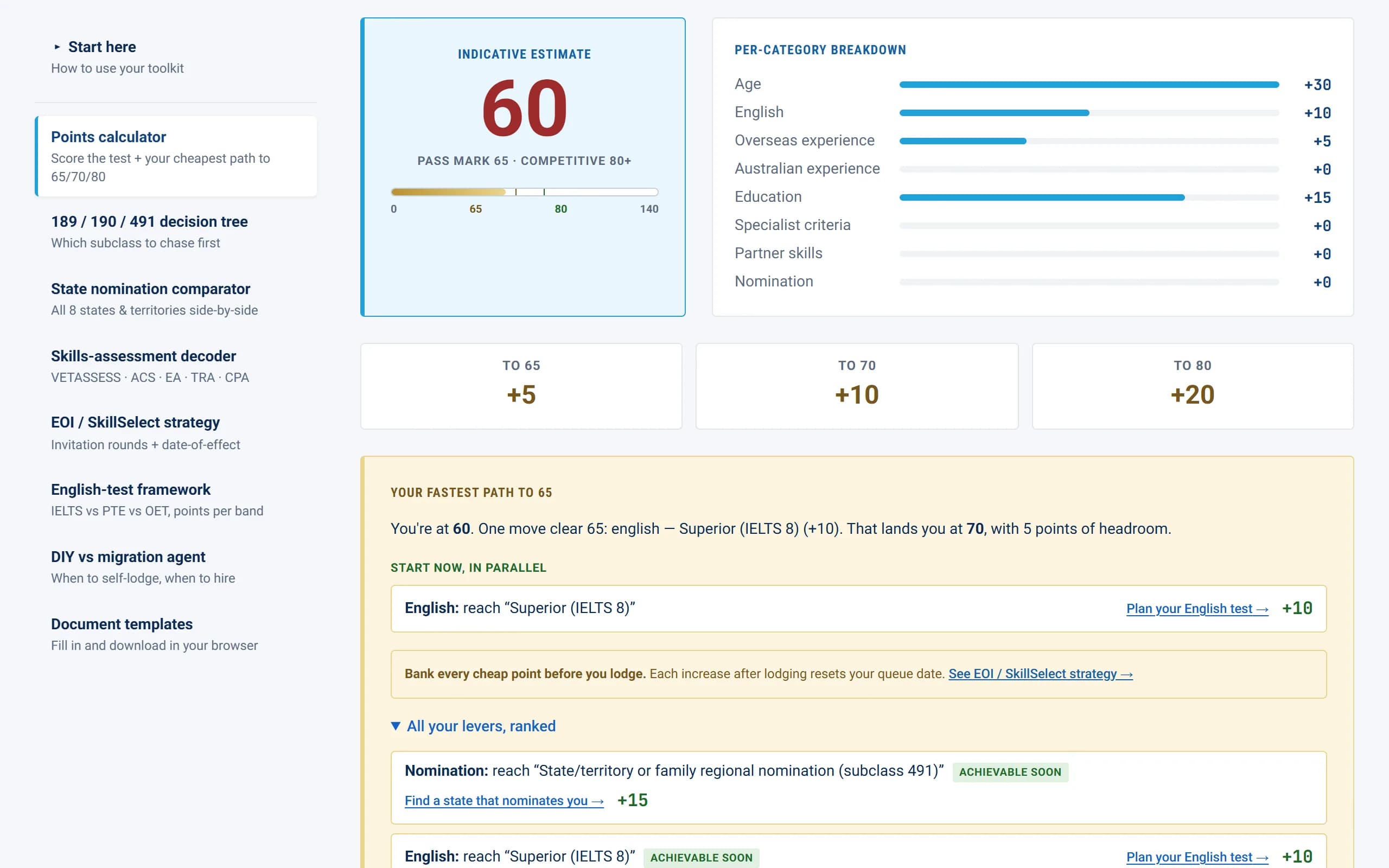
| Points Factor | Points | Notes |
|---|---|---|
| Age (25-32) | 30 | Maximum |
| Age (33-39) | 25 | Common for mid-career CAs |
| English (Superior 8.0+) | 20 | Decisive for invitation |
| English (Proficient 7.0) | 10 | Minimum for skills assessment, modest points |
| Master's | 15 | Common via top-up programmes |
| Bachelor | 15 | Standard |
| Overseas experience (5-7 yrs) | 10 | Most candidates |
| Overseas experience (8+ yrs) | 15 | Senior CAs |
| Australian experience (1 yr) | 5 | If completed locally |
| State Nomination (190) | 5 | |
| Regional (491) | 15 | Strong leverage |
| Partner skills | 5-10 | |
| Professional Year (Accounting) | 5 | Available for Australian graduates |
| NAATI / Community Language | 5 |
Scenario 1: 30-year-old Indian CA, Big 4 senior associate
Bachelor of Commerce, Indian CA qualification, 6 years at Deloitte India, IELTS 7.0 each band. Age 30 + Bachelor 15 + English 10 + Experience 10 = 65 points. Add 491 SA = 80 points. Competitive with Superior English (90 points).
Scenario 2: 34-year-old Pakistani ACCA, Big 4 manager
ACCA plus Master's in Taxation, 9 years at PwC and Grant Thornton, IELTS 8.0 each band. Age 25 + Master's 15 + English 20 + Experience 15 = 75 points. Add 190 SA = 80; add 491 = 90. Invitation-grade.
State Nomination for Taxation Accountants
South Australia
The most consistent state for accounting occupations. SA nominates 221111, 221112, and 221113 across both 190 and 491 streams and runs regular invitation rounds. The state's offshore Skilled Visitor pathway has historically been the most accessible route for candidates without Australian employment.
New South Wales
NSW includes Taxation Accountant on its 190 priority list but typically requires applicants to demonstrate 12 months of NSW employment in the nominated occupation. The 491 stream for regional NSW invites with a confirmed job offer in a regional postcode — Wollongong, Newcastle, the Central West, and the Northern Rivers all have hiring activity. Quotas for accounting occupations fill quickly each round.
Victoria
Victoria nominates Taxation Accountants where the applicant can demonstrate genuine commitment to the state. Regional Victoria (Geelong, Ballarat, Bendigo, Shepparton) is the strongest sub-market for 491.
Queensland
Queensland's 'Working in Queensland' stream requires 6 months of full-time Queensland employment in the nominated occupation plus ongoing employment for a further 12 months. Brisbane, Sunshine Coast, and Gold Coast public-practice firms hire continuously. The state treats accounting occupations as non-priority in some rounds, which can mean longer waits for offshore candidates.
Tasmania
Tasmania nominates Taxation Accountant under 491 with a relatively low competition profile. The state's nomination program prioritises applicants with a job offer or a Tasmanian degree.
Western Australia
WA lists 221113 with focus on Perth-based firms and the resources-services consultancies. Migration WA opens accounting occupations periodically rather than continuously.
Salary and Employment Outlook
| Role | Typical Salary Range (AUD, 2026) |
|---|---|
| Graduate / Junior (0-2 yrs) | $65,000-$85,000 |
| Tax Accountant (3-5 yrs) | $85,000-$110,000 |
| Senior Tax Accountant | $105,000-$140,000 |
| Tax Manager | $130,000-$180,000 |
| Senior Tax Manager / Director | $175,000-$260,000+ |
| Tax Partner | $300,000-$700,000+ |
Sources: SEEK 2026, Indeed 2026, PayScale 2026. SEEK 2026 data on disclosed advertised salaries shows the typical range around AUD $80,000-$100,000 for full-time roles, with regional NSW offices (Dubbo, Albury) frequently advertising above metropolitan rates because of acute shortages. Indeed reports an average around AUD $80,335 across all experience levels. PayScale reports approximately AUD $67,000 for entry-level tax accountants, which reflects the heavy weighting toward graduate roles in their dataset.
Total packages add 11.5% superannuation. Big 4 and mid-tier firms in Sydney and Melbourne add bonuses (10-25% at manager level, higher at director and partner), and partners share in firm profits.
Highest-paying segments:
- Big 4 tax practice (transfer pricing, M&A tax, international tax)
- Specialist boutiques (top-tier independents servicing high-net-worth and family office clients)
- In-house corporate tax (resources majors, banks, telcos)
- Mid-tier firms with private-client and SMSF practices
- ATO senior technical roles (with permanent residency)
Tips for a Successful Application
- Audit your transcripts against the nine competency areas before paying for an assessment. The most common rejection is missing Audit, Business Law, or Quantitative Methods. Bridge programmes are available (CA Foundations, CPA Foundations, IPA Program), but they take 6-12 months — better to confirm the gap before lodging.
- Sit IELTS or PTE early and aim for Superior, not Proficient. The skills-assessment minimum is 7.0 per band (Proficient = 10 points). Pushing each band to 8.0 (Superior = 20 points) is decisive in a competitive accounting EOI pool. Most candidates underestimate the Writing band and need two attempts.
- Consider CPA Australia over CA ANZ if your degree is from India, Pakistan, the Philippines, Bangladesh, or Sri Lanka. CPA's competency mapping is often slightly more generous for these qualifications. Verify with a registered migration agent before committing.
- Target SA or regional 491 for the cleanest invitation odds. SA's 491 stream for offshore taxation accountants has been the most consistent route to PR in 2024-2026. The 15 regional points usually push competitive applicants over the line.
- Get one year of Australian experience if possible. A 12-month role in NSW or another state unlocks the 190 stream in that state and adds 5 experience points. Many candidates use a Working Holiday or 485 graduate visa to bridge into a public-practice role before applying for the permanent visa.
Step-by-Step Migration Roadmap
- Confirm duties match the ANZSCO 221113 description over 221111 General Accountant — see the ANZSCO code finder.
- Verify 221113 on the Skilled Occupation List 2026 and the CSOL.
- Audit your transcript against the nine competency areas.
- Choose between CAANZ, CPA Australia, and IPA — see the Skills Assessment Bodies Complete List.
- Sit IELTS Academic or PTE Academic. Target Superior English.
- Complete any required bridging programme (CA Foundations, CPA Foundations, or IPA Program) if competencies are missing.
- Lodge the skills assessment with the chosen body.
- Submit a SkillSelect EOI for 189/190/491.
- Apply for state nomination if pursuing 190 or 491 — SA is the most consistent option for offshore candidates.
- If pursuing 482/186, secure an offer from an approved sponsor.
- Receive invitation and lodge the visa within 60 days.
- Complete health and character checks; receive grant. After arrival, consider applying for CA ANZ or CPA Australia full membership if not already a member.
Frequently Asked Questions
Should I nominate Taxation Accountant (221113) or Accountant General (221111)?
Nominate the code that matches the majority of your duties over the last five years. Pure compliance-focused candidates (return preparation, ATO correspondence, FBT returns, BAS) belong under 221113. Candidates with a broader scope — financial reporting, audit support, general advisory — often fit 221111 better. The state nomination dynamics differ between the two codes, so check the current state lists before deciding. Misalignment between nominated code and reference letters is a common rejection cause.
Is CA ANZ stricter than CPA Australia for offshore qualifications?
In practice, CA ANZ's competency-mapping process is slightly more conservative for certain offshore qualifications, while CPA Australia's framework maps more cleanly to South Asian and Southeast Asian commerce degrees. Neither is universally easier — the right body depends on the specific degree. Most registered migration agents will run a free preliminary check before committing to one assessor.
Is the 482 sponsorship easier than the 189 for taxation accountants?
Often, yes, for senior candidates with a firm offer. The 482 typically processes within 1-3 months for accredited sponsors and avoids the points competition. The 189 sits in the 8-14 month band and requires 85-95 points to clear most 2026 invitation rounds. Big 4 firms routinely sponsor offshore senior associates and managers on the 482, then transition them to a permanent 186 after two years.
What's the demand outlook for Taxation Accountants in 2026?
Strong. CA ANZ identified Taxation Accountant as the accounting occupation at highest national shortage risk, with vacancy fill rates around 59%. The federal Occupation Shortage List includes the role. Demand is driven by ATO compliance pressure, an ageing professional cohort, the SMSF sector's growth, and complexity in the BAS, FBT, and international tax regimes. See the most in-demand occupations page.
Do I need to be a member of an Australian accounting body to work as a Taxation Accountant?
You do not need full membership to start work in public practice or industry. However, providing tax advice for a fee to the public requires registration with the Tax Practitioners Board (TPB), and TPB recognition typically requires CA ANZ, CPA Australia, or IPA membership plus Australian taxation law study. Pathway most candidates follow: enter Australia on the skilled visa, complete the membership requirements, then register with the TPB to sign off on tax returns.