Biochemist Visa Pathway to Australia: Complete 2026 Guide
Updated: 16 August 2026
Australia classifies Biochemist under ANZSCO 234513. VETASSESS conducts the skills assessment under Group A. The occupation is on the MLTSSL and the Core Skills Occupation List, unlocking subclasses 189, 190, 491, 482, and 186. Typical 2026 salaries range AUD $90,000-$170,000. With no state nomination for 234513 in 2025-26, employer sponsorship is the working pathway for most applicants.
Quick Facts: Biochemist Migration Pathway
| Detail | Information |
|---|---|
| ANZSCO Code | 234513 (Biochemist) |
| Skill Level | 1 (Bachelor degree or higher) |
| Skills Assessment | VETASSESS — Group A |
| Occupation List | MLTSSL and CSOL |
| Visa Options | 189, 190, 491, 482, 186 |
| Demand Level | Moderate — OSL 2025 records "No Shortage" nationally; biotech and medical research clusters drive sector-specific demand |
| Salary Range | AUD $90,000-$170,000 (SEEK and Glassdoor, May 2026) |
| Typical 189 Score | 85+ points for invitation given the small annual ceiling |
| Key Challenge | No 190 state nomination for 234513 in 2025-26 — sponsorship is the primary route |
What a Biochemist Does in Australia
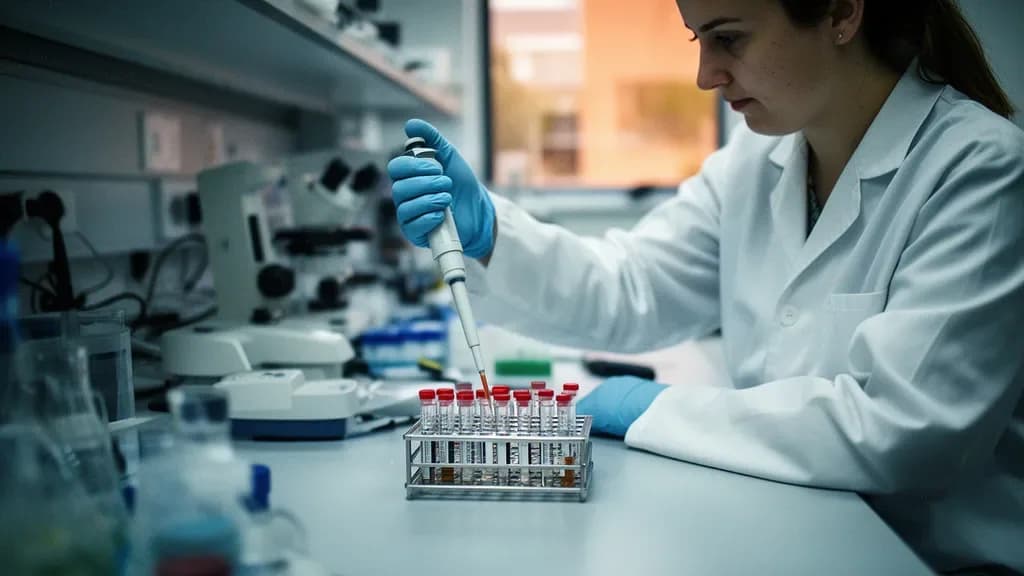
Biochemists study the chemical composition of living systems — proteins, nucleic acids, metabolites, and the reactions that produce, modify, and degrade them. Day-to-day work spans protein purification and characterisation, enzyme kinetics, structural biology (crystallography, cryo-EM, NMR), metabolomics, and increasingly mass-spectrometry-driven proteomics. Senior biochemists lead research groups, design experimental programs, and translate findings into publications, patents, or regulatory submissions.
Demand is concentrated around three employer clusters. Medical research institutes — the Walter and Eliza Hall Institute, Garvan Institute, Victor Chang, QIMR Berghofer, the Centenary Institute — recruit biochemists into disease-mechanism and translational research groups. Industry biotech (CSL Behring, Mesoblast, Vaxxas, Bionomics) employs biochemists in product development, analytical chemistry, and regulatory science. Universities across the Group of Eight maintain large biochemistry and molecular biology departments, with CSIRO Health and Biosecurity providing the largest single-institution employer in the public research sector.
ANZSCO 234513 — Code Mapping
234513 sits within the 2345 Life Scientists unit group. The code is appropriate for professionals whose work is primarily molecular and chemical in nature. Adjacent codes that may fit better for some applicants:
- 234517 Microbiologist — if your work centres on bacteria, viruses, or fungi
- 234514 Biotechnologist — if you work in applied product development rather than fundamental biochemistry
- 234511 Life Scientist (General) — if your work spans biochemistry plus other specialties
- 234599 Life Scientists nec — residual code for unusual specialty combinations
VETASSESS expects 234513 applicants to hold a biochemistry, molecular biology, or closely related qualification (chemistry, biotechnology with biochemistry major). Pure microbiology or pure cell biology degrees may struggle without postgraduate biochemistry specialisation.
Skills Assessment — VETASSESS Group A
Biochemist is assessed by VETASSESS under Group A criteria. Both qualification and employment must be satisfactory.
Qualification requirements:
- Australian Bachelor degree or higher equivalent
- Highly relevant field of study — Biochemistry, Molecular Biology, Chemistry (with biological focus), or Biotechnology with strong biochemistry content
Employment requirements:
- At least one year of post-qualification employment in the last five years
- Minimum 20 hours per week
- Duties highly relevant to the nominated occupation
Assessment cost:
- Offshore applicants: AUD $1,096
- Onshore applicants (incl. GST): AUD $1,205.60
- Priority processing surcharge: AUD $825 / AUD $907.50
Processing time: 12-14 weeks standard. Priority processing aims for 10 business days.
Common rejection reasons: Employment references describing technician-level duties (running protocols written by others) rather than scientist-level duties (designing experiments, interpreting results, supervising others); applicants from clinical biochemistry roles where the work is laboratory medicine rather than research; postgraduate qualifications in tangential fields creating ambiguity about field-of-study relevance.
Visa Pathways for Biochemists
Subclass 482 — Skills in Demand Visa
Employer sponsorship is the dominant pathway in 2026 given the absence of state nomination. Medical research institutes, universities, and biotech companies are experienced 482 sponsors.
- Visa fee: AUD $4,015 (Core Skills stream, primary applicant)
- Salary threshold: Core Skills Income Threshold applies; Specialist Skills stream above AUD $146,576
- Duration: Up to 4 years
- Reality: Senior biochemist roles in industry biotech typically clear the Specialist Skills threshold
Subclass 186 — Employer Nomination Scheme
Permanent residency through Direct Entry or TRT after two years on a 482.
- Visa fee: AUD $6,140
- Streams: Direct Entry or TRT
- Reality: Most institutional sponsors prefer the TRT pathway after a 482 probationary period
Subclass 189 — Skilled Independent Visa
Open in principle but capacity-constrained in 2026. The annual invitation ceiling for life sciences occupations is small.
- Visa fee: AUD $6,135
- Processing time: 3-12 months when invitations issue
- Realistic points target: 85-90 to be competitive
Subclass 491 — Skilled Work Regional Visa
Available via family sponsorship or regional employer sponsorship, since no state currently nominates 234513.
- Visa fee: AUD $6,140
- Points boost: +15 from regional nomination
- Pathway: 5-year provisional visa converting to 191 PR after 3 years
Subclass 190 — State Nominated Visa
234513 Biochemist is not on any state's 2025-26 skilled occupation list for 190 nomination.
- Visa fee: AUD $6,140 (if a state opens a pathway during the year)
Points Test Strategy
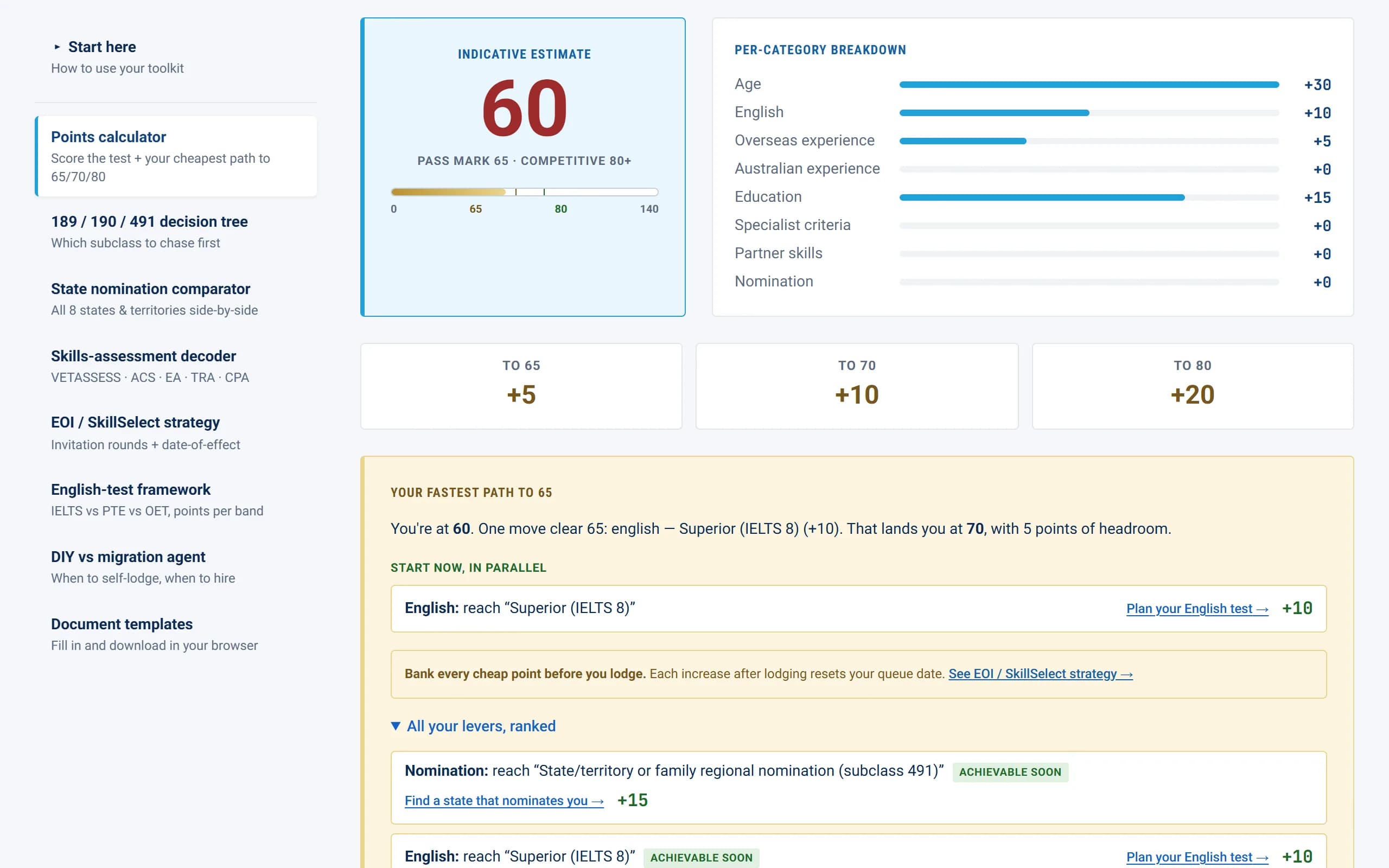
| Points Factor | Points | Notes |
|---|---|---|
| Age (25-32) | 30 | Maximum bracket |
| Age (33-39) | 25 | Strong but not max |
| Qualification (PhD) | 20 | Most senior biochemists |
| Qualification (Master's) | 15 | Standard for industry roles |
| Qualification (Bachelor's) | 15 | Skill Level 1 minimum |
| English (Superior — 8.0+) | 20 | Often decisive |
| English (Proficient — 7.0) | 10 | Common for science applicants |
| Overseas Experience (5-7 years) | 10 | After VETASSESS confirms relevance |
| Australian Experience (3 years) | 10 | Postdoc time counts |
| Family-sponsored Regional (491) | 15 | Where applicable |
| Partner Skills (skilled) | 10 | If partner has positive assessment |
Scenario 1 — PhD with 4-year Australian postdoc, 32, Superior English
30 (age) + 20 (PhD) + 20 (English) + 5 (overseas pre-postdoc) + 10 (Australian experience 3+ years) = 85. Competitive for 189 invitation in 2026.
Scenario 2 — Mid-career industry biochemist, 35, Proficient English, 7 years experience
25 (age) + 20 (PhD) + 10 (English) + 10 (overseas experience) = 65. Not competitive for 189. Realistic pathway: secure 482 sponsorship with an Australian biotech or research institute, then transition to 186 TRT.
State Nomination
No Australian state or territory currently nominates ANZSCO 234513 for the 190 or 491 program in 2025-26. This is consistent with the OSL 2025 "No Shortage" designation. State demand for life sciences professionals tends to surface under generic categories or via Designated Area Migration Agreements (DAMAs) in research-precinct regions rather than direct 190 nomination.
If you have flexibility on ANZSCO code, check whether your duties could also be assessed as 234511 Life Scientist (General) or 234517 Microbiologist — though neither currently provides a state nomination pathway either. The most reliable PR route remains 482 → 186.
Salary and Employment Outlook
What Biochemists Earn in 2026
| Role | Typical Salary Range |
|---|---|
| Graduate / Research Assistant | AUD $70,000-$85,000 |
| Postdoctoral Research Scientist | AUD $90,000-$115,000 |
| Senior Research Scientist / Lab Manager | AUD $115,000-$145,000 |
| Principal Scientist / Group Leader | AUD $150,000-$200,000+ |
| Industry Biochemist (Senior) | AUD $130,000-$180,000 |
| Pharma/Biotech Director-Level | AUD $180,000-$260,000+ |
SalaryExpert records the average biochemist gross salary in Australia at approximately $145,000, with senior-level (8+ years) averaging $166,000. Sydney pays approximately 6% above the national average; Melbourne sits at parity; Perth tracks 4% below. Total packages typically include 11.5% superannuation, NHMRC-aligned fellowship loadings at research institutes, and equity components at listed biotech employers.
Highest-Paying Sectors
- Industry biotech and pharma — CSL, Mesoblast, Telix, listed biotech and global pharma local subsidiaries pay strongest at senior levels
- Medical research institutes — WEHI, Garvan, QIMR, Victor Chang, Centenary — fellowship-dependent salaries, strong at Senior Research Fellow level
- CSIRO — Health and Biosecurity, Agriculture and Food — competitive base, strong superannuation, predictable progression
- Universities — Group of Eight pay top of the academic scale; Level B-D salaries comparable to research institute mid-career
- Clinical reference laboratories — laboratory medicine pathway, separate from research biochemistry
Geographic Concentration
Melbourne (Parkville and Monash precincts) and Sydney (Westmead, Garvan, UNSW, USyd) dominate biochemistry employment. Brisbane has growing capacity through UQ's Translational Research Institute and QIMR Berghofer. Adelaide hosts SAHMRI and Flinders. Perth and Hobart have smaller but specialised research economies.
Tips for a Successful Application
1. Choose between 234513 and 234511 carefully
If you hold a biochemistry-specific degree and your day-to-day work is recognisably biochemistry (protein, nucleic acid, enzyme, metabolomics work), 234513 is the right code. If your work spans multiple sub-disciplines or sits in a less defined area, 234511 Life Scientist (General) may fit better. The decision is permanent for that application — VETASSESS does not re-assess to a different code after a positive outcome.
2. Distinguish research from clinical biochemistry
Clinical biochemists working in hospital pathology labs are sometimes assessed differently because the role overlaps with Medical Laboratory Scientist (234611). If you work in laboratory medicine rather than research biochemistry, 234611 may be the correct code — and it is assessed by AIMS, not VETASSESS.
3. Document publication and grant output
For research applicants, attaching a CV with peer-reviewed publications, grant awards, and conference presentations strengthens the duties evidence. VETASSESS Group A assessments rely heavily on whether the employment evidence supports scientist-level rather than technician-level work, and publication output is unambiguous evidence of scientific independence.
4. Pursue Australian postdoctoral positions for sponsorship
The most common path from offshore PhD to Australian permanent residency for biochemists is via a postdoctoral position. Group Leaders at Australian institutes routinely sponsor postdocs under 482 visas. Build connections through international conferences, co-authored publications, and direct outreach to PIs whose research aligns with your training.
5. Plan around the 482 to 186 TRT sequence
Given the constrained 189 ceiling and the absence of state nomination, plan a 3-year horizon: year 1-2 on 482, year 3 transition to 186 TRT. Most Australian research and biotech employers are familiar with this sequence and can advise on timing.
Step-by-Step Migration Roadmap
- Confirm the correct ANZSCO code — verify 234513 fits via how to find your ANZSCO code
- Confirm list assignment — Core Skills Occupation List and Skilled Occupation List 2026
- Gather qualification documents — transcripts, completion letters, publication list
- Prepare employment references — duties statements signed and dated by line manager, on letterhead
- Sit your English test — aim for Superior 8.0
- Apply to VETASSESS — Group A full skills assessment
- Secure an Australian sponsorship offer — postdoc position or industry biotech role
- Lodge 482 visa application — sponsor nominates, employee applies
- Work on 482 for 2 years — accrue Australian experience
- Lodge 186 TRT application — through sponsoring employer
- Complete health and character checks
- Receive permanent visa grant
Frequently Asked Questions
What's the difference between Biochemist (234513) and Biotechnologist (234514)?
Biochemists study the molecular composition of living systems for scientific understanding — typically in academic, medical research, or pharma R&D settings. Biotechnologists apply biological systems to product development — fermentation, bioprocessing, applied genetic engineering, industrial enzyme production. The distinction is "why" the work is done: knowledge versus application.
Is clinical biochemistry assessed as Biochemist or Medical Laboratory Scientist?
Hospital and pathology-laboratory clinical biochemists are usually classified under 234611 Medical Laboratory Scientist, which is assessed by the Australian Institute of Medical and Clinical Scientists (AIMS), not VETASSESS. Research biochemists in academic, biotech, or industrial R&D settings are classified under 234513.
Will my PhD from outside Australia be recognised at AQF Level 10?
VETASSESS assesses overseas PhDs against Australian Qualifications Framework benchmarks. PhDs from recognised universities in the UK, US, Canada, EU, China, India, Singapore, Japan, and most other major research nations are routinely assessed as comparable to an Australian PhD (AQF 10), provided the degree is research-based and supported by a thesis and viva or equivalent.
Why isn't Biochemist on any state's 2025-26 list?
State nomination lists prioritise occupations where state labour-market analysis identifies unfilled vacancies. Life sciences shortages tend to surface under broader categories or DAMA arrangements rather than direct 190 listing. The OSL 2025 records "No Shortage" for 234513 nationally, which feeds into state decisions about which occupations to nominate.
How long does the full 482 → 186 sequence take?
Realistic timeline: 6-9 months from sponsorship offer to 482 grant; 24 months on the 482; 6-12 months for 186 TRT processing. Total: approximately 3-4 years from sponsorship offer to permanent residency grant. The 482 itself is valid for up to 4 years, providing a buffer if 186 processing extends.