Boat Builder and Repairer Visa Pathway to Australia: Complete 2026 Guide
Updated: 29 October 2026
Australia classifies Boat Builder and Repairer under ANZSCO 399111. Trades Recognition Australia (TRA) conducts the skills assessment through the Migration Skills Assessment, the Offshore Skills Assessment Program or, for Australian VET graduates, the Job Ready Program. The occupation appears on both the MLTSSL and the Core Skills Occupation List, opening subclasses 189, 190, 491, 494, 485, 482 and 186. SEEK records an average 2026 salary around AUD $77,250 with experienced trades reaching higher. Demand is concentrated in the marine precincts of Henderson WA, the Gold Coast, Sydney and Hobart.
Quick Facts: Boat Builder and Repairer Migration Pathway
| Detail | Information |
|---|---|
| ANZSCO Code | 399111 (Boat Builder and Repairer) |
| Skill Level | 3 (AQF Certificate III with at least two years of on-the-job training, or AQF Certificate IV) |
| Skills Assessment | TRA (Trades Recognition Australia): MSA or OSAP if you trained overseas; Job Ready Program for Australian VET graduates |
| Occupation List | MLTSSL and CSOL |
| Visas Home Affairs lists | 186, 189, 190, 407, 482, 485, 489, 491 and 494 |
| Demand Level | High — defence shipbuilding precincts (Henderson, Osborne), superyacht refit clusters (Gold Coast, Sydney) and recreational marine all hiring |
| Salary Range | AUD $70,000-$95,000 (SEEK 2026, AUD $77,250 average); refit specialists $45-$50/hour |
| Typical 189 Score | 65-75 (small applicant pool, modest invitation thresholds) |
| Key Challenge | Distinguishing Boat Builder (399111) from Shipwright (399112) on reference letters — TRA enforces the distinction strictly |
| Official figures checked | 28 October 2026 (Home Affairs occupation list, visa fees and processing times) |
What Boat Builders Actually Do in Australia
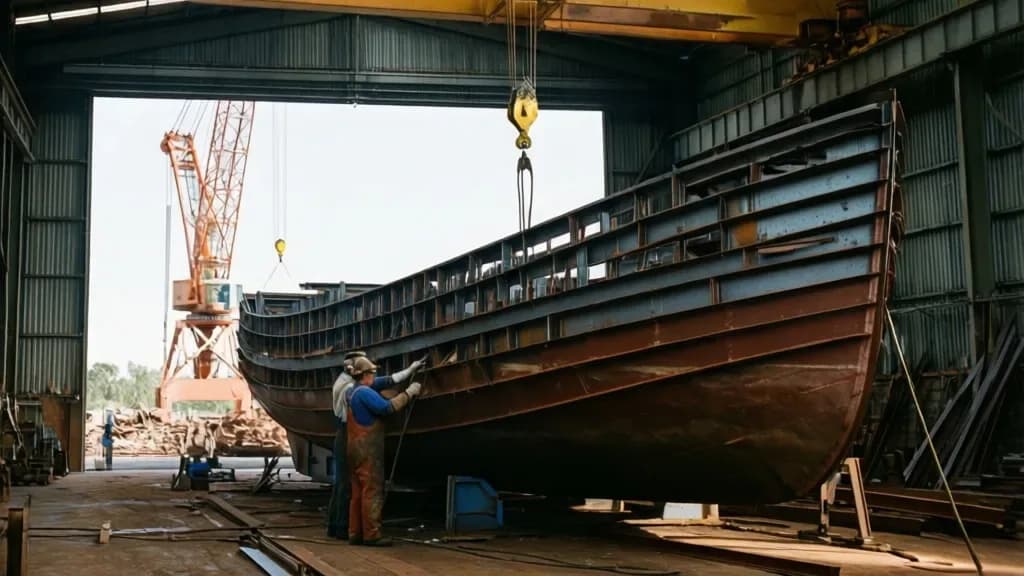
Boat builders and repairers construct, fit out, repair and overhaul small craft up to medium vessels — typically yachts, motor cruisers, tenders, workboats, ferries, fishing vessels, and recreational craft. Work spans fibreglass and composite construction, timber traditional builds, aluminium and steel hull fabrication, internal fit-out (joinery, cabinetry, headlining), mechanical systems installation, and ongoing repair and refit.
The trade clusters in distinct geographic precincts. The Gold Coast holds Australia's largest concentration of superyacht refit and recreational boat building, anchored by The Boat Works, Gold Coast City Marina, Rivergate Marina, and a dense network of subcontractors. Sydney has Rosehill, Mona Vale and Northbridge with a strong recreational and motor cruiser segment. Hobart hosts Incat Tasmania, a major aluminium fast-ferry builder. Adelaide and Henderson WA host the defence-adjacent maritime industries. Smaller hubs exist around Port Macquarie, Lake Macquarie, Sandstone Point and Fremantle. Defence shipbuilding precincts at Henderson (WA) and Osborne (SA) have generated unprecedented demand under the Australian Government's AUKUS commitments and the broader naval shipbuilding strategy.
The ANZSCO 399111 Code: What It Covers
ANZSCO 399111 sits inside Unit Group 3991 Boat Builders and Shipwrights, which contains two distinct codes. Boat Builder and Repairer (399111) covers construction and repair of generally smaller vessels and recreational craft. Shipwright (399112) covers larger commercial and naval vessels, typically with a stronger emphasis on hull fabrication, alignment and structural integrity work.
The two codes share an assessing body (TRA), an occupation list status (both on MLTSSL and CSOL), and identical visa eligibility. The practical difference lies in the type of vessel and the dominant skill set. If your work is on cruisers, yachts, leisure craft, small workboats and tenders, 399111 is the correct code. If it is on commercial ferries, naval ships, large fishing vessels or major refits of vessels over 24m, 399112 Shipwright is the better fit.
The official ANZSCO description for 399111 covers reading plans, setting out work, fabricating and assembling hulls and decks, fitting out interiors, repairing damaged craft, applying finishes, installing fittings and mechanical components, and conducting sea trials where applicable. Skill level 3 applies.
Skills Assessment Through Trades Recognition Australia
The Job Ready Program (Australian VET Graduates)
The Job Ready Program is for international graduates of an Australian VET course who are working in Australia. It is not an offshore route: all JRP employment must be in Australia. It starts with a Provisional Skills Assessment, then three TRA steps. The workplace assessment is observed against the marine craft construction competency standard.
Stage 1 — Provisional Skills Assessment (PSA): TRA checks your Australian qualification. It costs AUD130 in total, and TRA processes it typically within 12 weeks of submission, once all required evidence is provided.
Stage 2 — Job Ready Employment (JRE): At least 12 months of full-time (or equivalent part-time) paid boat-building work with a TRA-approved Australian employer, with evidence submitted every three months.
Stage 3 — Job Ready Workplace Assessment (JRWA): An independent TRA-approved assessor observes you working against the relevant Australian competency standard. Common observation tasks cover hull fabrication, fibreglassing, fit-out work, or repair techniques depending on your specialisation.
Stage 4 — Job Ready Final Assessment (JRFA): TRA finalises the assessment and issues the skills letter for visa lodgement.
Total program cost: TRA lists the Job Ready Program cost (stages 2-4) as AUD3,410 in total (AUD490 for Job Ready Employment, AUD2,845 for the Job Ready Workplace Assessment and AUD75 for the Job Ready Final Assessment), and more if you need more than one Workplace Assessment.
Total program duration: The Job Ready Program takes at least 12 months, because it needs 12 months of full-time (or equivalent) work with a TRA-approved employer, unless you have eligible prior employment. The JRE work-hours stage dominates the timeline.
Common rejection reasons: Reference letters that describe yacht-club maintenance or general marine labouring rather than skilled boat building; insufficient evidence of structural work (hull fabrication, framing, planking, lamination) versus fit-out only; conflating boat building with general carpentry or metal fabrication.
Migration Skills Assessment (MSA)
The Migration Skills Assessment (MSA) is TRA's documentary route for applicants who are not required to use OSAP, including overseas-trained boat builders. It is open to 399111 because the occupation is on the MLTSSL. It is not for 482 or 485 applicants. It costs AUD795 in total, and TRA processes it typically within 120 days of submission. If your passport country and occupation are on TRA's OSAP lists, the Offshore Skills Assessment Program (OSAP) applies instead; it costs up to AUD5,320 for Pathway 1 and AUD2,020 for Pathway 2. Use TRA's Pathfinder to confirm which program applies to your passport and occupation. If your 482 needs a skills assessment, TRA runs a separate Temporary Skills Shortage Skills Assessment Program; check its current fee and time on TRA's website.
Visa Pathways for Boat Builders and Repairers
Subclass 482 — Skills in Demand Visa
For offshore boat builders, 482 employer sponsorship is the fastest route into Australia. Larger marine industry employers — The Boat Works, Incat Tasmania, Riviera, Maritimo, Austal — are familiar with sponsoring offshore tradespeople, particularly in WA and South Australia where defence shipbuilding demand has overwhelmed the local labour market.
- Visa fee: AUD4,015 for the main applicant
- Salary threshold: Core Skills Income Threshold AUD79,423 (from 1 July 2026). The Specialist Skills stream is not open to this occupation, because Home Affairs excludes ANZSCO Major Groups 3, 7 and 8.
- Processing time: Core Skills stream: 50% of applications processed within 4 months and 90% within 9 months
- Quirk that matters: Defence-cleared roles at Henderson and Osborne often require Australian citizenship or PR, so the 482-to-186 progression matters more than usual for migrants targeting defence work
Subclass 186 — Employer Nomination Scheme
TRT stream is usually available after at least two years of eligible sponsored employment on a 482. Direct Entry is theoretically possible but rarely used.
- Visa fee: AUD6,140 for the main applicant
- Processing time: Direct Entry stream: 50% of applications processed within 21 months and 90% within 25 months; Temporary Residence Transition stream: 50% of applications processed within 21 months and 90% within 25 months
- Quirk that matters: boat building outside the Gold Coast and Sydney commonly counts as regional under the postcode definitions
Home Affairs also lists Boat Builder and Repairer for the Skilled Employer Sponsored Regional (subclass 494) visa, an employer-sponsored regional visa (AUD6,140 for the main applicant).
Subclass 491 — Skilled Work Regional Visa
Many boat-building hubs (Gold Coast outer areas, Tasmania, Henderson WA, Adelaide) sit inside the regional postcode definitions. The 491 adds 15 points and processes within typical timeframes.
- Visa fee: AUD6,140 for the main applicant
- Processing time: State or territory nominated: 50% of applications processed within 5 months and 90% within 18 months; Family sponsored: 50% of applications processed within 4 months and 90% within 7 months
- Quirk that matters: Hobart and the entire state of Tasmania count as regional, which makes the 491 particularly powerful for applicants targeting Incat or other Tasmanian marine employers
Subclass 190 — State Nominated Visa
Adds 5 points, delivers permanent residency, with a two-year state work and live obligation.
- Visa fee: AUD6,140 for the main applicant
- Processing time: 50% of applications processed within 4 months and 90% within 16 months
- Quirk that matters: WA and Tasmania have the strongest documented demand and the most accessible state nomination pathways for this occupation
Subclass 189 — Skilled Independent Visa
Available because 399111 is on the MLTSSL. The 189 has no sponsor and no regional restriction.
- Visa fee: AUD6,135 for the main applicant
- Processing time: 50% of applications processed within 61 days and 90% within 8 months
- Quirk that matters: Boat builder applicant volume is low, so invitation thresholds clear at 65-75 points rather than the 90+ ICT applicants face
Points Test Strategy for Boat Builders
| Points Factor | Points | Notes |
|---|---|---|
| Age (25-32) | 30 | Maximum bracket |
| Age (33-39) | 25 | Strong score |
| English (Superior: IELTS 8 in each band, or equivalent) | 20 | Hard target for trade applicants but unlocks all states |
| English (Proficient: IELTS 7 in each band, or equivalent) | 10 | The realistic target |
| Qualification (AQF Certificate III/IV) | 10 | Trade qualification points |
| Overseas Experience (5-7 years) | 10 | After any TRA-recommended deduction |
| Australian Experience (3+ years) | 10 | Standard for JRP graduates |
| State Nomination (190) | 5 | WA, SA, TAS the strongest nominators for marine trades |
| Regional Nomination (491) | 15 | The biggest single boost — applies across most marine hubs |
| Partner Skills | 5-10 | If partner holds skilled occupation |
Realistic Score Scenarios
Scenario 1: 27-year-old NZ-trained boat builder, IELTS 7.0, 5 years experience Age 30 + English 10 + Qualification 10 + Experience 10 = 60 points With 491 Tasmania regional nomination (+15) = 75 points — strongly competitive for invitation
Scenario 2: 33-year-old UK boat builder, City & Guilds Level 3, IELTS 6.5, 8 years experience Age 25 + English 0 + Qualification 10 + Experience 15 = 50 points With 491 (+15) and partner skills (+5) = 70 points — competitive
State Nomination for Boat Builders
Western Australia
WA's Henderson Defence Precinct is the single most significant driver of boat-building and shipwright demand in the country. The Australian Government has committed up to AUD $25 billion over the next decade to expand Henderson, with initial AUD $12 billion in immediate funding. Henderson is expected to support 10,000 direct jobs over the next two decades. WA's WASMOL Schedule includes marine trades, and the state received 3,400 nomination places for 2025-26.
Tasmania
Hobart hosts Incat Tasmania, a global leader in aluminium fast-ferry construction, plus a strong recreational and yacht building sector. The entire state qualifies as regional. Tasmania received 1,200 places for 190 and 650 for 491 in 2025-26.
South Australia
Adelaide's Osborne Naval Shipyard is where Australia will begin building its first SSN-AUKUS submarines by the end of the decade. The expansion of the Osborne precinct is creating sustained demand for marine trades across boat building, shipwright work and adjacent skilled disciplines. South Australia opened all skilled occupations to its 2025-26 program.
Queensland
The Gold Coast holds Australia's largest concentration of superyacht refit. Queensland received 2,600 nomination places for 2025-26 — more than double its prior allocation — and explicitly prioritises trade occupations. The 491 covers most Gold Coast boat building precincts as regional.
Salary and Employment Outlook
What Boat Builders Earn in 2026
| Role | Typical Salary Range |
|---|---|
| Apprentice / Trade Assistant | AUD $42,000-$58,000 |
| Qualified Boat Builder (PAYG) | AUD $70,000-$90,000 |
| Refit Specialist (Gold Coast / Sydney) | AUD $90,000-$115,000 (often paid AUD $45-$50/hour) |
| Senior / Foreman Boat Builder | AUD $95,000-$120,000 |
| Defence Shipbuilding (Henderson / Osborne) | AUD $90,000-$135,000+ with security clearance premium |
Source: SEEK Career Advice salary data 2026 (AUD $77,250 average across all roles), PayScale 2026, and industry survey data from the Australian Marine Complex.
Total package generally includes 12% superannuation. Defence-cleared work commands a meaningful premium because security-cleared trade workers are scarce. Superyacht refit work pays well during peak season (May to October) and dips during off-season unless workers move between projects.
Highest-Demand Sectors
- Defence shipbuilding — Henderson Defence Precinct (WA), Osborne Naval Shipyard (SA), Austal, ASC Pty Ltd
- Superyacht refit — The Boat Works (Coomera), Rivergate Marina (Brisbane), Sydney Northern Beaches
- Commercial ferry construction — Incat Tasmania (Hobart), Birdon (Port Macquarie)
- Recreational motor cruiser builders — Riviera Australia (Coomera), Maritimo (Coomera)
- Marine repair and refit subcontractors — every major marina supports multiple boat-building subcontractors
Skills Australia Outlook
Jobs and Skills Australia rates marine trades as in shortage across most assessments. The defence shipbuilding strategy alone is expected to require thousands of new marine trade workers through the 2030s, and the existing recreational and commercial boat-building workforce is already running short. Industry surveys describe time-to-fill for experienced boat builders as significantly extended through 2026.
Tips for a Successful Application
1. Pick 399111 or 399112 — and tilt your references accordingly
Boat Builder and Repairer (399111) and Shipwright (399112) sit in the same unit group but assess differently. Your reference letters need to consistently describe one or the other. If your career mixes both, choose the code that represents the majority of your last three years and have your referees describe duties in those terms.
2. Photograph your structural work
TRA assessors weight evidence of hull fabrication, framing, lamination and structural repair much more heavily than evidence of fit-out or cosmetic work. A portfolio of 15-25 photos of structural work, with dates and project captions, materially strengthens your TRA submission.
3. Target a defence-precinct employer for 482 sponsorship
Henderson WA and Osborne SA are sponsoring offshore marine trades at scale under the AUKUS commitments. The pay is higher, the visa pathway is faster, and the long-term security clearance pathway is valuable. The trade-off is that the highest-cleared roles require Australian citizenship, which is several years away on initial entry.
4. Choose Tasmania or regional WA for the 491 if your points are tight
Tasmania entirely qualifies as regional. Most of WA outside Perth metro qualifies. Both states have strong demand and have historically been more accessible than NSW or Victoria for trade nominations. The 15-point regional boost can transform a borderline points score.
5. Get your English to Proficient before lodging the EOI
Trade applicants often plateau at Competent (IELTS 6.0). Moving to Proficient (at least 7 in each IELTS band, or PTE Academic scores of 58 listening, 59 reading, 69 writing and 76 speaking (for PTE tests taken from 7 August 2025)) unlocks state nomination programs in WA, SA, NSW and Tasmania. PTE Academic is widely regarded as the easier of the accepted tests for hands-on trade applicants.
Step-by-Step Migration Roadmap
- Confirm 399111 is the right code — review the ANZSCO code finder and compare against 399112 Shipwright
- Gather qualification evidence and three years of post-qualification boat building experience — payslips, contracts, structural-work portfolio
- Submit your TRA application: the MSA (or OSAP if your passport requires it) if you trained overseas, or the Provisional Skills Assessment if you are an Australian VET graduate
- Sit your English test — aim for Proficient or higher to unlock state nomination
- Australian VET graduates only: register for the Job Ready Program: after a successful Provisional Skills Assessment
- (Job Ready Program) Complete 12 months of full-time (or equivalent part-time) paid Australian boat-building work: with a TRA-approved employer
- (Job Ready Program) Complete the Job Ready Workplace Assessment: observed competency assessment on-site
- Receive your TRA outcome letter: the document you lodge with the visa
- Submit an Expression of Interest in SkillSelect — for 189, 190 or 491
- Apply for state nomination — target WA, SA, TAS or QLD based on your preferred sector
- Alternatively, secure 482 employer sponsorship — defence precincts at Henderson and Osborne actively sponsoring
- Receive invitation and lodge your visa within 60 days — complete health and character checks
Frequently Asked Questions
Should I apply as a Boat Builder or a Shipwright?
It depends on the vessels you work on. Boat Builder and Repairer (399111) covers smaller and recreational craft. Shipwright (399112) covers commercial and naval vessels. If your career has been on yachts, motor cruisers and smaller commercial vessels, choose 399111. If it has been on ferries, naval ships, or vessels over 24m, choose 399112. The assessing body, visa eligibility and list status are identical between the two codes, but TRA strictly polices the reference-letter alignment to the chosen code.
How is AUKUS affecting marine trade migration?
Substantially. The AUKUS submarine commitment is driving a multi-decade expansion of Henderson WA and Osborne SA. Total planned investment under AUKUS Pillar 1 sits at AUD $71-96 billion. Both precincts are sponsoring offshore marine trades at scale through 482 visas. The pathway from initial 482 to 186 permanent residency is well-established for trade workers willing to commit to the defence sector.
Can I do my JRP work experience on the Gold Coast superyacht circuit?
Yes, provided the employer holds TRA approval to take JRP candidates. The Boat Works, Rivergate Marina, and most of the larger refit yards have hosted JRP candidates in the past. Smaller subcontractors often have not, so check approval status before accepting an offer. The Gold Coast also offers the broadest skill exposure — structural, finishing, mechanical — which strengthens the eventual JRWA assessment.
What's the difference between boat building and shipwright work in practice?
A boat builder typically constructs and repairs the hull, deck and structural elements of smaller craft, often working with composites, timber or aluminium. A shipwright commonly works on larger vessel structures, hull alignment, dry-docking, and major structural repairs. In practice the line blurs at the medium-vessel end of the market — a 22m motor cruiser refit might be done by either trade — but at the extremes the distinction is clear.
Are boat builder applications often rejected?
The most common rejection patterns are reference letters that describe yacht-club maintenance, marina caretaking, or general marine labour rather than skilled boat building; insufficient evidence of structural work; and wrong-code nomination (399111 when the work was actually shipwright duties or vice versa). Review the skills assessment process and the 2026 SOL for context. For applicants drawn to the maritime industry more broadly, the naval architect and marine designer pathway and the broader most in-demand occupations hub provide adjacent routes.