Barrister Visa Pathway to Australia: Complete 2026 Guide
Updated: 16 August 2026
Australia classifies Barrister under ANZSCO 271111. Skills assessment is conducted by the State or Territory Legal Admissions Authority where the applicant intends to practise. The occupation sits on both the MLTSSL and the Core Skills Occupation List, unlocking subclasses 189, 190, 491, 482 and 186. Typical 2026 earnings range AUD $95,000-$300,000+ depending on seniority and practice area.
Quick Facts: Barrister Migration Pathway
| Detail | Information |
|---|---|
| ANZSCO Code | 271111 (Barrister) |
| Skill Level | 1 (Bachelor of Laws or higher, plus admission to practice) |
| Skills Assessment | State/Territory Legal Admissions Authority (LPAB NSW, VLAB Vic, etc.) |
| Occupation List | MLTSSL and CSOL |
| Visa Options | 189, 190, 491, 482, 186 |
| Demand Level | Moderate — strong demand in commercial, regulatory and criminal Bar work |
| Salary Range | AUD $95,000-$300,000+ (SEEK Salary Hub and Gorilla Jobs Legal Salary Snapshot, 2026) |
| Typical 189 Score | 80-90 (legal occupations are competitive at the invitation stage) |
| Key Challenge | Two-stage process: assessment of qualifications then admission to the Bar in a specific state |
What Barristers Do in Australia
A Barrister is a specialist court advocate who appears in litigation and gives expert legal opinions. Unlike solicitors, who handle the day-to-day relationship with the client and the management of a matter, barristers are briefed by solicitors to argue cases in court, draft pleadings and provide written advice on complex points of law. The Australian legal profession is divided in most states — New South Wales, Victoria, Queensland, the ACT, Western Australia and Tasmania maintain a separate Bar, while South Australia and the Northern Territory have a fused profession where lawyers can practise as both barristers and solicitors.
Barristers are sole practitioners who join a chambers, share clerking arrangements and read for a year with a senior junior or Senior Counsel after admission. The most active commercial Bars are in Sydney, Melbourne and Brisbane, with significant Bars also in Perth and Adelaide. Practice areas vary widely: commercial litigation, equity, family, criminal, administrative, tax, intellectual property, native title, employment, planning and environment, regulatory and migration law all sustain dedicated junior and senior counsel.
Demand for skilled migration in this occupation is concentrated at the experienced commercial Bar and in specialist regulatory practice, where Australian firms and chambers recruit overseas-qualified lawyers — particularly those admitted in England and Wales, New Zealand, Singapore and other common-law jurisdictions.
ANZSCO 271111 Mapping
ANZSCO 271111 covers practitioners who pleads cases in courts of law and provides specialist legal opinions. Skill Level is 1: a Bachelor of Laws (LLB) or Juris Doctor (JD) is the minimum qualification, plus admission as a legal practitioner in an Australian state or territory and (in divided-profession states) call to the Bar.
Closely related codes:
- 271311 — Solicitor: For practitioners whose work is predominantly transactional or advisory, on the solicitor side of a divided profession. Many overseas-admitted lawyers map more naturally to 271311 than 271111.
- 271299 — Judicial and Other Legal Professionals (nec): Covers magistrates, judges' associates, tribunal members and certain in-house regulatory lawyers — not generally a migration entry point.
Choosing between 271111 and 271311 turns on the type of work the applicant has actually been doing overseas. UK barristers (England and Wales), Singapore advocates and solicitors, Hong Kong barristers and Irish barristers can usually map straightforwardly to 271111. Overseas solicitors and corporate lawyers who have not done courtroom advocacy typically fit 271311 more naturally. Both codes carry equivalent visa eligibility — both are on the MLTSSL and CSOL — so the practical question is which set of duties matches the applicant's record.
Skills Assessment
State and Territory Legal Admissions Authorities
There is no single national skills assessment for 271111. Each state and territory has its own Legal Admissions Authority that assesses overseas-qualified lawyers against the Uniform Principles for Assessing Qualifications of Overseas Applicants for Admission to the Australian Legal Profession. The principal authorities are:
- Legal Profession Admission Board (LPAB) — New South Wales
- Victorian Legal Admissions Board (VLAB) — Victoria
- Legal Practitioners Admissions Board (LPAB) — Queensland
- Legal Practice Board of Western Australia (LPBWA) — Western Australia
- Legal Practitioners Education and Admission Council (LPEAC) — South Australia
- Board of Legal Education — Tasmania
- Legal Profession Admission Board — ACT
- Legal Practitioners Admission Board — Northern Territory
For migration purposes, an applicant typically obtains an assessment from the authority in the state where they intend to practise. The assessment determines:
- Whether the overseas legal qualification is recognised as equivalent to an Australian Bachelor of Laws or JD
- Which (if any) of the eleven Priestley 11 core subjects need to be completed in Australia
- Whether further Practical Legal Training (PLT) is required
- Whether the applicant is admitted in their home jurisdiction and what conditions attach to that admission
Requirements:
- Recognised overseas law qualification (assessed by the Legal Admissions Authority)
- Evidence of admission and good standing in the home jurisdiction
- Completion of any required Priestley 11 top-up subjects through an Australian law school
- Practical Legal Training (PLT) where required — typically waived for applicants with substantial post-admission practice
- English language at the level required by the Authority
Assessment Cost: Application fees vary by jurisdiction. Conditional admission applications start from around AUD $360 (NSW), with additional fees for course assessment, admission, and Practising Certificate. The full cost of overseas-lawyer admission — including top-up subjects, PLT where required, and admission and Practising Certificate fees — typically runs AUD $2,000-$15,000 depending on the gap between the overseas qualification and Australian requirements.
Processing Time: Initial qualification assessment is typically 8-16 weeks. Required top-up study can add 6-18 months. Admission ceremonies are scheduled regularly through the Supreme Court of the relevant state.
Common rejection reasons: Overseas qualifications shorter than three years of full-time legal study, gaps in the Priestley 11 core areas (Property, Equity, Federal and State Constitutional Law, Administrative Law, Civil Procedure, Criminal Law and Procedure, Evidence, Contract, Tort, Professional Conduct, Trusts) that the applicant has not addressed, and incomplete evidence of admission in good standing.
Call to the Bar (Divided Profession States)
In NSW, Victoria, Queensland, WA, the ACT and Tasmania, admission as a lawyer is the first step. Practising as a barrister requires a further step: passing the Bar Examinations of the local Bar Association and completing the Bar Readers Course (typically nine to twelve months reading with a Senior Counsel or experienced junior). This is not a migration assessment — it is a professional admission process required to practise as a barrister rather than a solicitor.
For migration purposes, an applicant who is admitted as a legal practitioner in Australia and who intends to read at the Bar can lodge the skills assessment as 271111 from the point of admission. The Bar Readers Course is then completed after arrival.
Visa Pathways
Subclass 482 — Skills in Demand Visa
Employer-sponsored temporary visa, commonly used by Australian law firms recruiting overseas-qualified lawyers. The 482 is more typical of solicitor (271311) recruitment than barrister recruitment, because barristers are sole practitioners rather than employees, but lawyers entering Australia with a view to subsequently being called to the Bar often start on the 482.
- Visa fee (primary applicant): AUD $4,015 (Core Skills stream)
- Core Skills Income Threshold: AUD $79,423 (from 1 July 2026; previously AUD $76,515)
- Specialist Skills Income Threshold: AUD $146,576 — frequently reached by overseas-qualified mid-level and senior lawyers
- Processing time: Median 50% Core Skills 51 days; Specialist Skills 8 days
- Quirk: Most Australian top-tier and mid-tier firms — King & Wood Mallesons, Allens, Ashurst, Herbert Smith Freehills, Clayton Utz, Corrs, MinterEllison, Gilbert + Tobin — sponsor overseas lawyers regularly and have established processes
Subclass 186 — Employer Nomination Scheme
Permanent residency through firm sponsorship, Direct Entry or TRT after two years on a 482.
- Visa fee: AUD $6,140
- Processing time: Direct Entry currently 12-20+ months
- Quirk: Many large firms run structured progression from 482 to 186 for retained associates and special counsel
Subclass 189 — Skilled Independent
Permanent residency through the points system, without sponsorship.
- Visa fee: AUD $6,135
- Minimum points: 65; legal occupations have typically required 85-90 points for an invitation in 2025-26
- Processing time: 8-12 months after invitation
- Quirk: 271111 invitations are issued sparingly through SkillSelect; 271311 (Solicitor) attracts a larger allocation. Many applicants holding both eligibilities lodge under 271311
Subclass 190 — Skilled Nominated
State nomination adds 5 points, with a two-year residence obligation.
- Visa fee: AUD $6,140
- Processing time: 6-12 months after invitation
- Quirk: Most states require evidence of a current employment offer in the state or extensive Australian practice experience before nominating legal occupations
Subclass 491 — Skilled Work Regional
Regional provisional visa, 15 points, pathway to PR via subclass 191.
- Visa fee: AUD $6,140
- Processing time: 12-15+ months for 90% of applicants
- Quirk: Country circuits, regional Crown prosecution and Legal Aid roles in regional centres periodically support 491 nominations
Points Test Strategy
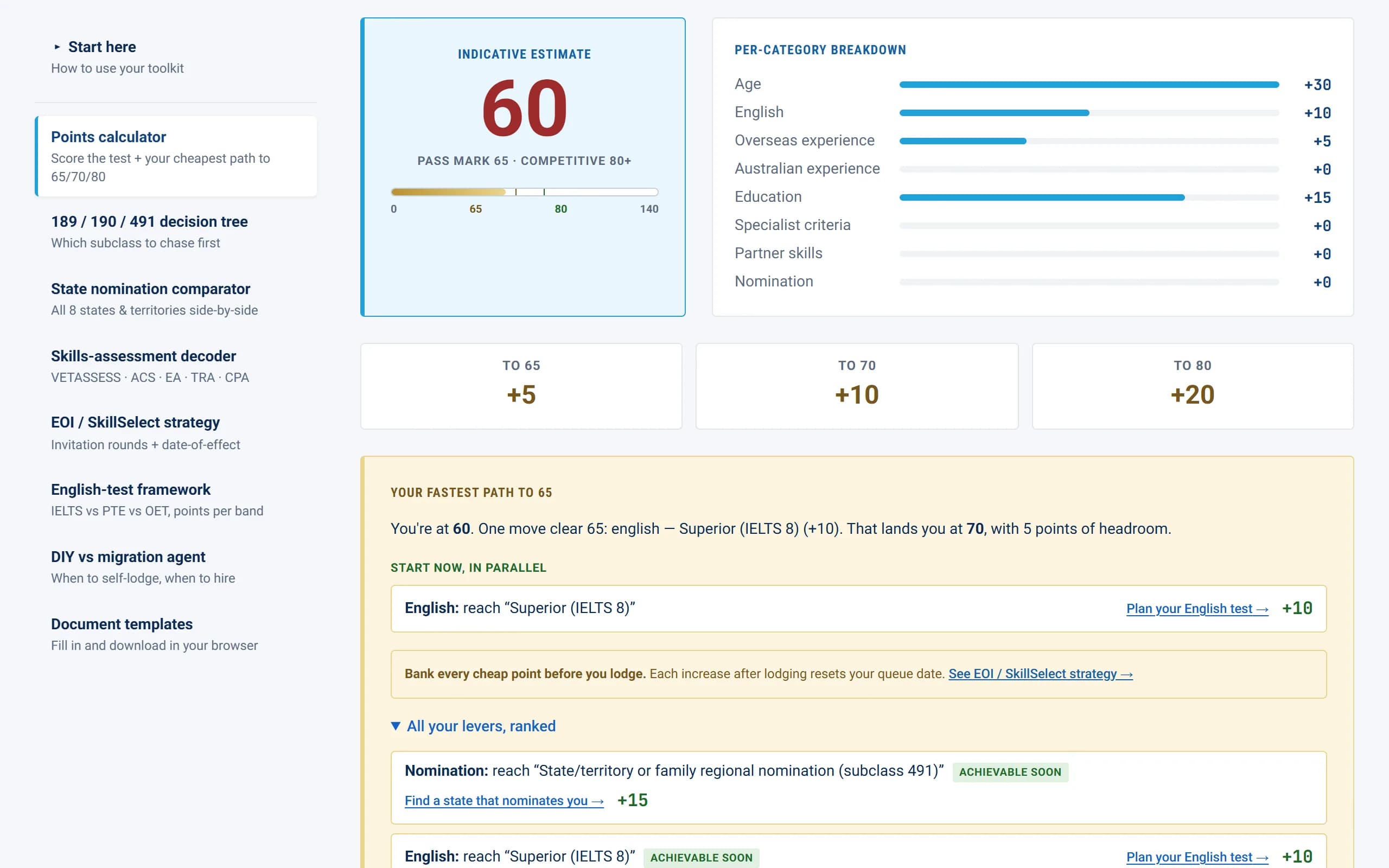
Legal occupations are competitive in the points system. Most invited applicants score at the top of the distribution.
| Points Factor | Points | Notes |
|---|---|---|
| Age 25-32 | 30 | Maximum bracket |
| Age 33-39 | 25 | Common for mid-career barristers |
| Bachelor of Laws / JD | 15 | Minimum Skill Level 1 |
| Master's (LLM) | 15 | Same as bachelor for points purposes |
| PhD (legal research) | 20 | Uncommon but high-impact |
| Superior English (IELTS 8.0) | 20 | Routinely achieved by common-law-trained applicants |
| Proficient English (IELTS 7.0) | 10 | Standard threshold |
| 8+ years overseas skilled experience | 15 | Typical for established practitioners |
| 3-4 years Australian experience | 10 | Built through post-admission practice |
| State nomination (190) | 5 | Useful where state lists open for 271111 |
| Regional nomination (491) | 15 | Limited but available for regional appointments |
| Partner skills | 5-10 | Where partner holds a skilled assessment |
Realistic Score Scenarios
Scenario 1: Mid-career commercial counsel, 33, Superior English, 9 years experience Age 25 + JD 15 + English 20 + Experience 15 = 75. With 190 nomination (+5) reaches 80, still typically below 271111 invitation thresholds — most applicants in this position pursue employer sponsorship.
Scenario 2: Senior junior counsel, 38, Superior English, 13 years experience, partner is also a lawyer Age 25 + JD 15 + English 20 + Experience 15 + Partner 10 = 85. Competitive for a 189 invitation under typical 2026 legal-occupation allocations.
State Nomination
Nomination for 271111 is narrow and competitive. Most state programmes treat the legal sector as a low-volume nomination category.
New South Wales
NSW's economy is the engine of Australian commercial law — Sydney is the dominant centre for banking and finance, corporate, M&A, regulatory and tax practice, and the NSW Bar is the largest in the country. NSW issued its full 2025-26 subclass 190 allocation before the end of the program year and is unlikely to issue further 271111 invitations until 2026-27. Nomination is conditional on a current NSW employment offer or substantial in-state experience.
Victoria
Victoria operates a tightly targeted nomination programme with a strong focus on healthcare, education, engineering and selected legal-sector roles. The 2025-26 allocation totals 3,400 places across 190 and 491. Victoria has historically nominated 271111 sparingly, with priority given to applicants who have secured a position with a Melbourne firm or chambers.
South Australia
South Australia operates a fused legal profession. The May 2026 nomination round delivered 295 subclass 190 invitations and 214 subclass 491 invitations across all occupations. Legal-occupation nominations are limited and typically tied to an Adelaide-based engagement.
Queensland
Queensland's nomination programme focuses heavily on offshore applicants with an offer in the state. The Brisbane commercial Bar is substantial, and the Queensland Government Solicitor and prosecution services regularly recruit overseas-trained lawyers.
Other states
Western Australia, Tasmania, the ACT and the Northern Territory all operate nomination programmes. ACT has historically not listed 271111 on its Critical Skills List, but Commonwealth and ACT legal roles occasionally support nomination. WA and NT support nomination where an applicant has a clear in-state appointment.
Salary and Employment Outlook
Barrister Earnings Profile
Barrister income is highly variable. Junior counsel in their first five years at the Bar typically earn AUD $95,000-$200,000 from briefs. Senior junior counsel (5-12 years) typically earn AUD $200,000-$500,000. Senior Counsel ("silks", appointed by the relevant Bar Association) at the commercial Bar in Sydney and Melbourne routinely earn AUD $1 million-$3 million annually, with leaders at the top of the profession earning considerably more.
Salary Reference for Employed Lawyers (Pre-Bar or Mixed Practice)
| Role | Typical Salary Range |
|---|---|
| Junior Lawyer (1-3 years PQE) | AUD $95,000-$135,000 |
| Mid-level Lawyer (4-6 years PQE) | AUD $135,000-$200,000 |
| Senior Associate (7-9 years PQE) | AUD $200,000-$280,000 |
| Special Counsel | AUD $260,000-$380,000 |
| Partner (mid-tier firm) | AUD $400,000-$800,000 |
| Partner (top-tier firm) | AUD $800,000-$3,000,000+ |
| Junior Counsel (Bar, 1-5 years) | AUD $95,000-$200,000 |
| Senior Junior Counsel | AUD $200,000-$500,000 |
| Senior Counsel (silk) | AUD $1,000,000-$3,000,000+ |
Sources: SEEK Salary Hub (May 2026), Gorilla Jobs 2026 Australian Legal Salary Snapshot, Hays Salary Guide FY25/26.
Highest-Paying Practice Areas
- Mergers and acquisitions, banking and finance, capital markets — top of the market in both firms and at the Bar
- Tax and regulatory advisory — sustained high demand in Sydney and Melbourne
- Commercial litigation and class actions — the strongest area of growth for the Bar
- Construction and infrastructure — strong demand driven by Australia's infrastructure pipeline
- Energy and resources — concentrated in Perth and Brisbane
Demand Outlook
Jobs and Skills Australia's 2025 Occupation Shortage List does not list 271111 as a national shortage, but commercial and regulatory practice areas continue to draw experienced overseas-qualified lawyers. Demand for English-and-Wales-trained, New Zealand-trained, Singapore-trained and Hong Kong-trained lawyers is strongest in Sydney and Melbourne commercial markets.
Tips for a Successful Application
-
Decide between 271111 and 271311 based on actual practice. If you have been doing courtroom advocacy and written advice from chambers (UK Bar, Hong Kong Bar, Irish Bar, Singapore Bar), 271111 is the natural fit. If your practice has been transactional, advisory, or as a solicitor in a fused jurisdiction, 271311 (Solicitor) typically suits better. Both codes carry the same visa eligibility — the question is which set of duties matches your record.
-
Lodge the qualification assessment in the state where you actually plan to practise. The Uniform Principles are nationally consistent, but each Legal Admissions Authority makes its own determination. Choose based on where the jobs are, where chambers will admit you to read, and where you intend to settle. NSW and Victoria are dominant for commercial practice; Queensland and South Australia for criminal and regulatory work.
-
Plan for the Priestley 11 gap. Most non-Australian LLB programmes do not cover all eleven core areas. The most common gaps for English-trained lawyers are Civil Procedure, Australian Constitutional Law and Australian Administrative Law. A bridging programme through an Australian law school (typically two to four subjects taken externally) is the standard fix.
-
For barristers specifically, factor in the Bar Readers Course. Even with full admission as a legal practitioner in Australia, you will need to pass the relevant Bar Association's exams and complete approximately nine to twelve months of supervised reading before you can take briefs unaccompanied. Plan for this period of reduced earnings in your relocation budget.
-
Run English testing early. Superior English (IELTS 8.0 or equivalent) is worth 20 points. Common-law-trained applicants routinely clear this threshold but should still book the test at the start of the process — points calculations depend on it.
Step-by-Step Migration Roadmap
- Confirm ANZSCO code fit — review 271111 vs 271311 against your actual practice using the ANZSCO code finder
- Verify list status — 271111 is on both the MLTSSL and CSOL
- Sit IELTS Academic or PTE Academic — target Superior (IELTS 8.0 across all bands)
- Choose your target state — base on where you intend to practise (NSW, Victoria, Queensland, etc.)
- Lodge the qualification assessment with the relevant Legal Admissions Authority — initial assessment 8-16 weeks
- Complete any required Priestley 11 top-up subjects — usually through an Australian law school
- Complete PLT if required — most experienced overseas-admitted lawyers receive a waiver
- Be admitted as an Australian legal practitioner — ceremony at the Supreme Court of the relevant state
- For the Bar: enrol in the Bar Readers Course and pass Bar Examinations — approximately 9-12 months
- Submit an Expression of Interest in SkillSelect for 189/190/491, or pursue 482 sponsorship through a law firm
- Receive invitation or nomination — lodge the visa within 60 days
- Complete health and character checks; receive grant and relocate
Frequently Asked Questions
Why is the skills assessment for barristers handled by state authorities rather than a single national body?
The Australian legal profession is regulated at the state and territory level. Each Legal Admissions Authority is a creature of the Supreme Court of its state and operates under the Legal Profession Uniform Law (in participating jurisdictions) or equivalent state legislation. There is national consistency through the Uniform Principles for Assessing Qualifications of Overseas Applicants, but the assessment and admission decisions are made state by state. This is unlike most other ANZSCO codes, where a single national body assesses skills.
Can I be assessed under 271111 if my home jurisdiction does not separate barristers from solicitors?
Yes. Lawyers from fused jurisdictions — Australian states such as South Australia and the Northern Territory, plus most US states, most Canadian provinces, and many other countries — can be assessed under 271111 if the work they have actually been doing matches the barrister description (courtroom advocacy, drafting pleadings, providing expert legal opinions). The assessment is task-based, not title-based.
Do I need to complete the Bar Readers Course before applying for a skilled visa?
No. The skills assessment for 271111 is based on your overseas qualifications and admission, not on Australian Bar admission. Many applicants enter Australia, are admitted as a legal practitioner, work for a period as a solicitor or in chambers, and then complete the Bar Readers Course after arrival. The visa application can proceed before any Australian practical training is undertaken.
What is the difference between 271111 (Barrister) and 271311 (Solicitor) for migration purposes?
Both occupations are on the MLTSSL and CSOL. Both attract the same range of visa subclasses. The difference is the nature of work the applicant has been doing: 271111 covers courtroom advocacy and expert legal opinion work; 271311 covers transactional, advisory and client-facing solicitor work. Annual SkillSelect invitation numbers for 271311 tend to be larger than for 271111, so where an applicant is eligible for both, 271311 can give a stronger invitation outcome.
Are overseas-admitted lawyers entitled to expedited admission processes in Australia?
Generally yes. Lawyers admitted in common-law jurisdictions with substantial post-admission practice routinely have PLT requirements waived and may only be required to complete a small number of Priestley 11 top-up subjects. The Uniform Principles set out the framework, and each Legal Admissions Authority applies it. Lawyers from civil-law jurisdictions or those with limited post-admission practice face a longer pathway.
Where can I find adjacent occupation information on this site?
For information about other professional codes see the most-in-demand occupations hub and the complete list of skills assessment bodies. For visa-by-visa eligibility see the skilled occupation list 2026 and the CSOL hub.