Teacher of the Hearing Impaired Visa Pathway to Australia: Complete 2026 Guide
Updated: 16 August 2026
Australia classifies Teacher of the Hearing Impaired under ANZSCO 241512. AITSL conducts the skills assessment for migration purposes, and state-based teacher registration is required separately before classroom work begins. The occupation sits on the MLTSSL and CSOL, unlocking subclasses 189, 190, 491, 482, 186 and 494. Typical 2026 salaries range AUD $85,000-$120,000. Demand is strong because the qualified workforce is small and the National Disability Insurance Scheme has expanded student support.
Quick Facts: Teacher of the Hearing Impaired Migration Pathway
| Detail | Information |
|---|---|
| ANZSCO Code | 241512 (Teacher of the Hearing Impaired) |
| Skill Level | 1 (Four years higher education including a year of specialised study in hearing impairment) |
| Skills Assessment | AITSL (Australian Institute for Teaching and School Leadership) |
| Occupation List | MLTSSL and CSOL |
| Visa Options | 189, 190, 491, 482, 186, 494 |
| Demand Level | High — specialist shortage across most jurisdictions |
| Salary Range | AUD $85,000-$120,000 (SEEK Career Advice Special Education, 2026) |
| Typical 189 Score | 70-80 (less competitive than ICT codes) |
| Key Challenge | Most international teaching qualifications lack the required one-year specialist study in deaf or hearing impaired education |
Role Context in Australia
Teachers of the Hearing Impaired work with deaf and hard-of-hearing students from early childhood through to senior secondary, in mainstream schools (often as itinerant specialists who visit several schools), in specialist deaf education facilities, and in early intervention services. The job blends curriculum teaching with assistive technology management (hearing aids, cochlear implant troubleshooting, FM systems), Auslan competency where students use signed language, and family liaison with audiologists and speech pathologists.
Australia's specialist deaf education workforce is small — under 1,000 nationally — and the cohort is ageing. The National Disability Insurance Scheme has expanded funded support for students with hearing loss, and the federal Disability Standards for Education require schools to provide reasonable adjustments. Both forces drive consistent vacancy creation in NSW (Royal Institute for Deaf and Blind Children, NSW Education itinerant services), Victoria (Victorian Deaf Education Institute), Queensland (Statewide Hearing Impairment Service) and the smaller states. Catholic Education and independent schools also recruit specialists, particularly where they host hearing-impairment unit programs.
ANZSCO Code Mapping
ANZSCO 241512 covers teachers who deliver academic and life-skills education to hearing-impaired students and support their social, emotional and physical development. Tasks include teaching subject content adapted to student need, supporting communication development (oral, signed or total communication approaches), assessing student progress, liaising with audiologists and Auslan interpreters, and supporting families.
Related codes include:
- 241513 Teacher of the Sight Impaired — for visual impairment specialists
- 241511 Special Needs Teacher — for teachers working with general developmental, learning or behavioural disabilities (see Special Needs Teacher pathway)
- 241599 Special Education Teachers nec — for specialisations that don't fit the above categories
If your specialisation is split between two codes, AITSL will assess against the code your qualification specifically prepared you to teach. For help selecting, see how to find your ANZSCO code.
Skills Assessment
AITSL — Teacher Migration Skills Assessment
The Australian Institute for Teaching and School Leadership is the sole assessing authority for all initial teaching occupations. AITSL's Teacher Migration Skills Assessment compares your qualifications against the Australian Professional Standards for Teachers.
Requirements for 241512:
- A minimum of four years of full-time (or part-time equivalent) higher education that results in a teaching qualification
- The qualifications must include a relevant initial teacher education program at AQF Level 7 (Bachelor) or higher
- The program must include at least one year of full-time equivalent specialist study in the education of hearing impaired students
- English at IELTS Academic (the only test AITSL accepts) — 7.0 in Reading and Writing, 8.0 in Speaking and Listening, with no individual band below 7.0 in Reading and Writing
Assessment cost: AUD $1,050.
Processing time: 4-6 weeks for assessment-ready applications.
Common rejection reasons: Initial teacher education qualifications that don't include the required one-year specialist study in deaf or hearing-impaired education. Some international Master of Special Education programs cover hearing impairment in only a single elective unit — AITSL will not accept that as the required full year of specialist study. Skilled employment statements that don't separate the years spent teaching general subjects from the years spent in specialist deaf education.
State Teacher Registration (Required Separately)
A positive AITSL assessment satisfies the visa requirement but does not grant the right to teach. Each Australian state and territory has its own teacher registration body — NESA in NSW, VIT in Victoria, QCT in Queensland, TRBSA in South Australia, TRBWA in Western Australia, TRB in Tasmania, TQI in the ACT, and TRB NT. These bodies conduct their own qualification, English and identity checks. Apply in parallel with your AITSL assessment to avoid arrival delays, and budget AUD $200-$400 per state.
For a wider overview of every assessing body, see the skills assessment bodies complete list.
Visa Pathways
The dominant route depends on your candidate profile. Specialist teachers with full qualifications who match the AITSL requirement often qualify under 189 or 190 with comfortable points. Where the AITSL assessment is borderline because of the one-year specialist study requirement, 482 employer sponsorship through a state or independent school authority can be the more reliable path.
Subclass 189 — Skilled Independent Visa
Permanent residency through the points system. The MLTSSL listing makes 241512 eligible.
- Visa fee: AUD $6,135 primary applicant
- Realistic invitation score: 70-80 in 2026
- Processing time: 6-12 months from invitation
- Quirk: Lower EOI volumes for specialist teaching codes mean 189 invitations are achievable at lower scores than ICT — 75 points is often workable
Subclass 190 — Skilled Nominated Visa
State nomination adds 5 points and grants permanent residency on grant.
- Visa fee: AUD $6,140
- Obligation: Two years living and working in the nominating state
- Quirk: All eastern states have nominated special education teachers in recent program years because of the specialist shortage
Subclass 491 — Skilled Work Regional Visa
Five-year provisional visa with a 191 pathway to permanent residency.
- Visa fee: AUD $6,140
- Quirk: Regional schools (in particular Catholic Education systems in regional NSW, Queensland and Victoria) actively sponsor 491 for specialist teachers because attracting Australian-trained specialists outside the capitals is difficult
Subclass 482 — Skills in Demand Visa (Core Skills stream)
Employer-sponsored temporary visa via a school or education authority.
- Visa fee: AUD $4,015 primary applicant
- Salary threshold: Core Skills Income Threshold AUD $79,423 (from 1 July 2026; previously AUD $76,515)
- Duration: Up to 4 years
- Quirk: Government and Catholic systemic schools usually start specialist teachers above CSIT under their enterprise agreements
Subclass 186 — Employer Nomination Scheme
Permanent residency via employer sponsorship.
- Visa fee: AUD $6,140
- Streams: Direct Entry (three years skilled experience plus positive assessment) or Temporary Residence Transition after holding a 482
Subclass 494 — Skilled Employer Sponsored Regional
Five-year provisional regional employer-sponsored visa.
- Visa fee: AUD $4,910
- Quirk: Used by regional dioceses and remote-area Aboriginal community schools where specialist teacher recruitment is acute
Points Test Strategy
| Points Factor | Points | Notes |
|---|---|---|
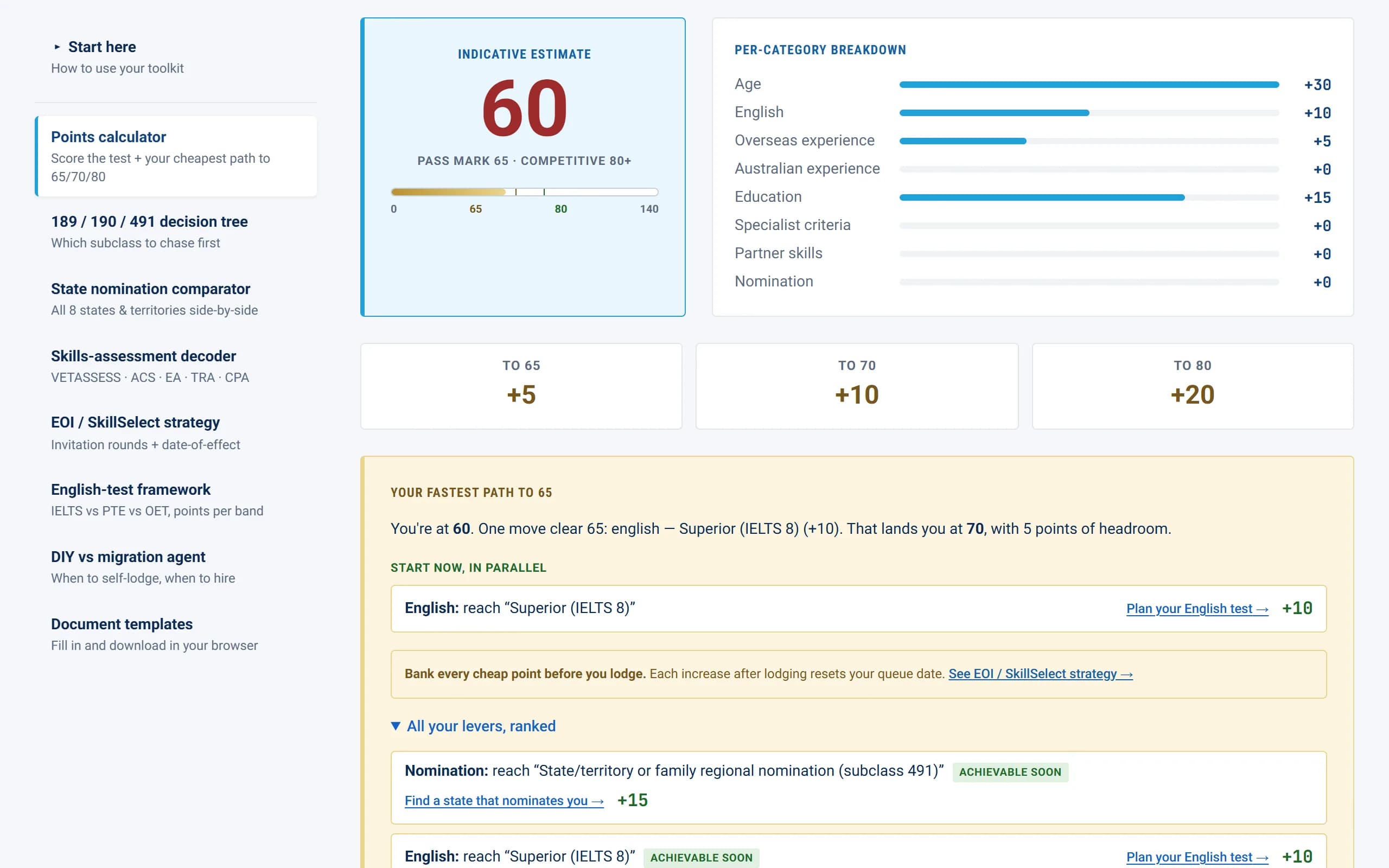
| Age (25-32) | 30 | Maximum bracket |
| Qualification (Master's) | 15 | Common for specialist teaching |
| Qualification (Bachelor) | 15 | Minimum entry |
| Qualification (PhD) | 20 | Rare but valuable |
| English (Proficient, IELTS 7 across bands) | 10 | Already exceeded by AITSL minimum |
| English (Superior, IELTS 8 across all four bands) | 20 | Worth targeting for 189 |
| Overseas experience 5-7 years | 10 | After AITSL skilled employment statement |
| Overseas experience 8+ years | 15 | After AITSL skilled employment statement |
| Australian experience | 5-20 | Where applicable |
| State nomination (190) | 5 | If invited |
| Regional nomination (491) | 15 | Largest single boost |
| Partner skills | 5-10 | If partner clears assessment |
| Australian study | 5 | Two years recent Australian study |
Realistic Scenarios
Scenario 1: Mid-career teacher with Master's and full specialist study
- Age 31 (30) + Master's (15) + Superior English (20) + 5 years specialist experience (10) = 75 points
- Add 190 nomination (+5) = 80 points — strong for 190 invitation
- The same score reaches 189 in less competitive years
Scenario 2: Early-career teacher with Bachelor and one-year deaf education specialisation
- Age 27 (30) + Bachelor (15) + Proficient English (10) + 3 years experience (5) = 60 points
- Add 491 regional nomination (+15) = 75 points — workable for regional invitation
- Adding partner skills (5) and NAATI (5) reaches 85
State Nomination
New South Wales
NSW publishes nomination lists at four-digit ANZSCO unit group level for 2025-26, so 2415 Special Education Teachers is captured at the group level. The state allocated 2,100 places to subclass 190 and 1,500 places to subclass 491. Education is a stated priority sector in the NSW migration strategy, and the specialist deaf and hearing-impaired teacher shortage in itinerant services is well documented.
Victoria
Victoria has nominated special education teachers consistently across recent program years. The Victorian Deaf Education Institute and integration support services in mainstream schools drive permanent demand. Applicants typically need a Victorian settlement plan or recent professional links to the state.
Queensland
Queensland allocated 2,600 places across 190 (1,850) and 491 (750) for 2025-26. The Statewide Hearing Impairment Service and Catholic Education Queensland recruit specialist teachers. Regional Queensland sites — Townsville, Cairns, Mackay, Toowoomba — feature in 491 nominations more frequently than Brisbane.
South Australia
South Australia has historically been open to offshore applicants with two years recent overseas experience. The Cora Barclay Centre in Adelaide and the Department for Education's hearing impairment program recruit through migration channels.
Western Australia, Tasmania, ACT and NT
All smaller jurisdictions periodically nominate special education teachers. Tasmania's 491 program suits candidates with study or employment links to the state. NT recruits specialist teachers for Aboriginal community schools where hearing loss prevalence is significantly higher than the national average, and offers strong financial incentives.
Salary and Employment Outlook
| Role | Typical Salary Range |
|---|---|
| Graduate Specialist Teacher | AUD $78,000-$92,000 |
| Specialist Teacher (3-5 years) | AUD $92,000-$110,000 |
| Senior Specialist Teacher | AUD $110,000-$125,000 |
| Lead / Head of Department | AUD $125,000-$155,000 |
| Itinerant Hearing Support Coordinator | AUD $110,000-$140,000 |
Sources: SEEK Career Advice Special Educational Needs Teacher page (2026, AUD $95,000-$110,000 average), state government teacher enterprise agreements 2025, AEU salary benchmarks. Total packages include 11.5% superannuation, plus location and remote-area allowances in regional and remote postings that can add 10-30% to base salary.
State government enterprise agreements drive most salaries. NSW, Victoria and Queensland have raised teacher pay materially since 2024 to address shortages, with senior classroom teacher steps reaching AUD $120,000+ in all three states. Catholic Education systemic schools track government rates closely. Independent schools vary widely — some pay 10-20% above the government scale, others sit slightly below.
Tips for a Successful Application
-
Audit your qualification against AITSL's specialist study requirement before lodging. AITSL requires a full year of full-time-equivalent study in deaf or hearing-impaired education. An ITE program with three elective units in special education will not satisfy this — you may need a separate postgraduate qualification before applying.
-
Document Auslan competency separately. AITSL doesn't require Auslan competency, but schools and education authorities prize it. If you hold Auslan certification or work history in signed-language environments, include this evidence in skilled employment statements and CVs.
-
Apply for state teacher registration in parallel with the AITSL assessment. State registration (NESA, VIT, QCT, etc.) is required before classroom work and has its own waiting list. Start the state application as soon as you lodge AITSL, not after the AITSL outcome arrives.
-
Consider 482 sponsorship first if your AITSL points are borderline. State and Catholic education systems sponsor 482 for specialist teachers regularly. Two years on 482 builds Australian experience points that make a subsequent 186 or 189 application straightforward.
-
Quote the AITSL English standard, not just IELTS overall. The minimum is 7.0 in Reading and Writing and 8.0 in Speaking and Listening — there is no overall band score that compensates for shortfalls in individual bands. AITSL only accepts IELTS Academic; no other tests are accepted.
Step-by-Step Migration Roadmap
- Confirm your qualification meets the AITSL specialist study requirement
- Cross-check 241512 against the Skilled Occupation List 2026 and Core Skills Occupation List
- Sit IELTS Academic — target 8.0 across all bands for Superior English points
- Prepare your AITSL submission — academic transcripts, English results, employment statements, identity documents
- Lodge the AITSL Teacher Migration Skills Assessment (AUD $1,050)
- In parallel, apply for state teacher registration in the state you plan to settle in
- Receive the positive AITSL outcome and recalculate points
- Submit an EOI in SkillSelect for 189, 190 or 491
- For employer-sponsored routes, secure an offer from a state education authority, Catholic system or independent school and lodge nomination plus 482
- Apply for state nomination if pursuing 190 or 491
- Receive an invitation and lodge the visa within 60 days
- Complete health, character and biometric checks; receive grant; complete state registration on arrival and start work
Frequently Asked Questions
My Master of Special Education covered hearing impairment in two units. Is that enough?
Almost certainly not. AITSL requires a full year of full-time-equivalent specialist study in the education of hearing-impaired students. Two units (typically 0.25 of a year of study) will not satisfy that requirement. The standard solution is to complete a specialist postgraduate certificate or graduate diploma in deaf education before lodging your AITSL assessment.
Do I need Auslan to work as a Teacher of the Hearing Impaired in Australia?
Not legally — many deaf students in Australia use oral, total communication or cochlear-implant supported approaches rather than Auslan. But Auslan competency dramatically increases your hireability, especially in specialist deaf education facilities and bilingual programs. Most teachers complete Auslan certification (Certificate II or III) during or after their specialist study.
Is the AITSL assessment harder than other teaching codes?
Yes, in the sense that the one-year specialist study requirement is more constraining than general primary or secondary teaching codes. The base process is the same — qualification check, English check, employment statement — but the qualification bar at 241512 catches more applicants than at 241211 Primary School Teacher or 241411 Secondary School Teacher.
Can I teach in a mainstream school as a Teacher of the Hearing Impaired?
Yes — many specialists work itinerant roles across multiple mainstream schools, providing direct teaching, support to classroom teachers, and hearing-aid and FM-system management. Some specialists hold dual roles: hearing-impaired specialist part-time, mainstream classroom teacher part-time, depending on student need.
Which Australian state pays specialist teachers best?
NSW and Victoria currently pay the highest base salaries at the top of the classroom teacher scale, both above AUD $120,000 from 2025 onwards. Queensland and the ACT are competitive. Western Australia and the Northern Territory pay competitive base rates plus significant location allowances for regional and remote postings — the Northern Territory's allowances can push total packages 20-30% above the NSW base for equivalent classroom work.