Middle School Teacher Visa Pathway to Australia: Complete 2026 Guide
Updated: 16 August 2026
Australia classifies Middle School Teachers under ANZSCO 241311. AITSL conducts the skills assessment. The occupation sits on the Core Skills Occupation List (CSOL), unlocking subclasses 190, 491, 482 and 186. Typical 2026 salaries range AUD $80,000-$120,000. Middle school teachers remain on the national shortage list across every state and territory.
Quick Facts: Middle School Teacher Migration Pathway
| Detail | Information |
|---|---|
| ANZSCO Code | 241311 (Middle School Teacher / Intermediate School Teacher) |
| Skill Level | 1 (Bachelor degree or higher plus teacher registration) |
| Skills Assessment | AITSL (Australian Institute for Teaching and School Leadership) |
| Occupation List | CSOL (also state-level STSOL for 190) |
| Visa Options | 190, 491, 482, 186 |
| Demand Level | High — listed in shortage in all states and territories |
| Salary Range | AUD $80,000-$120,000 (SEEK, 2026; PayScale, 2026) |
| Typical 189 Score | 241311 is not on the MLTSSL for 189 — 190/491 required |
| Key Challenge | Dual approval — AITSL assessment plus state teacher registration |
What a Middle School Teacher Does in Australia
In the Australian system, "middle school teacher" covers the bridge years between primary and senior secondary — generally Years 7 to 10, though some independent schools use middle-school year groupings of Years 5 to 9. The role differs from a Secondary School Teacher (241411) in that middle school teaching is typically generalist or two-subject specialist rather than single-subject specialist.
Demand is national but uneven. Catholic Education systems, independent schools, and Department of Education networks across NSW, Victoria, Queensland, Western Australia and the regional jurisdictions all carry persistent vacancies — most acutely in mathematics, sciences, technology, and special education. The Australian Government's National Teacher Workforce Action Plan, updated in September 2025, targets the same shortages skilled migrants are being recruited to fill.
Geographically, regional and outer-metropolitan postings hold the deepest vacancies. Many overseas-trained teachers find their first offer in a regional school under a 491 visa, then transition to metropolitan postings as Australian classroom experience accumulates.
ANZSCO 241311 — How the Code Is Defined
ANZSCO 241311 covers teachers who teach one or more subjects within a prescribed curriculum to middle school or intermediate school students, and who promote students' social, emotional, intellectual and physical development. The closest companion codes are 241213 (Early Childhood Teacher), 241213 (Primary School Teacher), and 241411 (Secondary School Teacher).
Choosing between 241311 and 241411 matters. AITSL requires applicants to nominate the code that best matches both the qualifications held and the bulk of teaching experience. If a teacher trained as a secondary specialist and taught mostly Years 11-12, 241411 is the correct match. If qualifications cover the lower-secondary band and most experience sits in Years 7-10, 241311 is the better fit. Picking the wrong code is one of the most common reasons AITSL applications come back unsuccessful.
Skills Assessment — AITSL
AITSL (the Australian Institute for Teaching and School Leadership) is the single assessing authority for migration purposes for all four school-teacher codes, including 241311. See the full list of Australian assessing bodies for cross-referencing other occupations.
Core requirements:
- A four-year initial teacher education qualification, or a three-year non-teaching degree plus a one-year teaching qualification of at least 800 hours of professional experience (often a Graduate Diploma or Master of Teaching).
- A minimum of 45 days supervised teaching practicum.
- Evidence that the qualification is comparable to an Australian Bachelor degree.
- English language proficiency: IELTS Academic 7.0 in reading and writing, 8.0 in listening and speaking (or equivalent in PTE / TOEFL iBT / Cambridge / OET).
Cost: AUD $1,050 for the standard skills assessment. An optional Skilled Employment Statement (used for points-test experience claims) adds AUD $234.
Processing time: Four to six weeks for complete applications, longer if AITSL requests further evidence on practicum hours or curriculum mapping.
Common rejection reasons: Insufficient supervised practicum days; a qualification that maps to a non-school context (such as adult education); English scores that don't meet the strict listening and speaking band. AITSL does not negotiate on the practicum threshold — applicants short on documented supervised teaching hours should consider a Graduate Diploma top-up before applying.
Teacher Registration Is a Separate Process
A positive AITSL skills assessment is not a licence to teach. Each Australian state and territory operates its own teacher regulator — VIT in Victoria, NESA in NSW, QCT in Queensland, TRBWA in Western Australia, TRBSA in South Australia, and equivalents in Tasmania, ACT and Northern Territory. Registration is mandatory before classroom employment begins. Most state regulators accept AITSL outcomes as part of their decision but run their own probity and qualification checks. Budget eight to sixteen weeks for state registration on top of the AITSL timeline.
Visa Pathways for Middle School Teachers
Subclass 190 — Skilled Nominated Visa
The dominant permanent pathway for 241311 because the code is not on the MLTSSL (and so cannot be used for 189) but is widely accepted across state nominated programs.
- Visa fee: AUD $6,140 (primary applicant)
- Eligibility: State nomination required; minimum 65 points including the +5 nomination boost
- Processing time: 75% finalised within eight months in 2026
- Quirk: Most states require evidence of a job offer or signed expression of interest from an Australian school before nomination is granted for teaching occupations
Subclass 491 — Skilled Work Regional Visa
Five-year provisional visa with a permanent residency pathway via the 191. Carries +15 points for regional nomination. For middle school teachers, this is often the most achievable route because regional Australian schools carry the deepest vacancies and the lowest competition for nomination.
- Visa fee: AUD $6,140
- Eligibility: Regional state or territory nomination; live and work in designated regional Australia
- Processing time: Comparable to 190
- Quirk: After three years of regional work meeting the income threshold, applicants can transition to permanent residency via subclass 191
Subclass 482 — Skills in Demand Visa
Employer-sponsored temporary visa. Useful when a school is willing to sponsor directly — common in independent and Catholic schools and in remote government schools.
- Visa fee: AUD $4,015 (primary applicant)
- Stream: Core Skills stream applies; the salary band for most teaching roles ($80,000-$120,000) sits between the Core Skills threshold ($79,423 in 2026-27) and the Specialist Skills threshold ($146,576)
- Processing time: Core Skills stream 90% finalised within roughly eight months in 2026; Specialist Skills stream is fast-tracked (7-67 days) but most teacher salaries don't reach the specialist threshold
- Quirk: A 482 grant requires the school to be an approved sponsor; many smaller regional schools are not, so the 190/491 routes are usually faster than persuading a non-sponsoring school to take on sponsorship paperwork
Subclass 186 — Employer Nomination Scheme
Permanent residency via employer sponsorship. Either Direct Entry (no prior 482 needed) or the Temporary Residence Transition stream (after two years on a 482 with the same employer).
- Visa fee: AUD $6,140 (primary applicant)
- Eligibility: A nominating Australian school plus AITSL assessment
- Processing time: Generally 6-12 months for Direct Entry
Points Test Strategy for 190 and 491
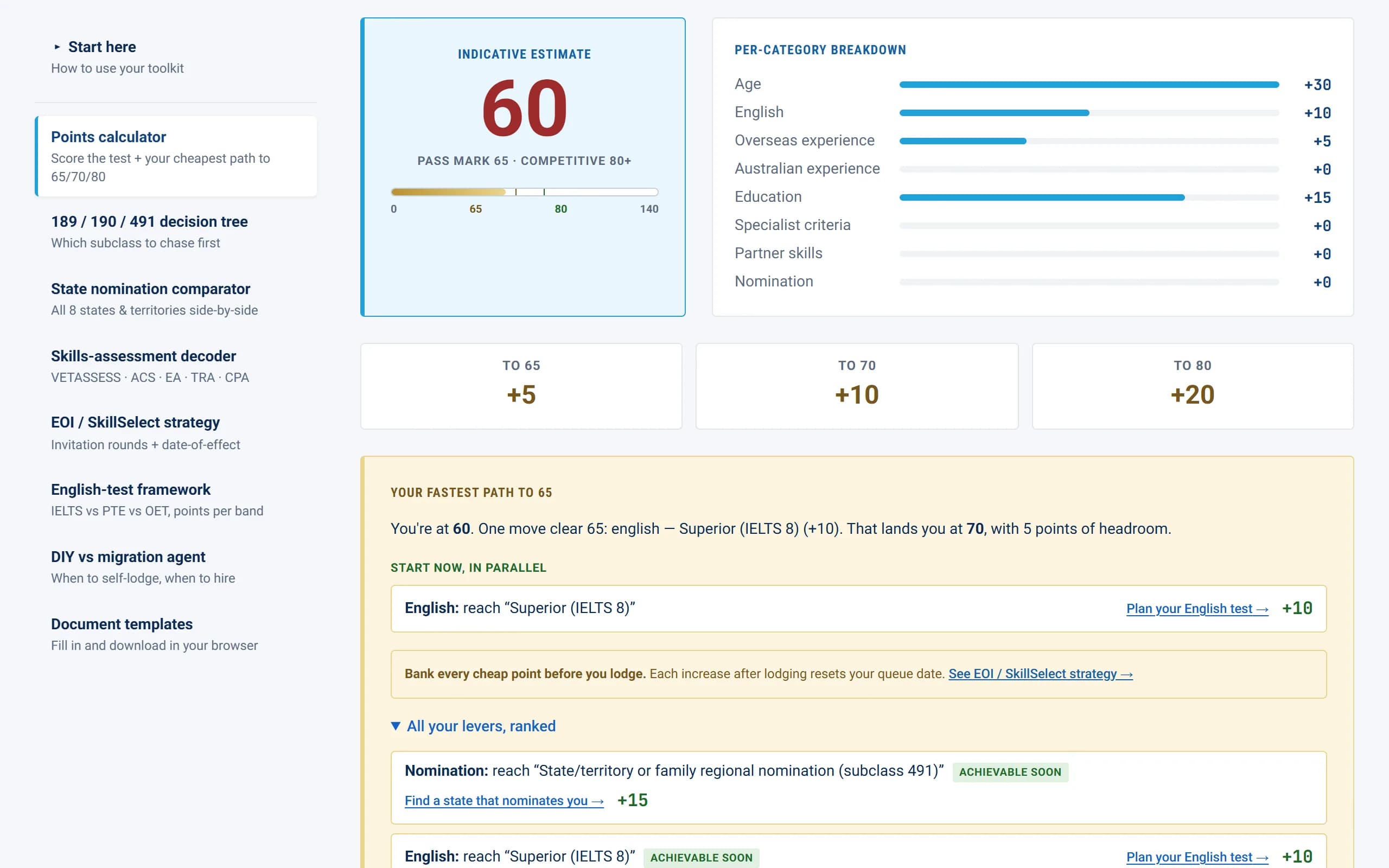
Because 241311 is on the CSOL but not the MLTSSL, the 189 visa is closed. The points calculation is the same standard table:
| Points Factor | Points | Notes |
|---|---|---|
| Age 25-32 | 30 | Maximum bracket |
| Age 33-39 | 25 | |
| Bachelor degree | 15 | Minimum for Skill Level 1 |
| Master's / PhD | 15 / 20 | Many overseas teachers hold Master of Education |
| English Superior (IELTS 8.0+) | 20 | Hardest single lever — also required for AITSL |
| English Proficient (IELTS 7.0) | 10 | Floor for AITSL |
| Overseas experience 5-8 years | 10 | After AITSL assesses skilled experience |
| State nomination (190) | 5 | |
| Regional nomination (491) | 15 | |
| Partner skills | 5-10 | |
| NAATI / CCL | 5 | Useful if a relevant community language matches |
Realistic Scenarios
Scenario 1 — Indian-trained teacher, age 30, B.Ed plus M.Ed, IELTS 7.5, 6 years teaching experience, no Australian experience, applying for regional 491:
30 (age) + 15 (bachelor) + 10 (English proficient) + 10 (overseas experience) + 15 (491 regional) = 80 points. Competitive for regional nomination, particularly for STEM-trained applicants.
Scenario 2 — Filipino teacher, age 34, four-year B.Ed, IELTS Academic 8/8/8/8 (Superior), 8 years teaching experience, no Australian experience, applying for 190:
25 (age) + 15 (bachelor) + 20 (Superior English) + 15 (8 years experience) + 5 (190 nomination) = 80 points. Strong candidate for state 190 once a state opens its 2026-27 allocation.
State Nomination for Middle School Teachers
New South Wales
NSW's 190 program treats teaching as a priority sector. The state typically nominates 241311 across the school year but requires applicants to demonstrate a genuine commitment to NSW — usually six months of residence or strong family or employment ties. NSW exhausted its 2025-26 allocation by May 2026; the next intake opens with the 2026-27 program year.
Victoria
Victoria's 2025-26 nomination program included school teaching occupations among its priority categories, with allocation focused on regional Victoria and outer-metropolitan growth corridors. The final 2025-26 invitation round was conducted on 1 May 2026.
Queensland
Queensland operates an onshore-priority program. Applicants already living and working in Queensland have stronger access to 190 nomination; offshore teachers are usually directed toward 491 regional pathways. The state's regional growth zones — Townsville, Cairns, Toowoomba — are among the most accessible postings for overseas-trained teachers.
South Australia
South Australia routinely opens 190 and 491 nominations for teaching occupations and has historically been more welcoming to offshore applicants than NSW or Victoria. The May 2026 round issued 295 subclass 190 and 214 subclass 491 invitations across priority occupations.
Western Australia
WA's 2025-26 program reserved 1,000 places each for the 190 and 491 streams. Education sits among the high-priority sectors on the WA Skilled Migration Occupation List, with regional postings — Geraldton, Kalgoorlie, Karratha — drawing the strongest invitation rates.
Tasmania, ACT and Northern Territory
All three smaller jurisdictions nominate teachers regularly, often with lower points cut-offs than the major states. Tasmania favours applicants already studying or working in-state; the ACT runs a Matrix system that rewards local connections; the NT actively recruits overseas-trained teachers for remote and Indigenous community schools.
Salary and Employment Outlook
| Role | Typical Salary Range |
|---|---|
| Graduate / Provisionally Registered Teacher | AUD $75,000-$85,000 |
| Fully Registered Middle School Teacher (mid-career) | AUD $90,000-$110,000 |
| Senior / Lead Teacher | AUD $110,000-$125,000 |
| Head of Department (Mathematics, Science) | AUD $115,000-$135,000 |
| Independent School Premium | +$5,000-$15,000 over public sector base |
Source: SEEK Career Advice (April-May 2026), public sector enterprise agreements published by NSW Department of Education, Victorian Government Schools Agreement 2022, and Queensland Teachers' Award.
Total package includes 11.5% superannuation, leave loading, and (in many states) salary packaging benefits for not-for-profit Catholic and independent employers. Remote and very remote postings in WA, NT and Queensland regularly attract location allowances and subsidised housing.
Highest-Demand Subject Areas
- Mathematics
- Physics and Chemistry
- Information Technology and Computing
- Special Education / Learning Support
- Languages (Mandarin, Indonesian, Japanese, French)
Teachers with credentials in two of the above are routinely invited for state nomination even when their points are otherwise borderline.
Tips for a Successful Application
1. Choose 241311 vs 241411 Deliberately
If both codes plausibly fit, run the numbers on each state's nomination list. Some states list 241411 (Secondary) but not 241311, or vice versa. Mapping to a code your target state actually nominates can change the outcome of your migration plan.
2. Document Practicum Hours Meticulously
AITSL's 45-day supervised teaching practicum threshold is non-negotiable. Get a signed letter from each placement school confirming dates, hours, supervisor name and observation notes. Universities that issue a single transcript line without daily breakdowns frequently cause AITSL delays.
3. Hit Superior English Early
Teaching is one of the few occupations where the assessing body itself demands a high English score. If you can reach IELTS 8.0 across all bands you both pass AITSL and gain 20 points — the single biggest lever in the points test.
4. Apply for State Registration in Parallel
AITSL assessment and state teacher registration are independent processes. Lodge both in parallel rather than sequentially. By the time the visa is granted, registration with VIT, NESA, QCT or equivalent should already be in hand so the first job offer doesn't stall.
5. Target Regional From the Start
The combined 491 + regional school job market is the fastest route for most overseas-trained teachers. Metropolitan permanent vacancies in Sydney and Melbourne are scarce; regional NSW, regional Victoria, far north Queensland, the Pilbara and the NT carry chronic shortages. A regional 491 with a published path to PR via 191 is often preferable to waiting two years for a metropolitan 190.
Step-by-Step Migration Roadmap
- Confirm 241311 matches your qualifications and majority of teaching experience using the ANZSCO code finder.
- Verify CSOL status and state nomination lists at the 2026 Skilled Occupation List hub.
- Sit IELTS Academic, PTE, or OET — target Superior (8.0 / 79 / B).
- Gather original qualification documents, practicum letters, and detailed employment references.
- Lodge the AITSL skills assessment ($1,050) plus optional Skilled Employment Statement ($234).
- While AITSL is processing, lodge state teacher registration application with your target state regulator.
- Calculate points using the points calculator guide.
- Submit an EOI in SkillSelect for subclass 190 and/or 491.
- Apply for state or territory nomination — most state portals require a separate application from the EOI.
- On invitation, lodge the visa within 60 days, pay $6,140, supply health and character checks.
- Wait for grant (typically 6-12 months for 190/491).
- Activate the visa, move to Australia, and finalise teacher registration with your state regulator before signing a contract.
Frequently Asked Questions
Why is Middle School Teacher (241311) on the CSOL but not the MLTSSL?
The MLTSSL is reserved for occupations with national, long-term shortages assessed against a stricter threshold by Jobs and Skills Australia. Teaching shortages are real but concentrated in regional and outer-metropolitan areas rather than uniformly national. The CSOL placement reflects this — 241311 is fully eligible for state-nominated 190 and 491 pathways, just not the independent 189.
Can I teach in Australia on a 482 visa without a permanent state registration?
You need provisional or full teacher registration with the relevant state regulator before commencing classroom teaching. A 482 grant lets you live and work in Australia for the sponsoring school, but the school cannot legally place you in front of students until state registration is in hand. Start the registration application as soon as AITSL issues a positive assessment.
Will my four-year B.Ed from India, Philippines, or South Africa be accepted?
Generally yes, provided the degree is from a recognised university, includes the required supervised practicum, and is followed by full teacher registration in the country of origin. AITSL assesses against the Australian standard, not against any specific country's curriculum. The bigger risk is documentation — if the university cannot produce a detailed practicum letter, the assessment slows down or fails.
Are independent and Catholic schools easier to get into than government schools?
Often yes for overseas-trained teachers. Many independent and Catholic schools recruit internationally, hold approved-sponsor status under the 482 program, and have HR teams experienced with migration. Government schools usually require state registration to be fully in place before a contract is signed, which slows down offshore applicants.
Which states have the highest demand for middle school teachers in 2026?
Northern Territory, regional Queensland, regional Western Australia, and regional NSW all sit at the top of vacancy lists. South Australia is the most accessible state nomination route for offshore applicants because of its relatively flexible criteria. The 2026 Jobs and Skills Australia shortage data lists middle school teachers as in shortage in every state and territory. See the most in-demand occupations hub for the broader 2026 shortage picture, or compare with the Vocational Education Teacher pathway if your teaching experience covers adult learners. Confirm CSOL placement against the Core Skills Occupation List hub.