Australian permanent residency can be obtained through eight main categories: skilled migration (Subclass 189, 190, 491→191), employer sponsorship (Subclass 186, 494→191), partner and family visas (Subclass 801/100, 143/103), the New Zealand stream, Business Innovation (now largely closed), Global Talent, Distinguished Talent, and humanitarian visas. Each pathway has different requirements, costs, and timelines. This guide maps every route so you can identify which ones apply to your situation.
Quick Overview: All PR Pathways
| Category | Key Visas | Typical Timeline | Cost Range |
|---|---|---|---|
| Skilled Migration | 189, 190, 491→191 | 1–4 years | From $6,135 (main applicant) |
| Employer Sponsored | 186, 494→191 | 2–5 years | From $6,140 (186) |
| Partner/Family | 801/100, 143/103 | 1–5+ years | $8,850–$49,440 |
| New Zealand Stream | 189 (NZ) | Immediate eligibility | $6,135 |
| Global Talent | 858 | 3–6 months | $6,235 |
| Business Investment | 888 (largely closed) | 4–5 years | $6,090 |
| Humanitarian | 200–204, 866 | Varies | Free |
Category 1: Skilled Migration
Skilled migration is the most common PR pathway, accounting for roughly two-thirds of all permanent migration to Australia. Three visas form the core of this category.
Subclass 189 — Skilled Independent
The gold standard. Permanent residency with no sponsor, no employer ties, and no location restrictions. You apply through the SkillSelect points-based system.
Key requirements:
- Minimum 65 points (realistically 80–95+ for an invitation)
- Occupation on the Medium and Long-term Strategic Skills List (MLTSSL)
- Positive skills assessment
- Under 45 years of age
- Competent English (minimum IELTS 6.0 each band)
Cost: $6,135 (main applicant) Processing: 5–12 months after invitation Full guide: Subclass 189 complete guide
Subclass 190 — Skilled Nominated
Same as the 189 but with state/territory government nomination, which adds 5 bonus points. You commit to living in the nominating state for approximately 2 years.
Key requirements:
- Same as 189, plus state nomination
- Occupation on the nominating state's list
- Meet state-specific criteria
Cost: $6,140 Processing: 5–12 months after invitation Full guide: Subclass 190 complete guide
Subclass 491 → Subclass 191 — Regional Pathway
A two-step pathway: the 491 is a 5-year provisional visa with 15 bonus points, requiring you to live in a regional area. After 3 years, apply for the 191 permanent visa.
Key requirements (491):
- Minimum 65 points (including 15 nomination points)
- State/territory nomination or family sponsorship
- Occupation on the relevant list
- Live and work in a designated regional area
Key requirements (191):
- Held 491 for at least 3 years
- Lived in a regional area
- Earned at least $53,900/year for 3 of the 5 years
Cost: $6,140 (491) + $630 (191) Timeline: 3.5–5 years Full guide: Subclass 491 complete guide
Which Skilled Visa Is Right?
For a detailed comparison: 189 vs 190 vs 491 comparison
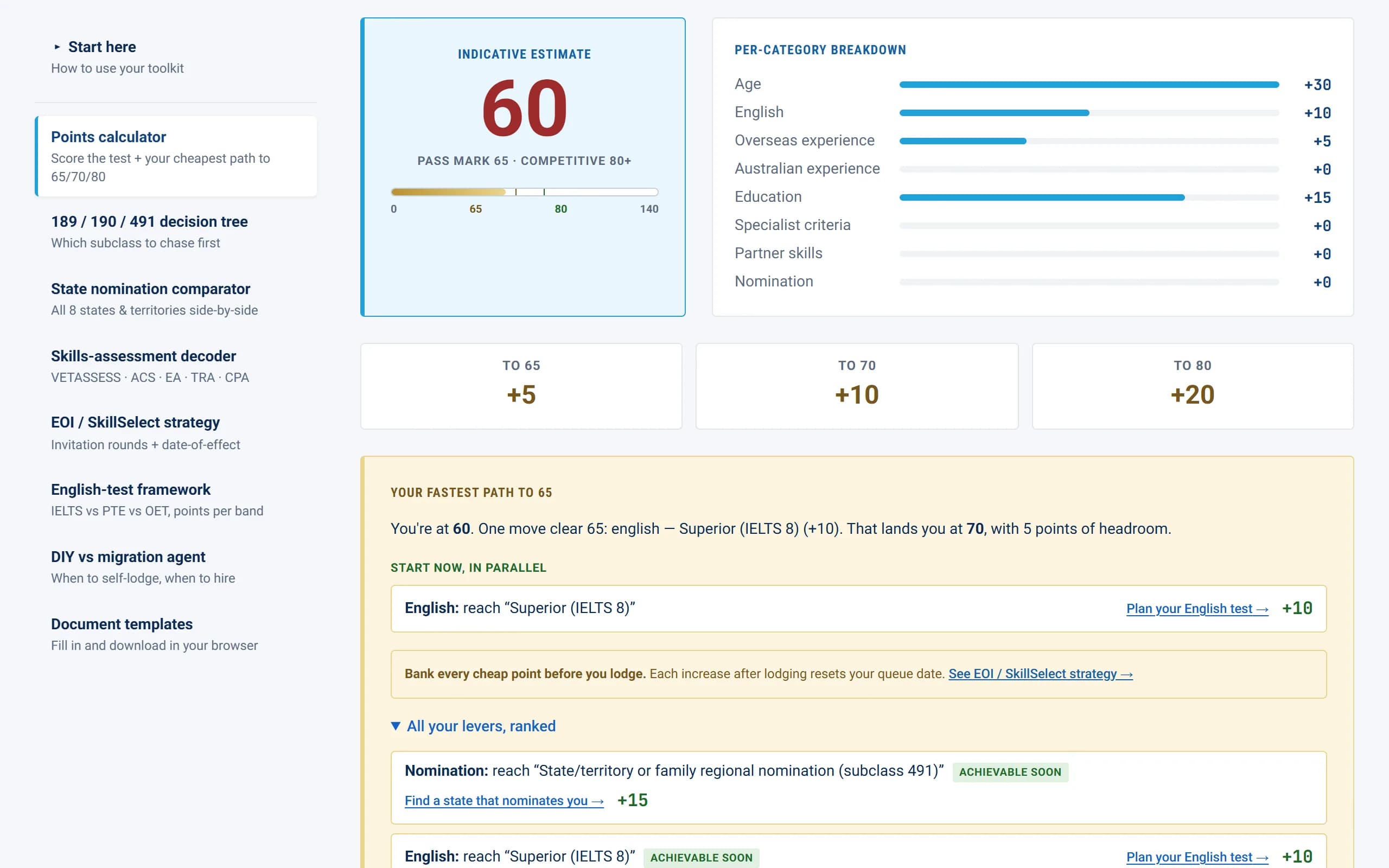
For the points test breakdown: Points calculator guide
Category 2: Employer-Sponsored
Employer-sponsored visas allow Australian businesses to sponsor skilled overseas workers for permanent positions. No points test required.
Subclass 186 — Employer Nomination Scheme
The main employer-sponsored PR visa. Three streams: Direct Entry (skills assessment, 3 years experience), Temporary Residence Transition (2 years on a 482/457), and Labour Agreement.
Key requirements:
- Nominated by an approved Australian employer
- Occupation on the relevant list (Direct Entry) or same employer for 2+ years (TRT)
- Under 45 (with some exemptions)
- Competent English (IELTS 6.0 each band)
- Skills assessment (Direct Entry stream only)
Cost: $6,140 Processing: 1–12 months Full guide: Subclass 186 complete guide
Subclass 482 → 186 TRT Pathway
The most common employer-sponsored route: get a temporary Skills in Demand visa (482), work for 2 years, then apply for 186 PR.
Timeline: 3–4 years total Full guide: 482 to 186 pathway
Subclass 494 → 191 — Skilled Employer Sponsored Regional
Similar to the 482→186 pathway but for regional employers. The 494 is a 5-year provisional visa for workers in regional Australia, with a pathway to the 191 permanent visa after 3 years.
Key requirements (494):
- Sponsored by a regional employer
- Occupation on the relevant list
- Under 45
- Competent English
- Live and work in a designated regional area
Key requirements (191):
- Held 494 for at least 3 years
- Lived regionally
- Earned minimum taxable income
Cost: $6,140 (494) + $630 (191) Timeline: 3.5–5 years
Category 3: Partner and Family Visas
Family-based migration is a significant pathway to PR, though it's among the most expensive and slowest.
Subclass 820/801 — Partner Visa (Onshore)
For people in a genuine, ongoing relationship with an Australian citizen, permanent resident, or eligible New Zealand citizen. Applied for while in Australia.
Stage 1 — Subclass 820 (Temporary): Grants a temporary visa while your permanent visa is processed. You get work rights and Medicare from this stage.
Stage 2 — Subclass 801 (Permanent): Granted approximately 2 years after the initial application if the relationship is ongoing.
Key requirements:
- Genuine, ongoing relationship (married or de facto for 12+ months)
- Australian sponsor
- Health and character requirements
Cost: $8,850 (total for both stages — paid upfront) Processing: 820 decision: 5–25 months; 801 decision: ~2 years from initial application Work rights: Yes (from 820 grant)
Subclass 309/100 — Partner Visa (Offshore)
Same as the 820/801 but applied for from outside Australia.
Stage 1 — Subclass 309 (Temporary): Allows entry to Australia. Stage 2 — Subclass 100 (Permanent): Granted ~2 years later.
Cost: $8,850 Processing: 309 decision: 7–28 months; 100 decision: ~2 years from initial application
Subclass 300 — Prospective Marriage
For people engaged to an Australian citizen/PR who want to come to Australia to marry. After marrying, apply for the 820/801 onshore partner visa.
Cost: $8,850 Validity: 9 months to enter Australia, then 15 months total
Parent Visas
Bringing parents to Australia permanently is one of the most expensive and time-consuming migration pathways.
| Visa | Type | Cost | Wait Time |
|---|---|---|---|
| Subclass 143 | Contributory Parent | $49,440 (second instalment) + $4,990 (first) | 5–7 years |
| Subclass 173→143 | Contributory Parent (staged payments) | $33,420 + $20,735 | 5–7 years |
| Subclass 103 | Non-contributory Parent | $4,990 | 15–30+ years |
| Subclass 864 | Contributory Aged Parent | $49,440 + $4,990 | 5–7 years |
| Subclass 804 | Non-contributory Aged Parent | $4,990 | 15–30+ years |
The reality of parent visas: The contributory parent visas (143, 864) cost approximately $55,000–$65,000 total per parent and take 5–7 years to process. The non-contributory options (103, 804) are far cheaper but have waiting times exceeding 30 years. Many families choose the expensive contributory option because the alternative is effectively never.
Balance of Family test: The parent must have at least half of their children living permanently in Australia (or more children in Australia than any other single country).
Other Family Visas
| Visa | Category | Notes |
|---|---|---|
| Subclass 101 | Child | For dependent children of Australian PR/citizens |
| Subclass 102 | Adoption | For children adopted through Hague Convention process |
| Subclass 114 | Aged Dependent Relative | Extremely limited — long waiting times |
| Subclass 115 | Remaining Relative | Must be last remaining close relative outside Australia |
| Subclass 116 | Carer | For carers of Australian relatives with medical conditions |
Category 4: New Zealand Stream
New Zealand citizens have a unique pathway to Australian PR.
Subclass 189 — New Zealand Stream
NZ citizens who have been living and working in Australia can apply for PR through a dedicated stream of the Subclass 189. This is separate from the points-tested 189 stream.
Key requirements:
- New Zealand citizen
- Usually resident in Australia since at least July 2016 (earlier pathway) or for 4 years (standard pathway)
- Met the income threshold ($53,900 taxable income per year) for specified years
- No substantial criminal record
- Character and health requirements
Cost: $6,135 Processing: Varies — typically faster than the points-tested 189
This pathway was significantly expanded in 2023, opening PR to hundreds of thousands of NZ citizens living in Australia who previously had no permanent residency route.
Category 5: Global Talent Visa
Subclass 858 — Global Talent (Independent)
For highly skilled professionals who are internationally recognised in one of Australia's priority sectors.
Priority sectors:
- Resources
- Agri-food and AgTech
- Energy
- Health Industries
- Defence, Advanced Manufacturing, and Space
- Circular Economy
- DigiTech
- Infrastructure and Tourism
- Financial Services and FinTech
- Education
Key requirements:
- Internationally recognised for outstanding achievements in your field
- Ability to earn above the Fair Work high-income threshold ($167,500 as of July 2024)
- Nominated by an Australian citizen, PR, or eligible NZ citizen, or a qualifying Australian organisation
- Still prominent in your field
Cost: $6,235 Processing: Typically 3–6 months (one of the fastest PR visas)
The Global Talent visa is fast-tracked and doesn't require a points test, employer sponsor, or state nomination. But the threshold is high — you need genuine international standing in your field. Think published researchers, tech entrepreneurs with track records, senior executives in target industries, or award-winning professionals.
Category 6: Business Innovation and Investment
Subclass 188 → 888 — Business Innovation and Investment
Australia's business migration program allows business owners and investors to gain PR by establishing or managing a business in Australia, or making qualifying investments.
Streams:
- Business Innovation (establishing/managing a business)
- Investor (investing $2.5 million in complying investments)
- Significant Investor ($5 million investment — fast-tracked)
- Premium Investor ($15 million investment — very limited)
- Entrepreneur (with funding from an approved source)
Important update: The Australian government announced significant changes to the business visa program in 2023–2024, with the intention of closing most streams. The Significant Investor stream and several others have been or are being phased out. Check the Department of Home Affairs website for the current status of business visa subclasses before pursuing this pathway.
Cost: $6,090+ (188) plus $6,090+ (888) Timeline: 4–5 years minimum (188 provisional, then 888 permanent)
Category 7: Humanitarian and Refugee
Australia operates one of the world's largest humanitarian resettlement programs.
Offshore Humanitarian Visas
| Visa | Category |
|---|---|
| Subclass 200 | Refugee |
| Subclass 201 | In-country Special Humanitarian |
| Subclass 202 | Global Special Humanitarian (proposed by Australian sponsor) |
| Subclass 203 | Emergency Rescue |
| Subclass 204 | Woman at Risk |
These visas are for people outside Australia who are subject to persecution, substantial discrimination, or human rights abuses. They grant permanent residency and full settlement support.
Cost: Free Allocation: Approximately 13,750 places per year in the humanitarian program
Subclass 866 — Protection Visa (Onshore)
For people already in Australia who are found to be refugees or in need of complementary protection under Australia's international obligations.
Cost: Free Processing: 6–24+ months
Category 8: Distinguished Talent
Subclass 124/858 — Distinguished Talent
For individuals with an exceptional and outstanding record of achievement in a profession, a sport, the arts, or academia and research. This is a higher bar than the Global Talent visa — think Olympic athletes, internationally acclaimed artists, or Nobel-calibre researchers.
Cost: $6,235 Processing: Varies
Choosing Your Pathway: Decision Tree
Do you have a skilled occupation + 80+ points? → Subclass 189 (immediate PR, no restrictions)
Skilled occupation + 65–80 points? → Subclass 190 (state nomination, +5 points, immediate PR) → Subclass 491 (regional nomination, +15 points, provisional → 191 PR)
Have an employer willing to sponsor? → 482 → 186 pathway (2-year work requirement, then PR)
Australian partner? → Subclass 820/801 or 309/100 (partner visa, ~2 years to PR)
New Zealand citizen in Australia? → Subclass 189 NZ stream (direct PR if income requirements met)
Internationally recognised expert? → Subclass 858 Global Talent (fast-tracked, 3–6 months)
Currently studying in Australia? → Student to PR pathway (500 → 485 → skilled/employer visa)
None of the above? → Consider starting with a student visa or working holiday visa to build Australian connections, then pursue a skilled or employer pathway.
How Many People Get PR Each Year?
The Australian government sets an annual Migration Program cap. For 2025–2026, the planning level is approximately 185,000 permanent places.
| Category | Approximate Allocation |
|---|---|
| Skilled (189, 190, 491→191, 186, etc.) | ~132,200 |
| Family (partner, parent, child) | ~52,500 |
| Special eligibility | ~300 |
Skilled migration dominates the program. Within skilled migration, employer-sponsored visas and the 491/190 have been given increasing priority over the 189 in recent years — reflecting the government's push toward regional and employer-driven migration.
Timeline Comparison: How Long to PR?
| Pathway | Minimum Time | Typical Time | Maximum Time |
|---|---|---|---|
| 189 (points-tested) | 6 months | 1–2 years | 3+ years (queue) |
| 190 (state nomination) | 6 months | 1–2 years | 3+ years |
| 491 → 191 (regional) | 3.5 years | 4–5 years | 6+ years |
| 482 → 186 (employer) | 2.5 years | 3–4 years | 5+ years |
| Partner (820/801) | 2 years | 2–3 years | 4+ years |
| Parent (143) | 5 years | 5–7 years | 8+ years |
| Global Talent (858) | 3 months | 3–6 months | 12 months |
| Student → PR | 4 years | 5–7 years | 8+ years |
Cost Comparison
| Pathway | Approximate Total Cost (Main Applicant) |
|---|---|
| 189 | $7,000–$10,000 (visa + skills assessment + English test) |
| 190 | $7,000–$10,000 |
| 491 → 191 | $7,500–$10,500 |
| 482 → 186 | $7,000–$12,000 (worker's costs) |
| Partner | $8,850–$12,000 |
| Parent (contributory) | $55,000–$65,000 per parent |
| Global Talent | $5,000–$7,000 |
Frequently Asked Questions
What's the easiest way to get Australian PR?
There's no universally "easy" pathway. The fastest is the Global Talent visa (858), but it requires genuine international recognition. The most accessible for average skilled workers is the 491 regional pathway, thanks to its 15-point bonus and broader occupation lists. The most reliable is employer sponsorship (482→186), if you can find a willing sponsor.
Can I get PR without English proficiency?
English is required for virtually all PR pathways except partner visas and humanitarian visas. For skilled migration, competent English (IELTS 6.0) is the minimum. For employer sponsorship, the same applies. Partner visa applicants don't need English for the visa, but may need it for citizenship later.
How much money do I need to migrate to Australia?
Budget at least $10,000–$15,000 AUD for visa applications, skills assessments, English tests, health examinations, police clearances, and initial settlement costs. If using a migration agent, add $3,000–$10,000. First 3 months of living costs in Australia: $5,000–$15,000 depending on the city. Total realistic budget: $20,000–$40,000 AUD for a single applicant through the skilled pathway.
Can I apply for multiple PR pathways simultaneously?
In most cases, yes. You can have active EOIs in SkillSelect for 189, 190, and 491 simultaneously. You can also have a partner visa application running parallel to a skilled visa application. However, if one visa is granted, you generally can't use the other — and you'll lose your application fees. Apply strategically based on your strongest pathway.
What happens after I get PR?
Permanent residency gives you the right to live and work in Australia indefinitely, access Medicare, access government education, and apply for citizenship after meeting residence requirements (typically 4 years in Australia including 1 year as PR). You can also sponsor family members for their own visas. The initial PR comes with a 5-year travel facility — after that, you'll need a Resident Return Visa to travel internationally while maintaining your status.