Australian Skilled Migration for UK Citizens: 2026 Guide
Updated: 16 August 2026
UK passport holders apply for Australian skilled migration through SkillSelect under subclass 189, 190, or 491, or through employer sponsorship via 482 and 186. Typical advantages: well-recognised qualifications and English-language treatment that often allows the IELTS to be skipped. The pinch point is cohort competition in popular ANZSCO codes, not the rules.
Quick Facts: Skilled Migration for UK Citizens
| Detail | Information |
|---|---|
| Main visas | 189 (Independent), 190 (State Nominated), 491 (Regional) |
| Employer sponsored | 482 (skill shortage) leading to 186 (permanent) |
| Points threshold (minimum) | 65, though actual invitation cut-offs run higher |
| Assessing bodies | ACS, Engineers Australia, AHPRA, VETASSESS, TRA, and others |
| English requirement | Usually demonstrated through citizenship; superior English worth 20 points |
| Police clearance | ACRO Police Certificate from the UK |
| Health exam | Required for all permanent visa applications |
| Application channel | SkillSelect EOI then ImmiAccount |
| Common pitfall | High cohort competition in IT, engineering, and accounting ANZSCO codes |
The Skilled Migration Pathways
Five visas account for nearly all British skilled migration to Australia.
Subclass 189, Skilled Independent. Permanent. Granted on points alone, no sponsorship. The hardest to qualify for (highest cut-offs) and the most flexible once granted: live and work anywhere with no state or employer obligations.
Subclass 190, Skilled Nominated. Permanent. State or territory nominated. Adds 5 points. Two-year commitment (tracked but not legally enforced) to live and work in the nominating state.
Subclass 491, Skilled Work Regional. Provisional, five years. State, territory, or eligible-family sponsored. Adds 15 points. Transitions to PR via subclass 191 after three years of meeting the income threshold.
Subclass 482, Skills in Demand. Employer-sponsored, temporary, up to four years. No points test, but you must meet occupation, salary, and English requirements.
Subclass 186, Employer Nomination Scheme. Permanent. Available either after two years on a 482 (Temporary Residence Transition stream) or directly with an employer sponsor (Direct Entry stream).
Comparing 189, 190, and 491 side by side:
| Feature | 189 | 190 | 491 |
|---|---|---|---|
| Status | Permanent | Permanent | Provisional |
| Bonus points | 0 | +5 | +15 |
| Where you live | Anywhere | Nominated state | Regional only |
| Path to PR | Granted directly | Granted directly | After 3 years via 191 |
| Typical invitation cut-off | Higher | Moderate | Lower |
Eligibility and Points
The points test sits at the centre of the 189/190/491 pathways. The minimum to lodge an EOI is 65, but invitation thresholds for popular occupations are routinely 85-95.
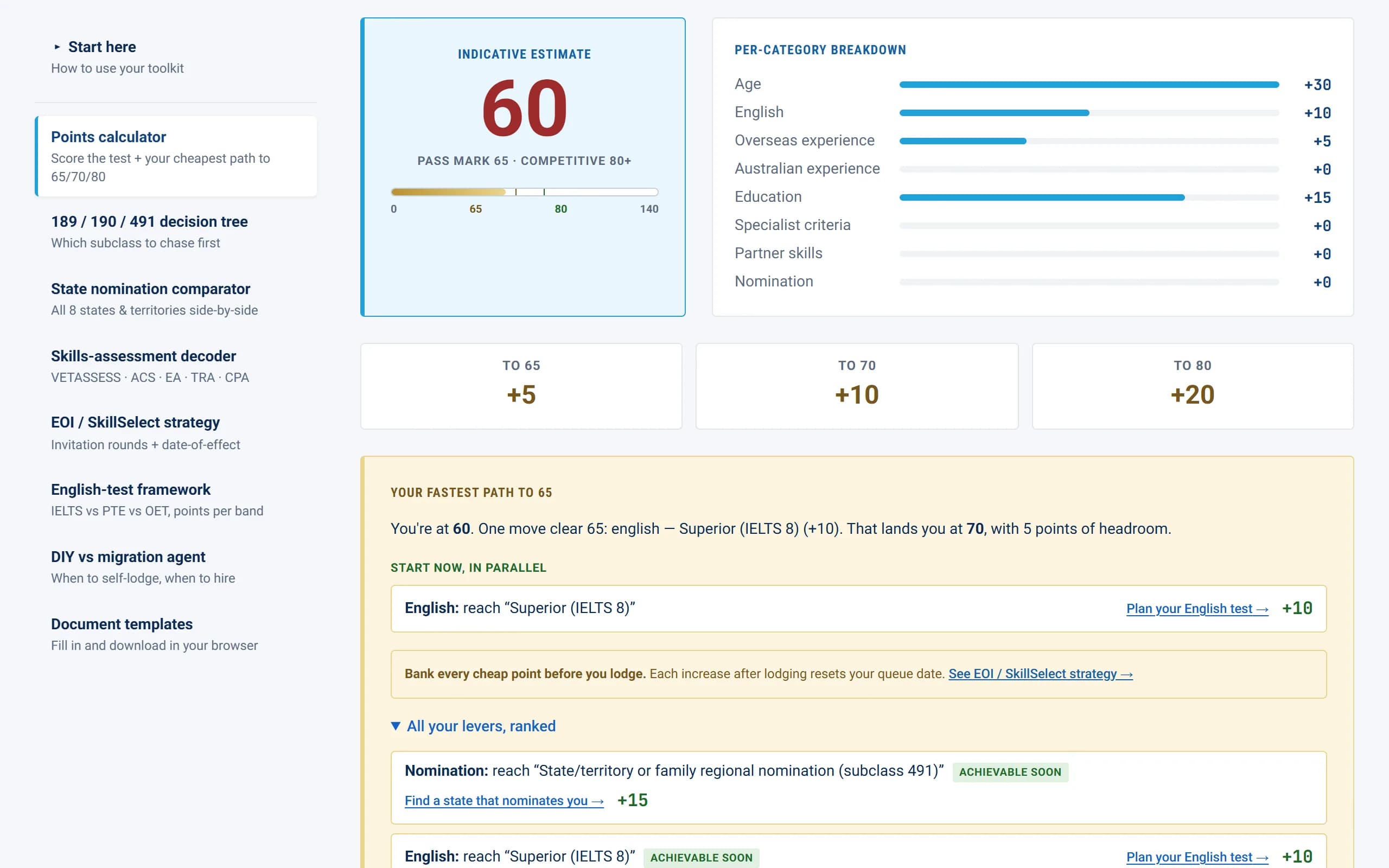
Points come from age (max 30 for 25-32), English (0/10/20 at competent/proficient/superior), qualifications (15 bachelor's, 20 postgraduate), skilled employment (up to 15), partner skills (up to 10), state nomination or family sponsorship (5 or 15), and several smaller categories. Use the points calculator guide to model your score against current cut-offs.
English: the UK Quirk
This is where UK passport holders get the most useful break.
For the purposes of meeting the visa's minimum English requirement, British citizens are accepted as having "functional English" by virtue of holding a UK passport. That means the IELTS or PTE test is generally not needed to qualify for the visa.
There's a catch. You only earn the 10 or 20 English-points bonus if you sit a formal test. Most UK applicants who want maximum points still sit the IELTS or PTE to claim superior English (20 points). Skipping the test is a perfectly valid strategy if your existing points are already above the cut-off without it.
The Department's rules on this have been tweaked several times. Confirm the current treatment in the English language requirements guide before deciding.
Skills Assessment
Every points-tested skilled visa requires a positive skills assessment from the appropriate body, set by the ANZSCO code on the relevant occupation list. The bodies UK applicants most often deal with:
- ACS for IT and computing
- Engineers Australia for engineering (UK degrees from accredited universities are recognised under the Washington Accord, which generally yields straightforward assessments)
- AHPRA for medical practitioners, nurses, and most allied health professions
- TRA for tradespeople (UK trade qualifications typically need a Job Ready Programme or Migration Points Advice)
- VETASSESS for professional and managerial occupations without a dedicated assessor
- CPA Australia, CA ANZ, or IPA for accountants
Assessments take three to six months on average and cost AUD $1,000-$2,500 depending on the body. Lodge yours early; you can't submit a SkillSelect EOI without it.
The Application Sequence
- Check your occupation is on the current Core Skills Occupation List or other applicable list.
- Lodge a skills assessment with the appropriate body.
- Sit IELTS or PTE if you want English bonus points (optional for UK applicants meeting the threshold without).
- Order an ACRO Police Certificate plus any other country police checks if you've lived elsewhere for 12+ months since age 16.
- Submit a SkillSelect Expression of Interest with your verified points score, target visa, and state preferences.
- Wait for an Invitation to Apply (189) or for state nomination (190 or 491).
- Lodge the visa application through ImmiAccount within the 60-day window after invitation.
- Complete the health examination at a Bupa panel clinic.
- Wait for grant. Processing runs 6-12 months for permanent visas, less for provisional.
Employer-sponsored pathways follow a different sequence: the employer lodges sponsorship and nomination, then you lodge the visa application linked to the nomination.
Cost and Processing Times
Headline application fees (primary applicant, current schedule):
- 189: AUD $6,135; 190 and 491: AUD $6,140
- 482: AUD $4,015 (same across streams)
- 186: AUD $6,140
Add fees for partners and children, the skills assessment (AUD $1,000-$2,500), an ACRO certificate (around GBP 65 standard service), and a health examination (around GBP 300-400 in the UK). Total out-of-pocket for a couple with a child applying for permanent residency typically lands in the AUD $10,000-$14,000 range before any migration-agent fees.
Processing times vary widely. The Department's processing-times guide updates monthly. UK applicants tend to clear well within the published medians due to low documentation risk.
What UK Applicants Need to Know
Cohort competition matters more than rules. Points cut-offs in popular ANZSCO codes are driven by competition. In IT (261313 Software Engineer, 261311 Analyst Programmer), accounting (221111), and some engineering codes, invitation thresholds are routinely 90+. If your score is 75-80, expect a long wait for 189 invitations and consider the 190 or 491 alternative.
State nomination is underused. Many UK applicants default to Sydney or Melbourne and the 189. The 190 and 491 routes, particularly to South Australia, Tasmania, Western Australia, and the Northern Territory, open the system up substantially. Five or fifteen bonus points changes the maths.
UK pension and tax planning matters more than for most cohorts. The day you cease UK tax residency has consequences: split-year treatment, your final Self Assessment return, and the timing of any property disposals or pension actions all interact. Your UK State Pension is portable to Australia but does not receive annual cost-of-living increases once you become an Australian resident (the freezing rule applies). A QROPS transfer is possible from some UK pension schemes to an Australian recognised scheme, but it's tightly governed by HMRC rules and worth professional advice. Watch the concessional and non-concessional super contribution caps if moving significant retirement savings. Speak to an accountant with genuine cross-border experience before you book the one-way flight.
ACRO certificate timing. UK Police Certificates have a fixed validity for visa purposes (typically 12 months from issue). Time it for after your invitation but with enough buffer that visa processing won't lapse the validity.
Common Pitfalls for UK Applicants
Claiming superior English without sitting a test. Citizenship covers functional English, not superior English. To claim the 20-point bonus, you have to sit IELTS, PTE, or an accepted alternative.
Wrong ANZSCO code. Your skills assessment, EOI, and visa application all have to align. UK applicants sometimes choose a higher-paying ANZSCO code than their actual job evidence supports. The assessing body's view of your role, not your job title, is what counts.
Underestimating cohort competition. A 75-point score sounds healthy until you see the IT 189 cut-off sitting at 95. Model your competition. The 190 or 491, or an employer-sponsored route, may be the realistic path.
Skipping cross-border tax advice. UK accountants don't typically know Australian tax law, and Australian accountants don't typically know HMRC. You need someone who handles both, and you need them before you move.
Failing the ACRO foreign-residence rule. If you've lived in another country for twelve months or more since age 16, you need a police certificate from that country too, not just an ACRO. This trips up Britons who've spent gap years in Asia or work stints in continental Europe.
Frequently Asked Questions
Do UK citizens need IELTS for skilled migration?
Not to qualify for the visa. UK passport holders meet the minimum English requirement on the basis of citizenship. You only need to sit IELTS or PTE if you want to claim the 10 or 20 English-points bonus. Many British applicants find the bonus essential for meeting invitation cut-offs.
Which Australian skilled visa is easiest for UK applicants?
There's no objective "easiest"; it depends on your occupation, points, and location flexibility. The 491 (regional) usually has the lowest invitation cut-offs, but it confines you to regional Australia for five years. The 189 has the highest cut-offs but the most freedom once granted. State-nominated 190 sits in the middle.
Are UK qualifications recognised by Australian assessing authorities?
Generally yes. UK university degrees are well-recognised by Engineers Australia, AHPRA, ACS, VETASSESS, and the accounting bodies. Trade qualifications from UK apprenticeship pathways are recognised by TRA, usually requiring documented evidence and sometimes a practical assessment.
What happens to my UK pension and State Pension in Australia?
Some private and workplace UK pension schemes can be transferred to an Australian Recognised Overseas Pension Scheme (QROPS), subject to HMRC and ATO rules. The State Pension cannot be transferred, but it can be paid to you in Australia, frozen at the rate that applied when you became a permanent Australian resident. Factor the frozen value into your long-term financial planning.
How long does Australian skilled migration take for UK applicants?
Twelve to twenty-four months is typical from starting a skills assessment to landing on a permanent visa. The skills assessment is three to six months, the EOI wait varies wildly by occupation, and visa processing once invited runs six to twelve months. Employer-sponsored pathways are often faster.
Do I need a migration agent?
Not legally required. Many UK applicants handle their own applications successfully. A registered MARA agent is worth considering for complex cases (visa refusals, character issues, unusual occupations) or tight points scenarios where strategy matters. Make sure any agent you use is MARA-registered.