How to Maximise Your Points Score: 15 Practical Tips
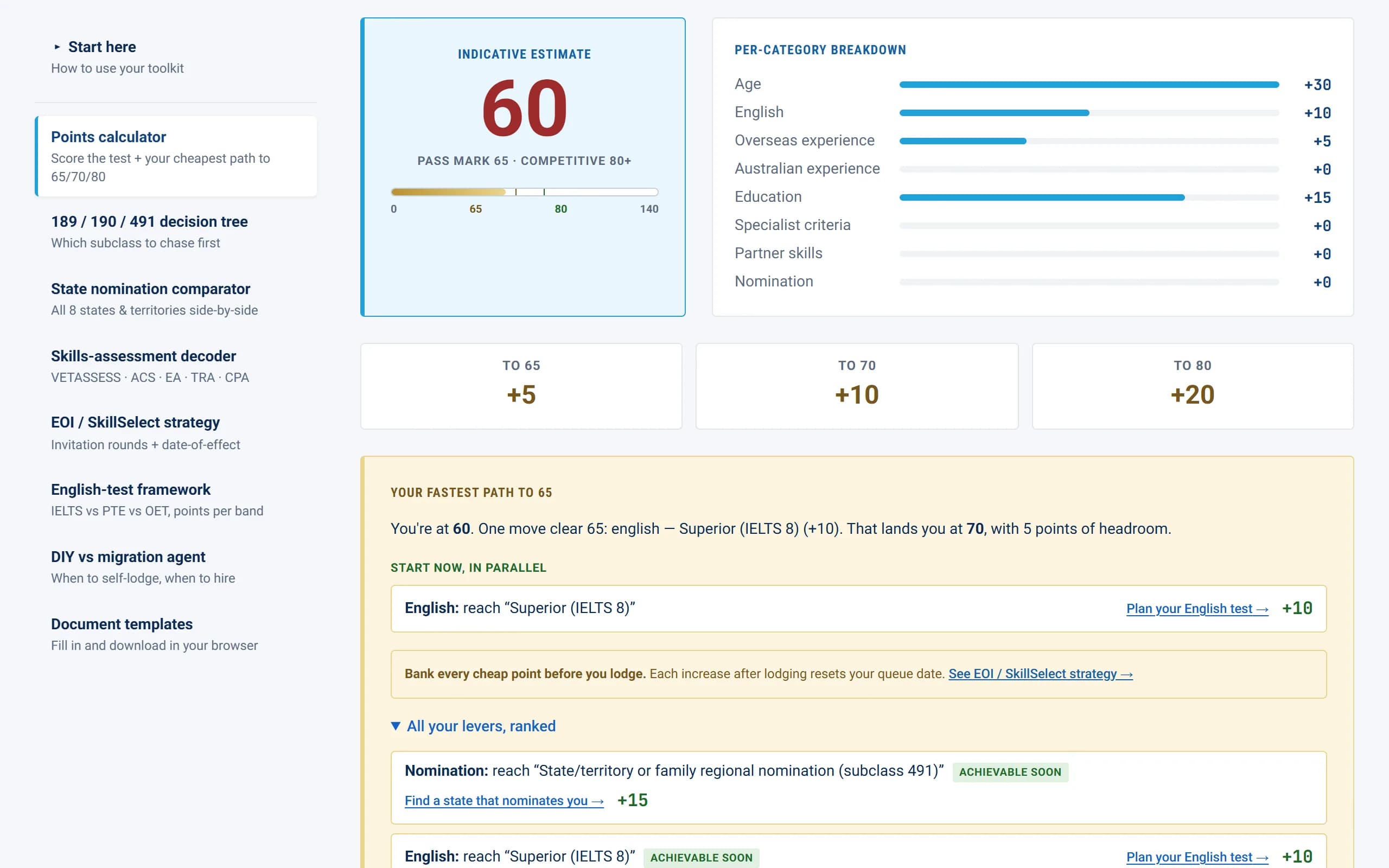
Every point matters in Australia's competitive skilled migration system. The difference between an invitation and years of waiting can be as little as 5 points. Here are 15 practical strategies to maximise your points score, from high-impact quick wins to longer-term investments. The most effective strategies are improving your English score, gaining Australian work experience, and leveraging partner skills or state nomination — together, these can add 20-35 points to your profile.
Quick Facts
| Strategy | Points Available | Time to Achieve |
|---|---|---|
| English improvement (7→8) | +10 points | 2-6 months prep |
| NAATI community language | +5 points | 3-6 months |
| Partner skills assessment | +5-10 points | 2-4 months |
| Australian study | +5 points | 2+ years |
| Regional study bonus | +5 points | Included with study |
| State nomination (190) | +5 points | 1-3 months |
| State nomination (491) | +15 points | 1-3 months |
High-Impact Strategies (10+ Points)
1. Push English to Superior (IELTS 8+)
This is the single highest-value strategy. Moving from Proficient (IELTS 7/PTE 65) to Superior (IELTS 8/PTE 79) gains you 10 points.
How to achieve it:
- Invest in a 3-6 month intensive English course
- Take practice tests repeatedly — familiarity with the format matters as much as English ability
- Consider switching test types: some people score better on PTE than IELTS, or vice versa
- Focus on your weakest band — all four bands need to be 8+ for IELTS (or 79+ for PTE)
Cost: $300-$400 per test attempt plus course fees. ROI: 10 points for a $1,000-$2,000 investment is exceptional value.
2. Apply for State Nomination (190 or 491)
State nomination adds 5 points (190) or 15 points (491). For many applicants, this is the difference between waiting indefinitely for a 189 and receiving an invitation within months.
190 strategy: Research each state's occupation list and nomination criteria. Some states actively recruit applicants in your occupation — living in that state or having a job offer there strengthens your nomination application.
491 strategy: The 15-point boost makes the 491 accessible to applicants with lower base scores. The trade-off is the 3-year regional residence requirement, but for many, PR after 3 years in a regional area is better than never receiving an invitation.
3. Claim Partner Skills (5-10 Points)
If your partner (spouse or de facto) has skills that would qualify for points, you can claim 5 or 10 bonus points.
10 points (single applicant): If you don't have a partner or your partner is an Australian citizen/PR. 5 points (skilled partner): If your partner has a positive skills assessment in an occupation on the skilled list and competent English.
Important: Many applicants overlook partner skills. If your partner has qualifications in an eligible occupation, getting their skills assessed is worth the investment.
Medium-Impact Strategies (5 Points)
4. Get NAATI Credentialed Community Language
If you speak a community language other than English, obtaining a NAATI credential in that language earns 5 points. NAATI (National Accreditation Authority for Translators and Interpreters) offers the Credentialed Community Language (CCL) test.
Languages: Over 50 languages are available, including Mandarin, Hindi, Vietnamese, Arabic, Korean, Spanish, and many others.
Test format: You listen to short dialogues in English and your community language and provide oral interpretations.
Cost: Approximately $800 for the test. Preparation: 1-3 months of practice. Online courses and practice materials are available.
5. Gain Australian Work Experience
Each year of Australian work experience in your nominated occupation adds points:
- 1 year: 5 points
- 3 years: 10 points
- 5 years: 15 points
- 8 years: 20 points
If you're already in Australia on a working holiday, student, or temporary visa, working in your skilled occupation accumulates valuable points. Even 1 year of Australian experience adds 5 points.
6. Gain Overseas Work Experience
Similarly, overseas work experience in your nominated occupation adds points:
- 3 years: 5 points
- 5 years: 10 points
- 8 years: 15 points
If you've been working in your field for several years but haven't claimed these points, ensure your skills assessment recognises your experience.
7. Complete an Australian Qualification
Completing at least 2 years of study in Australia (meeting the Australian Study Requirement) earns 5 points. If you're considering further education, an Australian qualification provides both the degree and the bonus points.
8. Study in Regional Australia
If your Australian study was in a designated regional area, you earn an additional 5 points. This stacks with the Australian Study Requirement — so regional study can be worth 10 points total.
Regional institutions to consider: University of Adelaide, University of Tasmania, James Cook University, Charles Sturt University, and others outside Sydney, Melbourne, and Brisbane.
Strategic Tips (No Direct Points, But Improve Chances)
9. Choose Your Occupation Strategically
Not all occupations have the same demand. If you qualify for multiple occupations, choose the one with:
- Lower invitation cutoff scores
- Larger annual quota
- Fewer applicants
Check recent invitation round data to compare occupations before committing to a skills assessment.
10. Time Your Birthday
Age points decrease at specific birthdays:
- 33: drops from 30 to 25 points
- 40: drops from 25 to 15 points
- 45: drops to 0 points
If you're approaching 33 or 40, submit your EOI before that birthday to lock in the higher points.
11. Submit Your EOI Early
Among applicants with the same points, the date of effect determines priority. Submit your EOI as soon as you reach your target score — don't wait for a "better time."
12. Consider a PhD
A PhD earns 20 points (compared to 15 for a bachelor's or master's). If you're close to qualifying for a PhD and it makes career sense, the additional 5 points could be decisive.
An Australian PhD in a STEM field provides the maximum benefit: 20 points for the qualification + 10 points for specialist education + 5 points for Australian study = 35 points from one degree.
13. Upgrade Your Skills Assessment
Some skills assessment bodies recognise additional experience or qualifications if you update your assessment. If you've gained experience since your original assessment, check whether an updated assessment could support a higher points claim.
14. Address All Claimable Points
Review the full points table and ensure you're claiming everything available. Common missed points:
- Partner skills (5-10 points)
- NAATI community language (5 points)
- Professional year (5 points — for accounting, IT, and engineering graduates)
- Regional study (5 points)
15. Use the Right English Test
Some people score significantly better on PTE Academic than IELTS, or on TOEFL than either. If you're stuck at IELTS 7.0 and can't crack 8.0, try PTE Academic — many applicants report it's easier to achieve the equivalent of IELTS 8 on PTE (79+).
Points Maximisation Scenarios
Scenario: Need 10 More Points
| Option | Points | Time | Cost |
|---|---|---|---|
| English 7→8 | +10 | 2-6 months | $1,000-$2,000 |
| NAATI + partner skills | +5+5=10 | 3-6 months | $2,000-$3,000 |
| 190 nomination + NAATI | +5+5=10 | 2-4 months | $1,500-$2,000 |
Scenario: Need 20+ More Points
Consider the 491 visa (+15 points) combined with one of the 5-point strategies above. Or invest in long-term strategies like Australian study and work experience.
Frequently Asked Questions
Can I claim points for both Australian and overseas experience?
Yes, but the total combined overseas and Australian experience points are capped. You can claim points from both, but check the points table for maximum claimable amounts.
Is the Professional Year program worth it?
For accounting, IT, and engineering graduates, the Professional Year adds 5 points and provides Australian work experience. At a cost of $10,000-$15,000 and 44 weeks of time, it's expensive per point but can be the difference for some applicants.
Do I lose points if I update my EOI?
Updating certain fields in your EOI (like claiming new points) may reset your date of effect. However, gaining points usually outweighs the date of effect reset — a higher score moves you up in the queue regardless of date.
Can I claim points for a qualification from my home country?
Yes, if your qualification is assessed as equivalent to an Australian qualification by the relevant skills assessment authority. The level of equivalence determines the points.