Telecommunications Cable Jointer Visa Pathway to Australia: Complete 2026 Guide
Updated: 16 August 2026
Australia classifies Telecommunications Cable Jointers under ANZSCO 342412. Trades Recognition Australia conducts the skills assessment. The occupation is on the CSOL but not the MLTSSL, STSOL, or ROL, which limits visa options to employer sponsorship — subclasses 482 and 186. Typical 2026 salaries range AUD $90,000-$130,000. Only about 610 cable jointers are employed across Australia, making it a narrow, employer-driven pathway.
Quick Facts: Telecommunications Cable Jointer Migration Pathway
| Detail | Information |
|---|---|
| ANZSCO Code | 342412 (Telecommunications Cable Jointer) |
| Skill Level | 3 (AQF Certificate III with at least two years on-the-job training, or Certificate IV) |
| Skills Assessment | TRA (Trades Recognition Australia) — JRP onshore, OSAP offshore |
| Occupation List | CSOL only — not on MLTSSL, STSOL, or ROL |
| Visa Options | 482, 186 (employer-sponsored only) |
| Demand Level | High in narrow specialism — only 610 employed nationally and ongoing carrier-network and renewable-tie-in work |
| Salary Range | AUD $90,000-$130,000 (SEEK Cable Jointer salary career advice, April 2026) |
| Typical 189 Score | Not applicable — occupation is not on MLTSSL |
| Key Challenge | No state nomination pathway; visa requires an employer with a Standard Business Sponsorship |
What Telecommunications Cable Jointers Do in Australia
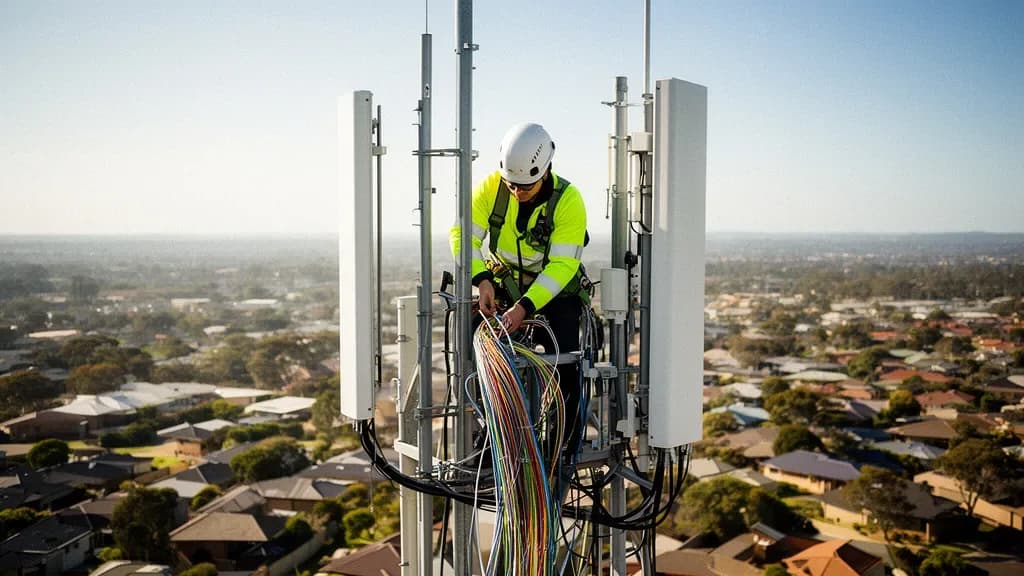
Cable jointers join, terminate, and repair carrier-grade copper and fibre-optic telecommunications cables installed in underground pits, manholes, conduits, and overhead routes. They prepare cable ends, perform fusion splicing on fibre and mechanical jointing on copper, install closures and protective sleeves, and certification-test completed joints with OTDR, fault locators, and pressure equipment. The work is typically performed by carrier-network contractors, NBN Co subcontractors, and EPC firms supporting transmission and renewable-energy tie-in projects.
This is a small, deeply specialised trade in Australia. Yourcareer and Jobs and Skills Australia data show approximately 610 telecommunications cable jointers employed nationally, with a 20% part-time share. Demand is concentrated where carrier infrastructure is being upgraded or extended: NBN remediation programs, hyperscale data-centre carrier diversity build-outs, mobile network backhaul expansion, and renewable-energy site communications tie-ins. Major employers include Service Stream, Visionstream, Ventia, Lendlease Services, and direct carrier contractors to Telstra, Optus, TPG, and NBN Co.
ANZSCO Code 342412 — What the Code Covers
The 342412 code covers people who joint, terminate, and repair telecommunications cables in carrier networks — typically in underground pits and manholes or on overhead spans. Tasks include cable preparation, copper and fibre splicing (fusion and mechanical), pressure testing, joint closure installation, route record updates, and fault location and repair.
342412 is distinct from Cabler (Data and Telecommunications) (342411), which covers customer-side and building-internal cabling. It is also distinct from Telecommunications Linesworker (342413), which covers external aerial-line construction work rather than jointing. If you spend most of your time in pits, manholes, or splicing joints in carrier networks, 342412 is the correct code. Cross-check duties against the ANZSCO code finder before assessment.
Skills Assessment: Trades Recognition Australia
TRA assesses 342412 through OSAP for offshore applicants and JRP for onshore applicants with an Australian qualification.
Offshore Skills Assessment Program (OSAP)
OSAP requires a Certificate III equivalent qualification plus at least three years of full-time relevant employment, including the 12 months immediately before lodgement.
- Assessment cost: approximately AUD $1,015 documentary plus technical fees set by the offshore provider
- Processing time: 8-12 weeks documentary; technical assessment adds 4-8 weeks
- Common rejection reasons: generic "telecommunications technician" duty statements that do not specify jointing; missing splicing equipment evidence; qualifications that focus on customer cabling rather than carrier work
Job Ready Program (JRP)
JRP is the onshore pathway. Most onshore applicants hold a Certificate III in Telecommunications with specialism in field cabling.
- Provisional Skills Assessment (PSA) — verifies qualification and prior experience. Valid for three years.
- Job Ready Employment (JRE) — register 1,725 hours of paid work in 12 months in your nominated occupation. Fee: AUD $490.
- Job Ready Workplace Assessment (JRWA) — workplace assessment by a TRA-authorised assessor. Fee: AUD $2,845.
- Job Ready Final Assessment (JRFA) — final positive outcome. Fee: AUD $75.
Total JRP fees through steps 2-4: approximately AUD $3,410. Realistic JRP timeline: 14-18 months.
ACMA Cabler Registration
Cable jointers performing work on cabling connected to carrier networks need an ACMA Cabler Registration with appropriate competencies (typically Open or specialist endorsements for fibre/copper jointing). The registration is issued by accredited registrars (RIA, BICSI, ACA). Plan to apply for registration in parallel with the TRA process — without it, you cannot work commercially on carrier cabling in Australia.
Visa Pathways for Telecommunications Cable Jointers
Because 342412 is on the CSOL but not on the STSOL, MLTSSL, or ROL, points-tested independent and state-nominated pathways (189, 190, 491) are not available. The only routes are employer sponsorship via 482 and 186.
Subclass 482 — Skills in Demand
The 482 is the dominant pathway. Carrier-network contractors and EPC firms with ongoing project pipelines sponsor cable jointers when local recruitment fails.
- Visa fee: AUD $3,210 (Core Skills stream, primary applicant)
- Salary requirement: Core Skills Income Threshold AUD $76,515, rising to AUD $79,499 from 1 July 2026. Most senior cable jointers clear this comfortably.
- Duration: up to 4 years
- Processing time: 50% of Core Skills stream applications in 2-4 months
- Quirk: small national workforce (about 610) means sponsoring employers know each other; reputation and references from previous Australian carrier-contractor work carry weight
Subclass 186 — Employer Nomination Scheme
Permanent residency through employer sponsorship. The Temporary Residence Transition stream is reachable after two years on a 482, which was reduced from three years in late 2024.
- Visa fee: AUD $6,140 (primary applicant)
- Processing time: 12-18 months TRT; 12-20+ months Direct Entry
- Quirk: Direct Entry requires a positive TRA assessment plus a minimum 3-year skilled-experience record
Why No 491, 190, or 189?
State nomination programs publish their own occupation lists and choose codes based on local shortage data. Because the national cable-jointer workforce is so small (about 610 people), no state has elected to put 342412 on its 190 or 491 list in 2026. The occupation appears only on the CSOL, which makes 482 and 186 the only practical routes. Subclass 189 requires MLTSSL listing, which 342412 does not have.
State and Territory Demand Picture (Not Nomination)
While 342412 is not state-nominated, employer demand varies by location and is worth knowing when planning the job search.
New South Wales
Sydney's data-centre corridor (Macquarie Park, Eastern Creek, Western Sydney Aerotropolis) and NBN remediation work concentrate demand in NSW. Service Stream, Visionstream, and Ventia all hold ongoing carrier contracts.
Victoria
Melbourne's outer industrial belt and Tullamarine data-centre cluster drive Victorian demand. NBN's Victorian remediation footprint is large and continues through 2028.
Western Australia
WA's Pilbara mining operations, Mid West renewable energy projects, and Perth's metropolitan upgrade work create demand for cable jointers on private carrier-style networks. Sponsoring employers are often EPC contractors rather than the major carriers.
Queensland
Brisbane's outer-metropolitan growth corridors and SEQ infrastructure programs produce ongoing demand. Renewable-energy tie-in work in central and northern Queensland is expanding.
Salary and Employment Outlook
What Telecommunications Cable Jointers Earn in 2026
| Role / Specialisation | Typical Salary Range |
|---|---|
| Entry-level jointer (post-qualification) | AUD $85,000-$100,000 |
| Experienced jointer (3-7 years) | AUD $95,000-$115,000 |
| Senior jointer / fault response specialist | AUD $110,000-$130,000 |
| Project lead / supervisor | AUD $120,000-$150,000+ |
| Remote / FIFO project jointer | AUD $130,000-$170,000+ with allowances |
Source: SEEK Cable Jointer salary career advice (April 2026) — average AUD $90,000-$110,000 for general cable-jointer roles, with telecommunications specialists earning at the upper end. Jora data places the national average for cable jointer work at AUD $99,694 per year. Total packages add 11.5% superannuation; on-call rotations and FIFO loadings push remote-area packages well above metropolitan rates.
Highest-Paying Sectors and Employers
- Carrier network contractors — Service Stream, Visionstream, Ventia, Lendlease Services
- Hyperscale data-centre carrier diversity projects — NEXTDC, AirTrunk, Equinix construction phases
- NBN remediation and upgrade programs — copper-to-fibre conversion programs through 2028
- Renewable-energy site communications — wind and solar farms with substation and SCADA tie-ins
- Mining sector private networks — Pilbara, Bowen Basin, Mount Isa carrier-style infrastructure
Tips for a Successful Application
1. Secure an Employer Sponsor Before You Lodge the TRA Assessment
Because 342412 has no state-nomination pathway, the entire migration hinges on a sponsoring employer with an approved Standard Business Sponsorship. Start the conversation with carrier contractors and EPC firms before committing time to TRA. Many sponsorships are arranged through reference networks rather than open job boards.
2. Document Splicing Equipment and Methods on Your Duty Statement
Carrier-grade cable jointing is equipment-specific. Specify the splicing equipment you have operated (Fujikura, Sumitomo, Inno), the cable types (single-mode OS2, multimode OM4, jelly-filled copper), and the joint closures you have installed (3M, TE Connectivity). Generic duty statements regularly fail.
3. Lodge ACMA Cabler Registration in Parallel
You cannot start work commercially without the registration. Apply through RIA, BICSI, or ACA immediately after your TRA PSA is positive. Many sponsoring employers will not let you commence until registration is confirmed.
4. Target the Core Skills Income Threshold From the Start
Senior cable-jointer roles clear AUD $76,515 comfortably, but entry-level positions sometimes do not. Plan to target experienced jointer roles or specialist fault-response positions where wages are reliably above the threshold. The threshold rises to AUD $79,499 from 1 July 2026.
5. Build a Portfolio of Completed Project Evidence
Sponsoring employers and TRA assessors both look for evidence of completed work. Maintain copies of joint reports, OTDR traces, and project completion certificates. International candidates with a documented portfolio of carrier-grade projects move through assessment substantially faster.
Step-by-Step Migration Roadmap
- Confirm your duties match ANZSCO 342412 — see the ANZSCO code finder
- Confirm 342412 is current on the CSOL — see the CSOL hub
- Identify a sponsoring employer — carrier contractors, EPC firms, data-centre projects
- Choose your pathway — OSAP if offshore, JRP if onshore with an Australian qualification
- Lodge the TRA application — documentary stage with employment evidence, payslips, and qualification certificates
- Begin ACMA Cabler Registration application — RIA, BICSI, or ACA in parallel
- Complete the technical or workplace assessment — offshore practical or JRWA onshore
- Sit your English test — IELTS 5.0 minimum for 482; functional English required
- Sponsoring employer lodges Standard Business Sponsorship and Nomination — if not already approved
- Lodge the 482 visa application — within 12 months of nomination approval
- After 2 years on 482, lodge subclass 186 TRT — for permanent residency
- Complete health and character checks, then receive grant
For the broader process, see the skills assessment bodies guide and the most in-demand occupations hub.
Frequently Asked Questions
Why isn't Telecommunications Cable Jointer on the 190 or 491 lists?
State nomination programs select occupations based on local shortage data and labour-market demand. With only about 610 cable jointers employed nationally, the occupation has not made any state's 2026 published lists. The Department of Home Affairs includes it on the CSOL because there is genuine demand at the national level — primarily met through employer sponsorship via 482 and 186.
Can I migrate as a cable jointer without an employer sponsor?
In practice, no. Without state nomination on 190 or 491 and without MLTSSL listing for 189, employer sponsorship is the only realistic route for 342412. Start the conversation with carrier contractors and EPC firms before committing time and money to TRA.
Is Cabler (342411) a better migration option than Cable Jointer (342412)?
342411 is on both the CSOL and STSOL, so 190 nomination is possible — a meaningful advantage. If your duties genuinely sit on the customer-cabling side (building-internal structured cabling) rather than carrier-grade jointing in pits and manholes, 342411 is both more accurate and more flexible. Pick the code that matches your actual work — never the code that looks easier.
Which Australian carriers and contractors sponsor cable jointers?
Service Stream, Visionstream, Ventia, Lendlease Services, and Programmed all hold ongoing contracts to NBN Co, Telstra, Optus, and TPG. Direct carrier sponsorship is rare; almost all sponsorship comes through the contractor tier. EPC firms running renewable-energy projects (UGL, Downer, Beon Energy Solutions) also sponsor for site-communications work.
What's the demand outlook for cable jointers in Australia?
Steady within a narrow specialism through 2028. NBN remediation, mobile network backhaul expansion, hyperscale data-centre carrier diversity, and renewable-energy site communications all require ongoing jointing capacity. The trade does not have the headline shortage numbers of larger occupations, but the small workforce means competent jointers with documented experience are reliably in demand.
How long does the full pathway take from offshore?
Realistic timeline: 6-8 months for OSAP (documentary + technical), 2-3 months for ACMA registration, 2-4 months for 482 decision once sponsorship is in place. End-to-end from first application to arrival in Australia is typically 9-14 months. The 186 permanent residency stage adds another 2 years on the 482 plus 12-18 months processing.